


 |
市場調查報告書
商品編碼
2117429
汽車燃油導軌:市場佔有率分析、產業趨勢與統計、成長預測(2026-2031)Automotive Fuel Rail - Market Share Analysis, Industry Trends & Statistics, Growth Forecasts (2026 - 2031) |
||||||

※ 本網頁內容可能與最新版本有所差異。詳細情況請與我們聯繫。
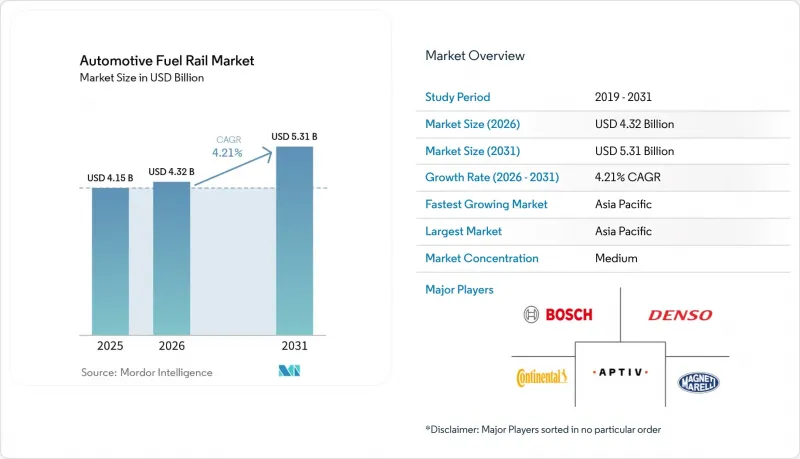
據 Mordor Intelligence 稱,2025 年汽車燃油軌道市場價值 41.5 億美元,預計 2026 年將達到 43.2 億美元,預計到 2031 年將達到 53.1 億美元。
預計從 2026 年到 2031 年,其複合年成長率將達到 4.21%。
本報告按引擎配置(直列式和V型引擎)、材質(不銹鋼等)、壓力系統(高壓和低壓燃油導軌)、車輛類型(乘用車和商用車)、燃料類型、供應方式、分銷管道和地區進行細分。市場預測以價值(美元)和數量(輛)為單位呈現。
全球汽車燃油軌道市場趨勢及洞察
更嚴格的歐6d、中國VI-b和美國LEV III排放氣體法規正在推動高壓鋼軌的需求。
世界各國政府目前都在實際駕駛條件下測量顆粒物(PN)排放量。這迫使汽車製造商採用高壓噴射系統,可將燃油霧化得極為精細,與傳統的歧管噴射相比,可顯著降低顆粒物排放。歐洲標準對顆粒物排放設定了嚴格的限制,這些標準也體現在中國的法規中,而美國則進一步收緊了其國內汽油排放標準。採用以卓越強度著稱的雙相不銹鋼,可以製造壁更薄的零件。這項創新不僅減輕了整體重量,而且確保了符合高壓要求。一級供應商正利用其先進的冶金技術和系統級檢驗能力來贏得合約。同時,規模較小的公司卻難以籌集資金來資金籌措滿足法規要求所需的模具費用和漫長的測試週期。
OEM廠商致力於採用350巴GDI技術,透過縮小引擎尺寸來降低15%的燃油消耗。
汽車製造商正從大型自然進氣引擎轉向配備先進燃油系統的小型渦輪增壓引擎。這一轉變顯著降低了油耗,提高了燃油效率,並幫助製造商避免因企業平均燃油經濟性標準而受到處罰。全球趨勢的例證包括Stellantis的創新直列六缸引擎、現代汽車的先進燃油系統開發專案以及博世的高性能平台,這些都顯示了這種方法的廣泛應用。這些先進燃油系統實施成本相對較低,與每輛車投資更高的混合動力技術相比,提供了更具成本效益的解決方案。因此,能夠提供整合式、完全相容的噴油器、油泵、燃油導軌和其他組件的供應商的需求日益成長。
預計到 2030 年,電動車將佔歐洲新車銷量的 30% 以上,這將抑制對內燃機燃油導軌的需求。
歐盟的「Fit for 55」計畫旨在未來十年內大幅提升電池式電動車(BEV)的普及率,並在不久的將來逐步淘汰內燃機汽車(ICE)。預計這項轉型將在未來幾年內逐步降低歐洲對燃油導軌的潛在需求。在中歐國家,燃油導軌組裝佔製造業GDP的比重極高,供應商必須轉型生產混合動力汽車和氫燃料汽車平台,以避免工廠關閉。雖然全球性企業可以透過將產能重新分配到亞洲和拉丁美洲等地區來降低風險,但那些完全依賴傳統製造方式的歐洲製造商則面臨著技術過時風險的增加。
細分市場分析
到2025年,直列式引擎將佔汽車燃油導軌市場產量的56.17%,預計到2031年將以4.23%的複合年成長率成長。直列式引擎允許透過單根燃油導軌向所有汽缸供油,從而縮短管路長度並降低材料成本。直列式設計非常適合目前全球乘用車生產的主流橫置前輪驅動平台,並且由於所有噴油器都可以透過單一下游感測器進行監控,因此簡化了排放氣體認證程序。
渦輪增壓直列四缸和直列六缸引擎也成為小型化戰略的基礎。 Stellantis公司用其「颶風」(Hurricane)直列六缸引擎取代了原有的大型V8引擎,顯著減少了導軌數量和成本。豐田的氫燃料電池汽車「GRCorolla」表明,這種架構也相容於替代燃料,即使在零碳排放法規下也能維持市場需求。隨著中國和印度的SUV車型轉向前輪驅動架構,直列引擎的優勢可能會進一步凸顯。
預計到2025年,不銹鋼將佔汽車燃油導軌出貨量的47.26%,而鋁合金的複合年成長率預計將達到4.43%,在所有材料類別中成長率最高。鋁的密度為2.7克/立方厘米,與不銹鋼相比,可使導軌重量減輕近一半。由於後處理會增加20-30公斤的重量,迫使製造商在其他設計上做出妥協,因此,整車製造商可以迅速收回減重帶來的優勢。
儘管不銹鋼在壓力超過 500 巴的超高壓原型製造中仍然至關重要,但雙相鋼的進步無法抵消鋁的密度優勢或鎳等原料成本波動的影響。投資擠壓機、摩擦攪拌焊接和自動化洩漏測試生產線的供應商表示,訂單已排至 2030 年,證實了對鋁結構件的需求持續強勁。
2025年,高壓規格(250巴及以上)的汽油產量將佔總產量的68.26%,預計到2031年將以4.27%的複合年成長率成長,這反映了全球向350巴GDI標準的趨同趨勢。這些高壓汽油能夠有效減少顆粒物排放,並有助於汽車製造商推遲汽油顆粒過濾器的引入。
低壓燃油導軌在靈活燃料和端口噴射汽車領域仍被廣泛應用,尤其是在巴西,預計2025年,巴西的乙醇摻混比例將達到30%。然而,隨著壓力的增加,保固和維護的複雜性也隨之增加。由於需要更換一次性壓緊墊圈和專用壓力表,維修成本可能超過3500美元。因此,能夠將燃油泵、燃油導軌和噴油器作為一個整體系統進行認證的整合供應商,在新項目中佔據了主導地位。
區域分析
預計到2025年,亞太地區將佔全球需求的38.83%,並將在2031年之前以4.37%的複合年成長率成長,成為所有地區中成長最快的地區。中國產能的復甦、印度的E20舉措以及東南亞國協電動車普及率較低,都支撐了內燃機汽車的銷售。儘管動力傳動系統技術不斷進步,但產品規劃仍優先考慮混合動力而非純電動化,每輛車的燃油軌道負荷也基本保持不變。
從中長期來看,歐洲佔據相當大的市場。然而,隨著電池式電動車(BEV)領域預計將在本世紀下半葉迎來關鍵轉折點,該地區正準備應對市場萎縮。碳邊境調節機制(CBAM)推高了不銹鋼價格,而中歐地區使用內燃機(ICE)平台的工廠則面臨運轉率下降的風險。為了因應歐盟政策的變化,位於北非和土耳其的供應商正在對其出口路線進行策略性調整。
同期,北美和南美合計佔據了相當大的出貨量。在美國,重型卡車和SUV的高壓汽油缸內直噴(GDI)系統是重點需求。同時,在巴西,耐腐蝕的低壓鋼軌因其用於乙醇燃料的車輛而備受青睞。在加拿大,儘管電動車(EV)的獎勵導致內燃機(ICE)新車組裝下降,但混合動力皮卡仍然是鋼軌訂單的主要驅動力。阿根廷和哥倫比亞則依賴售後改裝來應對經濟挑戰,維持市場需求。中東和非洲佔據了剩餘的市場佔有率。該地區的生產集中在土耳其和南非,而沙烏地阿拉伯則透過免稅區吸引整車製造商(OEM),這些免稅區支持以全散件組裝(CKD)方式進行生產。
其他好處:
- Excel格式的市場預測(ME)表
- 3個月的分析師支持
目錄
第1章:引言
- 研究假設和市場定義
- 調查範圍
第2章:調查方法
第3章執行摘要
第4章 市場狀況
- 市場概覽
- 市場促進因素
- 更嚴格的排放氣體法規,例如歐6d、中國VI-b和美國LEV III,正在推動對高壓鋼軌的需求。
- 為了在小型化引擎中降低 15% 的燃油消耗,OEM 廠商正在推廣採用 350 bar GDI 技術。
- 2023年半導體短缺過後,亞太地區微型車產量將迅速復甦
- 鋼軌由不銹鋼改為鋁製帶來的重量減輕,抵消了後處理造成的重量增加。
- 巴西、印度和美國中西部地區乙醇/E85彈性燃料計畫的激增。
- 氫內燃機(ICE)先導計畫(豐田、康明斯)需要新的高壓導軌。
- 市場限制因素
- 到 2030 年,如果電動車在歐洲新車銷售中佔比超過 30%,預計對內燃機車的需求將受到抑制。
- 含鎳不銹鋼原料價格波動
- 缺乏能夠處理 350 多種服務的熟練技術人員,導致保固成本上升。
- 東南亞地區假冒偽劣的售後導軌正在損害品牌聲譽。
- 價值供應鏈分析
- 監理情勢
- 技術展望
- 波特五力模型
第5章 市場規模與成長預測
- 按引擎配置
- 直列式引擎
- V型引擎
- 材料類型
- 不銹鋼
- 鋁合金
- 塑膠
- 鋼鍛件
- 增壓系統
- 高壓燃油軌
- 低壓燃油軌
- 按車輛類型
- 搭乘用車
- 掀背車
- 轎車
- SUV
- 小轎車
- 商用車輛
- LCV
- MCV
- HCV
- 搭乘用車
- 按燃料類型
- 汽油
- 柴油引擎
- 靈活燃料(E10-E85)
- CNG/LPG
- 生質燃料/合成燃料
- 氫
- 透過供應方法
- 汽油缸內直噴(GDI)
- 端口燃油噴射(PFI)
- 共軌柴油噴射
- 透過分銷管道
- OEM(工廠安裝)
- 售後市場(替換件)
- 按地區
- 北美洲
- 美國
- 加拿大
- 其他北美國家
- 南美洲
- 巴西
- 阿根廷
- 其他南美國家
- 歐洲
- 英國
- 德國
- 西班牙
- 義大利
- 法國
- 俄羅斯
- 其他歐洲國家
- 亞太地區
- 印度
- 中國
- 日本
- 韓國
- 其他亞太國家
- 中東和非洲
- 阿拉伯聯合大公國
- 沙烏地阿拉伯
- 土耳其
- 埃及
- 南非
- 其他中東和非洲國家
- 北美洲
第6章 競爭情勢
- 市場集中度
- 策略趨勢
- 市佔率分析
- 公司簡介
- Robert Bosch GmbH
- Denso Corporation
- Continental AG
- Aptiv PLC
- Magneti Marelli
- USUI Co. Ltd.
- Linamar Corporation
- Hitachi Astemo
- TI Automotive
- Aisin Corporation
- BorgWarner Inc.
- Stanadyne LLC
- Valeo SA
第7章 市場機會與未來展望
According to Mordor Intelligence, the automotive fuel rail market size was valued at USD 4.15 billion in 2025, expected to reach USD 4.32 billion in 2026, and is projected to reach USD 5.31 billion by 2031, growing at a CAGR of 4.21% over 2026-2031.
This report is Segmented by Engine Configuration (Inline Engine and V-Engine), Material Type (Stainless Steel and More), Pressure System (High-Pressure Fuel Rail and Low-Pressure Fuel Rail), Vehicle Type (Passenger Cars and Commercial Vehicles), Fuel Type, Delivery Method, Distribution Channel, and Geography. The Market Forecasts are Provided in Terms of Value (USD) and Volume (Units).
Global Automotive Fuel Rail Market Trends and Insights
Tightening Euro 6d, China VI-b, and US LEV III Emissions Norms Spur High-Pressure Rails
Governments are now measuring particulate numbers (PN) under real-world driving conditions. This has compelled OEMs to adopt high-pressure injection systems, which atomize fuel finely enough to significantly reduce PN compared to traditional port fuel injection . European standards have set stringent limits on particulate emissions, a benchmark reflected in China's regulations, while the United States has further tightened its domestic gasoline standards. Duplex stainless grades, known for their superior strength, enable the production of thinner walls. This innovation not only reduces overall weight but also ensures compliance with the high-pressure requirements . Tier-1 suppliers, leveraging their advanced metallurgy expertise and system-level validation capabilities, are successfully securing contracts. Meanwhile, smaller firms face difficulties in financing the necessary tooling and extensive testing cycles required to meet.
OEM Drive Toward 350-Bar GDI for 15% Lower Fuel Burn in Downsized Engines
Automakers are transitioning from larger, naturally aspirated engines to smaller, turbocharged alternatives equipped with advanced fuel systems. This change significantly reduces fuel consumption, contributing to improved efficiency and helping manufacturers avoid penalties associated with corporate average fuel economy standards. Examples of this global trend include Stellantis' innovative inline-six engine, Hyundai's advanced fuel system development program, and Bosch's high-performance platforms, all of which highlight the widespread adoption of this approach. With a relatively low additional cost, these advanced fuel systems offer a more cost-effective solution compared to hybrid technologies, which require a much higher investment per vehicle. Consequently, demand is increasingly concentrated among suppliers capable of providing integrated solutions, including injectors, pumps, and fuel rails, as complete and compatible systems.
EV Share Above 30% of New Sales in Europe by 2030 Curbs ICE Rail Demand
The EU's Fit for 55 plan aims to significantly increase the adoption of battery-electric vehicles (BEVs) over the next decade and phase out internal combustion engines (ICEs) in the near future. This transition is expected to gradually reduce Europe's addressable fuel-rail volume in the coming years. In Central European economies, where fuel-rail assembly accounts for a substantial share of manufacturing GDP, suppliers must adapt by shifting toward hybrid or hydrogen platforms to avoid plant closures. Although global firms can mitigate risks by reallocating capacity to regions such as Asia and Latin America, European fabricators that rely solely on traditional manufacturing methods face an increased risk of obsolescence.
Other drivers and restraints analyzed in the detailed report include:
- Rapid APAC Light-Vehicle Production Recovery Post-2023 Chip Crunch
- Stainless-to-Aluminum Rail Lightweighting to Offset Heavier After-Treatment
- Raw-Material Price Volatility for Nickel-Bearing Stainless Grades
For complete list of drivers and restraints, kindly check the Table Of Contents.
Segment Analysis
Inline engines accounted for 56.17% of the 2025 volume in the automotive fuel rail market and are forecast to grow at a 4.23% CAGR through 2031. They allow a single rail to feed all cylinders, thereby trimming tube length and reducing material costs. Inline designs fit transverse front-wheel-drive platforms that dominate global passenger-car output, and they simplify emissions certification because a single downstream sensor monitors all injectors.
Turbocharged inline-fours and inline-sixes also underpin downsizing strategies. Stellantis replaced large V8S with its Hurricane inline-six, slashing rail count and cost. Toyota's hydrogen-fueled GR Corolla shows the architecture can adapt to alternative fuels, sustaining demand even under zero-carbon rules. As SUVs migrate to front-drive architectures in China and India, inline dominance will rise further.
Stainless steel made up 47.26% of 2025 shipments, and aluminum alloy will post a 4.43% CAGR, the fastest of any material line in the automotive fuel rail market. At a density of 2.7 g/cm3, aluminum reduces the rail mass by almost half compared to stainless steel. OEMs recoup that saving quickly because after-treatment adds 20-30 kg and forces design trade-offs elsewhere.
Stainless retains relevance in ultra-high-pressure prototypes above 500 bar, yet duplex advances cannot offset aluminum's density edge and raw-material cost swings tied to nickel. Suppliers investing in extrusion presses, friction-stir welding, and automated leak-test lines report order books stretching into 2030, confirming the aluminum structural demand tailwind.
High-pressure variants (>= 250 bar) accounted for 68.26% of 2025 output and are set for a 4.27% CAGR through 2031, reflecting global convergence toward 350-bar GDI norms. These rails can efficiently reduce particulate-number emissions and help OEMs delay adoption of gasoline particulate filters.
Low-pressure rails remain in flex-fuel and port-injected segments, especially in Brazil, where ethanol blends rose to 30% in 2025. Yet as pressure climbs, warranty and service complexity grow: replacement of one-time-use crush washers and specialized gauges lifts repair bills above USD 3,500. Integrated suppliers that can certify pumps, rails, and injectors as a single system, therefore capture the lion's share of new programs.
Complete Report Scope:
- By Engine Configuration
- Inline Engine
- V-Engine
- By Material Type
- Stainless Steel
- Aluminum Alloy
- Plastic
- Steel Forged
- By Pressure System
- High-Pressure Fuel Rail
- Low-Pressure Fuel Rail
- By Vehicle Type
- Passenger Cars
- Hatchback
- Sedan
- SUV
- Coupe
- Commercial Vehicles
- LCV
- MCV
- HCV
- Passenger Cars
- By Fuel Type
- Gasoline
- Diesel
- Flex Fuel (E10-E85)
- CNG/LPG
- Biofuel/Synthetic
- Hydrogen
- By Delivery Method
- Gasoline Direct Injection (GDI)
- Port Fuel Injection (PFI)
- Common-Rail Diesel Injection
- By Distribution Channel
- OEM (Factory-Fitted)
- Aftermarket (Replacement)
- By Geography
- North America
- United States
- Canada
- Rest of North America
- South America
- Brazil
- Argentina
- Rest of South America
- Europe
- United Kingdom
- Germany
- Spain
- Italy
- France
- Russia
- Rest of Europe
- Asia-Pacific
- India
- China
- Japan
- South Korea
- Rest of Asia-Pacific
- Middle East and Africa
- United Arab Emirates
- Saudi Arabia
- Turkey
- Egypt
- South Africa
- Rest of Middle East and Africa
- North America
Geography Analysis
Asia-Pacific supplied 38.83% of 2025 demand and is tracking a 4.37% CAGR through 2031, the fastest regional growth rate. China's production rebound, India's E20 initiative, and low EV penetration across ASEAN economies are supporting internal combustion engine (ICE) vehicle volumes. Product plans continue to prioritize hybridization over full electrification, keeping fuel-rail content per vehicle largely intact despite powertrain evolution.
In the medium term, Europe holds a significant share of market volume. However, as the battery electric vehicle (BEV) segment is expected to surpass a critical threshold later in the decade, the region is preparing for a contraction. The Carbon Border Adjustment Mechanism is increasing stainless steel prices, while plants in Central Europe linked to ICE platforms face the risk of underutilization. In response to changes in EU policy, suppliers with operations in North Africa and Turkey are strategically adjusting their export routes.
During the same period, North and South America collectively account for a substantial share of shipments. The United States prioritizes high-pressure gasoline direct injection (GDI) systems for large trucks and SUVs. Meanwhile, Brazil's ethanol-reliant vehicle fleet requires corrosion-resistant low-pressure rails. In Canada, EV incentives are reducing the assembly of new ICE vehicles, although hybrid pickups remain a key driver of rail orders. Argentina and Colombia both rely on aftermarket conversions to sustain demand amid economic challenges. The Middle East and Africa account for the remaining market share. Production in the region is concentrated in Turkey and South Africa, while Saudi Arabia is attracting OEMs through duty-free zones that support completely knocked-down (CKD) assembly.
- Robert Bosch GmbH
- Denso Corporation
- Continental AG
- Aptiv PLC
- Magneti Marelli
- USUI Co. Ltd.
- Linamar Corporation
- Hitachi Astemo
- TI Automotive
- Aisin Corporation
- BorgWarner Inc.
- Stanadyne LLC
- Valeo SA
Additional Benefits:
- The market estimate (ME) sheet in Excel format
- 3 months of analyst support
TABLE OF CONTENTS
1 Introduction
- 1.1 Study Assumptions & Market Definition
- 1.2 Scope of the Study
2 Research Methodology
3 Executive Summary
4 Market Landscape
- 4.1 Market Overview
- 4.2 Market Drivers
- 4.2.1 Tightening Euro 6d, China VI-b and US LEV III Emissions Norms Spur High-Pressure Rails
- 4.2.2 OEM Drive Toward 350-Bar GDI for 15% Lower Fuel Burn in Downsized Engines
- 4.2.3 Rapid APAC Light-Vehicle Production Recovery Post-2023 Chip Crunch
- 4.2.4 Stainless-to-Aluminum Rail Light-Weighting to Offset Heavier After-Treatment
- 4.2.5 Surge in Ethanol/E85 Flex-Fuel Programs in Brazil, India and US Midwest
- 4.2.6 Hydrogen ICE Pilots (Toyota, Cummins) Require Novel High-Pressure Rails
- 4.3 Market Restraints
- 4.3.1 EV Share Above 30% of New Sales in Europe by 2030 Curbs ICE Rail Demand
- 4.3.2 Raw-Material Price Volatility for Nickel-Bearing Stainless Grades
- 4.3.3 Technician Skill Gap for Above 350-Bar Service Raises Warranty Costs
- 4.3.4 Counterfeit Aftermarket Rails in South-East Asia Undermining Brand Trust
- 4.4 Value / Supply-Chain Analysis
- 4.5 Regulatory Landscape
- 4.6 Technological Outlook
- 4.7 Porter's Five Forces
- 4.7.1 Threat of New Entrants
- 4.7.2 Bargaining Power of Suppliers
- 4.7.3 Bargaining Power of Buyers
- 4.7.4 Threat of Substitutes
- 4.7.5 Competitive Rivalry
5 Market Size & Growth Forecasts (Value (USD) and Volume (Units))
- 5.1 By Engine Configuration
- 5.1.1 Inline Engine
- 5.1.2 V-Engine
- 5.2 By Material Type
- 5.2.1 Stainless Steel
- 5.2.2 Aluminum Alloy
- 5.2.3 Plastic
- 5.2.4 Steel Forged
- 5.3 By Pressure System
- 5.3.1 High-Pressure Fuel Rail
- 5.3.2 Low-Pressure Fuel Rail
- 5.4 By Vehicle Type
- 5.4.1 Passenger Cars
- 5.4.1.1 Hatchback
- 5.4.1.2 Sedan
- 5.4.1.3 SUV
- 5.4.1.4 Coupe
- 5.4.2 Commercial Vehicles
- 5.4.2.1 LCV
- 5.4.2.2 MCV
- 5.4.2.3 HCV
- 5.4.1 Passenger Cars
- 5.5 By Fuel Type
- 5.5.1 Gasoline
- 5.5.2 Diesel
- 5.5.3 Flex Fuel (E10-E85)
- 5.5.4 CNG/LPG
- 5.5.5 Biofuel/Synthetic
- 5.5.6 Hydrogen
- 5.6 By Delivery Method
- 5.6.1 Gasoline Direct Injection (GDI)
- 5.6.2 Port Fuel Injection (PFI)
- 5.6.3 Common-Rail Diesel Injection
- 5.7 By Distribution Channel
- 5.7.1 OEM (Factory-Fitted)
- 5.7.2 Aftermarket (Replacement)
- 5.8 By Geography
- 5.8.1 North America
- 5.8.1.1 United States
- 5.8.1.2 Canada
- 5.8.1.3 Rest of North America
- 5.8.2 South America
- 5.8.2.1 Brazil
- 5.8.2.2 Argentina
- 5.8.2.3 Rest of South America
- 5.8.3 Europe
- 5.8.3.1 United Kingdom
- 5.8.3.2 Germany
- 5.8.3.3 Spain
- 5.8.3.4 Italy
- 5.8.3.5 France
- 5.8.3.6 Russia
- 5.8.3.7 Rest of Europe
- 5.8.4 Asia-Pacific
- 5.8.4.1 India
- 5.8.4.2 China
- 5.8.4.3 Japan
- 5.8.4.4 South Korea
- 5.8.4.5 Rest of Asia-Pacific
- 5.8.5 Middle East and Africa
- 5.8.5.1 United Arab Emirates
- 5.8.5.2 Saudi Arabia
- 5.8.5.3 Turkey
- 5.8.5.4 Egypt
- 5.8.5.5 South Africa
- 5.8.5.6 Rest of Middle East and Africa
- 5.8.1 North America
6 Competitive Landscape
- 6.1 Market Concentration
- 6.2 Strategic Moves
- 6.3 Market Share Analysis
- 6.4 Company Profiles (includes Global Level Overview, Market Level Overview, Core Segments, Financials as Available, Strategic Information, Market Rank/Share for Key Companies, Products and Services, SWOT Analysis, and Recent Developments)
- 6.4.1 Robert Bosch GmbH
- 6.4.2 Denso Corporation
- 6.4.3 Continental AG
- 6.4.4 Aptiv PLC
- 6.4.5 Magneti Marelli
- 6.4.6 USUI Co. Ltd.
- 6.4.7 Linamar Corporation
- 6.4.8 Hitachi Astemo
- 6.4.9 TI Automotive
- 6.4.10 Aisin Corporation
- 6.4.11 BorgWarner Inc.
- 6.4.12 Stanadyne LLC
- 6.4.13 Valeo SA
7 Market Opportunities & Future Outlook
- 7.1 White-space & Unmet-Need Assessment

 汽車燃油導軌市場:2026-2032年全球市場預測(依燃油系統類型、材質、燃油類型、額定壓力、車輛類型和分銷管道分類)
 氫燃料軌道系統市場分析及預測(至2035年):按類型、技術、組件、應用、材料類型、最終用戶、安裝類型、設備、解決方案和階段分類
 氫動力鐵路市場預測至2034年:按列車類型、燃料類型、技術、應用、最終用戶和地區分類的全球分析燃油阻尼器組件市場:按類型、安裝方式、行程長度、應用、終端用戶產業、通路分類,全球預測,2026-2032年
 汽車燃油導軌市場 - 全球產業規模、佔有率、趨勢、機會及預測(按燃料類型、引擎類型、材料、地區和競爭格局分類,2021-2031年)
 燃油軌道市場規模、佔有率和成長分析(按引擎類型、材質、壓力等級、車輛、銷售管道和地區分類)-2026-2033年產業預測