

 |
市場調查報告書
商品編碼
2117404
日本汽車排放標準及影響分析:市佔率分析、產業趨勢及統計、成長預測(2026-2031)Japan Vehicle Emission Standards and Impact Analysis - Market Share Analysis, Industry Trends & Statistics, Growth Forecasts (2026 - 2031) |
||||||

※ 本網頁內容可能與最新版本有所差異。詳細情況請與我們聯繫。
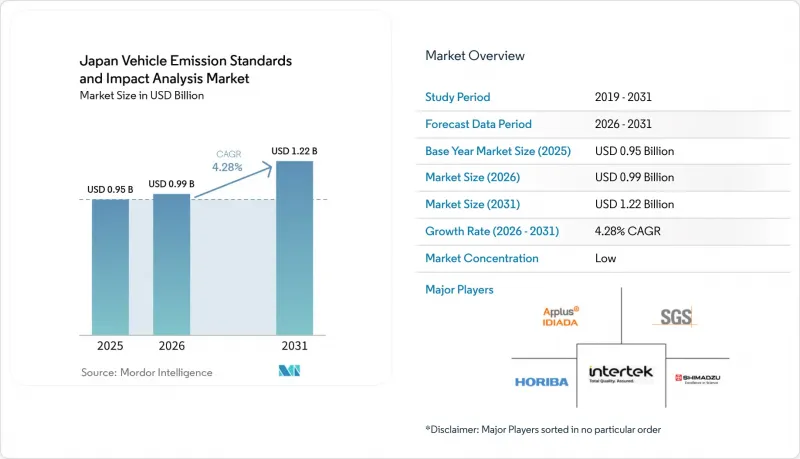
據 Mordor Intelligence 稱,2025 年日本汽車廢氣排放標準和影響分析的市場規模為 9.5 億美元,預計 2026 年將達到 9.9 億美元,預計到 2031 年將達到 12.2 億美元。
預計從 2026 年到 2031 年,其複合年成長率將達到 4.28%。
本報告按車輛類型(二輪車、三輪車等)、驅動方式(內燃機車輛、混合動力汽車等)、廢氣排放類型(二氧化碳等)和最終用戶(政府機構、整車製造商、獨立檢測機構)進行分類。市場預測以美元計價。
日本汽車排放標準及其影響分析:市場趨勢與洞察
自2030年起加強對大型車輛的“新的長期法規”
繼現有的柴油乘用車排放法規之後,日本正準備對卡車和客車引入粒狀物排放標準和實際道路排放測試。這些措施旨在減少對環境的影響,改善空氣質量,並確保符合全球排放標準。預計這些法規的實施將加速排放控制技術的進步,並鼓勵製造商進行更多創新。市場反應顯而易見:符合氮氧化物/粒狀物排放標準的中型卡車售價較高,凸顯了市場對嚴格測試、環保合規車輛和先進排放控制技術的強勁需求。此外,這些趨勢也反映出汽車市場對永續性重視以及法規結構的日益嚴格。
目標是到 2035 年實現輕型汽車(微型汽車)100% 零排放。
企業必須依照各都道府縣的法規,並根據國家目標(包括混合動力汽車的目標),對插電式混合動力汽車和電池式電動車車型檢驗。這些檢驗流程確保符合當地法規,並支持環保汽車的更廣泛普及。在東京,大規模汽車所有者必須確保其乘用車中一定比例為非汽油動力汽車,這增加了對涵蓋多個司法管轄區的綜合測試合約的需求。這項要求需要一個能夠適應不同法規環境的綜合測試體系。
國內汽車銷量低迷。
隨著城市優先發展公共交通導向產業以及人口老化,新車認證面臨許多限制。這些限制源於不斷變化的城市規劃需求以及對永續基礎設施日益成長的重視。車輛檢驗法規的調整導致檢驗任務重新分配,但檢驗總數並未增加。這種重新分配反映出監管重點從提高檢驗頻率轉向確保符合更新後的標準。因此,市場成長不再僅僅取決於車輛數量,而是更取決於法規的複雜性,這凸顯了政策框架在塑造產業趨勢方面發揮的關鍵作用。
細分市場分析
到2025年,乘用車將佔日本汽車排放量的68.72%。由於所有等級的混合動力汽車和電池式電動車都必須證明其性能與傳統內燃機汽車相當,預計到2031年,乘用車市場將以6.29%的複合年成長率成長,超過整體市場成長速度。電動SUV和多功能車正透過高利潤的認證專案提升利潤。相較之下,轎車和掀背車的支出趨勢則更為謹慎,主要集中在滿足法規要求。雖然摩托車目前仍處於小眾市場,但相關標準的引入預示著其發展前景廣闊,尤其是在檢驗的攜帶式引擎監測系統(PEMS)協議能夠解決現有振動問題的情況下。
在商用車領域,收入來源日益多元化。在一些大城市,低排放氣體區禁止老舊柴油車通行,導致售後改裝檢驗的需求激增。此外,更嚴格的卡車顆粒物排放限制即將生效,新的認證要求也隨之而來。市政公車業者被要求提高低排放車輛的比例,導致獨立檢測機構的電動公車測試出現瓶頸。
2025年,日本汽車排放標準市場主要由內燃機主導,汽油和柴油汽車佔據87.47%的市場佔有率,這主要得益於龐大的車輛保有量。實際道路排放法規的實施取消了以往較為寬鬆的合規措施,並增加了每款車型的測試次數。這項變更凸顯了監管機構日益重視確保實際道路排放與實驗室測試結果高度吻合,迫使製造商採用更嚴格的測試規程。
電池式電動車)正以6.28%的複合年成長率成為成長最快的動力系統。這一成長主要歸功於2026年新規中新增的煞車粉塵和輪胎磨損顆粒測量要求。這些新標準旨在解決非廢氣排放問題,因為非廢氣排放正日益成為顆粒物污染的主要來源。此外,實驗室設備也得到了改進,體現了業界致力於提升安全性和環保性能的承諾,例如引入了用於檢測小於23奈米顆粒的顆粒計數器以及用於測試電池熱失控情況的設備。
其他好處:
- Excel格式的市場預測(ME)表
- 3個月的分析師支持
目錄
第1章:引言
- 研究假設和市場定義
- 調查範圍
第2章:調查方法
第3章執行摘要
第4章 市場狀況
- 市場概覽
- 市場促進因素
- 加強對重型車輛(HDV)2030 年「新長期(PNLT)後」法規的監管
- 目標是到 2035 年,小型汽車銷售 100% 為零排放汽車 (ZEV)。
- 引入實際道路廢氣排放(RDE)和攜帶式排放測量系統(PEMS)測試
- 縣級低排放區試點項目
- 透過遠端車載診斷和遠端資訊處理技術擴大合規範圍
- 在ESG揭露中,基於車輛所有權的二氧化碳資料貨幣化
- 市場限制因素
- 國內汽車銷量成長停滯不前。
- 下一代廢氣檢測設備需要大量資金投入。
- 合格的廢氣檢測技術人員短缺
- 與遠端資訊處理資料隱私合規相關的成本
- 價值供應鏈分析
- 監理情勢
- 技術展望
- 波特五力模型
第5章 市場規模與成長預測
- 按車輛類型
- 摩托車
- 三輪車
- 搭乘用車
- 掀背車
- 轎車
- SUV(運動型多用途車)
- 多用途車輛
- 商用車輛
- 輕型商用車
- 中型和大型商用車輛
- 巴士和長途汽車
- 透過驅動系統
- 內燃機車
- 混合動力汽車
- 電池式電動車
- 依廢氣類型
- 二氧化碳(CO2)
- 氮氧化物(NOx)
- PM(顆粒物)
- 氫氧根(HC)
- 其他(CO、SO2 等)
- 最終用戶
- 政府監管機構
- OEM(汽車製造商)
- 獨立檢測實驗室
第6章 競爭情勢
- 市場集中度
- 策略趨勢
- 市佔率分析
- 公司簡介
- HORIBA Ltd.
- Shimadzu Corp.
- SGS Japan Inc.
- Intertek Group plc
- Applus+IDIADA Japan
- AVL List(Japan)
- Japan Automobile Research Institute(JARI)
- Japan Automobile Transport Technology Association(JATA)
- Nihon Environmental Research Institute(NERI)
- MAHLE Japan
- Bosch Japan
- ABB Japan(test-cell solutions)
- MTS Systems Japan
- A&D Company Ltd.
- Kanematsu Engineering
- Emitec Japan
- Horiba MIRA Ltd.(Japan)
- ESPEC Corp.
- Tokai Rika Co. Ltd.
- Yokogawa Test & Measurement
第7章 市場機會與未來展望
According to Mordor Intelligence, the Japan vehicle emission standards and impact analysis market size was valued at USD 0.95 billion in 2025, is estimated at USD 0.99 billion in 2026, and is projected to reach USD 1.22 billion by 2031, growing at a CAGR of 4.28% over 2026-2031.
This report is Segmented by Vehicle Type (Two-Wheeler, Three-Wheeler, and More), Propulsion Type (Internal Combustion Engine Vehicles, Hybrid Electric Vehicles, and More), Emission Type (CO2 (Carbon Dioxide), and More), and End-User (Government Agencies, Original Equipment Manufacturers, and Independent Labs). The Market Forecasts are Provided in Terms of Value (USD).
Japan Vehicle Emission Standards and Impact Analysis Market Trends and Insights
Tightening 2030 Post-New-Long-Term Limits for Heavy-Duty Vehicles
Japan is poised to implement particle-number limits and real-driving-emission checks for trucks and buses, mirroring existing regulations for diesel cars. These measures aim to reduce environmental impact, improve air quality, and ensure compliance with global emission standards. The introduction of these regulations is expected to drive advancements in emission-control technologies and encourage manufacturers to further innovate. The market's reaction is clear: medium-duty trucks that meet NOx/PM standards are commanding price premiums, highlighting robust demand for rigorous testing, environmentally compliant vehicles, and advanced emission-control technologies. Additionally, these developments reflect a growing emphasis on sustainability and stricter regulatory frameworks within the automotive market.
100% Zero-Emission Vehicle Target for Light-Duty Vehicles by 2035
Corporates are required to validate plug-in hybrid and battery-electric models across various prefecture schemes, aligning with the national goal that includes hybrids. These validation processes ensure compliance with regional regulations and support the broader adoption of environmentally friendly vehicles. In Tokyo, a mandate for large fleets necessitates a certain percentage of non-gasoline passenger cars, underscoring the demand for bundled multi-jurisdiction test contracts. This requirement drives the need for comprehensive testing frameworks that cater to diverse regulatory environments.
Flat Domestic Vehicle Sales Volume Growth
As cities prioritize transit-oriented development and populations age, new-model certifications encounter constraints. These constraints arise due to the evolving needs of urban planning and the growing emphasis on sustainable infrastructure. Changes to inspection rules have redistributed tests without boosting their total count. This redistribution reflects a shift in focus toward compliance with updated standards rather than increasing testing frequency. Consequently, market growth now leans more on regulatory intricacies than on the mere number of units, highlighting the critical role of policy frameworks in shaping industry dynamics.
Other drivers and restraints analyzed in the detailed report include:
- Adoption of Real-Driving-Emissions and PEMS Testing
- Prefecture-Level Low-Emission Zones Pilot Programs
- High Capital Expenditure for Next-Generation Emission Test Benches
For complete list of drivers and restraints, kindly check the Table Of Contents.
Segment Analysis
Passenger cars accounted for 68.72% of Japan's vehicle emissions in 2025. They will outpace the total market at a 6.29% CAGR through 2031, as every hybrid and battery-electric trim level must prove parity with legacy internal-combustion baselines. Electrified variants of SUVs and multi-utility vehicles boost revenue with their high-margin certification packages. In contrast, sedans and hatchbacks are experiencing a more measured, compliance-driven spending. While two-wheelers currently occupy a niche status, the anticipated adoption of relevant standards suggests a promising growth trajectory, especially once the validated PEMS protocol addresses existing vibration challenges.
Commercial segments are broadening their revenue streams. In major cities, bans on older diesel vehicles in low-emission zones are driving a surge in demand for retrofit validation. Furthermore, with trucks facing stricter particle-number limits, an additional certification layer is on the horizon. Municipal bus operators are mandated to achieve higher low-pollution fleet ratios, leading to a bottleneck of electric-bus tests at independent laboratories.
In 2025, internal-combustion engines dominated Japan's vehicle emission standards market, accounting for 87.47% of the market, driven by a substantial stock of gasoline- and diesel-powered vehicles. The introduction of real-driving-emissions parity rules has eliminated previous compliance leniencies, resulting in increased test counts for each model. This shift highlights the growing regulatory focus on ensuring that real-world emissions closely align with laboratory test results, pushing manufacturers to adopt stricter testing protocols.
Battery-electric vehicles are emerging as the fastest-growing propulsion category, boasting a 6.28% CAGR. This surge comes as 2026 regulations expand focus to include counts of brake-dust and tire-wear particles. These new standards aim to address non-exhaust emissions, which are becoming a significant contributor to particulate pollution. Furthermore, laboratory enhancements now feature sub-23 nm particle-number counters and rigs for testing battery thermal runaway scenarios, reflecting the industry's commitment to improving safety and environmental performance.
Complete Report Scope:
- By Vehicle Type
- Two-Wheeler
- Three-Wheeler
- Passenger Cars
- Hatchbacks
- Sedans
- Sports Utility Vehicles
- Multi-Purpose Vehicles
- Commercial Vehicles
- Light Commercial Vehicles
- Medium and Heavy Commercial Vehicles
- Buses and Coaches
- By Propulsion Type
- Internal-Combustion Engine Vehicles
- Hybrid Electric Vehicles
- Battery Electric Vehicles
- By Emission Type
- CO2 (Carbon Dioxide)
- NOx (Nitrogen Oxides)
- PM (Particulate Matter)
- HC (Hydrocarbons)
- Others (CO, SO2, etc.)
- By End-Users
- Government Regulating Agencies
- Original Equipment Manufacturers
- Independent Testing Labs
List of Companies Covered in this Report:
- HORIBA Ltd.
- Shimadzu Corp.
- SGS Japan Inc.
- Intertek Group plc
- Applus+ IDIADA Japan
- AVL List (Japan)
- Japan Automobile Research Institute (JARI)
- Japan Automobile Transport Technology Association (JATA)
- Nihon Environmental Research Institute (NERI)
- MAHLE Japan
- Bosch Japan
- ABB Japan (test-cell solutions)
- MTS Systems Japan
- A&D Company Ltd.
- Kanematsu Engineering
- Emitec Japan
- Horiba MIRA Ltd. (Japan)
- ESPEC Corp.
- Tokai Rika Co. Ltd.
- Yokogawa Test & Measurement
Additional Benefits:
- The market estimate (ME) sheet in Excel format
- 3 months of analyst support
TABLE OF CONTENTS
1 Introduction
- 1.1 Study Assumptions and Market Definition
- 1.2 Scope of the Study
2 Research Methodology
3 Executive Summary
4 Market Landscape
- 4.1 Market Overview
- 4.2 Market Drivers
- 4.2.1 Tightening 2030 Post-New-Long-Term (PNLT) Limits for HDVs
- 4.2.2 100 % ZEV Sales Target for Light-duty Vehicles by 2035
- 4.2.3 Adoption of Real-Driving-Emissions (RDE) and PEMS testing
- 4.2.4 Prefecture-level Low-emission-zone Pilots
- 4.2.5 Expansion of Remote OBD and Telematics-based Compliance
- 4.2.6 Monetization of Fleet-level CO2 data in ESG Disclosures
- 4.3 Market Restraints
- 4.3.1 Flat Domestic Vehicle-Sales Growth
- 4.3.2 High Capex for Next-Gen Emission Test Benches
- 4.3.3 Shortage of Certified Emission-Lab Technicians
- 4.3.4 Telematics Data-Privacy Compliance Costs
- 4.4 Value / Supply-Chain Analysis
- 4.5 Regulatory Landscape
- 4.6 Technological Outlook
- 4.7 Porter's Five Forces
- 4.7.1 Threat of New Entrants
- 4.7.2 Bargaining Power of Suppliers
- 4.7.3 Bargaining Power of Buyers
- 4.7.4 Threat of Substitutes
- 4.7.5 Industry Rivalry
5 Market Size and Growth Forecasts (Value in USD)
- 5.1 By Vehicle Type
- 5.1.1 Two-Wheeler
- 5.1.2 Three-Wheeler
- 5.1.3 Passenger Cars
- 5.1.3.1 Hatchbacks
- 5.1.3.2 Sedans
- 5.1.3.3 Sports Utility Vehicles
- 5.1.3.4 Multi-Purpose Vehicles
- 5.1.4 Commercial Vehicles
- 5.1.4.1 Light Commercial Vehicles
- 5.1.4.2 Medium and Heavy Commercial Vehicles
- 5.1.4.3 Buses and Coaches
- 5.2 By Propulsion Type
- 5.2.1 Internal-Combustion Engine Vehicles
- 5.2.2 Hybrid Electric Vehicles
- 5.2.3 Battery Electric Vehicles
- 5.3 By Emission Type
- 5.3.1 CO2 (Carbon Dioxide)
- 5.3.2 NOx (Nitrogen Oxides)
- 5.3.3 PM (Particulate Matter)
- 5.3.4 HC (Hydrocarbons)
- 5.3.5 Others (CO, SO2, etc.)
- 5.4 By End-Users
- 5.4.1 Government Regulating Agencies
- 5.4.2 Original Equipment Manufacturers
- 5.4.3 Independent Testing Labs
6 Competitive Landscape
- 6.1 Market Concentration
- 6.2 Strategic Moves
- 6.3 Market Share Analysis
- 6.4 Company Profiles (Includes Global level Overview, Market level overview, Core Segments, Financials as available, Strategic Information, Market Rank/Share for key companies, Products & Services, and Recent Developments)
- 6.4.1 HORIBA Ltd.
- 6.4.2 Shimadzu Corp.
- 6.4.3 SGS Japan Inc.
- 6.4.4 Intertek Group plc
- 6.4.5 Applus+ IDIADA Japan
- 6.4.6 AVL List (Japan)
- 6.4.7 Japan Automobile Research Institute (JARI)
- 6.4.8 Japan Automobile Transport Technology Association (JATA)
- 6.4.9 Nihon Environmental Research Institute (NERI)
- 6.4.10 MAHLE Japan
- 6.4.11 Bosch Japan
- 6.4.12 ABB Japan (test-cell solutions)
- 6.4.13 MTS Systems Japan
- 6.4.14 A&D Company Ltd.
- 6.4.15 Kanematsu Engineering
- 6.4.16 Emitec Japan
- 6.4.17 Horiba MIRA Ltd. (Japan)
- 6.4.18 ESPEC Corp.
- 6.4.19 Tokai Rika Co. Ltd.
- 6.4.20 Yokogawa Test & Measurement


