


 |
市場調查報告書
商品編碼
2117402
光衛星通訊:市場佔有率分析、產業趨勢與統計、成長預測(2025-2030 年)Optical Satellite Communication - Market Share Analysis, Industry Trends & Statistics, Growth Forecasts (2025 - 2030) |
||||||

※ 本網頁內容可能與最新版本有所差異。詳細情況請與我們聯繫。
根據 Mordor Intelligence 預測,光衛星通訊市場規模預計將在 2025 年達到 15.6 億美元,到 2030 年達到 44.5 億美元,複合年成長率為 23.36%。
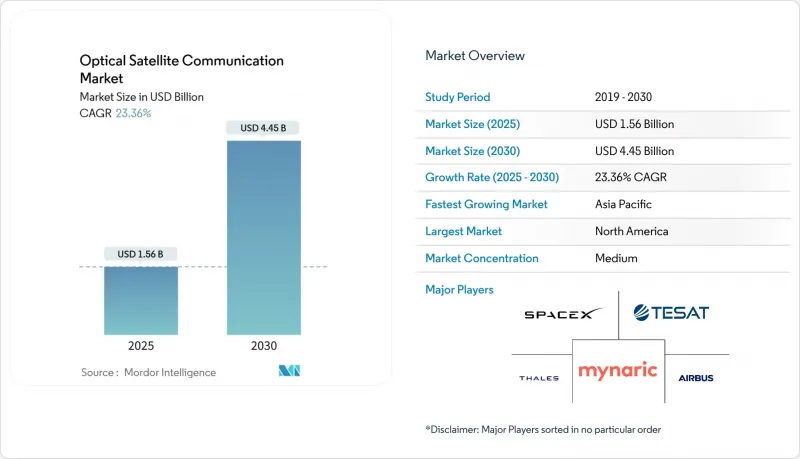
本報告按組件(光收發終端、光地面站等)、軌道(低地球軌道、中地球軌道等)、有效載荷(小型衛星、中型衛星等)、最終用戶(政府/國防等)和地區(北美、歐洲等)進行細分。市場預測以美元計價。
全球光衛星通訊市場趨勢與洞察
低地球軌道寬頻衛星星系正在迅速擴張。
營運商正在部署星間光鏈路作為其低地球軌道(LEO)網路的標準骨幹網,以消除對地面中繼鏈的依賴。 SpaceX公司透過在美國太空發展局(SDA)的「互通性 Space Architecture)計畫下,將約克太空系統公司(York Space Systems)的太空船與星鏈(Starlink)單元連接起來,展示了不同廠商雷射鏈路的互通性。空中巴士已獲得100顆配備基準規格光終端的OneWeb衛星的額外訂單,這表明雷射鏈路已從實驗階段發展成為必要需求。 MDA Space公司與EchoStar公司簽訂的價值13億美元的契約,旨在構建一個由100多顆衛星組成的設備直接連接衛星群,該星座的核心是光鏈路,以確保數據路由的容錯性,這進一步鞏固了光衛星通訊市場。這些努力表明,雷射網狀網路顯然正被優先考慮,以實現在軌延遲、容量和自主性目標。
對高吞吐量和安全通訊鏈路的需求
軍事和情報機構將光通訊技術視為實現抗干擾和低截獲性通訊的最有前景的手段。 L3Harris公司已贏得一份價值8940萬美元的契約,該契約隸屬於“利用商業空間網際網路進行國防實驗”舉措,旨在為機載平台部署雷射終端。北約對立陶宛POLARIS系統的評估以及泰雷茲阿萊尼亞太空公司的量子金鑰傳輸任務表明,國防採購商正在將高數據傳輸速度與抗量子加密相結合。窄波束寬度、無射頻輻射以及線上量子金鑰交換提供了傳統Ka波段通訊無法實現的差異化安全環境,光纖通訊正逐漸成為衝突地區光衛星通訊市場的標準架構。
大氣衰減和雲量
赤道和季風地區的持續雲層覆蓋有時會將地面站光鏈路的可用性降低到30%以下,導致難以滿足服務等級協定 (SLA)。賽峰集團的IRIS自適應光學地面終端可以解決湍流和雲邊緣衍射問題,但硬體成本高。像TeraNet-3這樣的可攜式地面站可以在48小時內快速重新部署,但建立一個能夠應對全球各種天氣條件的網路所需的資本投入遠高於同類射頻容錯移轉。因此,營運商正在尋求混合架構——使用光纖通訊作為骨幹網,射頻通訊用於故障轉移——但這限制了短期內的普及率。
細分市場分析
光收發器終端將雷射光源、檢測器和控制邏輯整合到堅固耐用、抗輻射的封裝中,2024年佔總銷售額的26.78%。受大規模衛星星系部署的推動,預計到2030年,光衛星通訊市場收發器的市場規模將達到13.7億美元。敏捷波束控制組件正成為市場成長的驅動力,預計到2030年,其複合年成長率將達到26.76%,主要得益於能夠同時處理多個鏈路的多孔路徑陣列。光子積體電路的整合使終端體積縮小了40%,加速了微型衛星的普及應用。 MACOM等供應商正在提供10-50瓦的太空加固型光放大器樣品,以支援遠端地球靜止軌道鏈路。
第二層組件(光學地面站、調變解調器和控制器)整合到承包「光學隱形港」解決方案中,該方案將望遠鏡、自適應光學系統和雲緩解軟體打包在服務合約中。與CCSDS藍皮書波形的互通性允許營運商混合使用來自不同供應商的硬體,同時保持鏈路相容性。預計組件市場將圍繞能夠保證端到端性能和安全合規性的垂直整合型主要製造商進行整合。
2024年,低地球軌道(LEO)光衛星通訊的市佔率達到58.84%。這主要歸功於高密度寬頻衛星的部署,它們需要數萬條衛星群內鏈路。短路徑損耗和低定向要求降低了資本支出(CAPEX)和營運成本。目前,高橢圓軌道、中軌道和月球軌道僅佔已部署鏈路的8%,但預計將以24.43%的複合年成長率成長,這主要得益於NASA的獵戶座O2O系統和ESA的月光數據中繼系統。正如ESA的EDRS Global所示,LEO和GEO繼電器之間光纖通訊的互通性正在將目標市場擴展到深空科學任務領域。
地球靜止軌道上的應用場景主要涉及資料回程傳輸中繼,以將影像資料和物聯網流量從低地球軌道(LEO)網路分流出去。結合低地球軌道和地球靜止軌道的混合雷射鏈路繞過了地面光纖回程傳輸和競爭激烈的射頻閘道器,從而消除了延遲瓶頸,並滿足了資料居住的主權要求。
區域分析
2024年,北美地區佔全球收入的26.65%,這主要得益於SpaceX、亞馬遜的Kuiper計畫以及眾多老牌國防相關企業,它們共同佔據了美國光電生產的大部分佔有率。聯邦政府的研發投入,包括DARPA的Space-BACI光纖通訊項目,支撐著一條能夠抵禦出口限制的國內供應鏈。同時,亞太地區正以25.33%的複合年成長率快速成長,這主要得益於中國實現了100Gbps的傳輸速度以及印度基於IN-SPACe的商業化改革。日本的i-QKD衛星群提案和澳洲對自主光閘道器的推廣也進一步擴大了該地區的需求。
歐洲正利用歐洲太空總署(ESA)的計畫來建構“標準優先的生態系統”,重點開發符合國際武器貿易條例(ITAR)豁免要求的可出口終端。中東和非洲仍處於發展階段,但它們有潛力透過採用與商業衛星群容量相結合的承包光學隱形傳態技術,實現射頻(RF)部署的跨越式發展。在南美洲,該技術的應用進展緩慢,主要體現在地球觀測業者尋求為農業相關企業提供低延遲影像傳輸服務。
其他好處:
- Excel格式的市場預測(ME)表
- 3個月的分析師支持
目錄
第1章:引言
- 市場分析與定義的前提條件
- 分析範圍
第2章 分析方法
第3章執行摘要
第4章 市場狀況
- 市場概覽
- 市場促進因素
- 低地球軌道(LEO)寬頻衛星星系的激增
- 對高吞吐量和安全通訊線路的需求
- 射頻頻段的頻寬擁塞
- 政府擴大太空預算
- 星間光纖通訊終端的標準化
- 量子衛星通訊鏈路(對量子金鑰分發的需求)
- 市場限制因素
- 大氣衰減和雲量
- 航太用雷射終端需要高額資本投資
- 眼眶碎片可能導致視線受阻
- 光電級供應鏈的瓶頸
- 價值鏈分析
- 監理情勢
- 技術展望
- 波特五力分析
第5章:預測市場規模與成長率
- 按組件
- 光收發終端
- 光學地面站
- 數據機控制器
- 光束控制指向組件
- 其他
- 通過軌道
- 低地球軌道(LEO)
- 中軌道(MEO)
- 地球靜止軌道(GEO)
- 其他(高地球軌道、月球軌道)
- 有效載荷
- 小型衛星
- 中型衛星
- 大型衛星
- 最終用戶
- 政府/國防
- 商業寬頻服務供應商
- 地球觀測服務供應商
- 學術和科研機構
- 按地區
- 北美洲
- 美國
- 加拿大
- 墨西哥
- 歐洲
- 英國
- 法國
- 德國
- 俄羅斯
- 其他歐洲國家
- 亞太地區
- 中國
- 印度
- 日本
- 韓國
- 其他亞太國家
- 南美洲
- 巴西
- 其他南美國家
- 中東和非洲
- 中東
- 阿拉伯聯合大公國
- 沙烏地阿拉伯
- 其他中東國家
- 非洲
- 南非
- 其他非洲國家
- 中東
- 北美洲
第6章 競爭情勢
- 市場集中度
- 策略趨勢
- 市佔率分析
- 公司簡介
- Tesat-Spacecom GmbH & Co. KG
- Mynaric AG
- Space Exploration Technologies Corp.
- Thales Group
- Airbus SE
- BAE Systems plc
- L3Harris Technologies, Inc.
- Honeywell International Inc.
- General Atomics
- Lockheed Martin Corporation
- BridgeComm, Inc.
- General Dynamics Corporation
- CAILABS
- Kongsberg Satellite Services(Kongsberg Gruppen ASA)
- Kepler Communications Inc.
第7章 市場機會與未來展望
According to Mordor Intelligence, the optical satellite communication market size is USD 1.56 billion in 2025 and is projected to reach USD 4.45 billion by 2030, advancing at a 23.36% CAGR.
This report is Segmented by Component (Optical Transceiver Terminals, Optical Ground Stations, and More), Orbit (Low-Earth Orbit, Medium-Earth Orbit, and More), Payload (Small Satellite, Medium Satellite, and More), End-User (Government and Defense, and More), and Geography (North America, Europe, and More). The Market Forecasts are Provided in Terms of Value (USD).
Global Optical Satellite Communication Market Trends and Insights
Proliferation of LEO Broadband Constellations
Operators are embedding optical inter-satellite links as the canonical backbone of LEO networks to eliminate dependence on terrestrial relay chains. SpaceX validated cross-vendor laser interoperability by linking York Space Systems spacecraft with Starlink units under the US Space Development Agency's Proliferated Warfighter Space Architecture program. Airbus received an extension order for 100 OneWeb satellites that will ship with baseline optical terminals, signaling that laser links have moved from experiment to requirement. MDA Space's USD 1.3 billion EchoStar contract-a 100-plus satellite direct-to-device constellation-centers on optical links for data routing resiliency, reinforcing the optical satellite communication market. These commitments demonstrate a clear preference for laser mesh networking to meet latency, capacity, and autonomy targets in orbit.
Demand for High-Throughput Secure Links
Military and intelligence agencies view optical technology as the most promising path toward jam-resistant, low-probability-of-intercept communications. L3Harris won USD 89.4 million under the Defense Experimentation Using Commercial Space Internet initiative to field laser-capable terminals for airborne platforms. NATO evaluation of Lithuania's POLARIS system, coupled with Thales Alenia Space's quantum-key distribution mission, illustrates how defense buyers are coupling high data rates with quantum-safe encryption. Narrow beamwidth, absence of RF emissions, and in-line quantum key exchange deliver a differentiated security envelope that conventional Ka-band links cannot match, making optical the architecture of record for contested theaters in the optical satellite communication market.
Atmospheric Attenuation and Cloud Cover
Persistent cloud layers in equatorial and monsoon regions depress optical ground-station link availability below 30% on some days, compromising service level agreements. Safran's IRIS adaptive-optics ground terminal tackles turbulence and cloud-edge diffraction, but at a premium hardware cost. Portable stations such as TeraNet-3 achieve rapid redeployment within 48 hours, but scaling a global weather-diverse network requires capital outlays that dwarf comparable RF gateways. Operators therefore pursue hybrid architectures: optical for backbone and RF for fallback, tempering near-term adoption rates.
Other drivers and restraints analyzed in the detailed report include:
- Spectrum Congestion in RF Bands
- Government Space-Budget Acceleration
- High CAPEX of Space-Qualified Laser Terminals
For complete list of drivers and restraints, kindly check the Table Of Contents.
Segment Analysis
Optical transceiver terminals held 26.78% of 2024 revenue as they combine laser sources, detectors, and control logic into ruggedized, radiation-tolerant packages. The optical satellite communication market size for transceivers is forecasted to reach USD 1.37 billion by 2030, tracking broad constellation rollouts. Momentum is shifting toward agile beam-steering assemblies, which are expected to post a 26.76% CAGR through 2030 thanks to multi-aperture arrays that can simultaneously address several links. Integrating photonic-integrated circuits cuts terminal volume by 40%, facilitating the adoption of microsats. Suppliers such as MACOM are sampling 10-50 W space-hardened optical amplifiers to support long-haul geostationary links.
Second-tier components-optical ground stations, modems, and controllers-converge into turnkey "optical teleport" offerings that package telescopes, adaptive optics, and cloud-mitigation software under service contracts. Interoperability with CCSDS blue-book waveforms allows operators to mix vendor hardware while maintaining cross-link compatibility. The component landscape will likely consolidate around vertically integrated primes that can guarantee end-to-end performance and security compliance.
LEO's optical satellite communication market share stood at 58.84% in 2024, driven by the density of broadband satellites requiring tens of thousands of intra-constellation links. Shorter path losses and lower pointing requirements lower both capex and operating costs. High-elliptical, medium-Earth, and cislunar orbits represent just 8% of current deployed links but are projected to expand at 24.43% CAGR, supported by NASA's Orion O2O system and ESA's Moonlight data relays. As exemplified by ESA's EDRS Global, optical interoperability between LEO and GEO relays is widening the addressable market to include deep-space scientific missions.
Use cases in Geostationary Orbit revolve around data-backhaul relays that offload imagery and IoT traffic from LEO nets. Hybrid LEO-GEO laser chains remove latency bottlenecks by avoiding terrestrial fiber back-haul and contested RF gateways, thereby addressing sovereign data-residency requirements.
Complete Report Scope:
- By Component
- Optical Transceiver Terminals
- Optical Ground Stations
- Modems and Controllers
- Beam Steering and Pointing Assemblies
- Others
- By Orbit
- Low-Earth Orbit (LEO)
- Medium-Earth Orbit (MEO)
- Geostationary Orbit (GEO)
- Others (HEO and Cislunar Orbits)
- By Payload
- Small Satellites
- Medium Satellites
- Large Satellites
- By End-User
- Government and Defense
- Commercial Broadband Operators
- Earth-Observation Service Providers
- Academic and Scientific Agencies
- By Geography
- North America
- United States
- Canada
- Mexico
- Europe
- United Kingdom
- France
- Germany
- Russia
- Rest of Europe
- Asia-Pacific
- China
- India
- Japan
- South Korea
- Rest of Asia-Pacific
- South America
- Brazil
- Rest of South America
- Middle East and Africa
- Middle East
- United Arab Emirates
- Saudi Arabia
- Rest of Middle East
- Africa
- South Africa
- Rest of Africa
- Middle East
- North America
Geography Analysis
North America controlled 26.65% of 2024 revenue thanks to SpaceX, Amazon's Kuiper, and entrenched defense contractors that collectively absorb the majority of US photonics output. Federal R&D, including DARPA's Space-BACI optical program, underwrites a domestic supply chain that is resilient to export restrictions. Asia-Pacific, however, is sprinting at a 25.33% CAGR on the back of China's 100 Gbps transmission milestone and India's commercialization reforms under IN-SPACe. Japan's i-QKD constellation proposal and Australia's push for sovereign optical gateways widen regional demand.
Europe leverages ESA programs to evolve a standards-first ecosystem, focusing on exportable terminals that comply with ITAR-free requirements. The Middle East and Africa are nascent but could leapfrog RF deployments by adopting turnkey optical teleports bundled with commercial constellation capacity. South America shows modest adoption, mainly via Earth-observation operators seeking low-latency imagery delivery for agribusiness clients.
- Tesat-Spacecom GmbH & Co. KG
- Mynaric AG
- Space Exploration Technologies Corp.
- Thales Group
- Airbus SE
- BAE Systems plc
- L3Harris Technologies, Inc.
- Honeywell International Inc.
- General Atomics
- Lockheed Martin Corporation
- BridgeComm, Inc.
- General Dynamics Corporation
- CAILABS
- Kongsberg Satellite Services (Kongsberg Gruppen ASA)
- Kepler Communications Inc.
Additional Benefits:
- The market estimate (ME) sheet in Excel format
- 3 months of analyst support
TABLE OF CONTENTS
1 INTRODUCTION
- 1.1 Study Assumptions and Market Definition
- 1.2 Scope of the Study
2 RESEARCH METHODOLOGY
3 EXECUTIVE SUMMARY
4 MARKET LANDSCAPE
- 4.1 Market Overview
- 4.2 Market Drivers
- 4.2.1 Proliferation of LEO broadband constellations
- 4.2.2 Demand for high-throughput secure links
- 4.2.3 Spectrum congestion in RF bands
- 4.2.4 Government space-budget acceleration
- 4.2.5 Standardization of optical inter-sat terminals
- 4.2.6 Quantum-ready satellite links (QKD demand)
- 4.3 Market Restraints
- 4.3.1 Atmospheric attenuation and cloud cover
- 4.3.2 High CAPEX of space-qualified laser terminals
- 4.3.3 Orbital-debris line-of-sight disruption risk
- 4.3.4 Photonics-grade supply-chain bottlenecks
- 4.4 Value Chain Analysis
- 4.5 Regulatory Landscape
- 4.6 Technological Outlook
- 4.7 Porter's Five Forces Analysis
- 4.7.1 Threat of New Entrants
- 4.7.2 Bargaining Power of Suppliers
- 4.7.3 Bargaining Power of Buyers
- 4.7.4 Threat of Substitutes
- 4.7.5 Intensity of Competitive Rivalry
5 MARKET SIZE AND GROWTH FORECASTS (VALUE)
- 5.1 By Component
- 5.1.1 Optical Transceiver Terminals
- 5.1.2 Optical Ground Stations
- 5.1.3 Modems and Controllers
- 5.1.4 Beam Steering and Pointing Assemblies
- 5.1.5 Others
- 5.2 By Orbit
- 5.2.1 Low-Earth Orbit (LEO)
- 5.2.2 Medium-Earth Orbit (MEO)
- 5.2.3 Geostationary Orbit (GEO)
- 5.2.4 Others (HEO and Cislunar Orbits)
- 5.3 By Payload
- 5.3.1 Small Satellites
- 5.3.2 Medium Satellites
- 5.3.3 Large Satellites
- 5.4 By End-User
- 5.4.1 Government and Defense
- 5.4.2 Commercial Broadband Operators
- 5.4.3 Earth-Observation Service Providers
- 5.4.4 Academic and Scientific Agencies
- 5.5 By Geography
- 5.5.1 North America
- 5.5.1.1 United States
- 5.5.1.2 Canada
- 5.5.1.3 Mexico
- 5.5.2 Europe
- 5.5.2.1 United Kingdom
- 5.5.2.2 France
- 5.5.2.3 Germany
- 5.5.2.4 Russia
- 5.5.2.5 Rest of Europe
- 5.5.3 Asia-Pacific
- 5.5.3.1 China
- 5.5.3.2 India
- 5.5.3.3 Japan
- 5.5.3.4 South Korea
- 5.5.3.5 Rest of Asia-Pacific
- 5.5.4 South America
- 5.5.4.1 Brazil
- 5.5.4.2 Rest of South America
- 5.5.5 Middle East and Africa
- 5.5.5.1 Middle East
- 5.5.5.1.1 United Arab Emirates
- 5.5.5.1.2 Saudi Arabia
- 5.5.5.1.3 Rest of Middle East
- 5.5.5.2 Africa
- 5.5.5.2.1 South Africa
- 5.5.5.2.2 Rest of Africa
- 5.5.5.1 Middle East
- 5.5.1 North America
6 COMPETITIVE LANDSCAPE
- 6.1 Market Concentration
- 6.2 Strategic Moves
- 6.3 Market Share Analysis
- 6.4 Company Profiles (includes Global level Overview, Market level overview, Core Segments, Financials as available, Strategic Information, Market Rank/Share for key companies, Products and Services, and Recent Developments)
- 6.4.1 Tesat-Spacecom GmbH & Co. KG
- 6.4.2 Mynaric AG
- 6.4.3 Space Exploration Technologies Corp.
- 6.4.4 Thales Group
- 6.4.5 Airbus SE
- 6.4.6 BAE Systems plc
- 6.4.7 L3Harris Technologies, Inc.
- 6.4.8 Honeywell International Inc.
- 6.4.9 General Atomics
- 6.4.10 Lockheed Martin Corporation
- 6.4.11 BridgeComm, Inc.
- 6.4.12 General Dynamics Corporation
- 6.4.13 CAILABS
- 6.4.14 Kongsberg Satellite Services (Kongsberg Gruppen ASA)
- 6.4.15 Kepler Communications Inc.
7 MARKET OPPORTUNITIES AND FUTURE OUTLOOK
- 7.1 White-Space and Unmet-Need Assessment

 全球光學衛星市場規模、佔有率、趨勢和成長分析報告(2026-2034)全球光衛星通訊市場規模、佔有率、趨勢和成長分析報告(2026-2034年)
 光學衛星市場分析及預測(至2035年):依類型、產品、服務、技術、組件、應用、部署、最終用戶、功能及安裝方式分類
 全球天基通訊市場預測至2034年:按通訊類型、頻段、軌道、應用、最終用戶和地區分類
 光衛星通訊市場:按組件、類型、雷射類型、技術、應用和最終用戶分類-2026-2032年全球市場預測
 光學衛星市場商機、成長要素、產業趨勢分析及2026-2035年預測。商業深空通訊市場分析與預測(至2035年):按類型、產品、服務、技術、組件、應用、最終用戶、功能、安裝和解決方案分類
 光學衛星市場報告:趨勢、預測與競爭分析(至2035年)
 2026年全球光學衛星市場報告2026年全球光衛星通訊市場報告