

 |
市場調查報告書
商品編碼
2101943
光學衛星市場商機、成長要素、產業趨勢分析及2026-2035年預測。Optical Satellite Market Opportunity, Growth Drivers, Industry Trend Analysis, and Forecast 2026 - 2035 |
||||||

全球光學衛星市場預計到 2025 年將價值 26 億美元,並將以 15.3% 的複合年成長率成長,到 2035 年將達到 108 億美元。
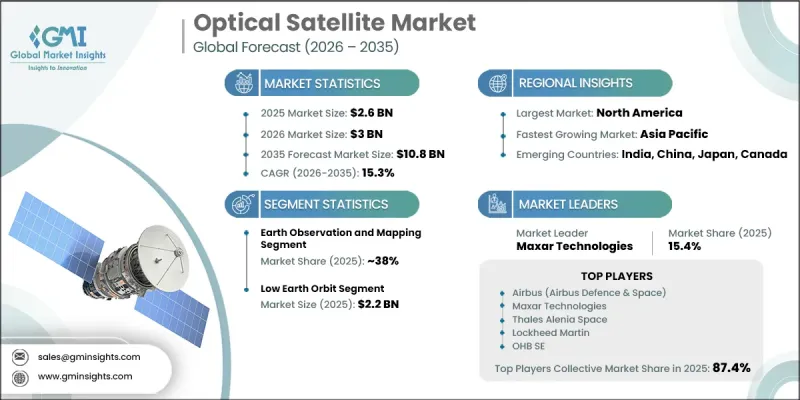
由於公共和私營部門對高解析度地理空間資料的需求持續成長,光學衛星市場正經歷強勁成長。政府機構增加對地球觀測能力的投資,以改善環境監測、基礎設施評估和資源管理;而私人企業則利用衛星影像來支援各行各業的數據驅動決策。國防能力的現代化和情報收集能力投資的增加也加速了先進光學成像衛星的部署。同時,發射成本的降低和衛星部署服務的普及,使得大規模的衛星星系得以發展,並擴大了私營部門在該行業的參與。星載人工智慧、感測器技術、影像處理以及衛星性能的不斷提升,正在提高地理空間資料收集的品質、速度和精度。隨著光學衛星技術被整合到更廣泛的商業和政府應用中,該市場正不斷發展,成為現代地理空間資訊和天基觀測基礎設施的重要組成部分。
| 市場範圍 | |
|---|---|
| 開始年份 | 2025 |
| 預測期 | 2026-2035 |
| 初始市場規模 | 26億美元 |
| 預測金額 | 108億美元 |
| 複合年成長率 | 15.3% |
預計到2025年,地球觀測和測繪領域的市場規模將達到10億美元。對精確地理空間資訊的持續需求推動了光學衛星技術在測繪、土地監測、基礎設施管理、環境評估和長期地理資料收集等領域的廣泛應用。隨著規劃、監測和分析應用對衛星影像的依賴性日益增強,預計該領域的市場地位將在預測期內持續鞏固。
2025年,低地球軌道(LEO)光學衛星市場規模將達22億美元。 LEO憑藉其軌道特性,持續主導市場,這些特性使其能夠實現高解析度影像擷取、高效能資料擷取和經濟高效的衛星部署。 LEO能夠捕捉到精細的地球影像,並支援不斷擴展的衛星星系部署,使其成為光學衛星任務的首選軌道,從而推動了整個行業的持續投資。
預計到2025年,北美光學衛星市場規模將達到12億美元,並在2035年之前以15.6%的複合年成長率成長。美國透過持續投資衛星技術、地球觀測計畫、科學研究和國家安全舉措,持續推動該地區的成長。強大的公共部門資金支持、不斷成長的私營部門參與以及衛星圖像技術的持續創新,鞏固了該地區在全球光學舉措市場的主導地位。
目錄
第1章:調查方法和範圍
第2章執行摘要
第3章 行業洞察
- 產業生態系分析
- 影響產業的因素
- 促進因素
- 對地球觀測資料的需求日益成長
- 加大對國防和邊境監控的投入
- 光學感測器技術的進步
- 在精密農業和氣候監測領域擴大應用。
- 產業潛在風險與挑戰
- 天氣和雲量限制
- 高昂的研發推出成本
- 市場機遇
- 商業地理空間分析服務的擴展
- 新興國家太空發展計畫的擴展
- 促進因素
- 成長潛力分析
- 監理情勢
- 技術展望
- 最新科技趨勢
- 新興技術
- 價格趨勢分析
- 未來市場趨勢
- 專利分析
- 波特的分析
- PESTLE分析
- 人工智慧和生成式人工智慧對市場的影響
- 價值鏈分析
- 投資與資金籌措分析
- 消費者洞察
第4章 競爭情勢
- 介紹
- 企業市佔率分析:按地區分類
- 北美洲
- 歐洲
- 亞太地區
- 中東和非洲
- 拉丁美洲
- 主要進展
- 重要合作夥伴關係和合作
- 主要併購活動
- 產品創新和新產品發布
- 市場擴大策略
- 競爭定位矩陣
第5章 市場規模及預測:依軌道類型分類,2022-2035年
- 低地球軌道(LEO)
- 中軌道(MEO)
- 地球靜止軌道(GEO)
- 其他
第6章 市場規模及預測:依衛星品質等級分類,2022-2035年
- 奈米衛星/立方衛星
- 微衛星
- 小型衛星
- 中型衛星
- 大型衛星
第7章 市場規模及預測:依應用領域分類,2022-2035年
- 地球觀測與測繪
- 國防、情報/偵察
- 環境監測與災害管理
- 科學研究/天文學
- 空間情境察覺
- 其他
第8章 市場規模與預測:依最終用戶分類,2022-2035年
- 政府和公共機構
- 國防/軍事
- 商業企業
- 研究和學術機構
第9章 市場規模及預測:依地區分類,2022-2035年
- 北美洲
- 美國
- 加拿大
- 歐洲
- 德國
- 法國
- 英國
- 荷蘭
- 西班牙
- 義大利
- 亞太地區
- 中國
- 日本
- 韓國
- 印度
- 澳洲
- 中東和非洲
- 沙烏地阿拉伯
- UAE
- 南非
- 拉丁美洲
- 巴西
- 阿根廷
- 墨西哥
第10章:公司簡介
- Airbus(Airbus Defence & Space)
- Antrix Corporation
- BlackSky Technology Inc.
- Boeing Defense, Space & Security
- CASC
- General Dynamics Mission Systems
- IAI(Israeli Aerospace Industries)
- Maxar Technologies
- Lockheed Martin
- Mitsubishi Electric Corp.
- NEC Corporation
- Northrop Grumman
- OHB SE
- Planet Labs PBC
- Satellogic Inc.
- Satrec Initiative
- Thales Alenia Space
- TUSAS(Turkish Aerospace Industries)
The Global Optical Satellite Market was valued at USD 2.6 billion in 2025 and is estimated to grow at a CAGR of 15.3% to reach USD 10.8 billion by 2035.
The optical satellite market is witnessing strong growth as demand for high-resolution geospatial data continues to increase across both public and private sectors. Government organizations are expanding investments in Earth observation capabilities to improve environmental monitoring, infrastructure assessment, and resource management, while commercial enterprises are utilizing satellite imagery to support data-driven decision-making across diverse industries. Growing investments in defense modernization and intelligence capabilities are also accelerating the deployment of advanced optical imaging satellites. At the same time, declining launch costs and broader access to satellite deployment services are enabling the development of larger satellite constellations and expanding commercial participation in the industry. Continuous advancements in onboard artificial intelligence, sensor technologies, image processing, and satellite performance are improving the quality, speed, and accuracy of geospatial data collection. As optical satellite technology becomes increasingly integrated into a wider range of commercial and government applications, the market continues to evolve into an essential component of modern geospatial intelligence and space-based observation infrastructure.
| Market Scope | |
|---|---|
| Start Year | 2025 |
| Forecast Year | 2026-2035 |
| Start Value | $2.6 Billion |
| Forecast Value | $10.8 Billion |
| CAGR | 15.3% |
The earth observation and mapping segment generated USD 1 billion in 2025. Continued demand for accurate geospatial information is supporting widespread adoption of optical satellite technology for mapping, land monitoring, infrastructure management, environmental assessment, and long-term geographic data collection. Increasing reliance on satellite-based imagery for planning, monitoring, and analytical applications continues to strengthen the market position of this segment throughout the forecast period.
The low Earth orbit (LEO) optical satellite market accounted for USD 2.2 billion in 2025. LEO continues to dominate the market because its orbital characteristics support high-resolution imaging, efficient data acquisition, and cost-effective satellite deployment. The ability to capture detailed Earth imagery while supporting expanding satellite constellation deployments continues to make LEO the preferred orbit for optical satellite missions, driving sustained investment across the industry.
North America Optical Satellite Market generated USD 1.2 billion in 2025 and is expected to grow at a CAGR of 15.6% through 2035. The United States continues to drive regional growth through ongoing investments in satellite technology, Earth observation programs, scientific research, and national security initiatives. Strong public-sector funding, expanding commercial participation, and continued innovation in satellite imaging technologies are supporting the region's leadership position within the global optical satellite market.
Leading companies operating in the optical satellite market include AXT Inc., Broadcom Inc., CMK Ltd., DOWA Electronics Materials Co., Ltd., Freiberger Compound Materials GmbH, JX Nippon Mining & Metals Corporation (Eneos Holdings Inc.), Logitech Ltd., MTI Corporation (USA), Nanografi Nano Technology, Sumitomo Electric Semiconductor Materials Inc., Umicore, Veeco Instruments Inc., Wafer Technology Ltd. (UK), Western Minmetals (SC) Corporation, Xiamen Powerway Advanced Material Co., and Yunnan Germanium Co., Ltd. Companies operating in the optical satellite market are strengthening their market position by investing in advanced imaging technologies, satellite miniaturization, and artificial intelligence-enabled data processing capabilities. Manufacturers continue to improve sensor performance, image resolution, and onboard processing efficiency to deliver faster and more accurate geospatial intelligence. Businesses are expanding research and development activities to enhance satellite reliability, operational lifespan, and overall mission performance while reducing manufacturing and deployment costs. Strategic collaborations with government agencies, commercial organizations, and technology partners are helping companies broaden their service offerings and increase market reach.
Table of Contents
Chapter 1 Methodology & Scope
- 1.1 Research approach
- 1.2 Quality commitments
- 1.2.1 GMI AI policy & data integrity commitment
- 1.2.1.1 Source consistency protocol
- 1.2.1 GMI AI policy & data integrity commitment
- 1.3 Research trail & confidence scoring
- 1.3.1 Research trail components
- 1.3.2 Scoring components
- 1.4 Data collection
- 1.4.1 Partial list of primary sources
- 1.5 Data mining sources
- 1.5.1 Paid sources
- 1.5.1.1 Sources, by region
- 1.5.1 Paid sources
- 1.6 Base estimates and calculations
- 1.6.1 Base year calculation for any one approach
- 1.7 Market estimates & forecasts parameters
- 1.8 Forecast model
- 1.8.1 Quantified market impact analysis
- 1.8.1.1 Mathematical impact of growth parameters on forecast
- 1.8.1 Quantified market impact analysis
- 1.9 Research transparency addendum
- 1.9.1 Source attribution framework
- 1.9.2 Quality assurance metrics
- 1.9.3 Our commitment to trust
- 1.10 Market definitions
Chapter 2 Executive Summary
- 2.1 Industry synopsis, 2022 - 2035
- 2.1.1 Orbit Type trends
- 2.1.2 Satellite Mass Class trends
- 2.1.3 Application trends
- 2.1.4 End User trends
- 2.1.5 Regional trends
Chapter 3 Industry Insights
- 3.1 Industry ecosystem analysis
- 3.2 Industry impact forces
- 3.2.1 Growth drivers
- 3.2.1.1 Increasing Demand for Earth Observation Data
- 3.2.1.2 Rising Defense and Border Surveillance Investments
- 3.2.1.3 Advancements in Optical Sensor Technologies
- 3.2.1.4 Growing Adoption in Precision Agriculture and Climate Monitoring
- 3.2.2 Industry pitfalls and challenges
- 3.2.2.1 Weather and Cloud Cover Limitations
- 3.2.2.2 High Development and Launch Costs
- 3.2.3 Market opportunities
- 3.2.3.1 Expansion of Commercial Geospatial Analytics Services
- 3.2.3.2 Growing Space Programs in Emerging Economies
- 3.2.1 Growth drivers
- 3.3 Growth potential analysis
- 3.4 Regulatory landscape (Driven by primary research)
- 3.4.1 North America
- 3.4.2 Europe
- 3.4.3 Asia Pacific
- 3.4.4 Latin America
- 3.4.5 MEA
- 3.5 Technology landscape
- 3.5.1 Current technological trends
- 3.5.2 Emerging technologies
- 3.6 Pricing trend analysis (Driven by primary research)
- 3.7 Future market trends
- 3.8 Patent analysis
- 3.9 Porter's analysis
- 3.10 PESTEL analysis
- 3.11 Impact of AI and Generative AI on the market (Driven by primary research)
- 3.12 Value chain analysis (Driven by primary research)
- 3.13 Investment & funding analysis (Driven by primary research)
- 3.14 Consumer insights (Driven by primary research)
Chapter 4 Competitive Landscape, 2025
- 4.1 Introduction
- 4.2 Company market share analysis, by region, 2025
- 4.2.1 North America
- 4.2.2 Europe
- 4.2.3 Asia Pacific
- 4.2.4 Middle East & Africa
- 4.2.5 Latin America
- 4.3 Key developments
- 4.3.1 Key partnerships & collaborations
- 4.3.2 Major M&A activities
- 4.3.3 Product innovations & launches
- 4.3.4 Market expansion strategies
- 4.4 Competitive positioning matrix
Chapter 5 Market Size and Forecast, By Orbit Type, 2022 - 2035 (USD Million & units)
- 5.1 Key trends
- 5.2 Low Earth Orbit (LEO)
- 5.3 Medium Earth Orbit (MEO)
- 5.4 Geostationary Earth Orbit (GEO)
- 5.5 Others
Chapter 6 Market Size and Forecast, By Satellite Mass Class, 2022 - 2035 (USD Million & units)
- 6.1 Key trends
- 6.2 Nano Satellites / CubeSats
- 6.3 Micro Satellites
- 6.4 Mini / Small Satellites
- 6.5 Medium Satellites
- 6.6 Large Satellites
Chapter 7 Market Size and Forecast, By Application, 2022 - 2035 (USD Million & units)
- 7.1 Key trends
- 7.2 Earth Observation & Mapping
- 7.3 Defense, Intelligence & Reconnaissance
- 7.4 Environmental Monitoring & Disaster Management
- 7.5 Scientific Research & Astronomy
- 7.6 Space Situational Awareness
- 7.7 Others
Chapter 8 Market Size and Forecast, By End User, 2022 - 2035 (USD Million & units)
- 8.1 Government & Civil Agencies
- 8.2 Defense & Military
- 8.3 Commercial Enterprises
- 8.4 Research & Academic Institutions
Chapter 9 Market Size and Forecast, By Region, 2022 - 2035 (USD Million)
- 9.1 Key trends
- 9.2 North America
- 9.2.1 U.S.
- 9.2.2 Canada
- 9.3 Europe
- 9.3.1 Germany
- 9.3.2 France
- 9.3.3 UK
- 9.3.4 Netherlands
- 9.3.5 Spain
- 9.3.6 Italy
- 9.4 Asia Pacific
- 9.4.1 China
- 9.4.2 Japan
- 9.4.3 South Korea
- 9.4.4 India
- 9.4.5 Australia
- 9.5 Middle East & Africa
- 9.5.1 Saudi Arabia
- 9.5.2 UAE
- 9.5.3 South Africa
- 9.6 Latin America
- 9.6.1 Brazil
- 9.6.2 Argentina
- 9.6.3 Mexico
Chapter 10 Company Profiles
- 10.1 Airbus (Airbus Defence & Space)
- 10.2 Antrix Corporation
- 10.3 BlackSky Technology Inc.
- 10.4 Boeing Defense, Space & Security
- 10.5 CASC
- 10.6 General Dynamics Mission Systems
- 10.7 IAI (Israeli Aerospace Industries)
- 10.8 Maxar Technologies
- 10.9 Lockheed Martin
- 10.10 Mitsubishi Electric Corp.
- 10.11 NEC Corporation
- 10.12 Northrop Grumman
- 10.13 OHB SE
- 10.14 Planet Labs PBC
- 10.15 Satellogic Inc.
- 10.16 Satrec Initiative
- 10.17 Thales Alenia Space
- 10.18 TUSAS (Turkish Aerospace Industries)

 全球光學衛星市場規模、佔有率、趨勢和成長分析報告(2026-2034)全球光衛星通訊市場規模、佔有率、趨勢和成長分析報告(2026-2034年)
 光衛星通訊:市場佔有率分析、產業趨勢與統計、成長預測(2025-2030 年)
 光學衛星市場分析及預測(至2035年):依類型、產品、服務、技術、組件、應用、部署、最終用戶、功能及安裝方式分類
 全球天基通訊市場預測至2034年:按通訊類型、頻段、軌道、應用、最終用戶和地區分類
 光衛星通訊市場:按組件、類型、雷射類型、技術、應用和最終用戶分類-2026-2032年全球市場預測商業深空通訊市場分析與預測(至2035年):按類型、產品、服務、技術、組件、應用、最終用戶、功能、安裝和解決方案分類
 光學衛星市場報告:趨勢、預測與競爭分析(至2035年)
 2026年全球光學衛星市場報告2026年全球光衛星通訊市場報告