


 |
市場調查報告書
商品編碼
2117397
歐洲電動車充電即服務 (CaaS):市場佔有率分析、產業趨勢與統計、成長預測 (2026-2031)Europe EV Charging As A Service - Market Share Analysis, Industry Trends & Statistics, Growth Forecasts (2026 - 2031) |
||||||

※ 本網頁內容可能與最新版本有所差異。詳細情況請與我們聯繫。
根據 Mordor Intelligence 估計,歐洲電動車充電即服務 (CaaS) 市場在 2025 年的價值為 1.326 億美元,從 2026 年的 1.6144 億美元成長到 2031 年的 4.569 億美元,在預測期(2026-2031 年成長率 2026-2031 年 2026-2031 年)。
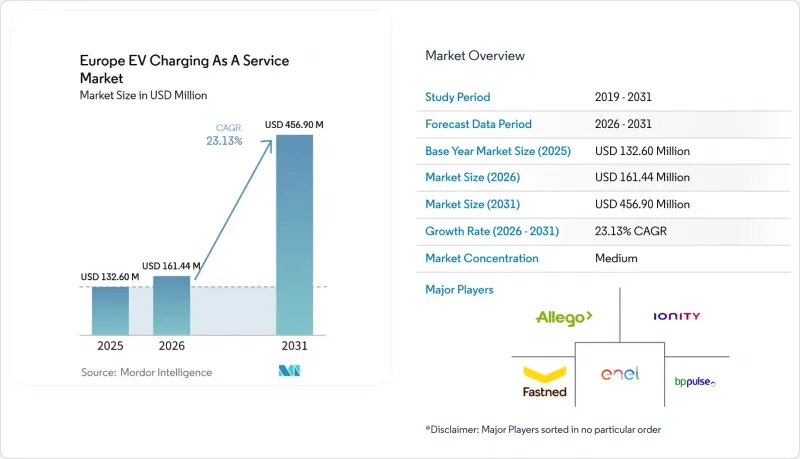
本報告按充電器類型(交流充電器、直流充電器)、輸出功率(1級/交流(小於22千瓦)、2級(22-50千瓦)、其他)、車隊服務類型(公司車輛/車輛共享、配送/物流、其他)、應用領域(半公共充電設施、公共充電設施)和國家進行分類。市場預測以美元計價。
歐洲電動車充電即服務 (CaaS) 市場的趨勢與見解。
歐盟 AFIR 和「Fit-for-55」實施期限
到2025年底,AFIR強制要求在泛歐交通網(TEN-T)核心路段每60公里安裝容量至少為400千瓦的輕型車輛充電站。到2027年,這項要求將提高到600千瓦,並在關鍵路段替換容量低於150千瓦的充電樁。該法規還強制要求近乎即時的資料傳輸和非接觸式支付,從而規範用戶體驗並減少漫遊摩擦。波蘭的走廊資金籌措方案表明,歐盟資金正在彌補落後成員國的資金缺口。德國和法國面臨最嚴峻的合規挑戰,但將於2026年生效的違規處罰措施正在加快許可證核准和未來容量預留的速度。總而言之,AFIR正在將監管確定性轉化為歐洲電動車充電即服務(CaaS)市場的穩固收入基礎。
降低150千瓦以上直流充電樁的平準化發電成本
2024年,受Alpitronic、Kempower和ABB等廠商模組化機櫃設計的大規模生產推動,300-400千瓦充電樁的平均價格下降。 Kempower於2025年推出的1.2兆瓦充電樁將使業者能夠逐步提升充電容量,從而顯著降低每個充電口的資本支出(CAPEX)。同時,中國製造商正在開發價格較親民的充電樁,但網路安全認證的挑戰可能會延緩其部署。隨著硬體成本的降低,即使是次要交通走廊的專案內部收益率(IRR)也超過了營運商可接受的最低收益率。這種轉變正在擴大歐洲電動車充電即服務(CaaS)的潛在市場,使其不再局限於主要高速公路位置,而是擴展到更廣泛的地理區域。
電網連接延遲和容量瓶頸
在波蘭、法國、義大利和西班牙,電網營運商經常面臨中壓升級改造高功率站點的漫長核准流程。這種延誤阻礙了沿線地區的開發,尤其是在AFIR(快速充電基礎設施)專案截止日期臨近之際。 2025年,柏林和慕尼黑的大部分快速充電申請都面臨核准時間過長的問題,迫使業者縮減計畫或完全撤回申請。義大利從其疫情後復甦舉措中撥出大量資金用於充電基礎設施建設。然而,截至2025年底,僅有一小部分指定的安裝站點併入電網。儘管歐盟市場設計改革預計將在2028年前加快核准流程,但這些延誤的影響已經顯現,導致專案延期和收入延遲。
細分市場分析
到2025年,交流充電收入佔總收入的62.41%,但隨著擁有者優先考慮縮短充電時間,其佔有率正在下降。低功率交流充電仍然是市政路邊停車位和辦公大樓停車場最經濟實惠的普及選擇,尤其是在夜間停車與非尖峰時段電價重合的情況下。然而,AFIR的最低技術標準和企業運轉率目標正促使新的投資轉向高功率直流充電,這一趨勢在TEN-T的核心走廊尤為明顯。因此,優先發展歐洲電動車充電即服務(CaaS)市場的營運商正在將資金從輔助低速交流充電設施的投資重新分配到沿線的直流充電站,因為直流充電站能夠帶來更大的收入來源和額外的電網服務收入。
超快速直流充電樁的吸引力在於其用戶便利性和成本效益,預計到2031年將以26.48%的複合年成長率成長。 IONITY不斷擴大的資金籌措、Kempower的模組化機櫃以及特斯拉500千瓦V4型充電樁的結合,使得每個充電站的處理能力加倍,而無需增加土地或連接成本。目前已在交流充電網路佔據主導地位的營運商正在增加直流充電站的數量以維持其市場佔有率,而新參與企業則直接進入高功率硬體市場。隨著這些趨勢的持續,交流充電在歐洲電動車充電即服務(CaaS)市場的佔有率可能會繼續下降。然而,隨著該地區電動車數量的成長,交流充電的絕對使用量預計仍將繼續逐步增加。
2025年,功率低於22千瓦的充電樁銷量佔49.03%,但在高速公路上的效用正在下降。由於AFIR強制要求站點部署400千瓦的充電樁,營運商被迫過渡到350-400千瓦的充電樁,以確保其資產的未來獲利能力。 300-400千瓦級硬體成本的下降縮小了與50-150千瓦型號的價格差距,促使許多投資者選擇更高容量的方案。因此,高功率直流充電樁(150千瓦及以上)將在歐洲電動車充電服務市場新增資本配置中佔據最大佔有率,預計將以35.28%的複合年成長率成長。
兆瓦級充電是下一個發展前沿。 Kempower 的 1.2 兆瓦充電櫃和特斯拉的 Megacharger 試點計畫表明,電動車充電技術已具備服務長途貨車的能力。歐盟支持的 CV-Charging Europe 計畫正在推進 MCS 3.2 連接器的標準化。早期試點計畫的回饋表明,即使利用率低至 7-8%,兆瓦級充電站也能獲利能力,這主要得益於充電時間縮短帶來的高價。因此,預計從 2026 年到 2031 年,高功率直流充電將成為歐洲電動車充電即服務 (CaaS) 市場成長的主要驅動力,而中功率充電市場預計將萎縮,僅應用於諸如換乘停車場等小眾領域。
其他好處:
- Excel格式的市場預測(ME)表
- 3個月的分析師支持
目錄
第1章:引言
- 市場分析與定義的前提條件
- 分析範圍
第2章 分析方法
第3章執行摘要
第4章 市場狀況
- 市場概覽
- 市場促進因素
- 歐盟 AFIR 和「Fit-for-55」實施期限
- 降低150千瓦以上直流充電樁的平準化發電成本
- 由原始設備製造商 (OEM)主導的走廊型聯盟(IONITY、CV-Charging Europe)
- 企業車輛強制電氣化
- 人工智慧驅動的動態定價引擎可提高網站使用率。
- 透過 V2G(車輛到電網)網路交易剩餘可再生能源並累積收益。
- 市場限制因素
- 電網連接延遲和容量瓶頸
- 低流量網站的高初始資本支出/投資報酬率風險。
- 軟體堆疊碎片化/漫遊故障
- 電池更換站作為替代方案
- 價值鍊和供應鏈分析
- 監理情勢
- 技術展望
- 波特五力分析
第5章:預測市場規模與成長率
- 充電器類型
- 交流充電器
- 直流充電器
- 依輸出類型
- 1級/交流電(小於22千瓦)
- 2級(22-50度)
- 高速直流(50-150千瓦)
- 高功率直流電(150千瓦或以上)
- 車隊服務類型
- 公司用車/車輛共享
- 配送/物流
- 乘用車車隊
- 按最終用途
- 半公共充電設施
- 公共充電設備
- 國家
- 德國
- 英國
- 法國
- 義大利
- 西班牙
- 荷蘭
- 挪威
- 瑞典
- 丹麥
- 波蘭
- 其他歐洲國家
第6章 競爭情勢
- 市場集中度
- 策略趨勢
- 市佔率分析
- 公司簡介
- Allego BV
- IONITY
- Fastned
- Enel Group
- ChargePoint, Inc.
- BP Pulse
- Shell Recharge
- TotalEnergies Charging Services
- Tesla, Inc.
- Pod Point
- Mer Germany GmbH
- Electra
- GreenWay
- Virta
- Powerdot
- Kempower
第7章 市場機會與未來展望
According to Mordor Intelligence, the european EV charging as a service market size was valued at USD 132.60 million in 2025 and is estimated to grow from USD 161.44 million in 2026 to reach USD 456.90 million by 2031, at a CAGR of 23.13% during the forecast period (2026-2031).
This report is Segmented by Charger Type (AC Chargers, DC Chargers), Power Output (Level 1/AC (Less Than 22 KW), Level 2 (22 To 50 KW), and More), Fleet Service Type (Company Vehicles and Motor Pools, Delivery and Logistics, and More), End-Use (Semi-Public Charging Setup, Public Charging Setup), and Country. The Market Forecasts are Provided in Terms of Value (USD).
Europe EV Charging As A Service Market Trends and Insights
EU AFIR and "Fit-for-55" Rollout Deadlines
By late 2025, the AFIR required the core Trans-European Transport Network (TEN-T) to establish recharging stations for light-duty vehicles every 60 km, with a minimum capacity of 400 kW. This requirement will be increased to 600 kW by 2027, replacing sub-150 kW hardware on key corridors. The regulation also mandates near-real-time data feeds and contactless payments, which standardize user experience and shrink roaming friction. Poland's corridor-funding package illustrates how EU capital is filling financing gaps for lagging member states. Germany and France face the steepest compliance curves, yet the penalties for non-conformance beginning in 2026 are accelerating permit approvals and forward-capacity reservations. Overall, AFIR is turning regulatory certainty into a bankable revenue floor for the European EV Charging As A Service market.
Declining Levelized Cost of More Than 150 kW DC Chargers
In 2024, average prices for 300-400 kW dispensers declined, driven by scaled production of modular cabinet designs from Alpitronic, Kempower, and ABB. Kempower's 1.2 MW Power Unit, which debuted in 2025, allows operators to incrementally boost capacity, significantly reducing per-port CAPEX. Meanwhile, Chinese manufacturers are experimenting with more affordable units, but face potential delays due to cybersecurity certification challenges. As hardware costs decline, project internal rates of return now exceed operator hurdle rates, even on secondary corridors. This shift expands the addressable market for Europe's EV Charging As A Service, reaching beyond just prime motorway locations.
Grid-Connection Delays and Capacity Bottlenecks
In Poland, France, Italy, and Spain, distribution-system operators frequently take extended periods to approve medium-voltage upgrades for high-power sites. This delay stalls corridor deployment, especially as AFIR deadlines loom closer. In 2025, a significant portion of fast-charging applications in Berlin and Munich faced prolonged processing times. This led operators to either scale back their plans or abandon requests altogether. Italy allocated substantial funds from its post-pandemic recovery initiative for charging infrastructure. However, by the end of 2025, only a fraction of the designated sites gained grid access. While EU market-design reforms are set to expedite approvals by 2028, the repercussions of these delays are already evident in project backlogs and postponed revenues.
Other drivers and restraints analyzed in the detailed report include:
- OEM-Led Corridor Alliances (IONITY, CV-Charging Europe)
- Corporate-Fleet Electrification Mandates
- High Upfront CAPEX/ROI Risk at Low-Traffic Sites
For complete list of drivers and restraints, kindly check the Table Of Contents.
Segment Analysis
AC posts held 62.41% of 2025 revenue, but their grip is loosening as fleets value faster turnaround times. At municipal curbsides and office carparks, low-power AC remains the lowest-cost path to coverage, especially where overnight dwell aligns with off-peak tariffs. Yet AFIR's technical minimums and corporate uptime targets are tilting fresh investment toward high-power DC, most visibly on TEN-T core corridors. Operators prioritizing Europe EV Charging As A Service market size expansion are therefore reallocating capital from slow AC infill to corridor DC hubs that promise higher ticket sizes and ancillary grid-service revenue.
Ultra-fast DCs' appeal rests on both user convenience and headline economics, and is set to expand at a 26.48% CAGR through 2031. IONITY's expansion financing, Kempower's modular cabinets, and Tesla's 500 kW V4 dispensers combine to double site throughput without doubling land or connection costs. Operators that already command AC footprints are adding DC islands to defend share, while new entrants skip straight to high-power hardware. As these dynamics unfold, the share of AC in the European EV Charging As A Service market will continue to decline, even though absolute AC volumes will still inch upward alongside the region's EV parc.
Sub-22 kW units represented 49.03% of 2025 revenue, but their utility on motorway routes is fading. AFIR's 400 kW site-level mandate pushes operators toward 350-400 kW dispensers today to future-proof assets. The cost drop for 300-400 kW hardware has narrowed the price gap with 50-150 kW models, tipping many investors toward the higher-throughput option. Consequently, high-power DC (above 150 kW) will capture the largest share of new capital allocations in the European EV Charging-as-a-Service market, growing at a 35.28% CAGR.
Megawatt-scale charging is the next frontier. Kempower's 1.2 MW cabinets and Tesla's Megacharger trials signal readiness for long-haul trucks, while EU-backed CV-Charging Europe is standardizing the MCS 3.2 connector . Early pilot feedback indicates that megawatt hubs can reach profitability at as low as 7-8% utilization, largely thanks to premium tariffs justified by time savings. Over 2026-2031, high-power DC will therefore shoulder most of the growth in Europe's EV Charging As A Service market, compressing the mid-power segment into niche roles such as park-&-ride lots.
Complete Report Scope:
- By Charger Type
- AC Chargers
- DC Chargers
- By Power Output
- Level 1/AC (Less than 22 kW)
- Level 2 (22 to 50 kW)
- Fast DC (50 to 150 kW)
- High-Power DC (More than 150 kW)
- By Fleet Service Type
- Company Vehicles and Motor Pools
- Delivery and Logistics
- Passenger Fleets
- By End-use
- Semi-Public Charging Setup
- Public Charging Setup
- By Country
- Germany
- United Kingdom
- France
- Italy
- Spain
- Netherlands
- Norway
- Sweden
- Denmark
- Poland
- Rest of Europe
List of Companies Covered in this Report:
- Allego B.V.
- IONITY
- Fastned
- Enel Group
- ChargePoint, Inc.
- BP Pulse
- Shell Recharge
- TotalEnergies Charging Services
- Tesla, Inc.
- Pod Point
- Mer Germany GmbH
- Electra
- GreenWay
- Virta
- Powerdot
- Kempower
Additional Benefits:
- The market estimate (ME) sheet in Excel format
- 3 months of analyst support
TABLE OF CONTENTS
1 Introduction
- 1.1 Study Assumptions and Market Definition
- 1.2 Scope of the Study
2 Research Methodology
3 Executive Summary
4 Market Landscape
- 4.1 Market Overview
- 4.2 Market Drivers
- 4.2.1 EU AFIR and "Fit-for-55" Rollout Deadlines
- 4.2.2 Declining Levelized Cost of More Than 150 kW DC Chargers
- 4.2.3 OEM-Led Corridor Alliances (IONITY, CV-Charging Europe)
- 4.2.4 Corporate-Fleet Electrification Mandates
- 4.2.5 AI-Driven Dynamic-Pricing Engines Raise Site Utilization
- 4.2.6 Surplus-Renewables Trading and V2G Revenue Stacking
- 4.3 Market Restraints
- 4.3.1 Grid-Connection Delays and Capacity Bottlenecks
- 4.3.2 High Upfront CAPEX/ROI Risk at Low-Traffic Sites
- 4.3.3 Software-Stack Fragmentation/Roaming Failures
- 4.3.4 Battery-Swapping Stations as Substitute Solution
- 4.4 Value/Supply-Chain Analysis
- 4.5 Regulatory Landscape
- 4.6 Technological Outlook
- 4.7 Porter's Five Forces
- 4.7.1 Threat of New Entrants
- 4.7.2 Bargaining Power of Suppliers
- 4.7.3 Bargaining Power of Buyers
- 4.7.4 Threat of Substitutes
- 4.7.5 Competitive Rivalry
5 Market Size and Growth Forecasts (Value, USD)
- 5.1 By Charger Type
- 5.1.1 AC Chargers
- 5.1.2 DC Chargers
- 5.2 By Power Output
- 5.2.1 Level 1/AC (Less than 22 kW)
- 5.2.2 Level 2 (22 to 50 kW)
- 5.2.3 Fast DC (50 to 150 kW)
- 5.2.4 High-Power DC (More than 150 kW)
- 5.3 By Fleet Service Type
- 5.3.1 Company Vehicles and Motor Pools
- 5.3.2 Delivery and Logistics
- 5.3.3 Passenger Fleets
- 5.4 By End-use
- 5.4.1 Semi-Public Charging Setup
- 5.4.2 Public Charging Setup
- 5.5 By Country
- 5.5.1 Germany
- 5.5.2 United Kingdom
- 5.5.3 France
- 5.5.4 Italy
- 5.5.5 Spain
- 5.5.6 Netherlands
- 5.5.7 Norway
- 5.5.8 Sweden
- 5.5.9 Denmark
- 5.5.10 Poland
- 5.5.11 Rest of Europe
6 Competitive Landscape
- 6.1 Market Concentration
- 6.2 Strategic Moves
- 6.3 Market Share Analysis
- 6.4 Company Profiles (Includes Global Level Overview, Market Level Overview, Core Segments, Financials as Available, Strategic Information, Market Rank/Share for Key Companies, Products and Services, SWOT Analysis, and Recent Developments)
- 6.4.1 Allego B.V.
- 6.4.2 IONITY
- 6.4.3 Fastned
- 6.4.4 Enel Group
- 6.4.5 ChargePoint, Inc.
- 6.4.6 BP Pulse
- 6.4.7 Shell Recharge
- 6.4.8 TotalEnergies Charging Services
- 6.4.9 Tesla, Inc.
- 6.4.10 Pod Point
- 6.4.11 Mer Germany GmbH
- 6.4.12 Electra
- 6.4.13 GreenWay
- 6.4.14 Virta
- 6.4.15 Powerdot
- 6.4.16 Kempower
7 Market Opportunities and Future Outlook
- 7.1 White-Space and Unmet-Need Assessment

 美國電動車充電即服務 (CaaS):市場佔有率分析、產業趨勢與統計、成長預測 (2026-2031)
 電動車充電服務市場:商業機會、成長要素、產業趨勢分析及2026-2035年預測
 充電服務市場規模、佔有率和成長分析:按服務模式、應用、安裝地點和地區分類-2026-2033年產業預測
 充電即服務 (CaaS) 市場:按服務、充電站、應用、區域分類
 「收費即服務」市場規模、佔有率、成長及全球產業分析:按類型、應用和地區分類的洞察,2026-2034 年預測全球充電服務市場規模、佔有率、趨勢和成長分析報告(2026-2034)
 個人化計費服務計畫市場:服務模式、訂閱類型、最終用戶和性別,全球預測(2026-2032 年)
 充電即服務 (CaaS) 市場規模、佔有率和趨勢分析報告:按服務、充電站、應用、地區和細分市場預測 (2026-2033)
 充電即服務-全球市場佔有率和排名、總收入和需求預測(2025-2031年)
 充電即服務市場(按充電器類型、最終用途、車隊服務類型和地區分類)- 預測至 2035 年