


 |
市場調查報告書
商品編碼
2117394
印度電動車充電即服務 (CaaS):市場佔有率分析、產業趨勢與統計、成長預測 (2026-2031)India EV Charging-As-A-Service - Market Share Analysis, Industry Trends & Statistics, Growth Forecasts (2026 - 2031) |
||||||

※ 本網頁內容可能與最新版本有所差異。詳細情況請與我們聯繫。
據 Mordor Intelligence 稱,印度電動車充電即服務 (CaaS) 市場在 2025 年的估值為 1,490 萬美元,預計到 2031 年將從 2026 年的 1902 萬美元成長到 6,501 萬美元,2026 年至 2031 年的複合年成長率為 27.87%。
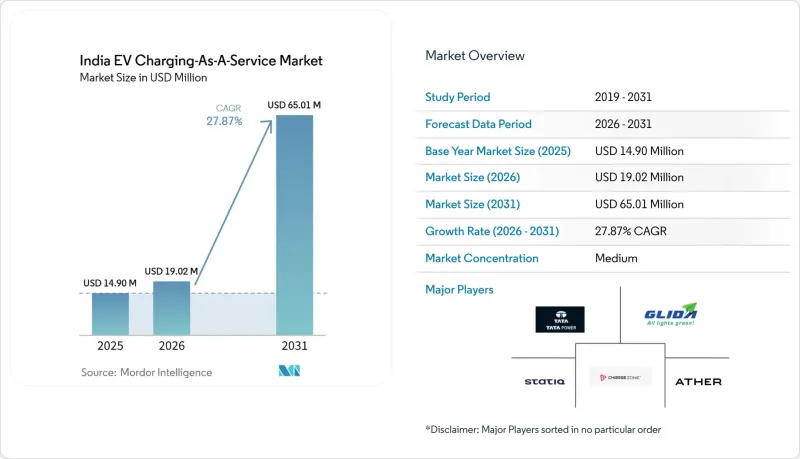
本報告按充電器類型(交流充電器、直流充電器)、輸出功率(1級/交流(小於22千瓦)、2級(22-50千瓦)等)、車隊服務類型(公司用車/車輛共享、配送/物流等)、應用領域(半公共充電設施、公共充電設施)和地區進行分類。市場預測以美元計價。
印度電動車充電即服務 (CaaS) 市場的趨勢與洞見。
電子商務和物流巨頭強制要求其公司車輛實現電氣化。
CAQM指令已將企業承諾轉化為合規要求,加速了印度電動車充電即服務(CaaS)市場的合約成長。 Flipkart計劃投入超過2萬輛電動送貨車,亞馬遜印度計劃投入1萬輛,這清楚地表明了市場對專用充電樁的巨大需求。充電站營運商正在將車輛租賃、充電和軟體整合到訂閱套餐中,從而降低續航里程的擔憂,並最佳化總體擁有成本(TCO)。
延長FAME-II分階段退役期限及國家級資本投資補貼
印度重工業部已將FAME-II獎勵延長至2027年,並推出了「PM E-DRIVE」計劃,撥款200億印度盧比(約2.4億美元)用於中小城市的公共充電樁建設。在馬哈拉斯特拉邦和卡納塔克邦,類似的政策也為硬體設備提供了大量的資本投資補貼。這項獎勵將車輛停車點的充電樁安裝投資回收期縮短至短短幾年。雖然這種雙層支持有助於縮小早期採用充電樁的大都會圈與二線市場之間的獲利能力差距,但營運商仍面臨著補貼支付延遲帶來的融資壓力。
功率超過 50 千瓦的直流充電器初始成本較高。
雖然中等容量的充電樁通常價格更實惠,但高容量充電樁仍然昂貴得多,這給小規模服務供應商的部署帶來了挑戰。雖然政府提供補貼來降低部分硬體成本,但由於核准流程繁瑣以及變壓器升級帶來的額外費用,申請過程往往十分複雜。鑑於這些挑戰,許多業者計劃先投資建造低容量模組,然後隨著情況好轉逐步擴展基礎設施。
細分市場分析
預計到2025年,交流充電器將佔印度電動車充電即服務(CaaS)市場60.13%的佔有率。這主要歸功於其相對較低的硬體成本以及能夠適應車輛夜間運作。 Flipkart的履約中心正在部署交流充電樁,以顯著降低白天的充電成本,並採用與太陽能發電相關的收費系統。這些設施近年來推出,正受到企業園區和中小型物流公司的青睞。
儘管直流快速充電樁成本高昂,但在車輛週轉時間必須控制在30-45分鐘以內的最後一公里配送和共享出行樞紐,直流快速充電樁正迅速普及。 Jio-bp 95%的充電網路已採用直流充電樁,而塔塔電力公司(Tata Power)的新型60-320千瓦EVERTA充電樁也正在主要高速公路沿線安裝,預計到2031年,印度電動車充電即服務(CaaS)市場直流硬體的複合年成長率將達到29.65%。
2 級(22-50 千瓦)適用於停車時間為 4-6 小時的標準樞紐運營,預計到 2025 年將佔印度電動車充電即服務 (CaaS) 市場佔有率的 44.36%。在班加羅爾和海得拉巴,ChargeZone 和 Statiq 正在策略性地整合中中功率充電樁,以滿足 BluSmart 不斷成長的計程車車隊的需求。
預計對功率超過 150 千瓦的高功率充電器(長途卡車和城際巴士的必需品)的需求將以 30.48% 的複合年成長率成長。塔塔汽車計劃沿著黃金四邊形公路定期安裝巨型充電樁,以簡化營運並將電動卡車的充電時間縮短至一小時以內。
其他好處:
- Excel格式的市場預測(ME)表
- 3個月的分析師支持
目錄
第1章:引言
- 市場分析與定義的前提條件
- 分析範圍
第2章 分析方法
第3章執行摘要
第4章 市場狀況
- 市場概覽
- 市場促進因素
- 電子商務和物流巨頭強制要求其公司車輛實現電氣化。
- 延長FAME-II和國家級資本投資補貼的逐步取消期限
- CaaS中心與BSaaS(電池更換即服務)的整合
- 《國家建築標準法》(2025 年草案)中關於電動車相容停車設施的強制規定
- 引入“Bharat電動汽車充電器互通性協議”
- 根據一天中不同時段而變化的可再生能源定價系統降低了充電站的充電成本。
- 市場限制因素
- 功率超過 50 千瓦的直流充電器初始成本較高。
- 二、三線城市配電變壓器容量缺口
- 在收費服務中應用消費稅稅額扣抵的要求仍不明確。
- 公共充電設施的市政土地租賃標準有差異。
- 價值鍊和供應鏈分析
- 監理情勢
- 技術展望
- 波特五力分析
第5章:預測市場規模與成長率
- 充電器類型
- 交流充電器
- 直流充電器
- 依輸出類型
- 1級/交流電(小於22千瓦)
- 2級(22-50度)
- 高速(50-150千瓦)
- 高功率(150千瓦或以上)
- 車隊服務類型
- 公司車輛/車輛共享
- 配送/物流
- 客運車輛(叫車服務、公司計程車)
- 按最終用途
- 半公共充電設施(車輛停車處、園區)
- 公共充電設施(高速公路、都市區中心)
- 按地區(州和聯邦領地)
- 印度(德里、北方邦、旁遮普邦、哈里亞納邦、喜馬偕爾邦、北阿坎德邦、拉賈斯坦邦)
- 印度東北部(阿薩姆邦、阿魯納恰爾邦、曼尼普爾邦、梅加拉亞邦、米佐拉姆邦、那加蘭邦、特里普拉邦、錫金)
- 印度南部(泰米爾納德邦、卡納塔克邦、安得拉邦、特倫甘納邦、喀拉拉邦)
- 印度西部(馬哈拉斯特拉邦、古吉拉突邦、拉賈斯坦邦、果阿邦)
- 印度東部(西孟加拉邦、奧裡薩邦、比哈爾邦、賈坎德邦)
- 印度中部(中央邦和恰蒂斯加爾邦)
- 聯邦直轄區(查謨和克什米爾、拉達克、昌迪加爾、安達曼和尼科巴群島、拉克沙群島、達德拉納加爾哈維利、達曼迪烏、本地治裡)
第6章 競爭情勢
- 市場集中度
- 策略趨勢
- 市佔率分析
- 公司簡介
- Tata Power
- GLIDA(Fortum Charge & Drive India)
- Statiq
- ChargeZone
- Charzer
- Magenta ChargeGrid
- Ather Energy Limited
- Volttic
- Jio-bp pulse
- Convergence Energy Services Ltd(CESL)
第7章 市場機會與未來展望
According to Mordor Intelligence, the India EV charging-As-A-Service market size was valued at USD 14.90 million in 2025 and is estimated to grow from USD 19.02 million in 2026 to reach USD 65.01 million by 2031, growing at a CAGR of 27.87% over 2026-2031.
This report is Segmented by Charger Type (AC Chargers, DC Chargers), Power Output (Level 1/AC (Below 22 KW), Level 2 (22-50 KW), and More), Fleet-Service Type (Company Vehicles and Motor Pools, Delivery and Logistics, and More), End-Use (Semi-Public Charging Setup, Public Charging Setup), and Geography. Market Forecasts are Provided in Terms of Value (USD).
India EV Charging-As-A-Service Market Trends and Insights
Corporate Fleet Electrification Mandates by E-Commerce and Logistics Majors
The CAQM directive converts corporate pledges into compliance requirements, accelerating contract volumes for the India EV Charging-As-A-Service market . Flipkart's 20,000-plus electric delivery vehicles and Amazon India's 10,000-vehicle target illustrate the scale of captive charging demand. Depot operators are bundling vehicle leasing, charging, and software in subscription packages that mitigate range anxiety and optimize total cost of ownership.
FAME-II Phase-Out Extension and State-Level CAPEX Subsidies
The Ministry of Heavy Industries extended FAME-II incentives through 2027 and introduced the PM E-DRIVE program, earmarking INR 2,000 crore (~USD 240 million) for public chargers in smaller cities . In Maharashtra and Karnataka, parallel policies offer significant capital subsidies on hardware. This incentive reduces payback periods for depot installations to a few years. While this dual-layer support helps bridge the viability gap between early-adopter metros and Tier-2 markets, operators face a challenge: disbursement lags that strain their working capital.
High Upfront Cost of Above 50 kW DC Chargers
Charging units with moderate capacity are generally more accessible in terms of cost, whereas higher-capacity chargers remain significantly more expensive, posing challenges for smaller service providers to adopt them. Although subsidies are available to reduce a portion of the hardware costs, the process is often complicated by delays in obtaining necessary approvals and the additional expenses associated with upgrading transformers. These challenges lead many operators to initially invest in lower-capacity modules, with plans to expand their infrastructure gradually as conditions become more favorable.
Other drivers and restraints analyzed in the detailed report include:
- Battery-Swapping-as-a-Service Integration with CaaS Hubs
- Mandatory EV-Ready Parking Provisions in National Building Code (2025 Draft)
- Distribution-Transformer Capacity Gaps in Tier-2/3 Cities
For complete list of drivers and restraints, kindly check the Table Of Contents.
Segment Analysis
AC installations dominated the India EV Charging-As-A-Service market size at 60.13% in 2025, thanks to lower hardware prices and alignment with overnight fleet downtime. Flipkart's fulfillment centers have adopted AC points, leveraging solar-linked tariffs to significantly reduce charging costs during the day. Introduced in recent years, these units have gained popularity among corporate campuses and smaller logistics firms.
DC fast chargers, although more expensive, are scaling quickly in last-mile delivery and ride-hailing depots where vehicle turnaround cannot exceed 30-45 minutes. Jio-bp's network is 95% DC, and Tata Power's new 60-320 kW EVERTA models will anchor highway corridors, helping the India EV Charging-As-A-Service market record a 29.65% CAGR for DC hardware through 2031.
Level 2 (22-50 kW) captured 44.36% of India's EV Charging-As-A-Service market share in 2025 because four- to six-hour dwell times fit standard depot operations. In Bengaluru and Hyderabad, ChargeZone and Statiq have strategically clustered mid-range units to cater to BluSmart's growing taxi fleet.
High-power chargers above 150 kW, necessary for long-haul trucks and inter-city buses, are forecast to rise at a 30.48% CAGR. In a bid to streamline operations, Tata Motors plans to install mega-chargers at regular intervals along the Golden Quadrilateral, reducing electric truck recharge stops to under an hour.
Complete Report Scope:
- By Charger Type
- AC Chargers
- DC Chargers
- By Power Output
- Level 1 / AC (Below 22 kW)
- Level 2 (22 - 50 kW)
- Fast (50 -150 kW)
- High-Power (Above 150 kW)
- By Fleet-Service Type
- Company Vehicles and Motor Pools
- Delivery and Logistics
- Passenger Fleets (Ride-hailing, Corporate Cabs)
- By End-Use
- Semi-Public Charging Setup (Depots, Campuses)
- Public Charging Setup (Highways, Urban Hubs)
- By Geography (States & UTs)
- North India (Delhi, Uttar Pradesh, Punjab, Haryana, Himachal Pradesh, Uttarakhand, and Rajasthan)
- North-East India (Assam, Arunachal Pradesh, Manipur, Meghalaya, Mizoram, Nagaland, Tripura, and Sikkim)
- South India (Tamil Nadu, Karnataka, Andhra Pradesh, Telangana, and Kerala)
- West India (Maharashtra, Gujarat, Rajasthan, and Goa)
- East India (West Bengal, Odisha, Bihar, and Jharkhand)
- Central India (Madhya Pradesh and Chhattisgarh)
- Union Territories (Jammu & Kashmir, Ladakh, Chandigarh, Andaman & Nicobar Islands, Lakshadweep, Dadra & Nagar Haveli, Daman & Diu, and Puducherry)
List of Companies Covered in this Report:
- Tata Power
- GLIDA (Fortum Charge & Drive India)
- Statiq
- ChargeZone
- Charzer
- Magenta ChargeGrid
- Ather Energy Limited
- Volttic
- Jio-bp pulse
- Convergence Energy Services Ltd (CESL)
Additional Benefits:
- The market estimate (ME) sheet in Excel format
- 3 months of analyst support
TABLE OF CONTENTS
1 Introduction
- 1.1 Study Assumptions & Market Definition
- 1.2 Scope of the Study
2 Research Methodology
3 Executive Summary
4 Market Landscape
- 4.1 Market Overview
- 4.2 Market Drivers
- 4.2.1 Corporate Fleet Electrification Mandates by E-Commerce and Logistics Majors
- 4.2.2 FAME-II Phase-Out Extension and State-Level CAPEX Subsidies
- 4.2.3 Battery-Swapping-as-a-Service Integration with CaaS Hubs
- 4.2.4 Mandatory EV-Ready Parking Provisions in National Building Code (2025 Draft)
- 4.2.5 Implementation of Bharat EV Charger Interoperability Protocols
- 4.2.6 Time-of-Day Renewable-Linked Tariffs Lowering Depot Charging Costs
- 4.3 Market Restraints
- 4.3.1 High Upfront Cost of Above 50 kW DC Chargers
- 4.3.2 Distribution-Transformer Capacity Gaps in Tier-2/3 Cities
- 4.3.3 Uncertain GST Input-Tax-Credit Eligibility on Charging Services
- 4.3.4 Fragmented Municipal Land-Lease Norms for Public Chargers
- 4.4 Value / Supply-Chain Analysis
- 4.5 Regulatory Landscape
- 4.6 Technological Outlook
- 4.7 Porter's Five Forces
- 4.7.1 Threat of New Entrants
- 4.7.2 Bargaining Power of Suppliers
- 4.7.3 Bargaining Power of Buyers
- 4.7.4 Threat of Substitutes (Battery Swapping, Home Charging)
- 4.7.5 Competitive Rivalry
5 Market Size & Growth Forecasts (Value, USD)
- 5.1 By Charger Type
- 5.1.1 AC Chargers
- 5.1.2 DC Chargers
- 5.2 By Power Output
- 5.2.1 Level 1 / AC (Below 22 kW)
- 5.2.2 Level 2 (22 - 50 kW)
- 5.2.3 Fast (50 -150 kW)
- 5.2.4 High-Power (Above 150 kW)
- 5.3 By Fleet-Service Type
- 5.3.1 Company Vehicles and Motor Pools
- 5.3.2 Delivery and Logistics
- 5.3.3 Passenger Fleets (Ride-hailing, Corporate Cabs)
- 5.4 By End-Use
- 5.4.1 Semi-Public Charging Setup (Depots, Campuses)
- 5.4.2 Public Charging Setup (Highways, Urban Hubs)
- 5.5 By Geography (States & UTs)
- 5.5.1 North India (Delhi, Uttar Pradesh, Punjab, Haryana, Himachal Pradesh, Uttarakhand, and Rajasthan)
- 5.5.2 North-East India (Assam, Arunachal Pradesh, Manipur, Meghalaya, Mizoram, Nagaland, Tripura, and Sikkim)
- 5.5.3 South India (Tamil Nadu, Karnataka, Andhra Pradesh, Telangana, and Kerala)
- 5.5.4 West India (Maharashtra, Gujarat, Rajasthan, and Goa)
- 5.5.5 East India (West Bengal, Odisha, Bihar, and Jharkhand)
- 5.5.6 Central India (Madhya Pradesh and Chhattisgarh)
- 5.5.7 Union Territories (Jammu & Kashmir, Ladakh, Chandigarh, Andaman & Nicobar Islands, Lakshadweep, Dadra & Nagar Haveli, Daman & Diu, and Puducherry)
6 Competitive Landscape
- 6.1 Market Concentration
- 6.2 Strategic Moves
- 6.3 Market Share Analysis
- 6.4 Company Profiles (Includes Global Level Overview, Market Level Overview, Core Segments, Financials as Available, Strategic Information, Market Rank/Share for Key Companies, Products and Services, SWOT Analysis, and Recent Developments)
- 6.4.1 Tata Power
- 6.4.2 GLIDA (Fortum Charge & Drive India)
- 6.4.3 Statiq
- 6.4.4 ChargeZone
- 6.4.5 Charzer
- 6.4.6 Magenta ChargeGrid
- 6.4.7 Ather Energy Limited
- 6.4.8 Volttic
- 6.4.9 Jio-bp pulse
- 6.4.10 Convergence Energy Services Ltd (CESL)
7 Market Opportunities & Future Outlook

 電動卡車充電基礎設施市場預測至2034年—按充電方式、輸出功率、應用領域、最終用戶和地區分類的全球分析
 電動車兆瓦級充電系統市場:全球市場預測,2026-2032年
 全球電動車多合一整合驅動單元市場規模、佔有率及成長預測(2026-2031 年)
 電動車快速充電系統市場-全球及區域分析:按產品、應用和國家分類-分析與預測(2026-2035年)2026-2041年印度交通繁忙地區卡車充電基礎設施的商機2026-2034年全球電動車快速充電系統市場規模、佔有率、趨勢與成長分析報告
 中國電動車充電即服務(CaaS):市場佔有率分析、產業趨勢與統計、成長預測(2026-2031)
 超級充電樁市場分析及至2035年預測:類型、產品、服務、技術、組件、應用、部署、最終用戶、安裝類型智慧電動車隊基礎設施市場預測至2034年-按基礎設施類型、充電管理技術、能源管理功能、車隊車輛類型、最終用戶和地區分類的全球分析電動車充電管理軟體市場預測至2034年-全球市場分析(按軟體類型、充電基礎設施、部署模式、充電地點、最終用戶和地區分類)