


 |
市場調查報告書
商品編碼
2117392
中國電動車充電即服務(CaaS):市場佔有率分析、產業趨勢與統計、成長預測(2026-2031)China EV Charging-as-a-Service - Market Share Analysis, Industry Trends & Statistics, Growth Forecasts (2026 - 2031) |
||||||

※ 本網頁內容可能與最新版本有所差異。詳細情況請與我們聯繫。
根據 Mordor Intelligence 預測,中國電動車充電即服務 (CaaS) 市場規模預計在 2025 年達到 7,620 萬美元,2026 年達到 9,401 萬美元,到 2031 年達到 2.8701 億美元,在預測期(2026-2031 年)複合年成長率為 25.0%。
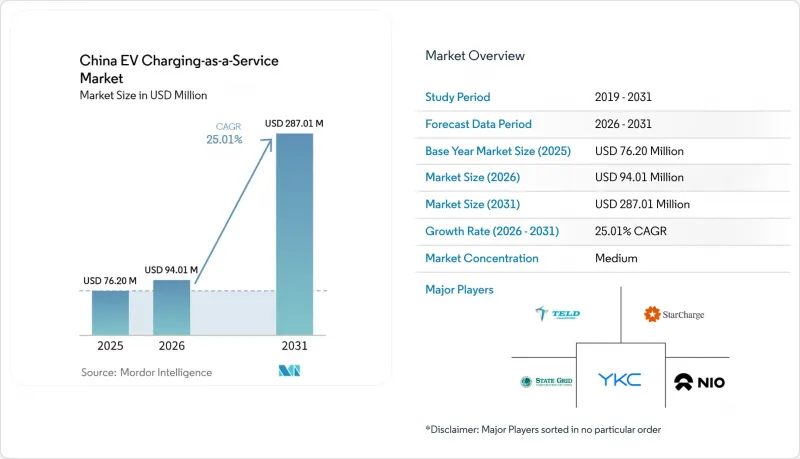
本報告按充電器類型(交流充電器、直流充電器)、車隊服務類型(公司車輛/車輛共享、配送/物流等)、輸出功率(1級/交流(小於22千瓦)、2級(22-50千瓦)等)和最終用途(半公共充電設施、公共充電設施)進行分類。市場預測以美元計價。
中國電動車充電即服務 (CaaS) 市場的趨勢與見解。
政府對充電站直流快速充電提供補貼和優惠價格。
2025年至2027年間,中央政府和省級政府預計將透過一系列項目對充電基礎設施進行大量投資。位於沿海製造地的充電站營運商可獲得資金津貼,以抵銷部分設備和安裝成本。與白天的商業電價相比,離峰時段的電費可大幅降低成本,進而提高高利用率充電站的內部報酬率。符合GB/T標準的全國性互通性法規將透過防止供應商鎖定和擴大潛在車輛基數,進一步提升這些收益。這些獎勵的結合,使得中國的電動車充電即服務(CaaS)市場成為尋求穩定、類似公共產業現金流的基礎設施基金的首選目標。
電子商務當日送達服務的蓬勃發展,使得車輛需要進行夜間充電。
2024年,中國將處理大量小包裹,預計2027年,大部分包裹將實現當日或隔天送達。為了滿足如此緊迫的配送期限,業者擴大選擇在夜間六小時的非尖峰時段更換或充電貨車,而不是依賴白天的公共充電樁。配備高容量充電樁的倉庫直流充電單元可有效率地恢復車輛續航里程。這種高效率使得貨車能夠每天完成多次配送。廣州、上海、武漢和長沙等主要城市正成為超快充電站的樞紐。這主要是因為這些城市除了位置大規模電履約中心外,還擁有都市區配送中心。夜間需求的預期激增不僅保證了服務供應商穩定的收入來源,也增強了中國電動車充電即服務(CaaS)市場的長期前景。
大城市中心區域配電變壓器的壅塞成本
當特大城市局部的電動車密度超過臨界水準時,現有電網將面臨過載挑戰。物流樞紐開發商被迫承擔更換變壓器的成本,並可能面臨漫長的等待核可流程。這些延誤不僅佔用流動資金,還會降低內部報酬率。因此,擁有剩餘容量的郊區地塊在短期內成為更具吸引力的選擇。這套頸部阻礙了中國電動車充電即服務(CaaS)市場的盈利擴張,尤其是在需求旺盛的中心地區。
細分市場分析
預計到2025年,交流充電硬體將佔據中國電動車充電即服務(CaaS)市場54.21%的佔有率。這主要得益於其較低的硬體成本和對電網升級的最小要求。企業車輛停放場的夜間停車時段適合使用7千瓦至40千瓦的充電功率,使業者能夠避開尖峰時段的收費。同時,預計到2031年,直流快充的年成長率將達到26.33%。這一成長趨勢得益於車輛停車場安裝50千瓦至150千瓦的充電設備,從而實現兩班制車輛運作,使貨車充電時間縮短至三小時。比亞迪與TELD和星充合作開發的1兆瓦先導計畫表明,一台高功率充電槍每天可為40至50輛貨車充電,其每平方公尺的收益是交流充電樁的四倍。
在中國電動車充電即服務(CaaS)市場,隨著物流車隊不斷引進採用800V或1000V電壓的新型汽車平臺,直流充電櫃的佔有率也不斷上升。公開數據顯示,到2026年2月,全國平均供電將顯著成長,預示著電力密度將發生重大轉變。儘管交流電在家庭和職場仍佔據主導地位,但直流電的經濟效益正日益吸引配送中心。這一轉變的驅動力是不斷成長的小包裹量和日益嚴格的配送時間要求。
到2025年,企業用車和車輛共享業務將佔總收入的41.33%,這些業務提供穩定的多年期契約,並具有可預測的夜間充電模式。然而,隨著電商巨頭加速推進「當日送達」服務,配送和物流車輛的數量正以27.04%的複合年成長率成長。電動小包裹配送車的能源成本僅為柴油卡車的三分之一,但這僅限於充電站的充電樁能夠在一次充電後提供200公里的續航里程。車輛在特大城市物流園區的集中使用,使服務供應商能夠在單一地點實現規模經濟並提高投資效率。
共享出行車輛介於這兩種極端情況之間,它結合了充電站的直流快充(用於夜間充電)和公共超快充(用於白天充電)。滴滴出行的充電業務部門小聚能源目前已從商用車輛取得大部分電力供應,證實了B2B需求在中國電動車充電即服務(CaaS)市場中扮演核心角色。隨著低排放區的擴大,宅配公司在收入貢獻方面將超越企業車隊,從而鞏固物流作為市場領先應用場景的地位。
其他好處:
- Excel格式的市場預測(ME)表
- 3個月的分析師支持
目錄
第1章:引言
- 市場分析與定義的前提條件
- 分析範圍
第2章 分析方法
第3章執行摘要
第4章 市場狀況
- 市場概覽
- 市場促進因素
- 政府對充電站直流快速充電的補貼和電價優惠
- 電子商務當日送達服務的蓬勃發展,使得送貨車輛需要在夜間充電成為必要。
- PPP資金籌措模式能夠快速部署半公共充電站。
- 都市區低排放區的法規正在加速物流車輛的電氣化。
- 人工智慧驅動的負載平衡平台可降低高峰需求費用
- 電池更換停車位標準化
- 市場限制因素
- 主要城市中心配電變壓器的擁擠成本
- 現貨電力價格波動劇烈,CaaS的利潤率帶來了壓力。
- OEM整合充電網路正在消耗運轉率。
- 物流樞紐倉庫擴建的土地使用限制
- 價值鍊和供應鏈分析
- 監理情勢
- 技術展望
- 波特五力分析
第5章:預測市場規模與成長率
- 充電器類型
- 交流充電器
- 直流充電器
- 車隊服務類型
- 公司車輛/車輛共享
- 配送/物流
- 乘用車車隊
- 依輸出類型
- 1級/交流電(小於22千瓦)
- 2級(22-50度)
- 高速(50-150千瓦)
- 高功率(150千瓦或以上)
- 按最終用途
- 半公共充電設施
- 公共充電設備
第6章 競爭情勢
- 市場集中度
- 策略趨勢
- 市佔率分析
- 公司簡介
- TELD New Energy Co., Ltd.
- StarCharge
- State Grid Corporation of China
- YKC Clean Energy Technologies
- Xiaoju Energy(Xiaoju Charging)
- NIO Power
- XCharge
- Shell Recharge China
- BP Pulse
- Tesla China
- Contemporary Amperex Technology Co. Ltd.(CATL)
- Gotion High-tech
- Xiaomi Auto
- GAC Energy Technology Company Ltd
第7章 市場機會與未來展望
According to Mordor Intelligence, the China EV charging-as-a-Service market was valued at USD 76.20 million in 2025 and estimated to grow from USD 94.01 million in 2026 to reach USD 287.01 million by 2031, at a CAGR of 25.01% during the forecast period (2026-2031).
This report is Segmented by Charger Type (AC Chargers, DC Chargers), Fleet Service Type (Company Vehicle and Motor Pools, Delivery and Logistics, and More), Power Output (Level 1/AC (Below 22 KW), Level 2 (22-50 KW), and More), and End-Use (Semi-Public Charging Setup, Public Charging Setup). Market Forecasts are Provided in Terms of Value (USD).
China EV Charging-as-a-Service Market Trends and Insights
Government Subsidies and Tariff Incentives for Depot DC Fast Charging
Between 2025 and 2027, central and provincial programs are set to invest significantly in charging infrastructure. Depot operators in coastal manufacturing hubs can secure capital grants to offset a portion of their equipment and installation expenses. Off-peak electricity rates offer substantial savings compared to daytime commercial tariffs, enhancing internal rates of return for high-utilization depots. Nationwide interoperability rules, adhering to the GB/T standard, further bolster these returns by preventing vendor lock-in and expanding the potential fleet base. With these combined incentives, the China EV Charging-as-a-Service market is emerging as a prime target for infrastructure funds seeking stable, utility-like cash flows .
E-Commerce Same-Day Delivery Boom Requiring Overnight Fleet Charging
In 2024, China processed a significant volume of parcels, with projections indicating that by 2027, a majority of these will be delivered the same or next day. To meet these tight delivery deadlines, operators are increasingly opting to swap or recharge their vans during the six-hour night shift lull, rather than depending on public chargers during the day. Depot DC units, offering high charging capacities, can replenish vehicle ranges efficiently. This efficiency allows trucks to be available for multiple delivery waves each day. Major cities like Guangzhou, Shanghai, Wuhan, and Changsha are emerging as hotspots for ultra-fast charging sites, largely because they house large e-commerce fulfillment centers alongside urban depots. This predictable surge in overnight demand not only guarantees a steady revenue stream for service providers but also strengthens the long-term prospects of China's EV Charging-as-a-Service market.
Distribution Transformer Congestion Costs in Tier-1 Urban Cores
As localized EV density in megacities surpasses critical thresholds, legacy grids face overload challenges. Depot developers are compelled to finance transformer replacements and grapple with approval waits that can extend for significant periods. Such delays not only tie up working capital but also diminish internal rates of return. Consequently, suburban plots boasting spare capacity emerge as a more appealing option in the short term. This bottleneck curtails the immediate expansion of China's EV Charging-as-a-Service market, particularly in its most lucrative demand centers.
Other drivers and restraints analyzed in the detailed report include:
- PPP Financing Models Enabling Rapid Semi-Public Charger Rollout
- Urban Low-Emission-Zone Mandates Accelerating Logistics Fleet Electrification
- Volatile Spot Electricity Prices Eroding CaaS Profit Margins
For complete list of drivers and restraints, kindly check the Table Of Contents.
Segment Analysis
AC hardware owned 54.21% of the China EV Charging-as-a-Service market in 2025, thanks to low hardware costs and minimal grid-upgrade requirements. Overnight dwell times in company motor pools align with 7 kW-40 kW charge rates, helping operators sidestep peak-demand tariffs. DC fast chargers, however, are projected to expand at 26.33% through 2031. That trajectory is anchored in 50 kW-150 kW depot installs that turn vans around in under three hours, unlocking double-shift vehicle utilization. BYD's 1 MW pilot, rolled out with TELD and Star Charge, shows how a single ultra-high-power gun can service 40-50 vans per day, quadrupling revenue per square meter versus AC bays.
The China EV Charging-as-a-Service market share of DC cabinets rises each time logistics fleets add a new wave of 800-V or 1,000-V vehicle platforms. Public data reveals that the nationwide average delivered power experienced a notable increase by February 2026, highlighting a significant shift in power density. While AC continues to dominate in homes and workplaces, the economics of depots are increasingly favoring DC. This shift is driven by rising parcel volumes and tightening delivery windows.
Company vehicle and motor pools generated 41.33% of 2025 revenue, offering stable, multi-year contracts with predictable overnight charging patterns. Yet delivery and logistics fleets are growing at a 27.04% CAGR as e-commerce giants accelerate same-day guarantees. Electrified parcel vans boast energy costs one-third those of diesel trucks, but only if depot chargers can deliver 200 km of range within a single shift break. Fleet concentration in mega-city logistics parks gives service providers scale at a single site, amplifying investment efficiency.
Ride-hailing fleets sit between the two poles, blending depot DC fast charging for overnight top-ups with public ultra-fast sessions during the day. Xiaoju Energy, Didi's charging arm, already derives a major share of its electricity volume from commercial fleets, validating the centrality of B2B demand to the China EV Charging-as-a-Service market. As low-emission zones proliferate, parcel operators will overtake corporate pools in revenue contribution, cementing logistics as the market's defining use-case.
Complete Report Scope:
- By Charger Type
- AC Chargers
- DC Chargers
- By Fleet Service Type
- Company Vehicle and Motor Pools
- Delivery and Logistics
- Passenger Fleets
- By Power Output
- Level 1 / AC (Below 22 kW)
- Level 2 (22 - 50 kW)
- Fast (50 - 150 kW)
- High-Power (Above 150 kW)
- By End-Use
- Semi-Public Charging Setup
- Public Charging Setup
List of Companies Covered in this Report:
- TELD New Energy Co., Ltd.
- StarCharge
- State Grid Corporation of China
- YKC Clean Energy Technologies
- Xiaoju Energy (Xiaoju Charging)
- NIO Power
- XCharge
- Shell Recharge China
- BP Pulse
- Tesla China
- Contemporary Amperex Technology Co. Ltd. (CATL)
- Gotion High-tech
- Xiaomi Auto
- GAC Energy Technology Company Ltd
Additional Benefits:
- The market estimate (ME) sheet in Excel format
- 3 months of analyst support
TABLE OF CONTENTS
1 Introduction
- 1.1 Study Assumptions & Market Definition
- 1.2 Scope of the Study
2 Research Methodology
3 Executive Summary
4 Market Landscape
- 4.1 Market Overview
- 4.2 Market Drivers
- 4.2.1 Government Subsidies and Tariff Incentives for Depot DC Fast Charging
- 4.2.2 E-Commerce Same-Day Delivery Boom Requiring Overnight Fleet Charging
- 4.2.3 PPP Financing Models Enabling Rapid Semi-Public Charger Rollout
- 4.2.4 Urban Low-Emission-Zone Mandates Accelerating Logistics Fleet Electrification
- 4.2.5 AI-Based Load Balancing Platforms Reducing Peak Demand Charges
- 4.2.6 Standardization of Battery-Swap-Ready Parking Bays
- 4.3 Market Restraints
- 4.3.1 Distribution Transformer Congestion Costs in Tier-1 Urban Cores
- 4.3.2 Volatile Spot Electricity Prices Eroding CaaS Profit Margins
- 4.3.3 OEM-Integrated Charging Networks Cannibalizing Utilization Rates
- 4.3.4 Land-Use Restrictions on Depot Expansion in Logistics Hubs
- 4.4 Value / Supply-Chain Analysis
- 4.5 Regulatory Landscape
- 4.6 Technological Outlook
- 4.7 Porter's Five Forces
- 4.7.1 Threat of New Entrants
- 4.7.2 Bargaining Power of Buyers
- 4.7.3 Bargaining Power of Suppliers
- 4.7.4 Threat of Substitutes
- 4.7.5 Competitive Rivalry
5 Market Size & Growth Forecasts (Value, USD)
- 5.1 By Charger Type
- 5.1.1 AC Chargers
- 5.1.2 DC Chargers
- 5.2 By Fleet Service Type
- 5.2.1 Company Vehicle and Motor Pools
- 5.2.2 Delivery and Logistics
- 5.2.3 Passenger Fleets
- 5.3 By Power Output
- 5.3.1 Level 1 / AC (Below 22 kW)
- 5.3.2 Level 2 (22 - 50 kW)
- 5.3.3 Fast (50 - 150 kW)
- 5.3.4 High-Power (Above 150 kW)
- 5.4 By End-Use
- 5.4.1 Semi-Public Charging Setup
- 5.4.2 Public Charging Setup
6 Competitive Landscape
- 6.1 Market Concentration
- 6.2 Strategic Moves
- 6.3 Market Share Analysis
- 6.4 Company Profiles (Includes Global Level Overview, Market Level Overview, Core Segments, Financials as Available, Strategic Information, Market Rank/Share for Key Companies, Products and Services, SWOT Analysis, and Recent Developments)
- 6.4.1 TELD New Energy Co., Ltd.
- 6.4.2 StarCharge
- 6.4.3 State Grid Corporation of China
- 6.4.4 YKC Clean Energy Technologies
- 6.4.5 Xiaoju Energy (Xiaoju Charging)
- 6.4.6 NIO Power
- 6.4.7 XCharge
- 6.4.8 Shell Recharge China
- 6.4.9 BP Pulse
- 6.4.10 Tesla China
- 6.4.11 Contemporary Amperex Technology Co. Ltd. (CATL)
- 6.4.12 Gotion High-tech
- 6.4.13 Xiaomi Auto
- 6.4.14 GAC Energy Technology Company Ltd
7 Market Opportunities & Future Outlook

 電動卡車充電基礎設施市場預測至2034年—按充電方式、輸出功率、應用領域、最終用戶和地區分類的全球分析
 電動車兆瓦級充電系統市場:全球市場預測,2026-2032年
 全球電動車多合一整合驅動單元市場規模、佔有率及成長預測(2026-2031 年)
 電動車快速充電系統市場-全球及區域分析:按產品、應用和國家分類-分析與預測(2026-2035年)2026-2041年印度交通繁忙地區卡車充電基礎設施的商機2026-2034年全球電動車快速充電系統市場規模、佔有率、趨勢與成長分析報告
 印度電動車充電即服務 (CaaS):市場佔有率分析、產業趨勢與統計、成長預測 (2026-2031)
 超級充電樁市場分析及至2035年預測:類型、產品、服務、技術、組件、應用、部署、最終用戶、安裝類型智慧電動車隊基礎設施市場預測至2034年-按基礎設施類型、充電管理技術、能源管理功能、車隊車輛類型、最終用戶和地區分類的全球分析電動車充電管理軟體市場預測至2034年-全球市場分析(按軟體類型、充電基礎設施、部署模式、充電地點、最終用戶和地區分類)