


 |
市場調查報告書
商品編碼
2117362
汽車OTA(空中下載)技術更新:市場佔有率分析、行業趨勢與統計數據、成長預測(2026-2031年)Automotive Over-the-Air Updates - Market Share Analysis, Industry Trends & Statistics, Growth Forecasts (2026 - 2031) |
||||||

※ 本網頁內容可能與最新版本有所差異。詳細情況請與我們聯繫。
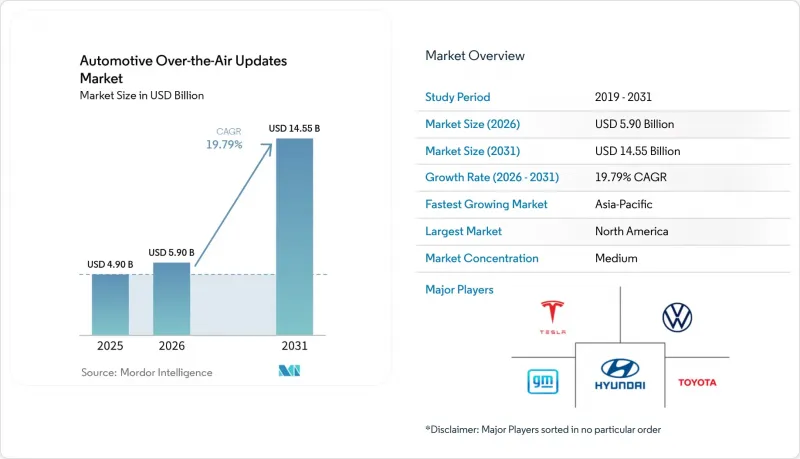
據 Mordor Intelligence 稱,2025 年汽車空中下載 (OTA) 更新市場價值 49 億美元,預計 2026 年將達到 59 億美元,並預計從 2026 年到 2031 年將以 19.79% 的複合年成長率成長,到 2031 年將達到 145.5 億美元。
本報告按技術(SOTA、FOTA)、應用(電控系統(ECU)、資訊娛樂系統等)、驅動系統(內燃機 (ICE)、電動車)、車輛類型、通訊方式和地區進行細分。市場預測以美元 (USD) 為單位。
全球汽車OTA(空中下載)市場趨勢及洞察
電氣化和SDV架構需要頻繁更新。
電池式電動車依靠複雜的軟體來管理能量使用、熱特性和再生煞車。特斯拉在2025年初推出的續航里程調整更新表明,無需硬體變更,即可透過售後韌體更新解決消費者的擔憂。網域控制器拓撲結構取代了數十個獨立的電控系統(ECU),簡化了檢驗,縮短了測試週期,並實現了每週發布新版本。大眾汽車於2026年推出的區域架構減輕了線束重量,降低了組件成本,並加快了整合速度。採用虛擬化工具的汽車製造商表示,由於軟體和硬體開發並行進行,開發週期得以縮短。這帶來了更快的功能交付、更高的客戶維繫和更多的訂閱收入。
聯網汽車和車載資訊科技的廣泛應用。
車載資訊控制單元作為蜂窩網路、Wi-Fi 和衛星數據的閘道器,預計到 2025 年將佔據應用收入的相當大一部分。沃爾沃卡車計劃在 2025 年每天進行約 10,000 次更新,從而減少意外維護,並在六個月內將其全球車隊的 80% 統一到單一軟體基準。 eSIM 技術使汽車製造商能夠動態地與營運商協商合約條款,從而在競爭激烈的市場中顯著降低韌體分發成本。配備Google原生資訊娛樂平台的乘用車需要與智慧型手機生態系統保持同步,因此需要提高基準更新頻率。隨著連接費用的持續下降,將能夠提供更全面的服務包,涵蓋導航更新、診斷、車載商務等更多功能。
傳統ECU架構和碎片化的軟體棧
許多2020年之前生產的車輛都配備了超過100個電控系統(ECU),這些ECU透過CAN或LIN總線進行通訊,每個ECU運行著自己的代碼。要實現全面的遠端更新,需要對數千種軟體組合進行徹底的整合測試,這個過程可能需要數月時間。 eSync聯盟正在推廣標準化的打包和Delta更新格式以減少有效載荷的大小,但這些格式的採用仍然是自願的。大眾汽車的內部部門Cariad在嘗試統一異質平台時遇到了數年的延誤,最終不得不採取分階段的控制器升級方式。因此,舊款車型通常將OTA更新限制在資訊娛樂模組上,錯失了提升安全性和排放氣體的機會。
細分市場分析
韌體分發如今已擴展到車輛更深層的組件,而此前空中升級(OTA)被認為是不可能的。隨著動力傳動系統、電池和底盤控制器向集中式架構發展,簡化了檢驗,汽車OTA(空中升級)市場預計將以22.74%的複合年成長率成長。汽車製造商正受益於延長組件壽命的現場校準,例如透過微調溫度控管來提高快速充電的耐久性。
軟體OTA更新對於資訊娛樂和導航仍然至關重要,由於消費者期望,許多更新將免費提供,預計到2025年,OTA更新將佔收入佔有率的68.14%。由於這兩種途徑並存,製造商需要維護兩條工具鏈:一條用於安全關鍵的核准流程,另一條則針對使用者體驗的快速改進進行了最佳化。隨著容器化的成熟,韌體模組可能會採用部分虛擬化,進一步模糊這兩種方法之間的界線。開發人員正專注於Delta文件打包和分階段部署,摒棄單體鏡像,以降低通訊成本和停機時間。自動駕駛功能堆疊就是這種融合的典型例子,其感知演算法每週更新,而執行器韌體則遵循季度更新周期。
車載資訊服務閘道作為資料傳輸路徑,在2025年佔據應用收入的最大佔有率,達36.25%。安全更新目前以21.34%的複合年成長率位居榜首,因為監管機構要求迅速修復潛在風險。隨著網路安全事件揭露義務日益嚴格,受安全修補程式驅動的汽車OTA(空中下載)更新市場佔有率預計將在2031年之前大幅成長。遠端診斷正在展現全天候系統的經濟價值,因為車隊管理人員可以應用預測分析來減少停機時間。資訊娛樂系統更新的交易量仍然很高,但由於消費者期望地圖資料更新免費,因此每次更新的平均收入並不高。
原始設備製造商 (OEM) 正在將入侵偵測代理程式整合到其閘道器中,並將資訊提供給雲端控制面板,該控制面板可在數小時內識別異常情況並觸發針對性修補程式。一家汽車製造商與網路安全專家成立的合資企業旨在將 ISO 24089檢驗流程投入實際應用,確保為型式認證機構提供隨時可用的稽核證據。未來,安全性和便利性將融為一體,駕駛監控演算法的更新頻率將與歌單策展人的更新頻率一樣高。
區域分析
預計到2025年,北美將佔全球市場佔有率的44.12%。這主要得益於特斯拉垂直整合的軟體架構,以及福特、通用汽車和Stellantis等公司推出的訂閱服務。目前正在美國國會審議的《汽車資料隱私和自動駕駛法案》將正式設定資料外洩報告的截止日期,雖然會增加合規相關支出,但也能更好地保護消費者。在加拿大,行動電話覆蓋不均加速了衛星通訊的早期測試,Subaru正與Starlink合作,為偏遠省份提供地圖更新服務。美國聯邦通訊委員會(FCC)將於2024年最終確定Cellular-V2X的頻段,並支持走廊式試點項目,在這些項目中,基礎設施會在經過車輛時向車輛傳輸最新的即時資訊。日益激烈的競爭促使國內半導體供應商在新推出的車載資訊系統晶片組中優先考慮汽車安全功能。
亞太地區預計在2026年至2031年間將維持20.15%的複合年成長率,這主要得益於中國電動車的快速普及以及蔚來、小鵬和比亞迪等廠商每週的新品發布速度。中國的GB 44495-2024標準將安全更新功能納入所有新車的型式認證,確保國有和民營品牌都能統一採用此標準。日本的「行動出行DX平台」正在推廣通用API,但主要專注於國內應用場景;韓國則正利用其全國性的5G網路建設,試圖成為一級硬體中心。印度的AIS 189和AIS 190標準強制要求部署安全更新系統,國內汽車製造商正與雲端超大規模資料中心業者雲端服務商合作,託管區域邊緣節點以降低頻寬成本。兩輪電動車數量的不斷成長也對輕量級更新機制提出了更高的要求,預計相關領域的應用也將隨之擴展。
儘管歐洲的法規結構十分嚴格,但舊有系統卻阻礙了發展進程。聯合國歐洲經濟委員會WP.29號工作小組的法規已經實施,但老牌製造商仍面臨線路和供應商網路老化的挑戰。大眾汽車優先考慮供應鏈的準備工作,率先在中國採用基於區域的架構,領先歐洲。歐盟的《網路彈性法案》要求品牌對安全代碼不足承擔責任,並鼓勵穿透測試和持續監控。衛星供應商將北極運輸走廊視為展示非地面電波通訊可靠性的良機。南美洲、中東和非洲雖然市場規模較小,但也正在利用混合連接來彌補遠端通訊覆蓋的不足。巴西監管機構正在推廣國內雲端託管,以降低跨境資料通訊成本;海灣國家電動車的日益普及,也促使人們青睞具有區域最佳化功能的優質OTA服務。在澳洲和南非,礦業公司正在為其大型卡車引入基於衛星的遠端資訊處理系統,以確保無線校準,從而獲得自動駕駛認證。
其他好處:
- Excel格式的市場預測(ME)表
- 3個月的分析師支持
目錄
第1章:引言
- 市場分析與定義的前提條件
- 分析範圍
第2章 分析方法
第3章執行摘要
第4章 市場狀況
- 市場概覽
- 市場促進因素
- 電氣化和SDV架構需要頻繁更新
- 聯網汽車和車載資訊科技的日益普及。
- 監管工作涉及安全、召回和網路安全合規性
- OEM廠商的「功能即服務」貨幣化模式
- 透過衛星向偏遠地區提供OTA傳輸服務
- 利用電動車充電站進行 OTA(空中下載)服務的非道路部署,可以降低行動電話通訊成本。
- 市場限制因素
- 傳統ECU架構和分散的軟體棧
- 網路安全和資料隱私漏洞
- 新興市場後端雲端的高頻寬成本
- 多品牌認證標準更新延遲
- 價值鍊和供應鏈分析
- 監理情勢
- 技術展望
- 波特五力分析
- 目前網路安全狀況
第5章:預測市場規模與成長率
- 透過技術
- SOTA (Software Over-The-Air Technology)
- FOTA (Firmware Over-The-Air Technology)
- 透過使用
- 電控系統(ECU)
- 資訊娛樂
- 安全保障
- 車載資訊控制單元(TCU)
- 其他
- 透過驅動系統
- 內燃機(ICE)
- 電動車
- 電池式電動車(BEV)
- 混合動力汽車(HEV)
- 插電式混合動力汽車(PHEV)
- 按車輛類型
- 搭乘用車
- 輕型商用車
- 大型商用車輛
- 透過溝通方式
- 行動電話(3G、4G LTE、5G)
- Wi-Fi
- 衛星
- DSRC (Dedicated Short-Range Communication)
- V2X (Vehicle-to-Everything)
- 按地區
- 北美洲
- 美國
- 加拿大
- 其他北美國家
- 南美洲
- 巴西
- 阿根廷
- 其他南美國家
- 歐洲
- 德國
- 英國
- 法國
- 義大利
- 西班牙
- 其他歐洲國家
- 亞太地區
- 中國
- 日本
- 印度
- 韓國
- 其他亞太國家
- 中東和非洲
- 沙烏地阿拉伯
- 阿拉伯聯合大公國
- 土耳其
- 南非
- 其他中東和非洲國家
- 北美洲
第6章 競爭情勢
- 市場集中度
- 策略趨勢
- 市佔率分析
- 公司簡介
- Tesla, Inc.
- Volkswagen AG
- General Motors Co.
- Hyundai Motor Company
- Toyota Motor Corp.
- BMW AG
- Mercedes-Benz Group AG
- Ford Motor Co.
- Stellantis NV
- Volvo Car Corp.
- Renault Group
- Nissan Motor Co., Ltd.
- SAIC Motor Corp.
- Geely Automobile Holdings
- Continental AG
- Robert Bosch GmbH
- Harman International
- Aptiv PLC
- Sibros Technologies Inc.
- Sonatus Inc.
- Excelfore Corp.
- Wind River Systems
- NXP Semiconductors NV
第7章 市場機會與未來展望
According to Mordor Intelligence, the automotive over-the-air updates market size was valued at USD 4.90 billion in 2025, is estimated at USD 5.90 billion in 2026, and is forecast to reach USD 14.55 billion by 2031 at a 19.79% CAGR over 2026-2031.
This report is Segmented by Technology (Software Over-The-Air Technology (SOTA), Firmware Over-The-Air Technology (FOTA)), Application (Electronic Control Unit (ECU), Infotainment, and More), Propulsion (Internal Combustion Engine (ICE), Electric Vehicle), Vehicle Type, Communication Type, and Geography. Market Forecasts are Provided in Value (USD).
Global Automotive Over-the-Air Updates Market Trends and Insights
Electrification and SDV Architectures Demanding Frequent Updates
Battery electric vehicles rely on sophisticated software to manage energy use, thermal behavior, and regenerative braking. Tesla's early 2025 range-recalibration update illustrated how post-sale firmware can resolve consumer concerns without hardware modification . Domain-controller topologies that replace dozens of discrete electronic control units streamline validation, shorten test cycles, and enable weekly release cadences. Volkswagen's zonal architecture rollout in 2026 reduced wiring harness weight, lowering bill-of-materials cost while supporting faster integration. Automakers adopting virtualization tools report shorter development programs because software and hardware tasks progress in parallel. The cumulative effect is higher feature velocity, which strengthens customer retention and supports subscription revenue.
Widespread Connected-Car and Telematics Penetration
Telematics control units act as gateways for cellular, Wi-Fi, and satellite data, holding a notable share of 2025 application revenue. Volvo Trucks delivered about 10,000 updates per day in 2025, cutting unplanned maintenance and bringing 80% of its global fleet to the same software baseline within six months . eSIM technology empowers automakers to dynamically negotiate carrier terms, significantly reducing firmware push costs in competitive markets. Passenger vehicles featuring native Google infotainment platforms are required to keep pace with smartphone ecosystems, leading to an increased baseline update frequency. As connectivity tariffs continue to decline, it paves the way for more extensive service bundles, encompassing navigation refreshes, diagnostics, and in-car commerce.
Legacy ECU Architectures and Fragmented Software Stacks
Many vehicles built before 2020 contain over 100 electronic control units that communicate via CAN or LIN buses, each running proprietary code. Comprehensive remote update coverage would require exhaustive integration testing across thousands of software combinations, a process that can take months. The eSync Alliance is promoting standardized packaging and delta-update formats that reduce payload size, yet adoption remains voluntary. Volkswagen's internal Cariad unit encountered multi-year delays while attempting to unify disparate platforms, ultimately moving to incremental controller upgrades. As a result, legacy fleets often restrict OTA to infotainment modules, forfeiting opportunities for safety or emissions improvements.
Other drivers and restraints analyzed in the detailed report include:
- Regulatory Push on Safety-Recall and Cyber-Security Compliance
- Feature-as-a-Service Monetization Models for OEMs
- Cyber-Security and Data-Privacy Vulnerabilities
For complete list of drivers and restraints, kindly check the Table Of Contents.
Segment Analysis
Firmware deliveries reached deeper vehicle layers once considered untouchable through wireless means. The automotive over-the-air updates market size for firmware is projected to register a 22.74% CAGR because powertrain, battery, and chassis controllers shift to centralized architectures that simplify validation. Automakers benefit from field calibrations that extend component life, such as thermal-management tweaks that improve fast-charging durability.
Software over-the-air remains essential for infotainment and navigation, and held 68.14% revenue share in 2025 as consumer expectations make many updates free. The coexistence of both pathways obliges manufacturers to maintain two toolchains: one with safety-critical sign-off gates and another tuned for rapid user-experience enhancements. As containerization matures, firmware modules may adopt partial virtualization, further blurring lines between the two methods. Developers emphasize delta-file packaging and staged rollouts, moving away from monolithic images to reduce cellular cost and downtime. Autonomous-driving feature stacks exemplify the converging paths, where perception algorithms update weekly while actuator firmware follows a quarterly rhythm.
Telematics gateways generated the largest 36.25% slice of 2025 application revenue, reflecting their role as data conduits. Safety and security updates now show the fastest 21.34% CAGR because regulators demand prompt remediation of potential hazards. The automotive over-the-air updates market share attributable to safety patches is set to climb sharply through 2031 as cyber-incident disclosure obligations tighten. Remote diagnostics let fleet managers apply predictive analytics that cut downtime, proving the economic value of always-connected systems. Infotainment updates maintain high transaction counts, yet average revenue per event is modest because consumers expect map refreshes at no cost.
OEMs integrate intrusion-detection agents inside gateways, feeding cloud dashboards that can isolate anomalies and trigger targeted patching within hours. Joint ventures between automakers and cybersecurity specialists aim to operationalize ISO 24089 validation flows, ensuring audit-ready evidence for type-approval authorities. Over time, safety and convenience domains will converge, with driver-monitoring algorithms updating as frequently as playlist curators.
Complete Report Scope:
- By Technology
- Software Over-The-Air Technology (SOTA)
- Firmware Over-The-Air Technology (FOTA)
- By Application
- Electronic Control Unit (ECU)
- Infotainment
- Safety and Security
- Telematics Control Unit (TCU)
- Others
- By Propulsion
- Internal Combustion Engine (ICE)
- Electric Vehicle
- Battery Electric Vehicle (BEV)
- Hybrid Electric Vehicle (HEV)
- Plug-In Hybrid Electric Vehicle (PHEV)
- By Vehicle Type
- Passenger Car
- Light Commercial Vehicle
- Heavy Commercial Vehicle
- By Communication Type
- Cellular (3G, 4G LTE, 5G)
- Wi-Fi
- Satellite
- Dedicated Short-Range Communication (DSRC)
- Vehicle-to-Everything (V2X)
- By Geography
- North America
- United States
- Canada
- Rest of North America
- South America
- Brazil
- Argentina
- Rest of South America
- Europe
- Germany
- United Kingdom
- France
- Italy
- Spain
- Rest of Europe
- Asia-Pacific
- China
- Japan
- India
- South Korea
- Rest of Asia-Pacific
- Middle East and Africa
- Saudi Arabia
- United Arab Emirates
- Turkey
- South Africa
- Rest of Middle East and Africa
- North America
Geography Analysis
North America accounted for 44.12% of the 2025 market value, anchored by Tesla's vertically integrated software stack and by subscription rollouts from Ford, General Motors, and Stellantis. The U.S. Auto Data Privacy and Autonomy Act under debate in Congress would formalize breach-reporting timelines, raising compliance expenditure yet protecting consumers . Canada's patchy cellular coverage is spurring early satellite trials, with Subaru partnering with Starlink for map updates in remote provinces. The FCC finalized Cellular-V2X spectrum in 2024, supporting corridor pilots where infrastructure pushes micro updates to passing vehicles. Competitive tension encourages domestic semiconductor suppliers to prioritize automotive cybersecurity features in new telematics chipsets.
Asia-Pacific is projected to post a 20.15% CAGR during 2026-2031, driven by China's rapid EV penetration and weekly release cadences at NIO, XPeng, and BYD. China's GB 44495-2024 embeds secure update capability into all new vehicle approvals, ensuring uniform adoption by both state-owned and private brands. Japan's Mobility DX Platform promotes common APIs but focuses on domestic use cases, while South Korea leverages national 5G buildout to position itself as a tier-1 hardware hub. India's AIS 189 and AIS 190 make secure update systems mandatory, and domestic automakers cooperate with cloud hyperscalers to host regional edge nodes that cut bandwidth cost. Growing two-wheel EV fleets also demand lightweight update mechanisms, opening adjacent segments.
Europe's regulatory framework is stringent, but legacy systems slow progress. UNECE WP.29 regulations are in place, yet historic manufacturers face challenges with outdated wiring and supplier networks. Volkswagen prioritized supply-chain readiness by introducing zonal architecture in China before Europe. The EU's Cyber Resilience Act will enforce accountability for insecure code, driving brands to adopt penetration testing and continuous monitoring. Satellite providers view Arctic transport corridors as opportunities to showcase non-terrestrial reliability. South America, the Middle East, and Africa, though smaller in market value, leverage hybrid connectivity to address remote coverage gaps. Brazilian regulators promote domestic cloud hosting to reduce cross-border data costs, while the Gulf states' growing EV adoption supports premium OTA services with localized features. In Australia and South Africa, mining companies use satellite-backed telematics in heavy trucks, ensuring over-the-air calibrations for autonomous haulage certifications.
- Tesla, Inc.
- Volkswagen AG
- General Motors Co.
- Hyundai Motor Company
- Toyota Motor Corp.
- BMW AG
- Mercedes-Benz Group AG
- Ford Motor Co.
- Stellantis N.V.
- Volvo Car Corp.
- Renault Group
- Nissan Motor Co., Ltd.
- SAIC Motor Corp.
- Geely Automobile Holdings
- Continental AG
- Robert Bosch GmbH
- Harman International
- Aptiv PLC
- Sibros Technologies Inc.
- Sonatus Inc.
- Excelfore Corp.
- Wind River Systems
- NXP Semiconductors N.V.
Additional Benefits:
- The market estimate (ME) sheet in Excel format
- 3 months of analyst support
TABLE OF CONTENTS
1 Introduction
- 1.1 Study Assumptions and Market Definition
- 1.2 Scope of the Study
2 Research Methodology
3 Executive Summary
4 Market Landscape
- 4.1 Market Overview
- 4.2 Market Drivers
- 4.2.1 Electrification and SDV Architectures Demanding Frequent Updates
- 4.2.2 Widespread Connected-Car and Telematics Penetration
- 4.2.3 Regulatory Push on Safety-Recall and Cyber-Security Compliance
- 4.2.4 Feature-as-a-Service Monetization Models for OEMs
- 4.2.5 Satellite-Enabled Coverage for Remote OTA Delivery
- 4.2.6 OTA Off-Load via EV-Charging Hubs Lowers Cellular Costs
- 4.3 Market Restraints
- 4.3.1 Legacy ECU Architectures and Fragmented Software Stacks
- 4.3.2 Cyber-Security and Data-Privacy Vulnerabilities
- 4.3.3 High Backend-Cloud Bandwidth Cost in Emerging Markets
- 4.3.4 Slow Multi-Brand Certification of Update Standards
- 4.4 Value / Supply-Chain Analysis
- 4.5 Regulatory Landscape
- 4.6 Technological Outlook
- 4.7 Porter's Five Forces Analysis
- 4.7.1 Bargaining Power of Suppliers
- 4.7.2 Bargaining Power of Buyers
- 4.7.3 Threat of New Entrants
- 4.7.4 Threat of Substitutes
- 4.7.5 Intensity of Competitive Rivalry
- 4.8 Cyber-Security Landscape
5 Market Size and Growth Forecasts
- 5.1 By Technology
- 5.1.1 Software Over-The-Air Technology (SOTA)
- 5.1.2 Firmware Over-The-Air Technology (FOTA)
- 5.2 By Application
- 5.2.1 Electronic Control Unit (ECU)
- 5.2.2 Infotainment
- 5.2.3 Safety and Security
- 5.2.4 Telematics Control Unit (TCU)
- 5.2.5 Others
- 5.3 By Propulsion
- 5.3.1 Internal Combustion Engine (ICE)
- 5.3.2 Electric Vehicle
- 5.3.2.1 Battery Electric Vehicle (BEV)
- 5.3.2.2 Hybrid Electric Vehicle (HEV)
- 5.3.2.3 Plug-In Hybrid Electric Vehicle (PHEV)
- 5.4 By Vehicle Type
- 5.4.1 Passenger Car
- 5.4.2 Light Commercial Vehicle
- 5.4.3 Heavy Commercial Vehicle
- 5.5 By Communication Type
- 5.5.1 Cellular (3G, 4G LTE, 5G)
- 5.5.2 Wi-Fi
- 5.5.3 Satellite
- 5.5.4 Dedicated Short-Range Communication (DSRC)
- 5.5.5 Vehicle-to-Everything (V2X)
- 5.6 By Geography
- 5.6.1 North America
- 5.6.1.1 United States
- 5.6.1.2 Canada
- 5.6.1.3 Rest of North America
- 5.6.2 South America
- 5.6.2.1 Brazil
- 5.6.2.2 Argentina
- 5.6.2.3 Rest of South America
- 5.6.3 Europe
- 5.6.3.1 Germany
- 5.6.3.2 United Kingdom
- 5.6.3.3 France
- 5.6.3.4 Italy
- 5.6.3.5 Spain
- 5.6.3.6 Rest of Europe
- 5.6.4 Asia-Pacific
- 5.6.4.1 China
- 5.6.4.2 Japan
- 5.6.4.3 India
- 5.6.4.4 South Korea
- 5.6.4.5 Rest of Asia-Pacific
- 5.6.5 Middle East and Africa
- 5.6.5.1 Saudi Arabia
- 5.6.5.2 United Arab Emirates
- 5.6.5.3 Turkey
- 5.6.5.4 South Africa
- 5.6.5.5 Rest of Middle East and Africa
- 5.6.1 North America
6 Competitive Landscape
- 6.1 Market Concentration
- 6.2 Strategic Moves
- 6.3 Market Share Analysis
- 6.4 Company Profiles (includes Global Level Overview, Market Level Overview, Core Segments, Financials as Available, Strategic Information, Market Rank/Share for Key Companies, Products and Services, SWOT Analysis, and Recent Developments)
- 6.4.1 Tesla, Inc.
- 6.4.2 Volkswagen AG
- 6.4.3 General Motors Co.
- 6.4.4 Hyundai Motor Company
- 6.4.5 Toyota Motor Corp.
- 6.4.6 BMW AG
- 6.4.7 Mercedes-Benz Group AG
- 6.4.8 Ford Motor Co.
- 6.4.9 Stellantis N.V.
- 6.4.10 Volvo Car Corp.
- 6.4.11 Renault Group
- 6.4.12 Nissan Motor Co., Ltd.
- 6.4.13 SAIC Motor Corp.
- 6.4.14 Geely Automobile Holdings
- 6.4.15 Continental AG
- 6.4.16 Robert Bosch GmbH
- 6.4.17 Harman International
- 6.4.18 Aptiv PLC
- 6.4.19 Sibros Technologies Inc.
- 6.4.20 Sonatus Inc.
- 6.4.21 Excelfore Corp.
- 6.4.22 Wind River Systems
- 6.4.23 NXP Semiconductors N.V.
7 Market Opportunities and Future Outlook
- 7.1 White-space and Unmet-Need Assessment

 訪客和員工尋呼系統市場規模、佔有率和成長分析:按產品、通訊技術、部署方式、最終用戶和地區分類-2026-2033年產業預測
 汽車OTA更新市場預測至2034年-全球分析(按更新類型、車輛類型、驅動系統、部署狀態、連接方式、應用程式、最終用戶、銷售模式和地區分類)汽車無線升級市場預測至2034年-按升級類型、部署模式、技術、組件、驅動系統、最終用戶和地區分類的全球分析汽車空中下載 (OTA) 更新市場預測至 2034 年—按更新類型、技術、車輛類型、驅動系統、應用程式、最終用戶和地區分類的全球分析
 汽車無線測試系統市場機會、成長促進因素、產業趨勢分析及2026-2035年預測
 汽車OTA(空中下載)市場分析與預測(至2035年):按類型、產品、服務、技術、組件、應用、部署方式、最終用戶和功能分類
 全球空中下載(OTA)汽車系統更新市場規模、佔有率、趨勢和成長分析報告(2026-2034)
 汽車空中下載 (OTA) 市場:按技術類型、連接類型、驅動系統、應用和車輛類型分類——2026-2032 年全球市場預測
 全球汽車空中下載(OTA)市場報告(2026年更新)汽車空中下載 (OTA) 更新市場機會、成長促進因素、產業趨勢分析及預測(2026-2035 年)