


 |
市場調查報告書
商品編碼
2117358
汽車回收:市場佔有率分析、產業趨勢及統計、成長預測(2026-2031)Vehicle Recycling - Market Share Analysis, Industry Trends & Statistics, Growth Forecasts (2026 - 2031) |
||||||

※ 本網頁內容可能與最新版本有所差異。詳細情況請與我們聯繫。
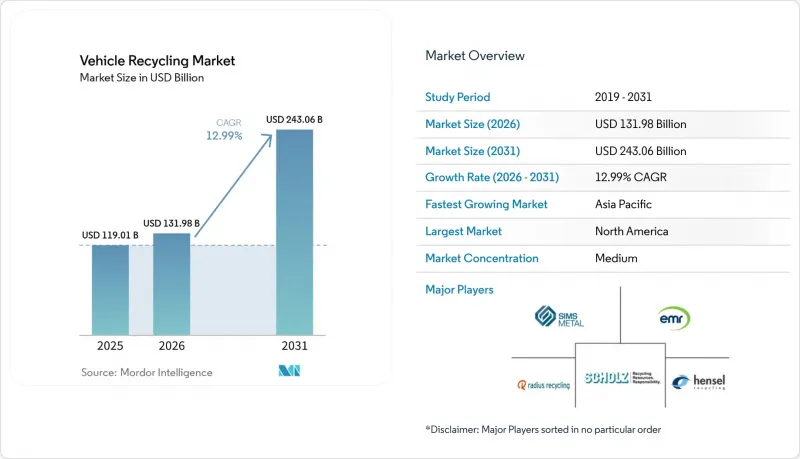
據 Mordor Intelligence 稱,2025 年汽車回收市場價值為 1190.1 億美元,預計到 2031 年將達到 2430.6 億美元,而 2026 年為 1319.8 億美元,預測期內(2026-2031 年)的複合成長率預計為 12.99%。
本報告按車輛類型(乘用車、商用車)、材料(鋼、鋁等)、應用(原廠配套、售後市場等)、回收過程(人工拆解和污染物去除、切碎機和磁選/渦流分離等)以及地區(北美、南美等)進行細分。市場預測以美元計價。
全球汽車回收市場趨勢與洞察
歐盟、中國和印度均有嚴格的報廢車輛指令。
歐盟修訂後的法規規定,到2032年,新車塑膠的15%必須回收利用,並要求汽車製造商公佈拆解指南。這使得能夠提供清潔、可追溯廢棄物的認證拆解商擁有了更大的議價能力。印度的報廢車輛(ELV)管理法規正在逐步提高鋼鐵回收目標,並引入集中式追蹤入口網站,引導車輛前往註冊的拆解設施。在中國,廣東省等省份正在將補貼與認證回收掛鉤,以鼓勵車主避免使用非正規拆解商。這些指令正在擴大合規差距,並推高可追溯材料的溢價。在東協,一項「電池護照」標準正在製定中,該標準將對鋰離子電池芯應用類似的追溯機制,從而創建一個統一的監管體系。
回收的鋁和鋼對於輕量化電動車車架至關重要。
比亞迪和漢泰克已將大量沖壓成型部件替換為採用再生材料的整合式鋁製框架,從而降低了整車重量。這凸顯了減重與再生金屬循環利用之間的關聯。回收鋁不僅節省資源,還能大幅減少碳排放,而碳排放正是汽車製造商在其車輛平均排放量揭露中經常強調的關鍵指標。 Rivian 的皮卡透過使用廢鋁,成功地在容納大容量電池的同時保持了具有競爭力的重量。這項成就表明,在電動車有效負載容量目標與再生材料的使用之間取得平衡是可行的。在商用卡車領域,像 Nucoa 這樣的小型鋼鐵廠正在將汽車破碎機整合到熔爐中。這項策略不僅能夠節省成本,還有助於減少範圍 3 排放。在電動車普及率快速成長的亞太地區,目前廢鋁的產量不足以滿足不斷成長的需求,導致跨太平洋地區分類鋁貿易激增。
先進的破碎和雜質去除生產線需要大量的資金投入。
奧羅比斯公司在喬治亞投資了一家銅回收廠,利用其先進的等離子爐實現了極高的純度。這種純度水平對於許多新興市場的營運商來說仍然遙不可及。例如,一台配備光學分類機和受控電池污染物去除區的中型切碎機價格極為昂貴。在印度和奈及利亞,由於當地金融機構將此類項目歸類為高風險項目,利率飆升。這種財務負擔使得低成本的非正規拆解公司佔據主導地位,這些公司提供的報廢車輛價格低於正規機構。獲得認證的機構面臨著運轉率率低的挑戰。例如,在2024-2025會計年度,印度註冊的拆解公司的運轉率極低。由於缺乏優惠融資管道,這些機構的擴張難以跟上不斷成長的需求。
細分市場分析
儘管預計到2031年商用車市場將以13.21%的複合年成長率成長,但2025年乘用車仍佔汽車回收市場收入的76.15%。電池驅動的廂型車、巴士和中型卡車配備高密度電池組,提高了每輛車的廢棄價值,並推動了對高壓污染物去除設施的投資。 8級卡車產生的可回收金屬遠多於緊湊型轎車,從而提高了每輛車的收入。在北美,由於乘用車的平均車齡在2025年達到歷史新高,汽車回收量保持穩定。在歐洲,內燃機汽車的快速淘汰正在加速報廢速度,並增加進入回收廠的報廢車輛數量。法規進一步加劇了區域差異。在印度,超過指定車齡的車輛必須接受檢驗,這有助於確保可回收車輛的穩定供應。然而,私家車經常被送到非官方的廢車場,經銷商在那裡拆卸零件,而不遵循正確的回收程序。
這些趨勢也受到其他因素的進一步放大。商用車車隊營運商擴大將電池回購保證納入租賃協議,從而加強與認證回收商的合作。歐盟針對重型車輛排放氣體嚴格的排放法規增加了非正規運營商的合規成本,市場佔有率也逐漸轉移到規模大規模的認證設施。預計2025年,大規模電動巴士的交付將大幅提升電池組的處理量。新興地區的乘用車回收市場規模龐大,但仍分散,且面臨監管落後的問題,導致其複合年成長率較低。
2025年,鋼鐵在汽車回收市場銷售額中佔比60.34%,但隨著汽車製造商優先考慮輕量化結構,預計到2031年,鋁材的年成長率將達到13.68%。減輕車身重量可以提高電動車的續航里程,使鋁材成為極具吸引力的替代材料。楊望U8L的車架採用一體式鑄造工藝,將多個部件整合於一體,並使用了回收材料,凸顯了循環利用的設計趨勢。福特與諾貝麗斯公司合作,建立了閉合迴路系統,可在數週內將廢棄鋼捲重新加工成新的車身鋼板。這不僅能保護利潤率免受現貨價格波動的影響,還能大幅降低能源消耗。同時,新煤集團的MiniMill正利用這一趨勢,將汽車廢鋼碎片送入電爐,進而降低原料進口成本。
區域供需不平衡正在影響貿易趨勢。亞太地區電動車普及率迅速成長,但同時也面臨廢鋁短缺的問題。這種短缺導致該地區不得不依賴從北美和歐洲進口分類廢鋁,因為這些地區的平均車輛使用壽命更長。銅的交易量雖然較小,但價格卻很高。這種高溢價使得電機回收成為一項盈利的業務。另一方面,塑膠和玻璃卻未能獲得應有的經濟效益。問題在於,混合基材的存在降低了機械回收的效率。然而,歐盟正在採取積極措施,透過其2032年關於使用再生塑膠的強制性規定來彌合這一差距。
區域分析
到2025年,北美將佔汽車回收市場收入的44.27%。這主要歸功於報廢車輛(ELV)持續穩定地流入拆解廠,而車齡較高是推動這一趨勢的主要原因。數位銷售已成為主流,大部分保險汽車拍賣交易都在網路上進行,從而縮短了庫存週轉時間,提高了盈利。 Copart公司採用了人工智慧驅動的評級,僅憑一輛車的掛牌資訊就吸引了北美自由貿易協定(北美自由貿易組織(NAFTA)境內的買家,並實現了高於數位化之前的成交價格。 LKQ公司透過出售其自助服務部門,專注於碰撞零件和電池模組,採取了一項策略性舉措,表明其正在向盈利更高的業務領域轉型。同時,由於缺乏聯邦層級的報廢車輛監管規定,各州都制定了自己的規則,這帶來了合規方面的挑戰,儘管實際執法力度仍然很弱。
預計到2031年,亞太地區的複合年成長率將達到14.13%。到2030年,印度的報廢車輛(ELV)庫存預計將加倍,達到5000萬輛,但由於與非正規買家之間存在持續的價格差距,只有一小部分車輛會被官方拆解商處理。在中國,廣東和浙江等省級政府的補貼政策引導電動車廢料流向認證工廠,但國家層級的監管仍存在不一致之處。比亞迪大量使用鋁材的電動車車架正在推動對清潔再生金屬的需求。在日本,成熟的法律體系帶來了較高的回收率,但成本壓力為產業結構調整帶來了挑戰。同時,東協2025年電池護照草案將強制要求跨境電池級可追溯性,將提高官方回收商的標準。
修訂後的歐盟報廢車輛指令(ELV指令)將於2024年最終確定,該指令要求汽車製造商採用循環設計原則並實現再生塑膠目標,從而刺激對化學回收的投資。雖然北歐已擁有密集的認證設施網路,但南歐和東歐仍有相當一部分報廢車輛最終被送往非正規拆解場。奧羅比斯公司(Aurobis)在其新建的美國冶煉廠中採購歐洲廢料,這反映了跨大西洋的物料流動。相較之下,南美、中東和非洲地區則落後於其他地區,受到自願回收限制和資金短缺的困擾。巴西的強制回收工作已經停滯不前,而在奈及利亞,非正規廢棄物場不受監管地運營,污染地下水卻未受到任何制裁。
其他好處:
- Excel格式的市場預測(ME)表
- 3個月的分析師支持
目錄
第1章:引言
- 市場分析與定義的前提條件
第2章 分析方法
第3章執行摘要
第4章 市場狀況
- 市場概覽
- 市場促進因素
- 歐盟、中國和印度均有嚴格的報廢車輛指令。
- 回收鋁和回收鋼對於輕量化電動車車架至關重要。
- 裸金屬價格波動推高了整車製造商對廢舊原料的需求。
- 使用人工智慧機器人進行拆除工作將提高恢復率。
- 針對再生金屬的原始設備製造商 (OEM)閉合迴路可追溯性試點計畫。
- 數位化報廢品競標加速了零件的流通。
- 市場限制因素
- 先進破碎淨化生產線的投資成本很高
- 新興國家報廢車輛收集路線的去中心化
- 高壓電池組拆卸作業中的安全風險
- 纖維增強複合材料回收的經濟效益尚不明確
- 價值鍊和供應鏈分析
- 監理情勢
- 技術展望
- 波特五力分析
第5章:預測市場規模與成長率
- 按車輛類型
- 搭乘用車
- 商用車輛
- 材料
- 鋼
- 鋁
- 橡皮
- 銅
- 玻璃
- 塑膠
- 其他
- 透過使用
- OEM(原始設備製造商)
- 售後市場
- 廢料處理公司/拆除公司
- 透過回收過程
- 人工拆除及清除污染物
- 切碎機處理、磁選/渦流分選
- 高品質鋰離子電池的回收利用
- 按地區
- 北美洲
- 美國
- 加拿大
- 其他北美國家
- 南美洲
- 巴西
- 阿根廷
- 其他南美國家
- 歐洲
- 德國
- 法國
- 英國
- 義大利
- 西班牙
- 俄羅斯
- 其他歐洲國家
- 亞太地區
- 中國
- 日本
- 印度
- 韓國
- 澳洲
- 其他亞太國家
- 中東和非洲
- 沙烏地阿拉伯
- 阿拉伯聯合大公國
- 土耳其
- 南非
- 奈及利亞
- 埃及
- 其他中東和非洲國家
- 北美洲
第6章 競爭情勢
- 市場集中度
- 策略趨勢
- 市佔率分析
- 公司簡介
- ASM Auto Recycling Ltd.
- Ecobat
- Hensel Recycling Group
- INDRA Automobile Recycling
- Keiaisha Co., Ltd.
- Radius Recycling, Inc.
- Scholz Recycling GmbH
- Sims Metal
- European Metal Recycling Limited
- Nucor Corporation
- Aurubis AG
- Toyota Tsusho Corporation
- Hyundai Glovis
- Li-Cycle Holdings Corp.
第7章 市場機會與未來展望
According to Mordor Intelligence, the vehicle recycling market size was valued at USD 119.01 billion in 2025 and estimated to grow from USD 131.98 billion in 2026 to reach USD 243.06 billion by 2031, at a CAGR of 12.99% during the forecast period (2026-2031).
This report is Segmented by Vehicle Type (Passenger Cars, Commercial Vehicles), Material (Iron and Steel, Aluminum, and More), Application (OEMs, Aftermarket, and More), Recycling Process (Manual Dismantling and Depollution, Shredding and Magnetic/Eddy Sorting, and More), and Geography (North America, South America, and More). The Market Forecasts are Provided in Terms of Value (USD).
Global Vehicle Recycling Market Trends and Insights
Stringent ELV Directives in EU, China, India
Revised rules in the European Union mandate that 15% of plastic in new cars be recycled by 2032 and require automakers to publish disassembly guides, which shifts bargaining power toward certified yards able to supply clean, traceable scrap . India's ELV Management Rules introduce escalating steel-recovery targets and a centralized tracking portal to channel fleets to registered scrapping facilities. Chinese provinces such as Guangdong tie subsidies to proof of certified recycling, nudging owners away from informal dismantlers. The directives have widened the compliance gap, lifting premiums for provenance-verified material. ASEAN is drafting battery passport norms that extend similar traceability to lithium-ion cells, creating an aligned regulatory block.
Recycled Aluminum and Steel Critical for Lightweight EV Frames
BYD and Hantek have introduced a one-piece aluminum frame that replaces numerous stamped components, reduces curb mass, and incorporates recycled content, highlighting the connection between lightweighting and secondary metal flows. Recycling aluminum not only conserves resources but also significantly reduces carbon emissions, a key figure often highlighted by automakers in their fleet-average disclosures. Rivian's pickup, using scrap-sourced aluminum, manages to maintain a competitive weight even with a sizable battery. This achievement underscores the possibility of aligning EV payload objectives with the use of recycled materials. In the realm of commercial trucks, mini-mill steelmakers like Nucor are integrating automotive shred into their furnaces. This strategy not only reduces costs but also diminishes scope-3 emissions. The Asia-Pacific region, witnessing a rapid surge in electric vehicle adoption, is now producing less scrap than it needs to meet its growing demand, leading to a burgeoning trans-Pacific trade in sorted aluminum.
High CAPEX for Advanced Shredding and Depollution Lines
Aurubis invested in a Georgia copper-recycling plant, achieving exceptional purity levels with its advanced plasma furnaces. This level of purity remains out of reach for many operators in emerging markets. To illustrate, midsize shredders with optical sorters and compliant battery-depollution bays incur high costs. In India and Nigeria, local lenders classify such projects as high-risk, resulting in elevated interest rates. This financial burden reinforces the dominance of low-cost informal yards, which offer lower payouts for end-of-life vehicles than formal facilities. Certified sites face challenges with under-utilization; for example, India's registered yards operated at minimal capacity during the fiscal year 2024-2025. Without access to concessional finance, the expansion of these facilities struggles to keep pace with growing demand.
Other drivers and restraints analyzed in the detailed report include:
- Volatile Virgin-Metal Prices Push OEM Demand for Scrap Feedstock
- AI-Enabled Robotic Dismantling Boosts Recovery Yields
- Fragmented ELV Collection Channels in Emerging Countries
For complete list of drivers and restraints, kindly check the Table Of Contents.
Segment Analysis
Commercial vehicles are forecast to grow at a 13.21% CAGR through 2031, although passenger cars accounted for 76.15% of the vehicle recycling market revenue in 2025. Battery-electric vans, buses, and medium-duty trucks contain dense battery packs that increase per-unit scrap value and support investment in high-voltage depollution bays. Class 8 trucks generate significantly more recyclable metal than compact sedans, increasing revenue per vehicle. In North America, vehicle recycling volumes remain stable as the average passenger car age reached a record high in 2025. In Europe, the rapid phaseout of internal combustion engine (ICE) vehicles accelerates scrappage rates and increases the flow of end-of-life vehicles to recycling yards. Regulations further emphasize regional differences. In India, fleets exceeding a specified age must undergo fitness tests, supporting a steady supply of vehicles for recycling. However, private cars often enter informal yards, where operators strip parts without following proper recycling practices.
Secondary effects further reinforce these dynamics. Commercial fleet operators increasingly incorporate battery buyback guarantees into their lease structures, strengthening partnerships with certified recyclers. Stricter EU depollution regulations for larger vehicles increase compliance costs for informal operators, gradually shifting market share toward larger certified plants. In 2025, a major shipment of electric buses drove up battery pack volumes. Although passenger car recycling in emerging regions has a larger base, it remains fragmented and faces regulatory delays, contributing to its slower CAGR.
Iron and steel accounted for 60.34% of the vehicle recycling market revenue in 2025, but aluminum is set to expand by 13.68% annually through 2031 as automakers prioritize lightweight structures. Aluminum substitution becomes appealing as reducing vehicle mass enhances EV range. The Yangwang U8L frame, consolidating multiple parts into a single casting, incorporates recycled content, highlighting a design trend towards circularity. Ford, in collaboration with Novelis, has established a closed-loop system that reintroduces scrap coils into fresh body sheets within weeks. This not only shields margins from fluctuations in spot prices but also significantly reduces energy consumption. Meanwhile, Nucor's mini-mills are capitalizing on the trend, channeling automotive shred into electric furnaces, resulting in cost savings on raw material imports.
Regional supply-demand disparities influence trade dynamics. The Asia-Pacific region, witnessing a rapid surge in EV adoption, grapples with a shortage of end-of-life aluminum. This shortfall has led to a reliance on imports of sorted scrap from North America and Europe, where vehicles tend to be older. Copper, despite being lighter in tonnage, commands a premium price. This premium positioning turns the recovery of motors and harnesses into a lucrative venture. On the other hand, plastics and glass are not reaping their due financial rewards. The challenge lies in mixed substrates, which hinder the efficiency of mechanical recycling. However, the EU is taking proactive steps, aiming to bridge this gap with a recycled-plastic mandate set for 2032.
Complete Report Scope:
- By Vehicle Type
- Passenger Cars
- Commercial Vehicles
- By Material
- Iron and Steel
- Aluminum
- Rubber
- Copper
- Glass
- Plastic
- Others
- By Application
- Original Equipment Manufacturers (OEMs)
- Aftermarket
- Scrap Processors/Dismantlers
- By Recycling Process
- Manual Dismantling and Depollution
- Shredding and Magnetic/Eddy Sorting
- Advanced Li-ion Battery Recycling
- By Geography
- North America
- United States
- Canada
- Rest of North America
- South America
- Brazil
- Argentina
- Rest of South America
- Europe
- Germany
- France
- United Kingdom
- Italy
- Spain
- Russia
- Rest of Europe
- Asia-Pacific
- China
- Japan
- India
- South Korea
- Australia
- Rest of Asia-Pacific
- Middle East and Africa
- Saudi Arabia
- United Arab Emirates
- Turkey
- South Africa
- Nigeria
- Egypt
- Rest of Middle East and Africa
- North America
Geography Analysis
North America accounted for 44.27% of the vehicle recycling market revenue in 2025, supported by an average fleet age that funnels a steady stream of ELVs to dismantlers. Digital sales dominated, with a substantial portion of Insurance Auto Auctions' transactions occurring online, reducing inventory days and enhancing returns. Copart used AI grading, enabling a single car listing to attract buyers across NAFTA borders and resulting in prices that surpassed pre-digital benchmarks. In a strategic move, LKQ divested its Self Service division to focus on collision parts and battery modules, signaling a shift towards more profitable streams. Meanwhile, the lack of federal ELV legislation allowed states to implement varied rules, introducing compliance challenges but minimal enforcement.
Asia-Pacific is set for a 14.13% CAGR to 2031. By 2030, India's ELV stock will double to 50 million, yet formal yards will process only a small fraction of vehicles due to a persistent price gap with informal buyers . In China, provincial subsidies in regions like Guangdong and Zhejiang are directing EV scrap to certified plants, although national legislation remains inconsistent. BYD's aluminum-heavy EV frames are driving demand for clean secondary metals. Japan's mature law achieves high recovery rates but faces consolidation challenges due to cost pressures. Meanwhile, ASEAN's 2025 draft for a battery passport is set to mandate cell-level traceability across borders, raising standards for formal recyclers.
Europe's updated End-of-Life Vehicles (ELV) Directive, finalized in 2024, requires automakers to adopt circular design principles and meet recycled-plastic targets, thereby driving investment in chemical recycling. While Northern Europe boasts a dense network of certified facilities, Southern and Eastern regions still see a significant portion of ELVs funneled to informal yards. Aurubis, reflecting trans-Atlantic material dynamics, is sourcing European scrap for its newly established U.S. smelter. In contrast, South America and the Middle East & Africa lag, struggling with voluntary or under-funded take-back regulations. Brazil's take-back mandate has stalled, and in Nigeria, informal yards operate unchecked, contaminating groundwater without facing repercussions.
- ASM Auto Recycling Ltd.
- Ecobat
- Hensel Recycling Group
- INDRA Automobile Recycling
- Keiaisha Co., Ltd.
- Radius Recycling, Inc.
- Scholz Recycling GmbH
- Sims Metal
- European Metal Recycling Limited
- Nucor Corporation
- Aurubis AG
- Toyota Tsusho Corporation
- Hyundai Glovis
- Li-Cycle Holdings Corp.
Additional Benefits:
- The market estimate (ME) sheet in Excel format
- 3 months of analyst support
TABLE OF CONTENTS
1 Introduction
- 1.1 Study Assumptions & Market Definition
2 Research Methodology
3 Executive Summary
4 Market Landscape
- 4.1 Market Overview
- 4.2 Market Drivers
- 4.2.1 Stringent ELV Directives in EU, China, India
- 4.2.2 Recycled Aluminum and Steel Critical for Lightweight EV Frames
- 4.2.3 Volatile Virgin-Metal Prices Push OEM Demand for Scrap Feedstock
- 4.2.4 AI-Enabled Robotic Dismantling Boosts Recovery Yields
- 4.2.5 OEM Closed-Loop Traceability Pilots for Secondary Metals
- 4.2.6 Digital Salvage Auctions Speed up Parts Circulation
- 4.3 Market Restraints
- 4.3.1 High CAPEX for Advanced Shredding and Depollution Lines
- 4.3.2 Fragmented ELV Collection Channels in Emerging Countries
- 4.3.3 Safety Risks of High-Voltage Battery Packs During Dismantling
- 4.3.4 Uncertain Economics of Fiber-Reinforced Composite Recycling
- 4.4 Value / Supply-Chain Analysis
- 4.5 Regulatory Landscape
- 4.6 Technological Outlook
- 4.7 Porter's Five Forces
- 4.7.1 Bargaining Power of Buyers
- 4.7.2 Bargaining Power of Suppliers
- 4.7.3 Threat of New Entrants
- 4.7.4 Threat of Substitutes
- 4.7.5 Degree of Competition
5 Market Size & Growth Forecasts (Value, USD)
- 5.1 By Vehicle Type
- 5.1.1 Passenger Cars
- 5.1.2 Commercial Vehicles
- 5.2 By Material
- 5.2.1 Iron and Steel
- 5.2.2 Aluminum
- 5.2.3 Rubber
- 5.2.4 Copper
- 5.2.5 Glass
- 5.2.6 Plastic
- 5.2.7 Others
- 5.3 By Application
- 5.3.1 Original Equipment Manufacturers (OEMs)
- 5.3.2 Aftermarket
- 5.3.3 Scrap Processors/Dismantlers
- 5.4 By Recycling Process
- 5.4.1 Manual Dismantling and Depollution
- 5.4.2 Shredding and Magnetic/Eddy Sorting
- 5.4.3 Advanced Li-ion Battery Recycling
- 5.5 By Geography
- 5.5.1 North America
- 5.5.1.1 United States
- 5.5.1.2 Canada
- 5.5.1.3 Rest of North America
- 5.5.2 South America
- 5.5.2.1 Brazil
- 5.5.2.2 Argentina
- 5.5.2.3 Rest of South America
- 5.5.3 Europe
- 5.5.3.1 Germany
- 5.5.3.2 France
- 5.5.3.3 United Kingdom
- 5.5.3.4 Italy
- 5.5.3.5 Spain
- 5.5.3.6 Russia
- 5.5.3.7 Rest of Europe
- 5.5.4 Asia-Pacific
- 5.5.4.1 China
- 5.5.4.2 Japan
- 5.5.4.3 India
- 5.5.4.4 South Korea
- 5.5.4.5 Australia
- 5.5.4.6 Rest of Asia-Pacific
- 5.5.5 Middle East and Africa
- 5.5.5.1 Saudi Arabia
- 5.5.5.2 United Arab Emirates
- 5.5.5.3 Turkey
- 5.5.5.4 South Africa
- 5.5.5.5 Nigeria
- 5.5.5.6 Egypt
- 5.5.5.7 Rest of Middle East and Africa
- 5.5.1 North America
6 Competitive Landscape
- 6.1 Market Concentration
- 6.2 Strategic Moves
- 6.3 Market Share Analysis
- 6.4 Company Profiles (Includes Global Level Overview, Market Level Overview, Core Segments, Financials as Available, Strategic Information, Market Rank/Share for Key Companies, Products and Services, SWOT Analysis, and Recent Developments)
- 6.4.1 ASM Auto Recycling Ltd.
- 6.4.2 Ecobat
- 6.4.3 Hensel Recycling Group
- 6.4.4 INDRA Automobile Recycling
- 6.4.5 Keiaisha Co., Ltd.
- 6.4.6 Radius Recycling, Inc.
- 6.4.7 Scholz Recycling GmbH
- 6.4.8 Sims Metal
- 6.4.9 European Metal Recycling Limited
- 6.4.10 Nucor Corporation
- 6.4.11 Aurubis AG
- 6.4.12 Toyota Tsusho Corporation
- 6.4.13 Hyundai Glovis
- 6.4.14 Li-Cycle Holdings Corp.
7 Market Opportunities & Future Outlook
- 7.1 White-space & Unmet-Need Assessment


