


 |
市場調查報告書
商品編碼
2101593
汽車回收市場:商業機會、成長要素、產業趨勢分析及2026-2035年預測Vehicle Recycling Market Opportunity, Growth Drivers, Industry Trend Analysis, and Forecast 2026 - 2035 |
||||||

全球汽車回收市場預計到 2025 年價值 888 億美元,年複合成長率為 6.1%,到 2035 年將達到 1,564 億美元。
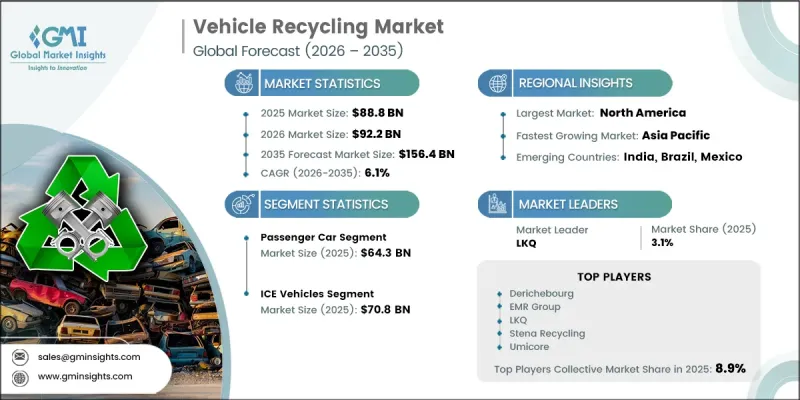
汽車回收業的整體成長主要得益於報廢車輛(ELV)監管的日益嚴格、電動車的普及以及製造業對回收的黑色金屬和非鐵金屬需求的不斷成長。電動車保有量的持續成長為回收有價值的電池材料創造了新的機遇,這已成為回收商的重要收入來源。隨著各國政府不斷收緊報廢車輛處理和資源回收的要求,監管措施仍是推動全球有組織汽車回收業務發展的最強動力之一。自2022年以來,全球已推出30多項針對關鍵礦物回收的政策措施,加速了更系統化的回收實踐的轉變。儘管存在這些有利趨勢,但在某些地區,非正規回收業務的存在仍然限制了有組織市場參與企業的擴張。非正規回收商通常合規成本較低,因此能夠為廢料和可重複使用的汽車零件提供更具競爭力的價格。隨著環境標準的不斷發展和對再生材料需求的增加,全球汽車回收市場有望受益於官方回收基礎設施投資的增加和資源回收能力的提高。
| 市場範圍 | |
|---|---|
| 開始年份 | 2025 |
| 預測期 | 2026-2035 |
| 上市時的市場規模 | 888億美元 |
| 預測金額 | 1564億美元 |
| 複合年成長率 | 6.1% |
乘用車市場佔72.4%的市場佔有率,預計到2025年市場規模將達到643億美元。該細分市場之所以能保持主導地位,是因為乘用車在全球車輛運作中佔最大。此外,傳統小型車輛成熟的拆解和材料回收流程有助於提高營運效率,使回收商能夠在處理大量車輛的同時最大限度地提高材料回收率,從而保障整個細分市場穩定的產生收入。
預計到2025年,內燃機(ICU)汽車零件市場將佔據79.7%的市場佔有率,市場規模達到708億美元。這一主導地位反映了內燃機汽車在全球汽車保有量中的持續主導地位,以及專為傳統動力傳動系統系統設計的回收系統的成熟度。成熟的拆解流程、最佳化的回收作業和高效率的材料分離,持續支撐內燃機汽車零件回收的經濟可行性。此外,現有的加工基礎設施使回收商能夠有效地回收有價值的汽車材料,進一步鞏固了該細分市場對整體市場收入的顯著貢獻。
預計到2025年,美國汽車回收市場規模將達315億美元。市場成長的持續驅動力來自全球最大的老舊乘用車保有量之一,這為待處理的報廢車輛提供了穩定的供應。美國完善的正規回收基礎設施,以及汽車回收商和金屬加工廠之間的緊密合作,不斷提高材料回收效率,從而支撐了汽車回收市場的長期發展。
目錄
第1章:調查方法
第2章執行摘要
第3章 行業洞察
- 產業生態系分析
- 供應商情況
- 利潤率
- 成本結構
- 每個階段增加的價值
- 影響價值鏈的因素
- 中斷
- 影響產業的因素
- 促進因素
- 嚴格的報廢車輛法規和回收目標正在推動常規報廢車輛行業的成長。
- 鋼鐵廠、電池製造商和OEM廠商對再生原料的需求不斷增加。
- 電動車的快速普及為高價值電池回收創造了成長機會。
- 全球車輛老化導致需要處理的報廢車輛數量不斷增加。
- 產業潛在風險與挑戰
- 來自非官方和非正規回收行業的競爭
- 先進的分類和電動車電池加工基礎設施需要大量投資。
- 市場機遇
- 從電動車驅動電池中回收必需礦物質
- EPR框架帶來了新的手續費收入機會。
- 促進因素
- 技術與創新展望
- 最新科技趨勢
- 機械拆除及淨化系統
- 磁選技術
- 新興技術
- 利用人工智慧機器人進行車輛拆解
- 先進的電動車電池回收技術
- 最新科技趨勢
- 成長潛力分析
- 監理情勢
- 北美洲
- 美國 - 美國環保署 (EPA)
- 加拿大 - 加拿大環境與氣候變遷部 (ECCC)
- 歐洲
- 歐盟-歐洲委員會(EC)
- 德國 - 德國聯邦環境署
- 亞太地區
- 中國 - 生態環境部
- 印度 - 公路運輸與公路部 (MoRTH)
- LATAM
- 巴西 - IBAMA
- 智利 - 環境部 (MMA)
- 中東和非洲
- 阿拉伯聯合大公國 - 阿布達比環境署 (EAD)
- 沙烏地阿拉伯 - 國家環境合規中心 (NCEC)
- 北美洲
- 波特的分析
- PESTLE分析
- 成本細分分析
- 專利分析
- 廢金屬收集網路分析
- 廢金屬收集網路的區域差異
- 非官方和有組織的廢品回收商的角色
- 廢金屬收集網路的數位化
- 報廢車輛(ELV)生態系的演變
- 從傳統廢料處理模式轉型
- 法規和政策框架對報廢車輛的影響
- 汽車拆解加工技術的發展
- 電動車(EV)驅動的轉型
- 人工智慧和生成式人工智慧對市場的影響
- 利用人工智慧改造現有經營模式
- 按細分市場分類的生成式人工智慧用例和部署藍圖
- 風險、限制和監管考量
- 預測假設和情境分析
- 基本案例:驅動複合年成長率的關鍵宏觀經濟與產業變量
- 樂觀情境:宏觀經濟與產業的順風
- 悲觀情景:宏觀經濟放緩或產業逆風
第4章 競爭情勢
- 介紹
- 企業市佔率分析
- 北美洲
- 歐洲
- 亞太地區
- LATAM
- 中東和非洲
- 主要市場公司的競爭分析
- 競爭定位矩陣
- 主要進展
- 併購
- 夥伴關係和聯盟
- 新產品發布
- 業務拓展計劃及資金籌措
- 按公司規模進行基準測試
- 排名分類標準與遴選標準
- 按銷售額、地區和創新能力分類的層級定位矩陣。
第5章 市場估價與預測:依車輛類型分類,2022-2035年
- 搭乘用車
- SUV
- 掀背車
- 轎車
- 商用車輛
- 輕型商用車(LCV)
- 中型商用車(MCV)
- 重型商用車(HCV)
- 摩托車
第6章 市場估計與預測:依促進因素分類,2022-2035年
- ICE
- 電動車和混合動力汽車
第7章 市場估計與預測:依收入來源分類,2022-2035年
- 鐵和金屬回收
- 碳鋼
- 鑄鐵
- 不銹鋼
- 非鐵金屬回收
- 鋁
- 銅
- 帶領
- 鋅
- 其他
- 可重複使用的零件和組件
- 再製造零件
- 非金屬材料的回收
- 電動汽車電池回收再利用
- 其他
第8章 市場估計與預測:依地區分類,2022-2035年
- 北美洲
- 美國
- 加拿大
- 歐洲
- 德國
- 英國
- 法國
- 義大利
- 西班牙
- 荷蘭
- 比利時
- 瑞典
- 波蘭
- 亞太地區
- 中國
- 印度
- 日本
- 韓國
- 澳洲
- 泰國
- 印尼
- 馬來西亞
- 拉丁美洲
- 巴西
- 墨西哥
- 阿根廷
- 智利
- 中東和非洲
- 南非
- 沙烏地阿拉伯
- UAE
第9章:公司簡介
- 世界公司
- LKQ
- EMR
- Stena Recycling
- Derichebourg
- Sims
- Toyota Tsusho
- Umicore
- Redwood Materials
- Glencore Battery Recycling
- 當地公司
- INDRA Automobile Recycling
- Galloo
- Kuusakoski
- Keiaisha
- ASM Auto Recycling
- Fenix Parts
- 新興企業
- IGAR Reciclagens
- Rosmerta Recycling
- Eccel Recycling
- Autocirc
- CERO Recycling
The Global Vehicle Recycling Market was valued at USD 88.8 billion in 2025 and is estimated to grow at a CAGR of 6.1% to reach USD 156.4 billion by 2035.
Growth across the vehicle recycling industry is supported by increasingly stringent end-of-life vehicle (ELV) regulations, rising electric vehicle adoption, and stronger demand for recovered ferrous and non-ferrous metals from manufacturing industries. The continued expansion of electric vehicle fleets is creating new opportunities for recovering valuable battery materials, adding an important source of revenue for recyclers. Regulatory initiatives remain one of the strongest factors encouraging the development of organized vehicle recycling operations worldwide, as governments continue to strengthen requirements related to end-of-life vehicle processing and resource recovery. Since 2022, more than 30 policy measures focused on critical mineral recycling have been introduced globally, supporting the transition toward more structured recycling practices. Despite these favorable developments, the presence of informal recycling operations continues to limit the expansion of organized market participants in several regions. Informal recyclers often operate with lower compliance costs, allowing them to offer more competitive pricing for scrap materials and reusable vehicle components. As environmental standards continue to evolve and demand for recycled materials increases, the global vehicle recycling market is expected to benefit from greater investment in formal recycling infrastructure and improved resource recovery capabilities.
| Market Scope | |
|---|---|
| Start Year | 2025 |
| Forecast Year | 2026-2035 |
| Start Value | $88.8 Billion |
| Forecast Value | $156.4 Billion |
| CAGR | 6.1% |
The passenger car segment held 72.4% share, generating USD 64.3 billion in 2025. The segment maintains its leading position because passenger cars represent the largest share of vehicles in operation worldwide. Established dismantling and material recovery processes for conventional light vehicles also contribute to higher operational efficiency, enabling recyclers to process large volumes while maximizing material recovery and supporting consistent revenue generation across the segment.
The ICE vehicle segment represented 79.7% share in 2025, reaching USD 70.8 billion. This leadership reflects the continued dominance of internal combustion engine vehicles within the global vehicle fleet and the maturity of recycling systems designed specifically for conventional powertrains. Well-established dismantling processes, optimized recovery operations, and efficient material separation continue to support the economic viability of recycling ICE vehicles. The existing processing infrastructure also enables recyclers to recover valuable automotive materials efficiently, reinforcing the segment's substantial contribution to overall market revenue.
United States Vehicle Recycling Market reached USD 31.5 billion in 2025. Market growth continues to be supported by one of the world's largest populations of aging passenger vehicles, creating a consistent supply of end-of-life vehicles for processing. The country's well-developed formal recycling infrastructure, combined with strong integration between vehicle recyclers and metal processing facilities, continues to strengthen material recovery efficiency and support the long-term expansion of the vehicle recycling market.
Major companies operating in the global vehicle recycling market include LKQ Corporation, EMR Group, Stena Recycling, Derichebourg, Sims Limited, Toyota Tsusho, Umicore, Redwood Materials, Glencore Battery Recycling, INDRA Automobile Recycling, Galloo Group, Kuusakoski Group, Keiaisha, ASM Auto Recycling, Fenix Parts, IGAR Reciclagem, Rosmerta Recycling, Eccel Recycling, Autocirc, and CERO Recycling. Companies operating in the vehicle recycling market are strengthening their competitive position by expanding recycling capacity, investing in advanced material recovery technologies, and improving processing efficiency across dismantling operations. Many organizations continue to prioritize automation, digital tracking systems, and optimized sorting technologies to increase recovery rates and improve operational performance. Strategic investments in battery recycling capabilities, sustainable processing methods, and resource recovery infrastructure are helping companies capture new revenue opportunities while meeting evolving regulatory requirements. Businesses are also expanding partnerships across the automotive value chain to secure a stable supply of end-of-life vehicles and recyclable materials.
Table of Contents
Chapter 1 Methodology
- 1.1 Research approach
- 1.2 Quality Commitments
- 1.2.1 GMI AI policy & data integrity commitment
- 1.3 Research Trail & Confidence Scoring
- 1.3.1 Research Trail Components
- 1.3.2 Scoring Components
- 1.4 Data Collection
- 1.5 Data mining sources
- 1.5.1 Paid sources
- 1.6 Base estimates and calculations
- 1.6.1 Base year calculation
- 1.7 Forecast model
- 1.7.1 Quantified market impact analysis
- 1.8 Research transparency addendum
- 1.8.1 Source attribution framework
- 1.8.2 Quality assurance metrics
- 1.8.3 Our commitment to trust
Chapter 2 Executive Summary
- 2.1 Industry 360° synopsis
- 2.2 Key market trends
- 2.2.1 Regional
- 2.2.2 Vehicle
- 2.2.3 Propulsion
- 2.2.4 Revenue Stream
- 2.3 TAM analysis, 2026-2035
- 2.4 CXO perspectives: Strategic imperatives
Chapter 3 Industry Insights
- 3.1 Industry ecosystem analysis
- 3.1.1 Supplier landscape
- 3.1.2 Profit margin
- 3.1.3 Cost structure
- 3.1.4 Value addition at each stage
- 3.1.5 Factor affecting the value chain
- 3.1.6 Disruptions
- 3.2 Industry impact forces
- 3.2.1 Growth drivers
- 3.2.1.1 Stringent ELV Regulations & Recycling Targets Boosting Formal Sector Growth
- 3.2.1.2 Rising Demand for Secondary Raw Materials from Steel Mills, Battery Makers & OEMs
- 3.2.1.3 Rapid EV Growth Creating High-Value Battery Recovery Opportunities
- 3.2.1.4 Aging Global Vehicle Fleet Expanding End-of-Life Vehicle Volumes
- 3.2.2 Industry pitfalls and challenges
- 3.2.2.1 Competition from Informal & Unorganized Recycling Sectors
- 3.2.2.2 High Investment Needs for Advanced Sorting & EV Battery Processing Infrastructure
- 3.2.3 Market opportunities
- 3.2.3.1 Critical Mineral Recovery from EV Traction Batteries
- 3.2.3.2 EPR Frameworks Creating New Processing Fee Revenue Opportunities
- 3.2.1 Growth drivers
- 3.3 Technology and innovation landscape
- 3.3.1 Current technological trends
- 3.3.1.1 Mechanical Dismantling & Depollution Systems
- 3.3.1.2 Magnetic Separation Technology
- 3.3.2 Emerging technologies
- 3.3.2.1 AI-Based Robotic Vehicle Dismantling
- 3.3.2.2 Advanced EV Battery Recycling Technologies
- 3.3.1 Current technological trends
- 3.4 Growth potential analysis
- 3.5 Regulatory landscape
- 3.5.1 North America
- 3.5.1.1 US - U.S. Environmental Protection Agency (EPA)
- 3.5.1.2 Canada - Environment and Climate Change Canada (ECCC)
- 3.5.2 Europe
- 3.5.2.1 EU - European Commission (EC)
- 3.5.2.2 Germany - German Federal Environment Agency
- 3.5.3 Asia Pacific
- 3.5.3.1 China - Ministry of Ecology and Environment (MEE)
- 3.5.3.2 India - Ministry of Road Transport and Highways (MoRTH)
- 3.5.4 LATAM
- 3.5.4.1 Brazil - IBAMA
- 3.5.4.2 Chile - Ministerio del Medio Ambiente (MMA)
- 3.5.5 MEA
- 3.5.5.1 UAE - Environment Agency - Abu Dhabi (EAD)
- 3.5.5.2 Saudi Arabia - National Center for Environmental Compliance (NCEC)
- 3.5.1 North America
- 3.6 Porter's analysis
- 3.7 PESTEL analysis
- 3.8 Cost breakdown analysis
- 3.9 Patent analysis (Driven by Primary Research)
- 3.10 Scrap Collection Network Analysis
- 3.10.1 Regional Differences in Scrap Collection Networks
- 3.10.2 Role of Informal vs. Organized Scrap Collectors
- 3.10.3 Digitalization of Scrap Collection Networks
- 3.11 Evolution of the End-of-Life Vehicle (ELV) Ecosystem
- 3.11.1 Shift from Traditional Scrapping to Circular Economy Models
- 3.11.2 Impact of ELV Regulations and Policy Frameworks
- 3.11.3 Evolution of Vehicle Dismantling and Processing Technologies
- 3.11.4 Transformation Driven by Electric Vehicles (EVs)
- 3.12 Impact of AI & generative AI on the market
- 3.12.1 AI-driven disruption of existing business models
- 3.12.2 GenAI use cases & adoption roadmap by segment
- 3.12.3 Risks, limitations & regulatory considerations
- 3.13 Forecast assumptions & scenario analysis (Driven by Primary Research)
- 3.13.1 Base Case- Key Macro & Industry Variables Driving CAGR
- 3.13.2 Optimistic Scenarios- Favorable macro and industry tailwinds
- 3.13.3 Pessimistic Scenario - Macroeconomic slowdown or industry headwinds
Chapter 4 Competitive Landscape, 2025
- 4.1 Introduction
- 4.2 Company market share analysis
- 4.2.1 North America
- 4.2.2 Europe
- 4.2.3 Asia Pacific
- 4.2.4 LATAM
- 4.2.5 MEA
- 4.3 Competitive analysis of major market players
- 4.4 Competitive positioning matrix
- 4.5 Key developments
- 4.5.1 Mergers & acquisitions
- 4.5.2 Partnerships & collaborations
- 4.5.3 New product launches
- 4.5.4 Expansion plans and funding
- 4.6 Company tier benchmarking
- 4.6.1 Tier classification criteria & qualifying thresholds
- 4.6.2 Tier positioning matrix by revenue, geography & innovation
Chapter 5 Market Estimates and Forecast, By Vehicle, 2022 - 2035 ($ Mn)
- 5.1 Key trends
- 5.2 Passenger cars
- 5.2.1 SUV
- 5.2.2 Hatchback
- 5.2.3 Sedan
- 5.3 Commercial vehicles
- 5.3.1 Light Commercial Vehicles (LCV)
- 5.3.2 Medium Commercial Vehicles (MCV)
- 5.3.3 Heavy Commercial Vehicles (HCV)
- 5.4 Two-Wheelers
Chapter 6 Market Estimates and Forecast, By Propulsion, 2022 - 2035 ($ Mn)
- 6.1 Key trends
- 6.2 ICE
- 6.3 Electric & Hybrid
Chapter 7 Market Estimates and Forecast, By Revenue Stream, 2022 - 2035 ($ Mn)
- 7.1 Key trends
- 7.2 Ferrous Metal Recovery
- 7.2.1 Carbon Steel
- 7.2.2 Cast Iron
- 7.2.3 Stainless Steel
- 7.3 Non-Ferrous Metal Recovery
- 7.3.1 Aluminum
- 7.3.2 Copper
- 7.3.3 Lead
- 7.3.4 Zinc
- 7.3.5 Others
- 7.4 Reusable Parts & Components
- 7.5 Remanufactured Components
- 7.6 Non-Metallic Material Recovery
- 7.7 EV Battery Recovery & Repurposing
- 7.8 Others
Chapter 8 Market Estimates & Forecast, By Region, 2022 - 2035 ($ Mn)
- 8.1 Key trends
- 8.2 North America
- 8.2.1 US
- 8.2.2 Canada
- 8.3 Europe
- 8.3.1 Germany
- 8.3.2 UK
- 8.3.3 France
- 8.3.4 Italy
- 8.3.5 Spain
- 8.3.6 Netherlands
- 8.3.7 Belgium
- 8.3.8 Sweden
- 8.3.9 Poland
- 8.4 Asia Pacific
- 8.4.1 China
- 8.4.2 India
- 8.4.3 Japan
- 8.4.4 South Korea
- 8.4.5 Australia
- 8.4.6 Thailand
- 8.4.7 Indonesia
- 8.4.8 Malaysia
- 8.5 Latin America
- 8.5.1 Brazil
- 8.5.2 Mexico
- 8.5.3 Argentina
- 8.5.4 Chile
- 8.6 MEA
- 8.6.1 South Africa
- 8.6.2 Saudi Arabia
- 8.6.3 UAE
Chapter 9 Company Profiles
- 9.1 Global players
- 9.1.1 LKQ
- 9.1.2 EMR
- 9.1.3 Stena Recycling
- 9.1.4 Derichebourg
- 9.1.5 Sims
- 9.1.6 Toyota Tsusho
- 9.1.7 Umicore
- 9.1.8 Redwood Materials
- 9.1.9 Glencore Battery Recycling
- 9.2 Regional players
- 9.2.1 INDRA Automobile Recycling
- 9.2.2 Galloo
- 9.2.3 Kuusakoski
- 9.2.4 Keiaisha
- 9.2.5 ASM Auto Recycling
- 9.2.6 Fenix Parts
- 9.3 Emerging players
- 9.3.1 IGAR Reciclagens
- 9.3.2 Rosmerta Recycling
- 9.3.3 Eccel Recycling
- 9.3.4 Autocirc
- 9.3.5 CERO Recycling


