


 |
市場調查報告書
商品編碼
2117354
焊接耗材:市場佔有率分析、產業趨勢與統計、成長預測(2026-2031)Welding Consumables - Market Share Analysis, Industry Trends & Statistics, Growth Forecasts (2026 - 2031) |
||||||

※ 本網頁內容可能與最新版本有所差異。詳細情況請與我們聯繫。
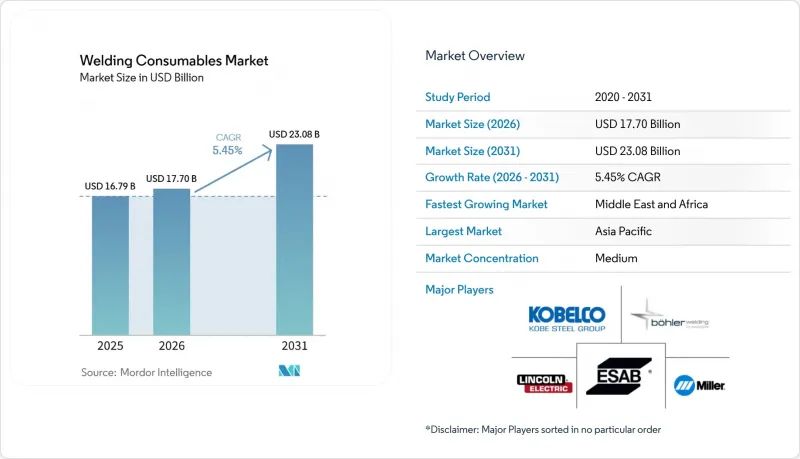
據 Mordor Intelligence 稱,2025 年焊接耗材市場價值為 167.9 億美元,預計到 2031 年將達到 230.8 億美元,而 2026 年為 177 億美元,預測期(2026-2031 年)的複合年成長率為 5.45%。
本報告按產品類型(棒狀電極、焊條、其他)、材料類型(鋼、鋁、鎳基合金、其他)、焊接方法(電弧焊接、電阻焊接、其他)、終端用戶行業(建築、石油天然氣、其他)和地區(北美、歐洲、其他)進行細分。報告提供了上述所有細分市場的市場規模和價值(以美元計)預測。
全球焊接耗材市場趨勢及洞察
亞太地區的基礎建設正在推動對鋼鐵加工的需求。
亞太地區仍然是焊接耗材的最大市場,這得益於中國、印度和日本在基礎設施、交通、工業設施和能源項目方面的持續投資。預計到2025年,中國鋼鐵消費量將達到約8.92億噸,主要需求來自交通基礎設施、能源項目、工業現代化和先進製造業。印度的鋼鐵消費量預計將在2025年成長9.8%,在2025-2026會計年度達到1.637億噸,其中建築和基礎設施佔該國鋼鐵需求的68%。印度的國家基礎設施建設規劃(NIP)涵蓋34個子產業的9142個項目,為結構鋼生產的持續需求提供了支撐。同時,日本繼續投資於交通基礎設施、工業現代化、離岸風力發電和抗災建築,這支撐了對用於重型結構製造和高品質結構應用的高性能焊接耗材的需求。在整個亞太地區,這些基礎設施和工業投資正推動低氫焊條、藥芯焊絲和潛弧焊接(SAW)耗材在厚壁結構焊接的應用日益廣泛。橋樑、鐵路、海上結構和工業設施的嚴格技術規範也持續青睞比傳統等級更高品質的耗材。
自動化焊接正在推動對優質焊絲和焊劑的需求。
美國焊接協會 (AWS) 預測,到 2029 年,美國將需要新增 320,500 名焊接專業人員。截至 2025 年,美國焊工總數為 771,000 人,其中超過 157,000 人已退休或即將退休。這種人手不足促使製造商採用機器人 MIG/MAG 焊接和藥芯焊絲電弧焊接單元,以實現高度可重複的接頭設計。自動化單元需要精確控制焊絲直徑、電弧穩定性和飛濺性能。 2025 年,美國勞工部批准了 AWS 的“自動化焊接專家學徒計畫”,該計畫旨在支援自動化焊接技術的培訓。韓國現代重工 (HD Hyundai Heavy Industries) 已在其造船廠部署了軌道式焊接機器人,使一名操作員能夠同時監控多達八台機器人。
原物料價格波動會導致成本增加。
鎳和鉬是不銹鋼、雙相鋼和鎳基焊接耗材的關鍵合金元素。由於它們的產地集中,成本易受政策變化、礦山產量和下游需求的影響。預計2025年大部分時間鎳價將維持在每噸14,000至15,500美元左右,並於2026年1月23日達到每噸18,756美元。隨著鉬鐵價格上漲,316L不銹鋼和2205雙相鋼等鋼種的合金附加費將增加。簽訂長期供應合約的生產商未必總是能透過價格調整來彌補這些成本上漲。因此,當不銹鋼需求強勁時期鎳和鉬成本同時上漲時,焊接耗材市場的利潤率將面臨壓力。
細分市場分析
2025年,焊條佔焊接耗材市場的34.20%。這主要得益於焊條的便攜性、相對較低的設備要求以及其在AWS A5.1和ISO 2560等標準下的廣泛認證。焊條仍然廣泛應用於現場維修、管道連接以及符合抗震標準的基建項目中,因為這些項目的電力和保護氣體供應往往不穩定。儘管送絲焊接工藝正在快速普及,但焊條在戶外和偏遠地區作業中的應用仍然保持著大規模的用戶群。 GMAW和MIG焊絲的銷量位居第二,這主要得益於汽車車體焊接和輕型結構製造領域的應用。埋弧焊(SAW)焊絲-焊劑複合複合材料的銷量最高,因為它們被用於焊接厚壁海洋結構和壓力容器。經認證的埋弧焊接套裝的焊接耗材市場規模也得益於對厚壁關鍵接頭的嚴格要求。
隨著機器人和半自動焊接單元在重複焊接中取代手工手工電弧焊(SMAW),藥芯焊絲成為成長最快的產品類型,年複合成長率高達 8.20%。由於其高熔敷率、全位置焊接能力以及與電弧監測系統的兼容性,氣體遮蔽藥芯焊絲(FCAW)在藥芯焊絲出貨量中佔據主導地位。自保護型產品在氣體供應困難的戶外施工和維修工作中仍然十分有用。互聯焊接平台也促進了可追溯焊接耗材批次的使用。使用帶有QR碼的焊絲捲盤可以將焊接耗材批次與焊接記錄關聯起來,從而滿足核能和航太價值鏈的採購需求。自動化、文件記錄和穩定的送絲性能相結合,為焊接耗材市場中高價值的藥芯焊絲產品線提供了支撐。
2025年,鋼材焊接耗材佔焊接耗材市場的45.60%,因為碳鋼、高強度低合金鋼和不銹鋼在結構、容器和管道的製造中仍然發揮核心作用。隨著煉鋼製程向電弧爐煉鋼的轉變,低氫鋼對厚壁微合金鋼零件的重要性日益凸顯。隨著碳當量值的嚴格要求,如果焊接過程控制不當,氫致裂紋的風險會增加。因此,低氫焊條和經認證的焊絲配方在環保鋼材的生產中仍然至關重要。不鏽鋼熔填材料符合EN ISO 14343和AWS A5.9標準,鎳合金焊絲則符合EN ISO 18274標準。這些標準要求增加了現有供應商的轉換成本。
鋁製品是焊接耗材市場中成長最快的材料類別,年複合成長率高達9.50%。這主要得益於對認證熔填材料的需求,尤其是在電動車電池機殼和輕量化車輛製造領域。採用熔填材料進行雷射焊接有助於抑制某些鋁製組裝中的氣孔和熱裂紋。鎳基產品雖然用量較小,但在石油和天然氣燃燒熱交換器、核能蒸汽產生器和航太燃燒部件等領域,其單價最高。銅、鈦和鈷焊接耗材的應用範圍則較為有限,例如電氣連接、航太結構和熱噴塗。這些特種產品與資本項目和認證要求密切相關。這種材料組合造就了整個焊接耗材產業價格範圍的廣泛性。
區域分析
2025年,亞太地區將佔據全球焊接耗材市場44.50%的佔有率,主要驅動力來自中國、印度、日本和韓國。預計2025年印度鋼鐵需求將成長9.8%,2025-2026會計年度鋼鐵產品消費量將達到1.637億噸。 2025年,全球新增離岸風力發電裝置容量9.3吉瓦中,將有6.6吉瓦在中國投入運作。日本和韓國正在大力支持符合KR、NK和DNV認證要求的高品質造船產品。印尼、越南、泰國和菲律賓的製造業和商業建設需求也在增加。 2025年1月,奧鋼聯博勒焊接公司宣布將擴大在企業發展,並提高其實心焊絲的產能。
北美和歐洲是焊接耗材市場中技術驅動型市場。 AWS勞動力數據顯示,北美焊工嚴重短缺,這推動了機器人焊接和協作焊接系統的應用。在加拿大,管道和水力發電廠建設支撐了市場需求;而在墨西哥,汽車生產與美國的需求共同推動了市場需求。歐洲製造商面臨著有關職業暴露的監管要求,這增加了對經認證的低菸產品的需求。德國、英國和義大利專注於汽車、航太和能源設備的製造。北歐的離岸風力發電和海底管線建設活動支撐了對DNV和勞氏暫存器認證的低溫抗衝擊焊接耗材的需求。
中東和非洲是焊接耗材市場成長最快的地區,年複合成長率達7.80%,這主要得益於海灣合作理事會(GCC)國家的製造業、基礎設施和土木工程項目。西非和阿曼灣的深海工程需要高鎳含量和耐腐蝕的產品用於海底設備。土耳其是北非、海灣國家和撒哈拉以南非洲地區的主要塗層焊條供應商。在南美洲,巴西鹽鹽層下近海開發、水力發電廠建設和汽車供應鏈帶來了穩定的投資主導需求。在阿根廷和秘魯,採礦設備維護和管道製造的需求也支持了市場需求。高品質的進口產品為能夠提供符合AWS或ISO認證標準的公共部門採購產品的供應商帶來了商機。
其他好處
- Excel格式的市場預測(ME)表
- 3個月的分析師支持
目錄
第1章:引言
- 研究假設和市場定義
- 調查範圍
第2章:調查方法
第3章執行摘要
第4章 市場狀況
- 市場概覽
- 市場促進因素
- 基礎建設正在推動鋼鐵加工的需求。
- 焊接自動化提高了對高品質焊絲和焊劑的需求。
- 用於離岸風力發電基礎的耗材,要求極高耐用性。
- 隨著輕型車輛越來越受歡迎,鋁熔填材料的使用量也不斷增加。
- 綠色鋼鐵法規為低氫電極的創新奠定了基礎。
- 航太和石油天然氣產業對高性能合金的需求
- 市場限制因素
- 原物料價格波動導致成本增加。
- 排放法規增加了與合規相關的成本。
- 固態熔接減少了耗材的使用量。
- 近淨成形積層製造正在減少航太領域的焊接過程。
- 價值供應鏈分析
- 技術展望
- 監理情勢
- 焊接需求展望(2025-2031年)
- 地緣政治事件對市場的影響
第5章 市場規模與成長預測
- 依產品類型
- 棒狀電極(SMAW)
- TIG焊條
- 用於潛弧焊接(SAW)的藥芯焊絲組
- 藥芯焊絲
- 焊絲(GMAW/MIG/實心焊絲)
- 其他物品(氧氣焊條、焊粉、保護氣體、焊嘴等)
- 依材料類型
- 鋼(碳鋼、不鏽鋼)
- 鋁
- 鎳基合金
- 其他(銅、鈦、鈷)
- 透過焊接方法
- 電弧焊接(手工電弧焊、熔化極氣體保護焊、氬弧焊、埋弧焊)
- 電阻焊接(點焊、縫焊)
- 氧燃料焊接
- 其他(雷射焊接、電子束焊接)
- 按最終用途行業分類
- 建築/施工
- 汽車和運輸業
- 造船/海洋
- 石油和天然氣、能源基礎設施
- 重型機械和工業設備
- 航太/國防
- 其他(鐵路、消費品)
- 按地區
- 北美洲
- 美國
- 加拿大
- 墨西哥
- 南美洲
- 巴西
- 阿根廷
- 其他南美國家
- 歐洲
- 英國
- 德國
- 法國
- 義大利
- 西班牙
- 比荷盧經濟聯盟(比利時、荷蘭、盧森堡)
- 北歐國家(丹麥、芬蘭、冰島、挪威、瑞典)
- 其他歐洲國家
- 亞太地區
- 中國
- 印度
- 日本
- 澳洲
- 韓國
- 東協(印尼、泰國、菲律賓、馬來西亞、越南)
- 其他亞太國家
- 中東和非洲
- 沙烏地阿拉伯
- 阿拉伯聯合大公國
- 土耳其
- 埃及
- 南非
- 其他中東和非洲國家
- 北美洲
第6章 競爭情勢
- 市場集中度
- 策略趨勢
- 市佔率分析
- 公司簡介
- Lincoln Electric Holdings Inc.
- ESAB Corporation
- Illinois Tool Works Inc.(Miller Welding)
- voestalpine Bohler Welding GmbH
- Kobe Steel Ltd.(Kobelco Welding)
- Hyundai Welding Co. Ltd.
- Tianjin Bridge Welding Materials Group Co., Ltd.
- Air Liquide SA(Welding Division)
- Ador Welding Ltd.
- Gedik Welding Inc.
- Welding Alloys Group
- Selectrode Industries Inc.
- Sandvik Materials Technology(Alleima)
- Panasonic Welding Systems
- TASETO Co., Ltd.
- Nippon Steel Welding & Engineering
- Oerlikon(CD&R-owned)
- Daihen Corporation
- Great Welding Ltd.
- Kiswel Co. Ltd.
第7章 市場機會與未來展望
According to Mordor Intelligence, the welding consumables market size was valued at USD 16.79 billion in 2025 and is estimated to grow from USD 17.70 billion in 2026 to reach USD 23.08 billion by 2031, at a CAGR of 5.45% during the forecast period (2026-2031).
This report is Segmented by Product Type (Stick Electrodes, Welding Rods, and More), by Material Type (Steel, Aluminum, Nickel-Based, and Others), by Welding Technique (Arc Welding, Resistance Welding, and More), by End-Use Industry (Building & Construction, Oil & Gas, and More), and by Geography (North America, Europe, and More). The Report Offers Market Size and Value (USD) Forecasts for all the Above Segments.
Global Welding Consumables Market Trends and Insights
Infrastructure Build-Out Across Asia-Pacific Driving Steel Fabrication Demand
Asia-Pacific remains the largest market for welding consumables, supported by sustained investments in infrastructure, transportation, industrial facilities, and energy projects across China, India, and Japan. China is expected to consume approximately 892 million metric tons of finished steel in 2025, with demand driven by transportation infrastructure, energy projects, industrial upgrades, and advanced manufacturing. India's finished steel consumption is projected to increase by 9.8% in 2025, reaching 163.7 million metric tons in FY 2025-26, with construction and infrastructure accounting for 68% of domestic steel demand. The country's National Infrastructure Pipeline (NIP) includes 9,142 projects across 34 subsectors, supporting sustained demand for structural steel fabrication. Meanwhile, Japan continues to invest in transportation infrastructure, industrial modernization, offshore wind, and disaster-resilient construction, which supports demand for high-performance welding consumables used in heavy fabrication and high-quality structural applications. Across the Asia-Pacific region, these infrastructure and industrial investments are increasing the use of low-hydrogen electrodes, flux-cored wires, and submerged arc welding (SAW) consumables for thick-section structural welding. Stringent engineering specifications for bridges, railways, offshore structures, and industrial facilities continue to favor premium consumables over conventional grades.
Welding Automation Raising Premium Wire And Flux Demand
The American Welding Society projects a need for 320,500 additional welding professionals in the United States by 2029. The workforce totaled 771,000 workers, and more than 157,000 were at or near retirement age in 2025. This shortage encourages fabricators to use robotic MIG/MAG and flux-cored arc welding cells for repeatable joint designs. Automated cells require close control of wire diameter, arc stability, and spatter performance. The United States Department of Labor approved AWS's Welding Automation Specialist Apprenticeship in 2025, which supports training for deploying automated welding. HD Hyundai Heavy Industries is using rail-mounted welding robots in South Korean shipyards, where one operator can supervise up to 8 robots.
Raw-Material Price Volatility Raising Costs
Nickel and molybdenum are important alloying inputs for stainless, duplex, and nickel-based welding consumables. Their supply is geographically concentrated, which makes costs sensitive to policy changes, mine output, and downstream demand. Nickel traded near USD 14,000-15,500 per tonne for much of 2025 and reached USD 18,756 per ton on January 23, 2026. Grades such as 316L stainless and 2205 duplex carry higher alloy surcharges when ferro-molybdenum prices rise. Producers serving long-term supply contracts cannot always recover these increases through list-price changes. The welding consumables market, therefore, faces margin pressure when nickel and molybdenum costs rise together during periods of stronger stainless demand.
Other drivers and restraints analyzed in the detailed report include:
- Offshore Wind Foundations Requiring High-Toughness Consumables
- Lightweight Vehicles Increasing Aluminum Filler Metal Use
- Fume-Emission Rules Raising Compliance Spending
For complete list of drivers and restraints, kindly check the Table Of Contents.
Segment Analysis
Stick electrodes accounted 34.20% of the welding consumables market in 2025, supported by their portability, modest equipment requirements, and broad approval under AWS A5.1 and ISO 2560. They remain widely used in field repair, pipe joining, and seismic-grade infrastructure projects where power or shielding gas may be unreliable. Their use in outdoor and remote work helps maintain a large installed base despite the faster adoption of wire-fed processes. Welding wires for GMAW and MIG applications held the second-largest volume, supported by automotive body joining and light structural fabrication. Submerged-arc wire-flux combinations have the highest revenue intensity per kilogram because they serve heavy-section offshore and pressure-vessel welding. The welding consumables market size for certified SAW sets benefits from the demanding requirements of thick, critical joints.
Flux-cored wires are the fastest-growing product type, registering a 8.20% CAGR, as robotic and semi-automatic cells replace manual SMAW on repetitive welds. Gas-shielded FCAW grades lead flux-cored volumes because they provide high deposition rates, all-position capability, and compatibility with arc-monitoring systems. Self-shielded variants remain useful for open-site construction and repair work where gas delivery is impractical. Connected welding platforms are also encouraging the use of traceable consumable lots. QR-coded wire reels can link a consumable batch to a weld record, which supports procurement requirements in nuclear and aerospace supply chains. This combination of automation, documentation, and stable feed performance supports higher-value flux-cored product lines within the welding consumables market.
Steel consumables accounted for 45.60% of the welding consumables market in 2025 because carbon steel, high-strength low-alloy steel, and stainless steel remain central to structural, vessel, and pipeline fabrication. The shift toward electric arc furnace steelmaking raises the importance of low-hydrogen grades for thick microalloyed steel sections. Tighter carbon equivalents can increase the risk of hydrogen-induced cracking when welding procedures are not controlled. Low-hydrogen electrodes and qualified wire formulations, therefore, remain important in green steel fabrication. Stainless fillers are governed by EN ISO 14343 and AWS A5.9, while nickel-alloy wires are covered by EN ISO 18274. These qualifications raise switching costs for established suppliers.
Aluminum products are the fastest-growing material category in the welding consumables market, registering a 9.50% CAGR, driven by EV battery enclosures and lightweight vehicle structures, which increase demand for qualified fillers. Laser welding with filler can help manage porosity and hot cracking in selected aluminum assemblies. Nickel-based products represent a smaller-volume category but have the highest unit value in oil- and gas-fired heat exchangers, nuclear steam generators, and aerospace combustion parts. Copper, titanium, and cobalt consumables are used in narrower applications, including electrical joining, aerospace structures, and hardfacing. These specialties are closely tied to capital projects and qualification requirements. The material mix supports a wide range of price points across the welding consumables industry.
Complete Report Scope:
- By Product Type
- Stick Electrodes (SMAW)
- Welding Rods (TIG)
- Submerged Arc Welding (SAW) Flux & Wire Sets
- Flux-Cored Wires
- Welding Wires (GMAW/MIG/ Solid Wires)
- Others (Oxy-fuel Welding Rods, Welding Powder, Shielding Gases, Tips, etc.)
- By Material Type
- Steel Welding Consumables (carbon, Stainless)
- Aluminum Welding Consumables
- Nickel-Based Welding Consumables
- Others (Copper, Titanium, Cobalt)
- By Welding Technique
- Arc Welding (SMAW, MIG, TIG, SAW)
- Resistance Welding (Spot, Seam)
- Oxy-Fuel Welding
- Others (Laser Welding, Electron Beam Welding)
- By End-Use Industry
- Building & Construction
- Automotive & Transportation
- Shipbuilding & Offshore
- Oil & Gas, Energy Infrastructure
- Heavy Machinery & Industrial Equipment
- Aerospace & Defense
- Others (Railway, Consumer Goods)
- By Geography
- North America
- United States
- Canada
- Mexico
- South America
- Brazil
- Argentina
- Rest of South America
- Europe
- United Kingdom
- Germany
- France
- Italy
- Spain
- BENELUX (Belgium, Netherlands, and Luxembourg)
- NORDICS (Denmark, Finland, Iceland, Norway, and Sweden)
- Rest of Europe
- Asia-Pacific
- China
- India
- Japan
- Australia
- South Korea
- ASEAN (Indonesia, Thailand, Philippines, Malaysia, Vietnam)
- Rest of Asia-Pacific
- Middle East and Africa
- Saudi Arabia
- United Arab Emirates
- Turkey
- Egypt
- South Africa
- Rest of Middle East and Africa
- North America
Geography Analysis
Asia-Pacific accounted for 44.50% of the regional welding consumables market in 2025, led by China, India, Japan, and South Korea. India's steel demand grew 9.8% in 2025, while finished steel consumption reached 163.7 million tons in fiscal 2025-26. China commissioned 6.6 GW of the 9.3 GW of offshore wind capacity added globally in 2025. Japan and South Korea support premium shipbuilding products that meet KR, NK, and DNV approval requirements. Indonesia, Vietnam, Thailand, and the Philippines add demand through manufacturing and commercial construction. In January 2025, voestalpine Bohler Welding said it would expand its footprint in Indian manufacturing and application technology and add solid-wire capacity.
North America and Europe form the technology-focused portion of the welding consumables market. AWS workforce data indicates a large welding labor gap in North America, which is increasing the use of robotic and collaborative welding systems. Canada supports demand through pipelines and hydroelectric construction, while Mexico supplies automotive production linked to the United States. European fabricators face occupational exposure requirements that increase demand for certified low-fume products. Germany, the United Kingdom, and Italy concentrate on automotive, aerospace, and energy equipment fabrication. Nordic offshore wind and subsea pipeline activity supports low-temperature-impact-qualified consumables approved by DNV and Lloyd's Register.
The Middle East and Africa are the fastest-growing regions in the welding consumables market, registering a 7.80% CAGR, supported by manufacturing, infrastructure, and civil construction programs in the GCC. Deepwater projects in West Africa and the Gulf of Oman require high-nickel and corrosion-resistant products for subsea equipment. Turkey is a major regional supplier of coated electrodes to North Africa, Gulf markets, and sub-Saharan Africa. South America has steady investment-led demand from Brazil's offshore pre-salt work, hydroelectric construction, and automotive supply chain. Argentina and Peru support demand through mining equipment maintenance and pipeline fabrication. Imported premium products create an opportunity for suppliers that can offer AWS- or ISO-certified grades for public-sector procurement.
- Lincoln Electric Holdings Inc.
- ESAB Corporation
- Illinois Tool Works Inc. (Miller Welding)
- voestalpine Bohler Welding GmbH
- Kobe Steel Ltd. (Kobelco Welding)
- Hyundai Welding Co. Ltd.
- Tianjin Bridge Welding Materials Group Co., Ltd.
- Air Liquide S.A. (Welding Division)
- Ador Welding Ltd.
- Gedik Welding Inc.
- Welding Alloys Group
- Selectrode Industries Inc.
- Sandvik Materials Technology (Alleima)
- Panasonic Welding Systems
- TASETO Co., Ltd.
- Nippon Steel Welding & Engineering
- Oerlikon (CD&R-owned)
- Daihen Corporation
- Great Welding Ltd.
- Kiswel Co. Ltd.
Additional Benefits:
- The market estimate (ME) sheet in Excel format
- 3 months of analyst support
TABLE OF CONTENTS
1 Introduction
- 1.1 Study Assumptions & Market Definition
- 1.2 Scope of the Study
2 Research Methodology
3 Executive Summary
4 Market Landscape
- 4.1 Market Overview
- 4.2 Market Drivers
- 4.2.1 Infrastructure Build-Out Driving Steel Fabrication Demand
- 4.2.2 Welding Automation Raising Premium Wire And Flux Demand
- 4.2.3 Offshore Wind Foundations Requiring High-Toughness Consumables
- 4.2.4 Lightweight Vehicles Increasing Aluminum Filler Metal Use
- 4.2.5 Green-Steel Mandates Supporting Low-Hydrogen Electrode Innovation
- 4.2.6 High-Performance Alloy Demand in Aerospace and Oil and Gas
- 4.3 Market Restraints
- 4.3.1 Raw-Material Price Volatility Raising Costs
- 4.3.2 Fume-Emission Rules Raising Compliance Spending
- 4.3.3 Solid-State Joining Reducing Consumable Intensity
- 4.3.4 Near-Net Additive Parts Reducing Aerospace Welding Steps
- 4.4 Value / Supply-Chain Analysis
- 4.5 Technological Outlook
- 4.6 Regulatory Landscape
- 4.7 Welding Demand Landscape (2025-2031)
- 4.8 Impact of Geo-Political Events on the Market
5 Market Size & Growth Forecasts (Value, In USD Billion)
- 5.1 By Product Type
- 5.1.1 Stick Electrodes (SMAW)
- 5.1.2 Welding Rods (TIG)
- 5.1.3 Submerged Arc Welding (SAW) Flux & Wire Sets
- 5.1.4 Flux-Cored Wires
- 5.1.5 Welding Wires (GMAW/MIG/ Solid Wires)
- 5.1.6 Others (Oxy-fuel Welding Rods, Welding Powder, Shielding Gases, Tips, etc.)
- 5.2 By Material Type
- 5.2.1 Steel Welding Consumables (carbon, Stainless)
- 5.2.2 Aluminum Welding Consumables
- 5.2.3 Nickel-Based Welding Consumables
- 5.2.4 Others (Copper, Titanium, Cobalt)
- 5.3 By Welding Technique
- 5.3.1 Arc Welding (SMAW, MIG, TIG, SAW)
- 5.3.2 Resistance Welding (Spot, Seam)
- 5.3.3 Oxy-Fuel Welding
- 5.3.4 Others (Laser Welding, Electron Beam Welding)
- 5.4 By End-Use Industry
- 5.4.1 Building & Construction
- 5.4.2 Automotive & Transportation
- 5.4.3 Shipbuilding & Offshore
- 5.4.4 Oil & Gas, Energy Infrastructure
- 5.4.5 Heavy Machinery & Industrial Equipment
- 5.4.6 Aerospace & Defense
- 5.4.7 Others (Railway, Consumer Goods)
- 5.5 By Geography
- 5.5.1 North America
- 5.5.1.1 United States
- 5.5.1.2 Canada
- 5.5.1.3 Mexico
- 5.5.2 South America
- 5.5.2.1 Brazil
- 5.5.2.2 Argentina
- 5.5.2.3 Rest of South America
- 5.5.3 Europe
- 5.5.3.1 United Kingdom
- 5.5.3.2 Germany
- 5.5.3.3 France
- 5.5.3.4 Italy
- 5.5.3.5 Spain
- 5.5.3.6 BENELUX (Belgium, Netherlands, and Luxembourg)
- 5.5.3.7 NORDICS (Denmark, Finland, Iceland, Norway, and Sweden)
- 5.5.3.8 Rest of Europe
- 5.5.4 Asia-Pacific
- 5.5.4.1 China
- 5.5.4.2 India
- 5.5.4.3 Japan
- 5.5.4.4 Australia
- 5.5.4.5 South Korea
- 5.5.4.6 ASEAN (Indonesia, Thailand, Philippines, Malaysia, Vietnam)
- 5.5.4.7 Rest of Asia-Pacific
- 5.5.5 Middle East and Africa
- 5.5.5.1 Saudi Arabia
- 5.5.5.2 United Arab Emirates
- 5.5.5.3 Turkey
- 5.5.5.4 Egypt
- 5.5.5.5 South Africa
- 5.5.5.6 Rest of Middle East and Africa
- 5.5.1 North America
6 Competitive Landscape
- 6.1 Market Concentration
- 6.2 Strategic Moves
- 6.3 Market Share Analysis
- 6.4 Company Profiles (includes Global level Overview, Market level overview, Core Segments, Financials as available, Strategic Information, Products & Services, and Recent Developments)
- 6.4.1 Lincoln Electric Holdings Inc.
- 6.4.2 ESAB Corporation
- 6.4.3 Illinois Tool Works Inc. (Miller Welding)
- 6.4.4 voestalpine Bohler Welding GmbH
- 6.4.5 Kobe Steel Ltd. (Kobelco Welding)
- 6.4.6 Hyundai Welding Co. Ltd.
- 6.4.7 Tianjin Bridge Welding Materials Group Co., Ltd.
- 6.4.8 Air Liquide S.A. (Welding Division)
- 6.4.9 Ador Welding Ltd.
- 6.4.10 Gedik Welding Inc.
- 6.4.11 Welding Alloys Group
- 6.4.12 Selectrode Industries Inc.
- 6.4.13 Sandvik Materials Technology (Alleima)
- 6.4.14 Panasonic Welding Systems
- 6.4.15 TASETO Co., Ltd.
- 6.4.16 Nippon Steel Welding & Engineering
- 6.4.17 Oerlikon (CD&R-owned)
- 6.4.18 Daihen Corporation
- 6.4.19 Great Welding Ltd.
- 6.4.20 Kiswel Co. Ltd.
7 Market Opportunities & Future Outlook
- 7.1 White-space & Unmet-Need Assessment

 焊接耗材市場:按產品類型、焊接工藝、材料類型、應用和最終用戶產業分類-全球預測,2026-2032年
 美國焊接耗材:市場佔有率分析、產業趨勢與統計及成長預測(2026-2031 年)
 焊接耗材市場報告:按產品類型、焊接技術、終端用戶產業和地區分類(2026-2034 年)
 焊接耗材市場:依焊接耗材、焊接技術、應用及地區分類電弧焊接市場:2026-2032年全球市場預測(依焊接流程、自動化程度、冷卻方式、焊槍類型、電流類型、最終用戶和應用分類)
 2026年全球汽車數位焊接設備市場報告2026年全球焊接耗材市場報告2026年全球耐磨件市場報告
 焊接材料市場規模、佔有率、成長及全球產業分析:依類型、應用和地區劃分的洞察與預測(2026-2034)新能源汽車焊接合金市場:按合金類型、焊接工藝、母材類型、形狀、應用和最終用戶分類,全球預測(2026-2032年)