


 |
市場調查報告書
商品編碼
2117238
亞太地區甲醛市場:市佔率分析、產業趨勢與統計及成長預測(2026-2031年)Asia-Pacific Formaldehyde - Market Share Analysis, Industry Trends & Statistics, Growth Forecasts (2026 - 2031) |
||||||

※ 本網頁內容可能與最新版本有所差異。詳細情況請與我們聯繫。
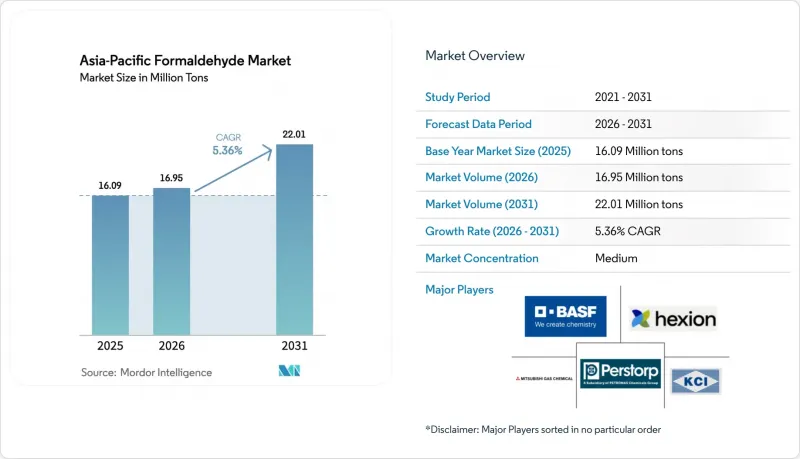
根據 Mordor Intelligence 預測,亞太地區甲醛市場預計將從 2025 年的 1,609 萬噸成長到 2026 年的 1,695 萬噸,然後在 2031 年達到 2,201 萬噸,2026 年至 2031 年的複合年成長率為 5.36%。
本報告依衍生物(脲醛、酚醛、三聚氰胺甲醛等)、終端用戶產業(建築、汽車、農業等)、應用領域(膠合板及木製品、紡織品及織品、汽車及運輸等)及地區(中國、印度、日本等)分類。市場預測以噸為單位。
亞太地區甲醛市場趨勢及洞察
建築複合材料需求增加
在印度和中國,橋樑、地鐵線路和資料中心等基礎設施投資持續進行。甲醛基酚醛樹脂因其耐季風濕氣和抗震性能而被廣泛用於室外膠合板。儘管印度膠合板產量在過去五年6.00%的複合年成長率的支撐下,預計2024年將同比成長6.71%,但國內中密度纖維板和塑合板的市場佔有率仍僅為20%,樹脂消費量仍有成長空間。 2024年1月至9月,印度豪華住宅交易量成長37.8%,推動了對符合新室內空氣品質標準的低排放層壓板的需求。在中國,2023年木質板材產量超過2.5億立方米,確保了對黏合劑的持續需求。同時,公共住宅規範已強制要求使用ENF級產品。
汽車塑膠和塗料的應用日益廣泛
在電動車 (EV)組裝,越來越多的材料開始採用符合嚴格車內空氣品質標準的聚甲醛 (POM) 和酚醛複合材料。為了應對不斷上漲的能源和運輸成本,以及持續的合規支出,BASF於 2025 年 3 月將亞太地區 Ultraform POM 的價格提高了 350 美元/噸。日本汽車製造商協會將車內甲醛濃度限制在 100 微克/立方公尺以內,這項標準現已體現在東協地區的採購合約中。此外,混合動力傳動系統的日益普及也加速了酚醛樹脂在煞車皮和離合器摩擦片等需要耐熱部件中的應用。
根據有毒致癌性物質的分類,收緊接觸限值。
在新加坡,自2026年起,室內塗料中將禁止使用甲醛,其含量限制在0.01 wt%以下,這將迫使塗料生產商轉向丙烯酸和矽酮黏合劑。在日本,《建築標準法》規定F4級板材的甲醛釋放量不得超過0.04 mg m⁻³,而汽車製造商則將車內甲醛暴露量限制在100 µg m⁻³以下,這迫使製造商升級其樹脂。在中國,GB/T 39600-2021標準新增了ENF(環保)類別,甲醛釋放量不得超過0.025 mg m⁻³,而每個板材廠對黏合劑維修的成本高達120萬美元。這些法規的實施正在擠壓小規模工廠的利潤空間,加速了三聚氰胺/脲醛樹脂和酚醛樹脂替代品的轉型。
細分市場分析
2025年,脲醛樹脂在亞太地區甲醛市佔率中佔46.50%。這反映了其在塑合板和中密度纖維板生產線上的低單位成本。預計到2031年,該細分市場將以5.97%的複合年成長率成長,儘管面臨監管方面的挑戰,預計仍將保持其在絕對產量方面的領先地位。受電動車內內部裝潢建材和精密齒輪需求的推動,聚甲醛的需求預計將達到近7%的複合年成長率。酚醛樹脂在防火膠合板領域得到小眾應用,這種膠合板在大都會圈和資料中心建設中備受青睞;而三聚氰胺甲醛樹脂則滿足了裝飾層壓板的需求,其耐刮擦性能使其價格更高。
脲醛(UF)製程的技術進步使得在不犧牲壓機產能的前提下生產符合ENF標準的板材成為可能,從而降低了替代風險。雖然六亞甲四胺在炸藥和獸藥領域仍然十分重要,但在燃料片領域,它正逐漸被其他原料取代。BASF位於湛江的可再生能源工廠計劃於2025年運作,而海信集團符合ENF標準的UF生產線也表明,全球供應商正在轉向使用符合中國標準的低排放化學品。同時,企業內部整合到MDI生產製程的甲醛生產能力,為滿足官方統計數據未反映的內部需求提供了基礎。
其他好處:
- Excel格式的市場預測(ME)表
- 3個月的分析師支持
目錄
第1章:引言
- 研究假設和市場定義
- 調查範圍
第2章:調查方法
第3章執行摘要
第4章 市場狀況
- 市場概覽
- 市場促進因素
- 建築業對複合材料的需求不斷成長
- 汽車塑膠和塗料的應用日益廣泛
- 木質複合材料(中密度纖維板/塑合板)產量激增
- 家具黏合劑中脲醛/酚醛樹脂的使用量增加
- 將甲醇整合到烯烴(MTO)中,正在提升公司本身的需求。
- 市場限制因素
- 隨著毒性和致癌性的分類,暴露限值也變得越來越嚴格。
- 亞太地區嚴格的環境法規和排放上限
- 木質板材向無甲醛樹脂過渡
- 價值鏈分析
- 波特五力分析
第5章 市場規模與成長預測
- 導數
- 尿素甲醛(UF)
- 酚醛樹脂(PF)
- 三聚氰胺甲醛(MF)
- 六亞甲四胺
- 聚甲醛(POM)
- 其他(MDI、BDO)
- 按最終用戶行業分類
- 建造
- 車
- 農業
- 衛生保健
- 化工/石油化工
- 其他終端用戶產業(油漆和紡織品)
- 透過使用
- 膠合板和木製品
- 紡織品和布料
- 汽車和運輸業
- 建材
- 化學製造
- 其他
- 按地區
- 中國
- 印度
- 日本
- 韓國
- 馬來西亞
- 泰國
- 印尼
- 越南
- 其他亞太國家
第6章 競爭情勢
- 市場集中度
- 策略趨勢
- 市佔率和排名分析
- 公司簡介
- Anhui Jinrui Investment Group Co., Ltd.
- ARCL Organics Ltd
- Asta Chemicals
- Atul Ltd
- Bakelite Synthetics
- Balaji Formalin Private Limited
- BASF
- Celanese Corporation
- Hexion
- Hexza Corporation Berhad
- Kanoria Chemicals & Industries Ltd(KCI)
- Mitsubishi Gas Chemical Company Inc.
- Perstorp
- Simalin Chemical Industries Pvt. Ltd
- Vechem Organics Pvt. Ltd
第7章 市場機會與未來展望
According to Mordor Intelligence, the Asia-Pacific formaldehyde market size is expected to grow from 16.09 Million tons in 2025 to 16.95 Million tons in 2026 and is forecast to reach 22.01 Million tons by 2031 at 5.36% CAGR over 2026-2031.
This report is Segmented by Derivative (Urea Formaldehyde, Phenol Formaldehyde, Melamine Formaldehyde, and More), End-User Industry (Construction, Automotive, Agriculture, and More), Application (Plywood and Wood Products, Textiles and Fabrics, Automotive and Transportation, and More), and Geography (China, India, Japan, and More). The Market Forecasts are Provided in Terms of Volume (Tons).
Asia-Pacific Formaldehyde Market Trends and Insights
Rising Demand From Construction Composites
India and China continue to channel infrastructure capex into bridges, metro corridors, and data centers. Formaldehyde-based phenol resins dominate plywood used for exterior cladding because they tolerate monsoon humidity and seismic stress. India's plywood output rose 6.71% year-on-year in FY 2024, underpinned by a five-year 6.00% CAGR, yet MDF and particleboard still hold only 20% domestic share, leaving headroom for resin consumption growth. Luxury housing transactions in India climbed 37.8% between January-September 2024, lifting demand for low-emission laminates that comply with emerging indoor-air standards. China produced more than 250 million m3 of wood-based panels in 2023, locking in sustained adhesive demand, while public-housing specifications already require ENF-grade products.
Expanding Automotive Plastics And Coatings Adoption
Electric-vehicle (EV) assembly is redirecting derivatives toward POM and phenolic composites that satisfy stringent cabin-air protocols. BASF raised Asia-Pacific Ultraform POM prices by USD 350/t in March 2025 to offset energy and freight inflation and continued compliance spending. Japan Automobile Manufacturers Association limits cabin formaldehyde to 100 µg m-3, a threshold now mirrored across ASEAN sourcing contracts. Hybrid powertrains also accelerate phenolic resin uptake in brake pads and clutch facings that require heat stability.
Toxic And Carcinogenic Classification Tightening Exposure Limits
Singapore bans formaldehyde in interior paints from 2026, capping content at 0.01 wt%, which pushes formulators toward acrylic and silicone binders. Japan's Building Standard Law demands F4 board ratings of <=0.04 mg m-3, while vehicle makers limit cabin exposure to 100 µg m-3, forcing resin upgrades. China's GB/T 39600-2021 added an ENF tier at <=0.025 mg m-3, and typical adhesive retrofits cost USD 1.2 million per panel plant. Compliance erodes smaller mills' margins and accelerates substitution by melamine-urea or phenolic alternatives.
Other drivers and restraints analyzed in the detailed report include:
- Surge In Engineered-Wood Output
- Growth Of UF/PF Resin Usage In Furniture Adhesives
- Stringent APAC Environmental Regulations And Emission Caps
For complete list of drivers and restraints, kindly check the Table Of Contents.
Segment Analysis
Urea formaldehyde contributed 46.50% of Asia-Pacific formaldehyde market share in 2025, reflecting its low unit cost in particleboard and MDF lines. The sub-segment is forecast to advance at a 5.97% CAGR through 2031, keeping absolute volume leadership despite regulatory headwinds. Polyoxymethylene demand is propelled by EV interior and precision gear demand that tracks a near 7% CAGR. Phenol formaldehyde gains niche adoption in fire-resistant plywood favored in metro and data-center builds, while melamine formaldehyde caters to decorative laminates where scratch resistance commands a price premium.
Technological upgrades in UF enable ENF-grade panels without sacrificing press throughput, mitigating substitution risk. Hexamine retains importance in explosives and veterinary applications but faces gradual displacement in fuel tablets. BASF's 2025 renewable-powered Zhanjiang unit and Hexion's ENF-compliant UF lines illustrate how global suppliers pivot toward low-emission chemistries aligned with China's standards. Concurrently, in-house formaldehyde capacity integrated into MDI routes anchors captive demand obscured from headline statistics.
Complete Report Scope:
- By Derivative
- Urea Formaldehyde (UF)
- Phenol Formaldehyde (PF)
- Melamine Formaldehyde (MF)
- Hexamine
- Polyoxymethylene (POM)
- Others (MDI, BDO)
- By End-user Industry
- Construction
- Automotive
- Agriculture
- Healthcare
- Chemical and Petrochemical
- Other End-User Industries (Paints and Textiles)
- By Application
- Plywood and Wood Products
- Textiles and Fabrics
- Automotive and Transportation
- Construction and Building Materials
- Chemical Manufacturing
- Others
- By Geography
- China
- India
- Japan
- South Korea
- Malaysia
- Thailand
- Indonesia
- Vietnam
- Rest of Asia-Pacific
List of Companies Covered in this Report:
- Anhui Jinrui Investment Group Co., Ltd.
- ARCL Organics Ltd
- Asta Chemicals
- Atul Ltd
- Bakelite Synthetics
- Balaji Formalin Private Limited
- BASF
- Celanese Corporation
- Hexion
- Hexza Corporation Berhad
- Kanoria Chemicals & Industries Ltd (KCI)
- Mitsubishi Gas Chemical Company Inc.
- Perstorp
- Simalin Chemical Industries Pvt. Ltd
- Vechem Organics Pvt. Ltd
Additional Benefits:
- The market estimate (ME) sheet in Excel format
- 3 months of analyst support
TABLE OF CONTENTS
1 Introduction
- 1.1 Study Assumptions and Market Definition
- 1.2 Scope of the Study
2 Research Methodology
3 Executive Summary
4 Market Landscape
- 4.1 Market Overview
- 4.2 Market Drivers
- 4.2.1 Rising demand from construction composites
- 4.2.2 Expanding automotive plastics and coatings adoption
- 4.2.3 Surge in engineered-wood (MDF/particleboard) output
- 4.2.4 Growth of UF / PF resin usage in furniture adhesives
- 4.2.5 Methanol-to-olefins (MTO) integration boosting captive demand
- 4.3 Market Restraints
- 4.3.1 Toxic and carcinogenic classification tightening exposure limits
- 4.3.2 Stringent APAC environmental regulations and emission caps
- 4.3.3 Shift toward formaldehyde-free resins in wood panels
- 4.4 Value Chain Analysis
- 4.5 Porter's Five Forces Analysis
- 4.5.1 Bargaining Power of Suppliers
- 4.5.2 Bargaining Power of Buyers
- 4.5.3 Threat of New Entrants
- 4.5.4 Threat of Substitutes
- 4.5.5 Degree of Competition
5 Market Size and Growth Forecasts (Volume)
- 5.1 By Derivative
- 5.1.1 Urea Formaldehyde (UF)
- 5.1.2 Phenol Formaldehyde (PF)
- 5.1.3 Melamine Formaldehyde (MF)
- 5.1.4 Hexamine
- 5.1.5 Polyoxymethylene (POM)
- 5.1.6 Others (MDI, BDO)
- 5.2 By End-user Industry
- 5.2.1 Construction
- 5.2.2 Automotive
- 5.2.3 Agriculture
- 5.2.4 Healthcare
- 5.2.5 Chemical and Petrochemical
- 5.2.6 Other End-User Industries (Paints and Textiles)
- 5.3 By Application
- 5.3.1 Plywood and Wood Products
- 5.3.2 Textiles and Fabrics
- 5.3.3 Automotive and Transportation
- 5.3.4 Construction and Building Materials
- 5.3.5 Chemical Manufacturing
- 5.3.6 Others
- 5.4 By Geography
- 5.4.1 China
- 5.4.2 India
- 5.4.3 Japan
- 5.4.4 South Korea
- 5.4.5 Malaysia
- 5.4.6 Thailand
- 5.4.7 Indonesia
- 5.4.8 Vietnam
- 5.4.9 Rest of Asia-Pacific
6 Competitive Landscape
- 6.1 Market Concentration
- 6.2 Strategic Moves
- 6.3 Market Share/Ranking Analysis
- 6.4 Company Profiles (includes Global-level Overview, Market-level Overview, Core Segments, Financials, Strategic Information, Market Rank/Share, Products and Services, Recent Developments)
- 6.4.1 Anhui Jinrui Investment Group Co., Ltd.
- 6.4.2 ARCL Organics Ltd
- 6.4.3 Asta Chemicals
- 6.4.4 Atul Ltd
- 6.4.5 Bakelite Synthetics
- 6.4.6 Balaji Formalin Private Limited
- 6.4.7 BASF
- 6.4.8 Celanese Corporation
- 6.4.9 Hexion
- 6.4.10 Hexza Corporation Berhad
- 6.4.11 Kanoria Chemicals & Industries Ltd (KCI)
- 6.4.12 Mitsubishi Gas Chemical Company Inc.
- 6.4.13 Perstorp
- 6.4.14 Simalin Chemical Industries Pvt. Ltd
- 6.4.15 Vechem Organics Pvt. Ltd
7 Market Opportunities and Future Outlook
- 7.1 White-space and Unmet-need Assessment

 甲醛:市場佔有率分析、產業趨勢與統計、成長預測(2026-2031)
 甲醛市場-2026-2032年全球市場預測六亞甲四胺市場-2026-2032年全球市場預測
 甲醛市場:依衍生物、最終用途及地區分類甲醛次硫酸鈉市場:按類型、形態、應用和最終用途行業分類-2026-2032年全球市場預測
 2026年全球馬尿酸甲胺片市場報告
 2026-2034年全球甲醛市場規模、佔有率、趨勢和成長分析報告2026年全球甲醛市場報告
 甲胺市場-全球產業規模、佔有率、趨勢、機會、預測:按應用、銷售管道、地區和競爭格局分類,2021-2031年
 甲醛市場機會、成長要素、產業趨勢分析及預測(2026年至2035年)