

 |
市場調查報告書
商品編碼
2114694
甲醛:市場佔有率分析、產業趨勢與統計、成長預測(2026-2031)Formaldehyde - Market Share Analysis, Industry Trends & Statistics, Growth Forecasts (2026 - 2031) |
||||||

※ 本網頁內容可能與最新版本有所差異。詳細情況請與我們聯繫。
據 Mordor Intelligence 稱,2025 年甲醛市場價值為 2305 萬噸,預計到 2031 年將達到 3098 萬噸,而 2026 年為 2421 萬噸,預測期(2026-2031 年)的複合年成長率為 5.05%。
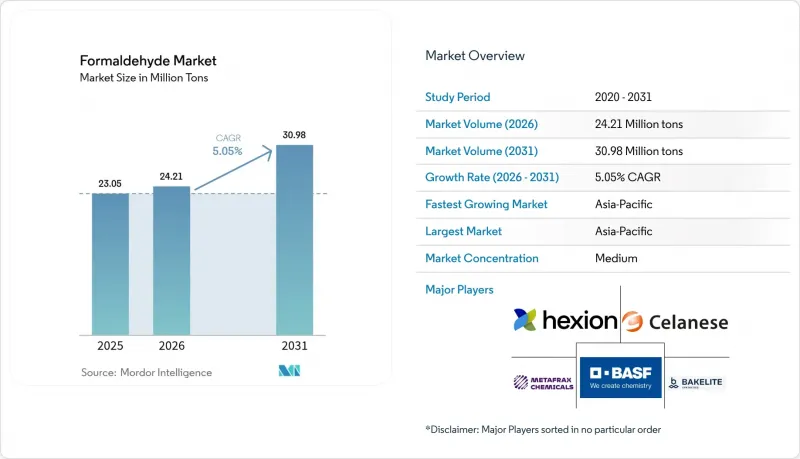
本報告依衍生物(脲醛樹脂、酚醛樹脂、六亞甲四胺等)、終端用戶產業(建築、汽車、農業、醫療等)、生產製程(銀催化劑、鐵鉬催化劑等)及地區(亞太、北美、歐洲、南美、中東和非洲)進行細分。市場預測以噸為單位。
全球甲醛市場趨勢及洞察
建築業對木板的需求
隨著都市化進程的推進,住宅開工量持續成長,導致複合板(主要依賴脲醛樹脂和酚醛樹脂黏合劑)的消耗量增加。儘管中國和印度在提升板材產能方面處於主導,但人工林硬木使用量的增加也要求改進樹脂配方,以在保持黏合強度的同時減少排放。主要板材製造商正在採用先進的清除劑添加劑和催化氧化設備,以滿足加州空氣資源委員會 (CARB) 的監管標準,同時又不影響生產線速度。雖然大豆蛋白基黏合劑等替代化學物質在高檔櫥櫃市場越來越受歡迎,但甲醛樹脂仍然是大眾市場板材最具成本效益的選擇。
汽車產業向聚甲醛(POM)基輕量化零件的轉變
在所有車型燃油效率目標的驅動下,汽車製造商正加速推進以工程熱塑性塑膠取代金屬的進程,其中高剛度密度比的聚甲醛(POM)是其輕量化策略的核心。在電池式電動車(BEV)車型中,該聚合物的耐水解性和介電強度進一步加速了其在電氣連接器和冷卻液管理歧管等領域的應用。位於中西部和東亞汽車產業中心附近的一級供應商已簽署多年契約,供應高純度甲醛,以確保聚合反應的穩定性。觸媒技術的進步提高了甲醇制POM的轉化效率,從而提高了加工能力並降低了每噸產品的能耗,進而增強了零件的價格競爭力。
室內空氣排放法規
美國環保署 (EPA) 根據《有毒物質控制法案》(TSCA) 於 2024 年作出的裁決,認定 58 種終端用途構成不合理的健康風險,這加速了向超低排放板材的轉型,迫使北美板材廠迅速升級設備。德國、日本和澳洲的類似法規也收緊了排放標準,迫使製造商採用再生熱氧化系統和清除劑樹脂。為遵守這些法規而進行的投資,使得每 30 萬立方公尺板材生產線的資本支出 (CAPEX) 每年增加高達 1,200 萬美元,擠壓了非一體化層壓板製造商的利潤空間。早期採用 Acrodur 水性系統的公司,如今正將其零排放記錄作為差異化優勢進行宣傳,從而獲得溢價。
細分市場分析
2025年,脲醛樹脂在甲醛市場仍佔36.25%的佔有率。這主要歸功於其在膠合板、塑合板和中密度纖維板(MDF)生產線上的經濟高效應用,這些生產線主要服務於亞太地區的經濟適用住宅專案。相較之下,聚甲醛(POM)以6.05%的複合年成長率成長,滿足了精密齒輪和電池組硬體的需求,這些產品對熱循環下的尺寸穩定性要求極高。三聚氰胺甲醛樹脂在耐火層壓板領域仍然佔據重要地位,而酚醛樹脂在需要更高耐熱性的鑄造和拋光盤領域中保持著強勁的需求。儘管對六亞甲四胺四胺的需求趨於穩定,但它仍然是軍用炸藥和工業橡膠硫化過程中不可或缺的原料。
莊信萬豐公司持續創新「FORMOX」品牌催化劑塗層技術,取得了一系列漸進式改進,包括選擇性提高1.5%,反應器溫度降低15 度C,這尤其有利於提高聚甲醛(POM)的經濟效益。綜合樹脂生產商正將業務多元化拓展至多聚甲醛和1,4-丁二醇領域,以應對脲醛樹脂供應週期性波動的影響,在充分利用現有甲醛資產的同時,提升產品價值。
區域分析
亞太地區憑藉其作為甲醛生產和消費中心的雙重角色,鞏固了其在甲醛市場的領先地位,預計到2025年將佔據51.88%的市場佔有率,並在2031年之前以5.8%的複合年成長率成長。在中國煤炭產區附近建造的甲醇製甲醛一體化生產線具有成本優勢,而脫碳目標正吸引新的投資者關注馬來西亞和泰國的天然氣項目。印度政府主導的城市住宅建設持續推動對中密度纖維板(MDF)的需求,港口城市附近的產能正在擴大,以利用甲醇進口。日本和韓國專注於電子產品用甲醛的生產,其高純度產品用於半導體濕蝕刻和電容器封裝。
2024年,北美地區的成長保持平穩或溫和,但該公司在低遊離甲醛(LFF)板材領域保持了技術領先地位。位於奧勒岡州和喬治亞的美國工廠升級了洗滌器和催化氧化系統,以符合美國環保署(EPA)針對有害空氣污染物製定的國家排放標準,但這並未導致產量大幅下降。加拿大充分利用其豐富的針葉林資源,並以魁北克省和不列顛哥倫比亞省的大型木質板材公司所在的綜合樹脂工廠為基礎。墨西哥毗鄰美國汽車工廠,刺激了對聚甲醛(POM)的需求,其中巴希奧地區被視為需求中心。
儘管歐洲關於循環經濟和揮發性有機化合物(VOC)法規的政策抑制了生產成長,但同時也推動了產品結構向高利潤、低排放樹脂的轉變。德國和波蘭的消費量合計佔歐洲總消費量的40%以上,德國企業正在投資生物甲醇試點計畫以規避碳風險。北歐板材製造商正在研發木質素替代品,但仍繼續採購甲醛作為結構芯材。
南美洲和中東/非洲的市場滲透率正在提高,儘管規模較小。在巴西,景氣衰退後建設業的復甦帶動了南里奧格蘭德州甲醛基板材產能的擴張。同時,甲醇資源豐富的沙烏地阿拉伯正考慮根據「2030願景」的多元化目標,發展下游甲醛和尿素業務。
其他好處:
- Excel格式的市場預測(ME)表
- 3個月的分析師支持
目錄
第1章:引言
- 研究假設和市場定義
- 調查範圍
第2章:調查方法
第3章執行摘要
第4章 市場狀況
- 市場概覽
- 市場促進因素
- 對木質板材建築的需求
- 汽車產業轉向輕質聚甲醛(POM)零件的轉變
- 開發中國家化肥產業的擴張
- 疫苗和消毒劑中的醫療應用
- 在化學產品製造的應用擴展
- 市場限制因素
- 室內空氣排放法規
- 化妝品和消費品相關法規
- 甲醇原料價格波動
- 價值鏈分析
- 波特五力模型
第5章 市場規模與成長預測
- 導數
- 尿素甲醛(UF)
- 酚醛樹脂(PF)
- 三聚氰胺甲醛(MF)
- 聚甲醛(POM)
- 六亞甲四胺
- 其他衍生物(MDI、1,4-丁二醇、多聚甲醛)
- 按最終用戶行業分類
- 建造
- 車
- 農業
- 衛生保健
- 化工/石油化工
- 其他終端用戶產業(油漆、紡織品等)
- 透過生產過程
- 銀催化劑(福爾莫克斯)工藝
- 鐵鉬基催化劑工藝
- 金屬氧化物混合催化劑工藝
- 按地區
- 亞太地區
- 中國
- 日本
- 印度
- 韓國
- 東南亞國協
- 其他亞太國家
- 北美洲
- 美國
- 加拿大
- 墨西哥
- 歐洲
- 德國
- 英國
- 法國
- 義大利
- 西班牙
- 俄羅斯
- 北歐國家
- 其他歐洲國家
- 南美洲
- 巴西
- 阿根廷
- 其他南美國家
- 中東和非洲
- 沙烏地阿拉伯
- 南非
- 其他中東和非洲國家
- 亞太地區
第6章 競爭情勢
- 市場集中度
- 策略趨勢
- 市佔率和排名分析
- 公司簡介
- BASF
- Acron
- Bakelite Synthetics
- Balaji Formalin Pvt. Ltd.
- Capital Resin Corporation
- Celanese Corporation
- Dynea AS
- Ercros SA
- Foremark Performance Chemicals
- Frati Luigi SpA
- Hexion Inc.
- Kanoria Chemicals & Industries Ltd.
- Metafrax Chemicals
- Perstorp
- Simalin Chemical Industries Pvt Ltd
第7章 市場機會與未來展望
According to Mordor Intelligence, the formaldehyde market size was valued at 23.05 Million tons in 2025 and estimated to grow from 24.21 Million tons in 2026 to reach 30.98 Million tons by 2031, at a CAGR of 5.05% during the forecast period (2026-2031).
This report is Segmented by Derivative (Urea Formaldehyde, Phenol Formaldehyde, Hexamine, and More), End-User Industry (Construction, Automotive, Agriculture, Healthcare, and More), Production Process (Silver Catalyst, Iron-Molybdenum Catalyst, and More), and Geography (Asia-Pacific, North America, Europe, South America, and Middle East and Africa). The Market Forecasts are Provided in Terms of Volume (tons).
Global Formaldehyde Market Trends and Insights
Construction Demand for Wood Panels
Urbanization continues to elevate housing starts, which in turn lifts engineered-wood consumption that relies on urea-formaldehyde and phenol-formaldehyde binders. China and India dominate incremental panel capacity, yet rising plantation hardwood use demands modified resin formulations that preserve bond strength while lowering emissions. Tier-1 panel producers deploy advanced scavenger additives and catalytic oxidation units to meet California Air Resources Board limits without sacrificing line speed. Although alternative chemistries such as soy-protein adhesives gain traction in premium cabinetry, formaldehyde resins remain cost-optimal for mass-market boards.
Automotive Shift to Polyoxymethylene (POM)-based Lightweight Parts
Fleet-wide fuel-economy targets spur automakers to replace metal with engineering thermoplastics, placing Polyoxymethylene (POM) at the center of light-weighting strategies due to its high stiffness-to-density ratio. Battery-electric models further accelerate POM uptake in electrical connectors and coolant-management manifolds because the polymer offers dielectric strength alongside hydrolysis resistance . Tier-1 suppliers situated near Midwest and East-Asian vehicle hubs secure multi-year contracts that guarantee formaldehyde of tight purity for stable polymerization. Catalyst advances improve methanol-to-POM conversion, yielding higher throughput and lower per-ton energy consumption, benefits that cascade into competitive component pricing.
Indoor-air Emission Regulations
The Environmental Protection Agency (EPA)'s 2024 TSCA determination that 58 end uses pose unreasonable health risks accelerates the shift to ultra-low-emission boards, requiring immediate retooling at North American panel mills. Similar rules in Germany, Japan, and Australia tighten emission thresholds, pushing producers to install regenerative thermal oxidizers and to adopt scavenger resins. Compliance investments raise capex by up to USD 12 million for a 300,000 m3/year board line, squeezing margins for non-integrated laminators. Firms that moved early on Acrodur water-based systems now market emission-free credentials as a price-premium differentiator .
Other drivers and restraints analyzed in the detailed report include:
- Fertilizer Sector Expansion in Developing Economies
- Healthcare Use in Vaccines and Disinfectants
- Methanol Feedstock Price Volatility
For complete list of drivers and restraints, kindly check the Table Of Contents.
Segment Analysis
Urea-formaldehyde retained 36.25% of the Formaldehyde market share in 2025, anchored by cost-efficient adoption across plywood, particleboard, and Medium Density Fiberboard (MDF) lines servicing affordable housing programs in Asia-Pacific. Polyoxymethylene (POM), in contrast, expands at a 6.05% CAGR by capturing demand for precision gearwheels and battery-package hardware where dimensional stability under thermal cycling is critical. Melamine-formaldehyde retains relevance for fire-resistant laminates, whereas phenol-formaldehyde persists in foundry and abrasive discs requiring higher thermal endurance. Hexamine demand plateaus but remains essential in military-grade explosives and industrial rubber vulcanization.
Continued innovation in catalyst coatings under Johnson Matthey's FORMOX label delivers incremental gains-1.5% higher selectivity and 15°C lower reactor temperature-significantly benefiting POM economics in particular. Integrated resin producers diversify into paraformaldehyde and 1,4-butanediol to hedge against UF cyclicality, leveraging existing formaldehyde assets while ascending the value curve.
Complete Report Scope:
- By Derivative
- Urea Formaldehyde (UF)
- Phenol Formaldehyde (PF)
- Melamine Formaldehyde (MF)
- Polyoxymethylene (POM)
- Hexamine
- Other Derivatives (MDI, 1,4-Butanediol, Para-formaldehyde)
- By End-user Industry
- Construction
- Automotive
- Agriculture
- Healthcare
- Chemicals and Petrochemicals
- Other End-user Industries (Paints, Textiles and Others, etc.)
- By Production Process
- Silver Catalyst (Formox) Process
- Iron-Molybdenum Catalyst Process
- Metal Oxide Mixed Catalyst Process
- By Geography
- Asia-Pacific
- China
- Japan
- India
- South Korea
- ASEAN Countries
- Rest of Asia-Pacific
- North America
- United States
- Canada
- Mexico
- Europe
- Germany
- United Kingdom
- France
- Italy
- Spain
- Russia
- NORDIC Countries
- Rest of Europe
- South America
- Brazil
- Argentina
- Rest of South America
- Middle East and Africa
- Saudi Arabia
- South Africa
- Rest of Middle East and Africa
- Asia-Pacific
Geography Analysis
Asia-Pacific's dual role as the production and consumption center cements its Formaldehyde market leadership, accounting for a 51.88% Formaldehyde market share in 2025 and tracking toward a 5.8% CAGR through 2031. China's integrated methanol-to-formaldehyde lines near coal basins offer cost advantages, yet decarbonization goals are steering new investors toward gas-fed projects in Malaysia and Thailand. Government-backed urban housing in India unlocks continuous Medium Density Fiberboard (MDF) demand, prompting capacity additions near port cities to exploit methanol imports. Japan and South Korea specialize in electronics-grade formaldehyde, diverting high-purity output into semiconductor wet-etch and capacitor encapsulants.
North America posted flat to modest growth in 2024 but retains technological leadership in low-free formaldehyde (LFF) panels. United States facilities in Oregon and Georgia upgraded scrubbers and catalytic oxidizers to comply with the EPA National Emission Standards for Hazardous Air Pollutants without material production curtailment. Canada benefits from vast softwood resources, anchoring resin plants integrated with wood-panel giants in Quebec and British Columbia. Mexico's proximity to United States auto plants stimulates POM off-take, positioning the Bajio region as a demand node.
Europe's policy stance on circularity and Volatile Organic Compound (VOC) limits restrains volume growth but skews the product mix toward high-margin low-emission resins. Germany and Poland together account for over 40% of European consumption, with German players investing in bio-methanol pilots to hedge carbon exposure. Nordic panel producers deploy lignin-substitution R&D yet continue purchasing formaldehyde for structural cores.
South America and the Middle East & Africa, though smaller, show rising penetration. Brazil's construction rebound after economic downturns drives formaldehyde-based panel capacity in Rio Grande do Sul. Meanwhile, methanol-rich Saudi Arabia evaluates downstream formaldehyde-UF ventures aligned with Vision 2030 diversification targets.
- BASF
- Acron
- Bakelite Synthetics
- Balaji Formalin Pvt. Ltd.
- Capital Resin Corporation
- Celanese Corporation
- Dynea AS
- Ercros S.A.
- Foremark Performance Chemicals
- Frati Luigi S.p.A
- Hexion Inc.
- Kanoria Chemicals & Industries Ltd.
- Metafrax Chemicals
- Perstorp
- Simalin Chemical Industries Pvt Ltd
Additional Benefits:
- The market estimate (ME) sheet in Excel format
- 3 months of analyst support
TABLE OF CONTENTS
1 Introduction
- 1.1 Study Assumptions and Market Definition
- 1.2 Scope of the Study
2 Research Methodology
3 Executive Summary
4 Market Landscape
- 4.1 Market Overview
- 4.2 Market Drivers
- 4.2.1 Construction Demand for Wood Panels
- 4.2.2 Automotive Shift to Polyoxymethylene (POM)-based Lightweight Parts
- 4.2.3 Fertilizer Sector Expansion in Developing Economies
- 4.2.4 Healthcare Use in Vaccines and Disinfectants
- 4.2.5 Growing Utilization for Chemical Manufacturing
- 4.3 Market Restraints
- 4.3.1 Indoor-air Emission Regulations
- 4.3.2 Cosmetics and Consumer Bans
- 4.3.3 Methanol Feedstock Price Volatility
- 4.4 Value Chain Analysis
- 4.5 Porter's Five Forces
- 4.5.1 Bargaining Power of Suppliers
- 4.5.2 Bargaining Power of Buyers
- 4.5.3 Threat of New Entrants
- 4.5.4 Threat of Substitutes
- 4.5.5 Degree of Competition
5 Market Size and Growth Forecasts (Volume)
- 5.1 By Derivative
- 5.1.1 Urea Formaldehyde (UF)
- 5.1.2 Phenol Formaldehyde (PF)
- 5.1.3 Melamine Formaldehyde (MF)
- 5.1.4 Polyoxymethylene (POM)
- 5.1.5 Hexamine
- 5.1.6 Other Derivatives (MDI, 1,4-Butanediol, Para-formaldehyde)
- 5.2 By End-user Industry
- 5.2.1 Construction
- 5.2.2 Automotive
- 5.2.3 Agriculture
- 5.2.4 Healthcare
- 5.2.5 Chemicals and Petrochemicals
- 5.2.6 Other End-user Industries (Paints, Textiles and Others, etc.)
- 5.3 By Production Process
- 5.3.1 Silver Catalyst (Formox) Process
- 5.3.2 Iron-Molybdenum Catalyst Process
- 5.3.3 Metal Oxide Mixed Catalyst Process
- 5.4 By Geography
- 5.4.1 Asia-Pacific
- 5.4.1.1 China
- 5.4.1.2 Japan
- 5.4.1.3 India
- 5.4.1.4 South Korea
- 5.4.1.5 ASEAN Countries
- 5.4.1.6 Rest of Asia-Pacific
- 5.4.2 North America
- 5.4.2.1 United States
- 5.4.2.2 Canada
- 5.4.2.3 Mexico
- 5.4.3 Europe
- 5.4.3.1 Germany
- 5.4.3.2 United Kingdom
- 5.4.3.3 France
- 5.4.3.4 Italy
- 5.4.3.5 Spain
- 5.4.3.6 Russia
- 5.4.3.7 NORDIC Countries
- 5.4.3.8 Rest of Europe
- 5.4.4 South America
- 5.4.4.1 Brazil
- 5.4.4.2 Argentina
- 5.4.4.3 Rest of South America
- 5.4.5 Middle East and Africa
- 5.4.5.1 Saudi Arabia
- 5.4.5.2 South Africa
- 5.4.5.3 Rest of Middle East and Africa
- 5.4.1 Asia-Pacific
6 Competitive Landscape
- 6.1 Market Concentration
- 6.2 Strategic Moves
- 6.3 Market Share(%)/Ranking Analysis
- 6.4 Company Profiles (includes Global level Overview, Market level overview, Core Segments, Financials as available, Strategic Information, Market Rank/Share for key companies, Products and Services, and Recent Developments)
- 6.4.1 BASF
- 6.4.2 Acron
- 6.4.3 Bakelite Synthetics
- 6.4.4 Balaji Formalin Pvt. Ltd.
- 6.4.5 Capital Resin Corporation
- 6.4.6 Celanese Corporation
- 6.4.7 Dynea AS
- 6.4.8 Ercros S.A.
- 6.4.9 Foremark Performance Chemicals
- 6.4.10 Frati Luigi S.p.A
- 6.4.11 Hexion Inc.
- 6.4.12 Kanoria Chemicals & Industries Ltd.
- 6.4.13 Metafrax Chemicals
- 6.4.14 Perstorp
- 6.4.15 Simalin Chemical Industries Pvt Ltd
7 Market Opportunities and Future Outlook
- 7.1 White-space and Unmet-need Assessment
- 7.2 Research and Development on Formaldehyde Use in Industrial Waste Treatment

 甲醛市場-2026-2032年全球市場預測六亞甲四胺市場-2026-2032年全球市場預測
 甲醛市場:依衍生物、最終用途及地區分類甲醛次硫酸鈉市場:按類型、形態、應用和最終用途行業分類-2026-2032年全球市場預測
 2026年全球馬尿酸甲胺片市場報告
 2026-2034年全球甲醛市場規模、佔有率、趨勢和成長分析報告2026年全球甲醛市場報告
 甲胺市場-全球產業規模、佔有率、趨勢、機會、預測:按應用、銷售管道、地區和競爭格局分類,2021-2031年
 甲醛市場機會、成長要素、產業趨勢分析及預測(2026年至2035年)甲醛市場-全球產業規模、佔有率、趨勢、機會及預測,依衍生性商品、最終用戶、地區及競爭狀況細分,2020-2030年