


 |
市場調查報告書
商品編碼
2117204
IT資產處置:市場佔有率分析、產業趨勢與統計、成長預測(2026-2031年)IT Asset Disposition - Market Share Analysis, Industry Trends & Statistics, Growth Forecasts (2026 - 2031) |
||||||

※ 本網頁內容可能與最新版本有所差異。詳細情況請與我們聯繫。
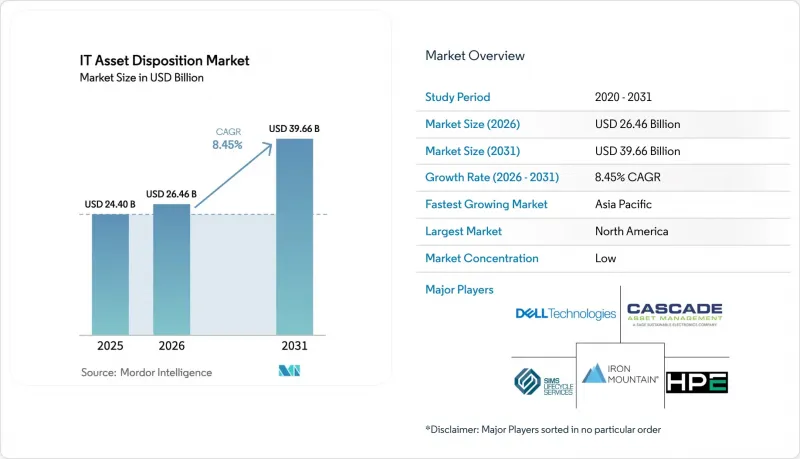
根據 Mordor Intelligence 預測,IT 資產處置市場規模將從 2025 年的 244 億美元成長到 2026 年的 264.6 億美元,然後在 2031 年達到 396.6 億美元,2026 年至 2031 年的複合年成長率為 8.45%。
本報告按服務(資料擦除和銷毀、轉售/再行銷、回收和材料回收、逆向物流和倉儲、全端資產生命週期管理)、資產類型(桌上型電腦/筆記型電腦、行動裝置、伺服器等)、公司規模(大型企業、中小企業)、最終用戶產業(銀行、金融服務和保險、IT和電信、醫療保健等)以及大型企業、中小企業)、最終用戶業(銀行、金融服務和保險、IT和電信、醫療保健等)以及大型企業、中小企業)、最終用戶業(銀行、金融服務和保險、IT和電信、醫療保健等)以及大型企業、中小企業)、最終用戶業(銀行、金融服務和保險、IT和電信、醫療保健等)以及大型企業、中小企業)、最終用戶業(銀行、金融服務和保險、IT和電信、醫療保健等)以及大型企業、中小企業)、最終用戶業(銀行、金融服務和保險、IT和電信、醫療保健等)以及大型企業、中小企業)、最終用戶業(銀行、金融服務和保險、IT和電信、醫療保健等)以及大型企業、中小企業)、最終用戶業(銀行、金融服務和保險、IT和電信、醫療保健等)以及大型企業、中小企業)、最終用戶業(銀行、金融服務和保險、IT和電信地區進行分類。
全球IT資產處置市場的趨勢與洞察
人工智慧資料中心更新周期快速擴展
人工智慧最佳化基礎設施的加速更新周期正以前所未有的速度推動大量硬體湧入IT資產處置市場。隨著企業向人工智慧設備轉型,預計到2025年將有2.4億台Windows 10 PC被報廢,這將迫使處置業者擴大處理能力,同時加強資料擦除流程。 2022年,資料中心產生了6,190萬噸電子廢棄物,但只有22.3%通過正規回收利用,凸顯了認證供應商為彌補這一缺口所做的快速努力。微軟對Cyclic Materials的投資標誌著從廢棄硬碟中回收稀土元素的趨勢,將資料安全與先進的材料提取技術緊密聯繫起來。提供整合切碎機、消磁和精密金屬分離服務的供應商正在實現利潤最大化。隨著人工智慧工作負載的擴展,對伺服器級GPU的需求將會增加,進一步縮短伺服器更換週期,這將支撐IT資產處置市場的長期成長。
包含逆向物流條款的設備即服務 (DaaS) 合約。
設備即服務 (DaaS) 模式將報廢責任從買方轉移到賣方,從而確保了認證的回收管道並穩定了處置量。 Cascade Asset Management 對 55 家公司進行的 2025 年調查發現,34% 的受訪者已將 ESG(環境、社會和治理)標準納入其 IT 採購流程,高於兩年前的 18%。龐大且分散的員工隊伍依賴宅配回收和檢驗的存儲歷史記錄追蹤,這促使處置公司投資於地理圍欄調度軟體和防篡改包裝。標準化的退貨條款抑制了灰色市場的流通,並提高了再行銷通路需求預測的準確性。從長遠來看,整合的逆向物流有望規範再交易流程,並有助於穩定 IT 資產處置市場中翻新筆記型電腦和智慧型手機的價格。
碎片化世界的監管鏈標準
跨國公司常面臨各國在廢棄物分類、運輸許可和資料抹除認證方面法規不一致的問題。歐洲工業圓桌會議列出了100多項監管障礙,這些障礙將在2025年前阻礙電子廢棄物的跨境流動,其中包括鋰離子電池運輸要求的差異。將於2025年1月生效的《巴塞爾公約》修正案要求出口商對許多類別的電子廢料獲得事先知情同意(PIC),這增加了運輸時間和行政負擔。雖然跨國處置公司可以透過其合規部門承擔這些成本,但小規模的專業公司卻面臨利潤空間被壓縮甚至被迫剝離的風險,從而減緩了IT資產處置市場的整體成長。
細分市場分析
到2025年,轉售和再行銷將佔IT資產處置市場收入的36.95%,憑藉對二手設備的穩定需求,構成IT資產處置市場的基礎。然而,快速成長的「全端資產生命週期管理」套件預計將在預測期內推動其在整體IT資產處置市場中的佔有率成長,複合年成長率將達到12.25%。企業正在將採購、維護和處置整合到單一的主服務合約中,以簡化合規流程,並在採購週期的早期階段了解剩餘價值。
此全端式方案整合了部署時的資產標籤、處置時的韌體擦除以及釹等關鍵礦物的材料回收。供應商透過結合即時庫存入口網站、認證物流和下游精煉夥伴關係,即使在純粹的轉售利潤趨於同質化的情況下,也能保持價格競爭力。這種整合方法模糊了IT資產處置(ITAD)和託管服務之間的界限,進一步提高了IT資產處置市場的客戶留存率。
2025年,受企業行動裝置持續升級的推動,桌上型電腦和筆記型電腦將佔IT資產處置市場的30.45%。然而,隨著超大規模資料中心業者以高密度GPU節點取代x86機架,伺服器的規模預計將以12%的複合年成長率成長,從而提升其在IT資產處置市場的佔有率。機架級處置的物流難度日益增加,現場切碎機和按序號追蹤組件的做法越來越受歡迎。
配備人工智慧加速器的刀片伺服器在二手市場價格高昂,需要精心維護其外觀才能最大程度地提高轉售價值。此外,融合式基礎架構基礎設施中儲存、運算和網路的整合也為處置專家帶來了技術難題。能夠拆卸固態硬碟、安全擦除資料並同時回收散熱器銅的公司,最有可能在IT資產處置市場中抓住成長機會。
區域分析
到 2025 年,北美將佔銷售額的 41.35%,這得益於美國證券交易委員會 (SEC) 的氣候變遷資訊揭露、成熟的二手硬體分銷管道以及 R2v3 等已建立的認證協議。透過 Carahsoft 等經銷商獲得的政府合約穩定了聯邦政府的需求,並維持了德克薩斯州、俄亥俄州和安大略省切碎機設施的高運轉率。
在歐洲,循環經濟目標正透過《永續消費品指令》(CSRD)和《廢棄電子電氣設備指令》(WEEE)等法律法規來推廣,而完善的文件記錄是企業競爭優勢的關鍵所在。歐盟內部法規的差異雖然增加了合規成本,但也為能夠應對多語言審查的供應商提供了設定溢價的機會。巴塞爾公約出口管制條款的修訂使跨海峽貿易的行政程序變得複雜,這為在德國、法國和北歐國家擁有本地處理能力的廢棄物處理公司帶來了優勢。
亞太地區正以12.8%的複合年成長率快速擴張,反映出數位政府專案和超大規模投資的快速發展。 SK Tess與VSD Holdings的合資企業計劃於2026年初在河內開設一家工廠,凸顯了東南亞地區從回收向全面處置的轉變。中國的「生產者延伸責任制」(EPR)法規和印度修訂後的《電子廢棄物(管理)法》要求原始設備製造商(OEM)證明其在國內的回收利用能力,這為全球IT資產處置(ITAD)品牌透過獲得本地授權的夥伴關係關係進入市場提供了契機。這些趨勢共同作用,不僅使IT資產處置市場的收入來源多元化,也有助於外匯匯率風險。
其他好處:
- Excel格式的市場預測(ME)表
- 3個月的分析師支持
目錄
第1章:引言
- 研究假設和市場定義
- 調查範圍
第2章:調查方法
第3章執行摘要
第4章 市場狀況
- 市場概覽
- 市場促進因素
- 人工智慧資料中心的更新換代週期正在迅速加快。
- 包含逆向物流條款的設備即服務 (DaaS) 合約
- 強制性碳計量揭露(SEC、CSRD)正在推高對ITAD的需求。
- ESG掛鉤信用定價評估經認證的循環技術實務。
- 面向新興地區傳統伺服器的超大規模資料中心業者的「出售和再投資」模式。
- 隨著向後量子密碼學的過渡,本地部署的 HSM/TPM 將被淘汰。
- 市場限制因素
- 全球監管鏈標準不一致
- 經認證的資料抹除人員短缺
- 物流公司的電池火災保險費
- 灰色市場出口的擴大給價格帶來了壓力。
- 監理情勢
- 技術展望
- 波特五力分析
第5章 市場規模與成長預測
- 按服務
- 資料清除和銷毀
- 轉售/再行銷
- 回收和資源回收
- 逆向物流和倉儲業
- 全端資產生命週期管理
- 按資產類型分類
- 桌上型電腦/筆記型電腦
- 行動裝置
- 伺服器
- 儲存裝置
- 網路和邊緣設備
- 其他
- 按公司規模
- 大公司
- 小型企業
- 按最終用戶行業分類
- BFSI
- IT/通訊
- 衛生保健
- 政府和公共機構
- 工業和能源
- 教育及其他
- 按地區
- 北美洲
- 美國
- 加拿大
- 歐洲
- 德國
- 英國
- 法國
- 其他歐洲國家
- 亞太地區
- 中國
- 日本
- 印度
- 韓國
- 其他亞太國家
- 南美洲
- 巴西
- 其他南美國家
- 中東和非洲
- 中東
- GCC
- 土耳其
- 非洲
- 南非
- 其他非洲國家
- 北美洲
第6章 競爭情勢
- 市場集中度
- 策略趨勢
- 市佔率分析
- 公司簡介
- Iron Mountain
- Dell Technologies
- Sims Lifecycle Services
- Hewlett Packard Enterprise
- Cascade Asset Management
- Apto Solutions
- SK tes
- Ingram Micro
- Procurri
- Wisetek
- Sage Sustainable Electronics
- Arrow Value Recovery
- DMD Systems
- CloudBlue
- Celestica
- IBM Global Asset Recovery
- Global Resale
- TES-AMM
- ERI
- PlanITROI
第7章 市場機會與未來展望
According to Mordor Intelligence, the IT asset disposition market size is expected to grow from USD 24.4 billion in 2025 to USD 26.46 billion in 2026 and is forecast to reach USD 39.66 billion by 2031 at 8.45% CAGR over 2026-2031.
This report is Segmented by Service (Data Sanitisation and Destruction, Resale / Remarketing, Recycling and Material Recovery, Reverse Logistics and Warehousing, Full-Stack Asset Lifecycle Management), Asset Type (Desktop / Laptop, Mobile Devices, Servers, and More), Enterprise Size (Large Enterprises, Small and Medium Enterprises), End-User Industry (BFSI, IT and Telecom, Healthcare, and More), and Geography.
Global IT Asset Disposition Market Trends and Insights
Explosion of AI-ready Data-Centre Refresh Cycles
Compressed refresh intervals for AI-optimized infrastructure are channeling unprecedented hardware volumes into the IT asset disposition market. Enterprises are retiring an estimated 240 million Windows 10 PCs during 2025 as they transition to AI-capable devices, forcing disposition providers to expand capacity while elevating data-sanitization rigor. Data centers generated 61.9 million metric tonnes of e-waste in 2022, yet formal recycling captured only 22.3% of that stream, underscoring a gap that certified vendors are rushing to fill. Microsoft's investment in Cyclic Materials illustrates the pivot toward rare-earth recovery from retired hard drives, intertwining data security with advanced materials extraction. Providers able to integrate shredding, degaussing, and precision metals separation now command premium margins. As AI workloads proliferate, demand for server-grade GPUs will further compress server refresh timelines, sustaining long-run growth for the IT asset disposition market.
Device-as-a-Service Contracts Embedding Reverse-Logistics Clauses
DaaS models shift end-of-life obligations from buyers to vendors, guaranteeing certified take-back pathways and stabilizing disposition volumes. The 2025 Cascade Asset Management survey of 55 enterprises reported that 34% of respondents embed ESG benchmarks in IT procurement, up from 18% two years earlier. Large, distributed workforces rely on courier-based pick-up and validated chain-of-custody tracking, which is prompting disposition firms to invest in geofenced scheduling software and tamper-evident packaging. Standardized return clauses reduce leakage into grey markets and improve forecasting for remarketing channels. Over the long term, embedded reverse logistics is expected to normalize re-commerce flows, underpinning price stability for refurbished laptops and smartphones in the IT asset disposition market.
Fragmented Global Chain-of-Custody Standards
Multinational corporations often wrestle with conflicting national rules on waste classification, shipment permits, and data-destruction attestations. The European Round Table for Industry catalogued more than 100 regulatory barriers hampering cross-border e-waste flows in 2025, including diverging lithium-ion battery transit requirements. Basel Convention amendments effective January 2025 now obligate exporters to secure prior informed consent for many e-scrap categories, prolonging transit times and elevating administrative overhead. Disposition firms with multinational footprints absorb these costs through compliance departments, but smaller specialists lose margin or cede business, tempering overall IT asset disposition market growth.
Other drivers and restraints analyzed in the detailed report include:
- Mandatory Carbon-Accounting Disclosures Elevating ITAD Demand
- ESG-Linked Credit Pricing Rewarding Certified Circular-Tech Practices
- Talent Shortages in Certified Data-Destruction Operatives
For complete list of drivers and restraints, kindly check the Table Of Contents.
Segment Analysis
Resale and remarketing captured 36.95% of 2025 revenue, anchoring the IT asset disposition market through predictable secondary-device demand. Yet the fast-growing Full-Stack Asset Lifecycle Management suite is posting a 12.25% CAGR that will lift its contribution within the overall IT asset disposition market size over the forecast period. Enterprises are bundling procurement, maintenance, and disposition under a single master service agreement to simplify compliance and unlock residual-value insights early in the buying cycle.
Full-stack programs integrate asset tagging at deployment, firmware erasure at retirement, and materials reclamation for critical minerals such as neodymium. Providers that combine real-time inventory portals, certified logistics, and downstream refining partnerships can defend pricing, even as pure-play resale margins commoditize. This integrated stance blurs the line between ITAD and managed services, deepening stickiness in the IT asset disposition market.
Desktop and laptop devices held 30.45% of the IT asset disposition market share in 2025 due to persistent enterprise mobility refreshes. However, server volumes are slated to expand at a 12% CAGR, enlarging their slice of the IT asset disposition market size as hyperscalers replace x86 racks with GPU-dense nodes. Rack-scale retirements favor on-site shredding and serialized component tracking, elevating logistics complexity.
Blades housing AI accelerators fetch a premium in secondary markets, encouraging meticulous cosmetic handling to maximize resale value. The convergence of storage, compute, and networking within hyper-converged infrastructure also raises the technical bar for disposition specialists. Firms capable of separating solid-state drives for secure erasure while harvesting heat-sink copper are best positioned to capture upside in the IT asset disposition market.
Complete Report Scope:
- By Service
- Data Sanitisation and Destruction
- Resale / Remarketing
- Recycling and Material Recovery
- Reverse Logistics and Warehousing
- Full-Stack Asset Lifecycle Management
- By Asset Type
- Desktop / Laptop
- Mobile Devices
- Servers
- Storage Devices
- Networking and Edge Equipment
- Others
- By Enterprise Size
- Large Enterprises
- Small and Medium Enterprises
- By End-user Industry
- BFSI
- IT and Telecom
- Healthcare
- Government and Public Institutions
- Industrial and Energy
- Education and Others
- By Geography
- North America
- United States
- Canada
- Europe
- Germany
- United Kingdom
- France
- Rest of Europe
- Asia-Pacific
- China
- Japan
- India
- South Korea
- Rest of Asia-Pacific
- South America
- Brazil
- Rest of South America
- Middle East and Africa
- Middle East
- GCC
- Turkey
- Africa
- South Africa
- Rest of Africa
- North America
Geography Analysis
North America retained a 41.35% revenue stake in 2025, underpinned by SEC climate disclosures, mature secondary-hardware channels, and entrenched certification protocols such as R2v3. Government contracts accessed through distributors like Carahsoft ensure predictable federal demand, keeping utilization rates high for shredding plants in Texas, Ohio, and Ontario.
Europe leverages CSRD and WEEE legislation to enforce circular-economy targets, making documentation depth a competitive differentiator. Regulatory heterogeneity across the bloc heightens compliance costs but also invites premium pricing for vendors that can navigate multi-language audit regimes. Basel Convention export revisions add administrative layers for cross-channel flows, favoring disposition firms with local processing capacity in Germany, France, and the Nordics.
Asia-Pacific is expanding at a 12.8% CAGR, reflecting digital government programs and booming hyperscale investments. SK Tes's joint venture with VSD Holdings will open a Hanoi plant by early 2026, underlining Southeast Asia's shift from collection to full processing. Chinese Extended Producer Responsibility rules and India's e-Waste (Management) Amendment impel OEMs to prove domestic recycling, presenting an entry path for global ITAD brands through licensed local partnerships. Together these dynamics diversify revenue for the IT asset disposition market and hedge currency risk.
- Iron Mountain
- Dell Technologies
- Sims Lifecycle Services
- Hewlett Packard Enterprise
- Cascade Asset Management
- Apto Solutions
- SK tes
- Ingram Micro
- Procurri
- Wisetek
- Sage Sustainable Electronics
- Arrow Value Recovery
- DMD Systems
- CloudBlue
- Celestica
- IBM Global Asset Recovery
- Global Resale
- TES-AMM
- ERI
- PlanITROI
Additional Benefits:
- The market estimate (ME) sheet in Excel format
- 3 months of analyst support
TABLE OF CONTENTS
1 INTRODUCTION
- 1.1 Study Assumptions and Market Definition
- 1.2 Scope of the Study
2 RESEARCH METHODOLOGY
3 EXECUTIVE SUMMARY
4 MARKET LANDSCAPE
- 4.1 Market Overview
- 4.2 Market Drivers
- 4.2.1 Explosion of AI-Ready Data-Centre Refresh Cycles
- 4.2.2 Device-As-A-Service (Daas) Contracts Embedding Reverse-Logistics Clauses
- 4.2.3 Mandatory Carbon-Accounting Disclosures (SEC, CSRD) Elevating ITAD Demand
- 4.2.4 ESG-Linked Credit Pricing Rewarding Certified Circular-Tech Practices
- 4.2.5 Hyperscaler Divest-to-Invest Model for Legacy Servers in Emerging Regions
- 4.2.6 On-Premise HSM/TPM Retirement Triggered by Post-Quantum Crypto Migrations
- 4.3 Market Restraints
- 4.3.1 Fragmented Global Chain-of-Custody Standards
- 4.3.2 Talent Shortages in Certified Data-Destruction Operatives
- 4.3.3 Battery-Fire Insurance Premiums for Logistics Providers
- 4.3.4 Growing Grey-Market Exports Driving Price Compression
- 4.4 Regulatory Landscape
- 4.5 Technological Outlook
- 4.6 Porter's Five Forces Analysis
- 4.6.1 Bargaining Power of Suppliers
- 4.6.2 Bargaining Power of Buyers
- 4.6.3 Threat of New Entrants
- 4.6.4 Threat of Substitute Products
- 4.6.5 Intensity of Competitive Rivalry
5 MARKET SIZE AND GROWTH FORECASTS (VALUE)
- 5.1 By Service
- 5.1.1 Data Sanitisation and Destruction
- 5.1.2 Resale / Remarketing
- 5.1.3 Recycling and Material Recovery
- 5.1.4 Reverse Logistics and Warehousing
- 5.1.5 Full-Stack Asset Lifecycle Management
- 5.2 By Asset Type
- 5.2.1 Desktop / Laptop
- 5.2.2 Mobile Devices
- 5.2.3 Servers
- 5.2.4 Storage Devices
- 5.2.5 Networking and Edge Equipment
- 5.2.6 Others
- 5.3 By Enterprise Size
- 5.3.1 Large Enterprises
- 5.3.2 Small and Medium Enterprises
- 5.4 By End-user Industry
- 5.4.1 BFSI
- 5.4.2 IT and Telecom
- 5.4.3 Healthcare
- 5.4.4 Government and Public Institutions
- 5.4.5 Industrial and Energy
- 5.4.6 Education and Others
- 5.5 By Geography
- 5.5.1 North America
- 5.5.1.1 United States
- 5.5.1.2 Canada
- 5.5.2 Europe
- 5.5.2.1 Germany
- 5.5.2.2 United Kingdom
- 5.5.2.3 France
- 5.5.2.4 Rest of Europe
- 5.5.3 Asia-Pacific
- 5.5.3.1 China
- 5.5.3.2 Japan
- 5.5.3.3 India
- 5.5.3.4 South Korea
- 5.5.3.5 Rest of Asia-Pacific
- 5.5.4 South America
- 5.5.4.1 Brazil
- 5.5.4.2 Rest of South America
- 5.5.5 Middle East and Africa
- 5.5.5.1 Middle East
- 5.5.5.2 GCC
- 5.5.5.3 Turkey
- 5.5.6 Africa
- 5.5.6.1 South Africa
- 5.5.6.2 Rest of Africa
- 5.5.1 North America
6 COMPETITIVE LANDSCAPE
- 6.1 Market Concentration
- 6.2 Strategic Moves
- 6.3 Market Share Analysis
- 6.4 Company Profiles (Includes global-level overview, market-level overview, core segments, financials (as available), strategic information, market rank/share, products and services, and recent developments)
- 6.4.1 Iron Mountain
- 6.4.2 Dell Technologies
- 6.4.3 Sims Lifecycle Services
- 6.4.4 Hewlett Packard Enterprise
- 6.4.5 Cascade Asset Management
- 6.4.6 Apto Solutions
- 6.4.7 SK tes
- 6.4.8 Ingram Micro
- 6.4.9 Procurri
- 6.4.10 Wisetek
- 6.4.11 Sage Sustainable Electronics
- 6.4.12 Arrow Value Recovery
- 6.4.13 DMD Systems
- 6.4.14 CloudBlue
- 6.4.15 Celestica
- 6.4.16 IBM Global Asset Recovery
- 6.4.17 Global Resale
- 6.4.18 TES-AMM
- 6.4.19 ERI
- 6.4.20 PlanITROI
7 MARKET OPPORTUNITIES AND FUTURE OUTLOOK
- 7.1 White-space and Unmet-Need Assessment

 歐洲IT資產處置:市場佔有率分析、產業趨勢與統計及成長預測(2026-2031年)
 IT資產處置市場-2026-2032年全球市場預測
 IT資產處置(ITAD)市場:按資產類型、服務、企業規模、最終用戶產業和地區分類
 IT資產處置市場分析及預測(至2035年):按類型、產品類型、服務、技術、組件、應用、流程、最終用戶及解決方案分類
 2026年全球企業IT資產處置市場報告IT資產處置(ITAD)全球市場報告(2026年)
 2026-2030年全球IT資產處分(ITAD)市場
 全球IT資產處置市場規模、佔有率、趨勢和成長分析報告(2026-2034年)
 IT資產再利用市場-全球產業規模、佔有率、趨勢、機會及預測(依產品類型、組織規模、垂直市場、地區及競爭格局分類,2021-2031年)IT資產處置市場-全球產業規模、佔有率、趨勢、機會、預測:按資產類型、最終用途、地區和競爭格局分類,2021-2031年