


 |
市場調查報告書
商品編碼
2116964
歐洲IT資產處置:市場佔有率分析、產業趨勢與統計及成長預測(2026-2031年)Europe IT Asset Disposition - Market Share Analysis, Industry Trends & Statistics, Growth Forecasts (2026 - 2031) |
||||||

※ 本網頁內容可能與最新版本有所差異。詳細情況請與我們聯繫。
據 Mordor Intelligence 稱,2025 年歐洲 IT 資產處置市場價值為 72.1 億美元,預計到 2031 年將從 2026 年的 81.4 億美元成長至 148.9 億美元,預測期(2026-2031 年)的複合年成長率為 12.86%。
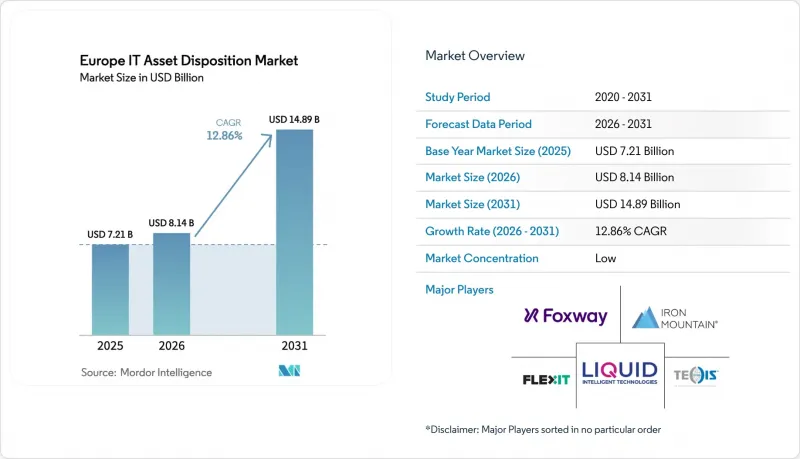
本報告按服務類型(資料擦除/銷毀、再行銷和價值回收等)、資產類型(電腦和筆記型電腦、行動裝置等)、公司規模(大型企業和中小企業)、最終用戶行業(銀行、金融服務和保險、IT和電信等)以及國家/地區進行細分。市場預測以美元計價。
歐洲IT資產處置市場的趨勢與洞察
歐盟2026年的能源標籤法規將加速個人電腦的更新換代。
即將實施的歐盟能源效率標籤制度將有效淘汰低性能電腦,迫使企業在2026年之前更換過時的電腦。許多採購團隊正在累計升級預算,以避免庫存不合規,預計將大幅增加歐洲IT資產處置市場的交易量。能夠及早獲得這些設備的企業,將在二手市場飽和之前,從其高殘值中獲利。這項法規與更廣泛的「永續產品生態設計」框架密切相關,該框架將於2027年引入「數位產品護照」。因此,獲得認證的回收商和翻新商將有機會與大型企業簽訂供應契約,並加快對產能的投資。
公司範圍內的 CSRD 報告推動了經過審計的 ITAD
自2024年1月起,企業社會責任處置(CSRD)要求歐洲約5萬家公司揭露範圍3的碳排放,這使得在設備處置階段進行檢驗的追蹤成為董事會層面的一項挑戰。目前,大型跨國公司在授予處置合約時,不僅考慮價格,還考慮審計準備、儲存歷史的透明度以及碳排放影響報告。擁有整合資料擦除、回收和轉售工作流程(每個流程都配有防篡改文件)的IT資產處置(ITAD)供應商,正在成為提案(RFP)中的首選供應商。例如,在醫療保健行業,選擇能夠證明其符合《醫療保健互通性與課責法案》(HITECH)並減少溫室氣體排放的供應商已成為一種日益成長的趨勢,歐洲IT資產處置市場正朝著服務品質差異化的方向發展。
歐盟27國廢棄電子電氣設備法規的碎片化
由於監管機構對廢棄電子電氣設備(WEEE)法規的解讀存在差異,跨境資產轉移需要遵守多項記錄保存程序,每一項都會增加成本。德國人均電子廢棄物產生量為12.5公斤,與波蘭相對寬鬆的法規形成鮮明對比,迫使供應商持有多個許可證並接受多項審計,這不僅使路線規劃複雜化,還削弱了潛在的規模經濟效益。在監管協調取得進展之前,營運商將面臨重複的合規相關費用以及歐盟內部運輸路線上的海關手續延誤。
細分市場分析
到2025年,「再行銷和價值回收」將佔銷售額的37.12%,凸顯了市場對符合預算和永續性目標的翻新設備的高需求。認證評級和全面的保固計畫讓買家安心,而OEM回收方案則支援最低迴購價格,使供應商能夠在轉售中獲得額外利潤。成長最快的領域是“逆向物流和移除”,其複合年成長率高達13.48%,反映出多站點公司計劃在能源效率標籤到期前同時進行更新。具有安全監管鏈的移除服務價格較高,以確保在運輸過程中資料和品牌的安全。 「租賃歸還和報廢管理」領域受益於金融公司對循環經濟的承諾。隨著客戶逐步符合ISO 27001和NIST SP 800-88協議,資料擦除服務的需求也穩定成長。
整合式合約結構正逐漸成為客戶採購的主流。涵蓋回收、擦除、轉售和報告的單一供應商框架減輕了協調負擔。人工智慧驅動的光學檢測和物聯網 (IoT) 追蹤器提高了產量預測的準確性,並提升了檢測線上的勞動生產力。電池回收和城市採礦服務雖然被歸類為“其他”,但由於原料短缺導致關鍵礦物價值不斷攀升,它們正在這個市場中佔據越來越大的佔有率。精通組件回收和整機轉售的供應商正在提高每公斤收入,並進一步鞏固其平台的競爭優勢。因此,在歐洲 IT 資產處置市場,儘管再行銷技能仍然重要,但物流的精準性也同樣備受重視。
預計到2025年,電腦和筆記型電腦將佔總銷售額的34.92%,這主要得益於企業在2026年前加速的大規模設備升級。然而,從智慧型手機到加固型平板電腦,行動裝置是成長最快的細分市場,複合年成長率高達14.35%。 2-3年的短更換週期和自帶設備辦公室(BYOD)趨勢正在推動銷量成長,而非洲和東南亞強勁的二手設備需求則推高了平均售價。伺服器和儲存陣列雖然銷量較小,但由於採用鍍金連接器和鋁製機殼,因此具有很高的價值密度。它們的報廢週期與雲端遷移里程碑相吻合,嚴格的資料擦除要求使其成為安全ITAD供應商利潤豐厚的細分市場。
邊緣運算正在催生新一波遍布零售商店和工業設施的微型伺服器和閘道器,這增加了回收的複雜性。同時,瑞典Advania公司的回收中心凸顯了每年處理一百萬台設備所需的大規模投資,再次印證了處理能力的擴張將決定競爭的走向。電動車充電器和可再生能源控制面板等新興趨勢被歸類為“其他資產”,代表著更廣泛的電子廢棄物,未來十年歐洲IT資產處置市場將面臨這一挑戰。在每個類別中,供應商都必須在安全資料處理和高效材料回收之間取得平衡,以最大限度地提高剩餘價值。
其他好處:
- Excel格式的市場預測(ME)表
- 3個月的分析師支持
目錄
第1章:引言
- 研究假設和市場定義
- 調查範圍
第2章:調查方法
第3章執行摘要
第4章 市場狀況
- 市場概覽
- 市場促進因素
- 歐盟2026年禁止能源標籤的政策將加速個人電腦的更換。
- 公司範圍內的 CSRD 報告推動了經過審計的 ITAD。
- 原廠召回計畫可以彌補轉售利潤損失。
- 向「設備即服務」合約的過渡現在包括了 ITAD(資訊技術資產處置)。
- 將老舊的本地資料中心硬體遷移到雲端
- 私募股權整合正在歐盟各地建立銷售基地。
- 市場限制因素
- 歐盟27個國家在廢棄電子電氣設備(WEEE)法規實施上存在差異
- 通貨膨脹導致物流成本上升,對利潤率帶來壓力。
- 通過灰色市場出口正在減少經認證的回收商的處理量。
- 企業採購負責人對再生產品的印象
- 供應鏈分析
- 監管狀況(WEEE、CSRD、GDPR、維修權)
- 科技趨勢(利用物聯網進行資產追蹤,利用人工智慧評級)
- 波特五力分析
- 供應商的議價能力
- 買方的議價能力
- 新進入者的威脅
- 替代品的威脅
- 競爭公司之間的競爭
- 歐盟資訊技術資產的關鍵指標
- 按裝置類型(PC、筆記型電腦、平板電腦、行動裝置)分類的部署單元數量
- 電子廢棄物產生量百分比(%)
- 歐盟主要國家的回收率
第5章 市場規模與成長預測
- 按服務類型
- 資料清除/銷毀
- 再行銷與價值回收
- 逆向物流和移除
- 租賃物歸還/報廢管理
- 其他
- 按資產類型分類
- 電腦和筆記型電腦
- 行動裝置
- 伺服器和儲存
- 其他
- 按公司規模
- 大公司
- 小型企業
- 按最終用戶行業分類
- BFSI
- IT/通訊
- 衛生保健
- 政府和公共機構
- 製造業
- 其他
- 國家
- 英國
- 德國
- 法國
- 義大利
- 西班牙
- 荷蘭
- 北歐國家(瑞典、丹麥、芬蘭)
- 波蘭
- 俄羅斯
- 其他歐洲國家
第6章 競爭情勢
- 市場集中度
- 策略趨勢
- 市佔率分析
- 公司簡介
- Iron Mountain
- Foxway
- Sims Lifecycle Services
- Econocom Group
- TES(SK ecoplant)
- Dell Technologies Asset Recovery
- HPE Asset Upcycling
- IBM Global Asset Recovery Services
- Flex IT
- Wisetek
- BNP Paribas 3 Step IT
- Liquid Technology
- CentricsIT
- CNE Direct
- TecDis Network
- Sims Recycling Solutions
- Ingram Micro ITAD
- Arrow Electronics
- Dynamic Lifecycle Innovations
- Sipi Asset Recovery
第7章 市場機會與未來展望
According to Mordor Intelligence, the europe iT asset disposition market size was valued at USD 7.21 billion in 2025 and estimated to grow from USD 8.14 billion in 2026 to reach USD 14.89 billion by 2031, at a CAGR of 12.86% during the forecast period (2026-2031).
This report is Segmented by Service Type (Data Sanitization/Destruction, Remarketing and Value Recovery, and More), Asset Type (Computers and Laptops, Mobile Devices, and More), Enterprise Size (Large Enterprises and SMEs), End-User Vertical (BFSI, IT and Telecom, and More), and by Country. The Market Forecasts are Provided in Terms of Value (USD).
Europe IT Asset Disposition Market Trends and Insights
Accelerated PC Refresh from EU 2026 Energy-Label Ban
The upcoming EU energy-efficiency label effectively removes low-performing computers from sale and pushes enterprises to replace legacy PCs before the 2026 deadline. Many procurement teams are front-loading refresh budgets to avoid non-compliant inventory, which is set to lift Europe's IT Asset Disposition market volumes significantly. Providers able to capture these units early profit from higher residual values before secondary-market saturation sets in, and the regulation dovetails with the broader Ecodesign for Sustainable Products framework that introduces Digital Product Passports starting in 2027.As a result, certified recyclers and refurbishers see a window to lock in supply contracts with large corporates and speed up capacity investments.
Corporate-wide CSRD Reporting Pushes Audited ITAD
From January 2024, the CSRD obliges around 50,000 European companies to disclose Scope 3 emissions, making verifiable end-of-life tracking for devices a board-level issue. Large multinationals are now awarding disposition contracts based on audit readiness, chain-of-custody transparency, and carbon-impact reporting rather than unit fees alone. ITAD providers with integrated data-destruction, recycling, and remarketing workflows, each accompanied by tamper-proof documentation, rise to preferred-supplier status in requests for proposals. Healthcare chains, for instance, increasingly select vendors that can prove Health Insurance Portability and Accountability Act (HITECH) compliance alongside greenhouse-gas savings, moving the Europe IT Asset Disposition market toward service-quality differentiation.
Fragmented WEEE Enforcement Across EU-27
Regulators interpret WEEE rules differently, so cross-border asset flows must comply with several record-keeping procedures, each adding cost. Germany's 12.5 kg per-capita e-waste generation contrasts with less-stringent enforcement in Poland, forcing providers to maintain multiple licences and audits, complicating route planning and undermining potential economies of scale. Until harmonisation improves, operators incur duplicated compliance overheads and slower customs clearance on trans-EU lanes.
Other drivers and restraints analyzed in the detailed report include:
- OEM Take-Back Schemes Subsidise Remarketing Margins
- Shift to Device-as-a-Service Contracts Bundles ITAD
- Inflation-Linked Logistics Costs Squeeze Margins
For complete list of drivers and restraints, kindly check the Table Of Contents.
Segment Analysis
Remarketing and Value Recovery held 37.12% of 2025 revenue, underlining the appetite for refurbished gear that meets budget and sustainability goals. Certified grading and robust warranty programs assure buyers, while OEM take-back schemes buttress minimum buy-back prices, letting providers capture extra margin on resale. Reverse Logistics and De-installation, the fastest-growing line at 13.48% CAGR, reflects multi-site enterprises scheduling simultaneous refreshes ahead of the energy-label deadline. Secure chain-of-custody removal services command price premiums, ensuring data and brand protection throughout transit. Lease Return and End-of-Life Management enjoys a tailwind from finance houses keen to present circular-economy credentials. Data Sanitisation gains steady demand as customers align with ISO 27001 and NIST SP 800-88 protocols.
Integrated contract structures dominate client procurement. Single-vendor frameworks covering collection, erasure, resale, and reporting remove coordination overhead. AI-enabled optical inspection and Internet-of-Things (IoT) trackers improve yield forecasting and increase labour productivity on the testing line. Battery-recovery and urban-mining offerings sit in the "Other" bucket and win share in markets where raw-material scarcity raises the value of critical minerals. Providers that master both component harvesting and full-device resale achieve higher return per kilogram and widen the moat around their platforms. The Europe IT Asset Disposition market thus continues to prize remarketing skills while rewarding logistical precision.
Computers and Laptops accounted for 34.92% of 2025 turnover, underpinned by a corporate fleet swap that accelerates through 2026. Yet Mobile Devices, from smartphones to rugged tablets, are the fastest-rising pool at 14.35% CAGR. Shorter two-to-three-year refresh intervals and the bring-your-own-device trend feed unit volumes, while strong secondary demand in Africa and South-East Asia lifts average selling prices. Servers and Storage arrays, although fewer in number, deliver high value density due to gold-plated connectors and aluminium casings. Their disposal schedules align with cloud migration milestones, and strict data-wiping needs make them premium margin for secure ITAD vendors.
Edge computing produces a new wave of micro-servers and gateways scattered across retail or industrial sites, adding collection complexity. Meanwhile, Advania's Swedish refurbishment centre highlights the scale investments needed to process 1 million devices annually, reinforcing how capacity build-outs set the competitive pace. Emerging streams such as electric-vehicle chargers and renewables control boards sit within "Other Assets" and signal the broader electronic-waste spectrum the Europe IT Asset Disposition market will tackle over the next decade. For each category, providers must balance secure data handling against efficient material harvesting to maximise residual values.
Complete Report Scope:
- By Service Type
- Data Sanitization / Destruction
- Remarketing and Value Recovery
- Reverse Logistics and De-installation
- Lease-Return / End-of-Life Mgmt.
- Others
- By Asset Type
- Computers and Laptops
- Mobile Devices
- Servers and Storage
- Others
- By Enterprise Size
- Large Enterprises
- Small and Medium Enterprises
- By End-User Vertical
- BFSI
- IT and Telecom
- Healthcare
- Government and Public Institutions
- Manufacturing
- Others
- By Country
- United Kingdom
- Germany
- France
- Italy
- Spain
- Netherlands
- Nordics (Sweden, Denmark, Finland)
- Poland
- Russia
- Rest of Europe
List of Companies Covered in this Report:
- Iron Mountain
- Foxway
- Sims Lifecycle Services
- Econocom Group
- TES (SK ecoplant)
- Dell Technologies Asset Recovery
- HPE Asset Upcycling
- IBM Global Asset Recovery Services
- Flex IT
- Wisetek
- BNP Paribas 3 Step IT
- Liquid Technology
- CentricsIT
- CNE Direct
- TecDis Network
- Sims Recycling Solutions
- Ingram Micro ITAD
- Arrow Electronics
- Dynamic Lifecycle Innovations
- Sipi Asset Recovery
Additional Benefits:
- The market estimate (ME) sheet in Excel format
- 3 months of analyst support
TABLE OF CONTENTS
1 INTRODUCTION
- 1.1 Study Assumptions and Market Definition
- 1.2 Scope of the Study
2 RESEARCH METHODOLOGY
3 EXECUTIVE SUMMARY
4 MARKET LANDSCAPE
- 4.1 Market Overview
- 4.2 Market Drivers
- 4.2.1 Accelerated PC refresh from EUs 2026 energy-label ban
- 4.2.2 Corporate-wide CSRD reporting pushes audited ITAD
- 4.2.3 OEM take-back schemes subsidize remarketing margins
- 4.2.4 Shift to Device-as-a-Service contracts bundles ITAD
- 4.2.5 Cloud exit from ageing on-premise data-centre hardware
- 4.2.6 Private-equity roll-ups create pan-EU disposal hubs
- 4.3 Market Restraints
- 4.3.1 Fragmented WEEE enforcement across EU-27
- 4.3.2 Inflation-linked logistics costs squeeze margins
- 4.3.3 Grey-market exports erode certified recyclers volume
- 4.3.4 Refurb device stigma among enterprise buyers
- 4.4 Supply-Chain Analysis
- 4.5 Regulatory Landscape (WEEE, CSRD, GDPR, Right-to-Repair)
- 4.6 Technological Outlook (IoT asset-tracking, AI grading)
- 4.7 Porter's Five Force Analysis
- 4.7.1 Bargaining Power of Suppliers
- 4.7.2 Bargaining Power of Buyers
- 4.7.3 Threat of New Entrants
- 4.7.4 Threat of Substitutes
- 4.7.5 Intensity of Competitive Rivalry
- 4.8 Key Metrics for EU IT Assets
- 4.8.1 Installed Base by Device (PC, Laptop, Tablet, Mobile)
- 4.8.2 E-waste Generation Share (%)
- 4.8.3 Recycling Rate by Major EU Countries
5 MARKET SIZE AND GROWTH FORECASTS (VALUE)
- 5.1 By Service Type
- 5.1.1 Data Sanitization / Destruction
- 5.1.2 Remarketing and Value Recovery
- 5.1.3 Reverse Logistics and De-installation
- 5.1.4 Lease-Return / End-of-Life Mgmt.
- 5.1.5 Others
- 5.2 By Asset Type
- 5.2.1 Computers and Laptops
- 5.2.2 Mobile Devices
- 5.2.3 Servers and Storage
- 5.2.4 Others
- 5.3 By Enterprise Size
- 5.3.1 Large Enterprises
- 5.3.2 Small and Medium Enterprises
- 5.4 By End-User Vertical
- 5.4.1 BFSI
- 5.4.2 IT and Telecom
- 5.4.3 Healthcare
- 5.4.4 Government and Public Institutions
- 5.4.5 Manufacturing
- 5.4.6 Others
- 5.5 By Country
- 5.5.1 United Kingdom
- 5.5.2 Germany
- 5.5.3 France
- 5.5.4 Italy
- 5.5.5 Spain
- 5.5.6 Netherlands
- 5.5.7 Nordics (Sweden, Denmark, Finland)
- 5.5.8 Poland
- 5.5.9 Russia
- 5.5.10 Rest of Europe
6 COMPETITIVE LANDSCAPE
- 6.1 Market Concentration
- 6.2 Strategic Moves
- 6.3 Market Share Analysis
- 6.4 Company Profiles (includes global overview, market-level overview, core segments, financials, strategic information, market rank/share, products and services, recent developments)
- 6.4.1 Iron Mountain
- 6.4.2 Foxway
- 6.4.3 Sims Lifecycle Services
- 6.4.4 Econocom Group
- 6.4.5 TES (SK ecoplant)
- 6.4.6 Dell Technologies Asset Recovery
- 6.4.7 HPE Asset Upcycling
- 6.4.8 IBM Global Asset Recovery Services
- 6.4.9 Flex IT
- 6.4.10 Wisetek
- 6.4.11 BNP Paribas 3 Step IT
- 6.4.12 Liquid Technology
- 6.4.13 CentricsIT
- 6.4.14 CNE Direct
- 6.4.15 TecDis Network
- 6.4.16 Sims Recycling Solutions
- 6.4.17 Ingram Micro ITAD
- 6.4.18 Arrow Electronics
- 6.4.19 Dynamic Lifecycle Innovations
- 6.4.20 Sipi Asset Recovery
7 MARKET OPPORTUNITIES AND FUTURE OUTLOOK
- 7.1 White-Space and Unmet-Need Assessment

 IT資產處置:市場佔有率分析、產業趨勢與統計、成長預測(2026-2031年)
 IT資產處置市場-2026-2032年全球市場預測
 IT資產處置(ITAD)市場:按資產類型、服務、企業規模、最終用戶產業和地區分類
 IT資產處置市場分析及預測(至2035年):按類型、產品類型、服務、技術、組件、應用、流程、最終用戶及解決方案分類
 2026年全球企業IT資產處置市場報告IT資產處置(ITAD)全球市場報告(2026年)
 2026-2030年全球IT資產處分(ITAD)市場
 全球IT資產處置市場規模、佔有率、趨勢和成長分析報告(2026-2034年)
 IT資產再利用市場-全球產業規模、佔有率、趨勢、機會及預測(依產品類型、組織規模、垂直市場、地區及競爭格局分類,2021-2031年)IT資產處置市場-全球產業規模、佔有率、趨勢、機會、預測:按資產類型、最終用途、地區和競爭格局分類,2021-2031年