


 |
市場調查報告書
商品編碼
2117196
招募管理軟體:市佔率分析、產業趨勢與統計、成長預測(2026-2031)Recruitment Software - Market Share Analysis, Industry Trends & Statistics, Growth Forecasts (2026 - 2031) |
||||||

※ 本網頁內容可能與最新版本有所差異。詳細情況請與我們聯繫。
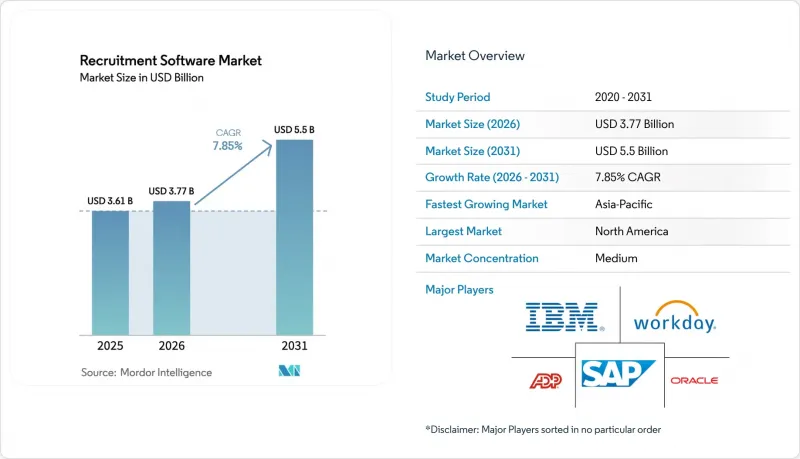
根據 Mordor Intelligence 預測,招募管理軟體的市場規模將從 2025 年的 36.1 億美元和 2026 年的 37.7 億美元成長到 2031 年的 55 億美元,2026 年至 2031 年的複合年成長率為 7.85%。
本報告按部署模式(本地部署和雲端部署)、組織規模(中小企業和大型企業)、組件(解決方案和服務)、功能(應徵者追蹤系統、招聘CRM/行銷等)、最終用戶行業(IT和電信、銀行、金融服務和保險、零售和電子商務等)以及地區進行細分。市場預測以價值(美元)表示。
全球招募管理軟體市場趨勢及洞察
在整個人力資源技術堆疊中實作「雲端優先」方法。
企業正在逐步淘汰本地部署的應徵者追蹤系統,轉而優先採用整合式SaaS套件,以降低擁有成本並消除資料孤島。 Oracle的自主招募系統計畫於2025年在Fusion Cloud HCM中發布,該系統展示了多租戶平台如何透過單一介面自動完成篩選、面試安排和發放錄用通知書等流程。供應商正在收集匿名化的招募數據,以訓練配對演算法並提高招募準確率。儘管拉丁美洲和非洲部分地區的寬頻網路覆蓋不足減緩了系統普及速度,但自主雲端和邊緣運算的普及正在降低區域壁壘。隨著企業將雲端招聘系統與薪資核算和績效管理模組整合,以統一管理員工記錄,這一趨勢也增加了招聘管理軟體市場供應商對整合性的需求。
人工智慧和機器學習應用案例的爆炸性成長
人工智慧已從試點階段發展成為企業的標準工具。 LinkedIn 的即時職位資訊流向其模型,提供 1.34 億個職位信息,從而最佳化廣告支出並預測候選人成功率。 iCIMS 和 Workday 的生成式協同助理可在幾秒鐘內起草招募方案、建立面試問題並彙總回饋,將招募週期縮短一半。然而,監管機構現在將自動化招募流程視為高風險。歐盟人工智慧法規強制要求提供可解釋性儀表板和合規性評估,鼓勵採購者選擇具備偏見檢測功能的供應商。在招募管理軟體市場,提供透明評分和預測性洞察的平台正在獲得合規優勢。
資料隱私和演算法偏見合規成本
歐盟人工智慧法案、GDPR第22條以及紐約市第144號地區法案均強制要求進行偏見審計、風險日誌記錄和人工審核,將使每家公司額外支出50萬至200萬美元。違規的罰款最高可達全球銷售額的7%,這種風險正迫使企業將預算從創新轉向法律支出。大型供應商可以分攤這些成本,但中型供應商可能會面臨利潤率壓力,甚至被迫進行併購。因此,客戶正傾向於選擇那些對其模型進行認證並發布持續審計摘要的供應商。
細分市場分析
到2025年,雲端採用將佔總營收的68.73%,且這一比例的成長速度將超過整體招募管理軟體市場,到2031年複合年成長率將達到9.21%。這項優勢源自於雲端的即時可擴展性和持續功能交付能力,包括大規模語言模型推理(該推理大量利用GPU),而這在本地伺服器上是無法實現的。 Oracle於2025年10月發布的雲端代理(Cloud Agent)清楚地展現了這一優勢,它利用匿名化的跨客戶端資料洞察,自動提案候選人名單。雖然在國防和銀行等對資料主權有嚴格要求的行業,本地系統仍然佔據一席之地,但混合架構允許將尋源和互動模組部署在雲端,而候選人記錄則保留在防火牆內。隨著主權雲端計畫的日趨成熟,預計即使是受監管的買家也會遷移其分析工作負載,從而縮小採用模式上的差距。
預計到2031年,基於雲端的求職者追蹤軟體市場規模將成長13億美元,而本地部署軟體的銷售額預計將基本保持穩定。供應商正在引入成本計算工具,以證明總擁有成本可在18個月內降低,從而說服財務部門將預算從資本支出轉向營運支出。這種轉變確保了永續的收入來源,一旦核心求職者追蹤系統(ATS)投入運作,供應商就可以交叉銷售分析和學習模組。採用完整雲端架構的買家還將受益於更快的監管更新,鑑於對有偏見審計的要求日益嚴格,這是一個顯著的優勢。
在招募管理軟體市場,大型企業預計到2025年仍將佔據60.95%的收入佔有率,因為其龐大的全球員工隊伍需要更高的合約薪資。然而,成長最快的細分市場是中小企業(SME),模組化、基於用戶的定價模式降低了准入門檻,預計到2031年,該細分市場的複合年成長率將達到10.23%。 BambooHR和Recruitee提供的免費增值計畫起價約為每位使用者每月50美元,即使是只有10名員工的新創公司也能使用人工智慧驅動的候選人排名和自動化招募功能,而這些功能通常僅限於財富500強企業的人力資源團隊。
在新興市場,應徵者管理仍主要依賴電子表格,對招募管理軟體(CRM)的認知度較低。因此,供應商正在針對本地市場最佳化行動優先介面,並將招募功能與本地薪資核算公司捆綁銷售。預計中小企業招募管理軟體的市佔率將從2025年的39%小幅成長至2031年的45%。為了抓住這一成長機遇,供應商正透過「點擊連接」的招聘網站整合功能簡化實施流程,最大限度地減少資源受限企業對IT的依賴。
區域分析
預計到2025年,北美將佔總收入的34.62%,這反映出該地區人力資源技術的高滲透率、充裕的IT預算以及對平等機會的嚴格執行。 Workday、Oracle和SAP等主要成熟公司在該地區設有總部或大規模業務機構,從而縮短了產品改進的回饋週期。產業整合正在推進,Paychex於2025年1月收購了Paycor,以加強其面向中型企業的銷售網路。然而,與新興地區相比,北美的成長速度較慢,因為大多數大型企業已經採用了最新的ATS套件。
亞太地區是成長最快的地區,預計到2031年複合年成長率將達到10.66%。印度IT服務巨頭每年招聘數十萬應屆畢業生,因此對能夠篩檢數百萬份履歷的平台需求旺盛。中國國營企業出於數據主權的考慮,更傾向於選擇國內供應商,而外國跨國公司則通常採用介面本地化為中文(普通話)的全球套件。雖然在日本和韓國,基於建議的招募方式仍然盛行,但隨著人口老化,數位化招募正被大力推廣以擴大人才庫。東南亞市場,尤其是印尼和越南,尚未充分開發,隨著智慧型手機普及率超過桌上型電腦,輕量級、以應用程式為中心的招募工具正日益受到歡迎。
歐洲正處於這些趨勢的中心。儘管由於GDPR和歐盟人工智慧法規的實施,合規性變得日益複雜,但歐盟內部人員的自由流動正在擴大候選人才庫,雇主也轉向實施具備偏見監控功能的招募系統。德國的中型製造商正面臨技術工人短缺的問題,而英國脫歐後的勞動力短缺正在推動相關技術的應用。中東和非洲仍處於發展初期。沙烏地阿拉伯的「2030願景」基礎設施項目正在建立正式的招募系統,而南非和奈及利亞的行動優先計畫也正處於早期階段。拉丁美洲的雲端運算需求集中在巴西和阿根廷,但貨幣波動導致訂閱式軟體進口預算減少,從而抑制了其成長。
其他好處:
- Excel格式的市場預測(ME)表
- 3個月的分析師支持
目錄
第1章:引言
- 研究假設和市場定義
- 調查範圍
第2章:調查方法
第3章執行摘要
第4章 市場狀況
- 市場概覽
- 市場促進因素
- 在整個人力資源技術堆疊中採用「雲端優先」方法。
- 人工智慧/機器學習在人才招聘工作流程中的應用案例爆炸性成長
- 新冠疫情後,遠距和混合辦公模式激增。
- 利用社群媒體發展招募和雇主品牌推廣平台。
- 配備人工智慧副駕駛的自主「代理型ATS」的出現。
- 創業投資資金轉向技能圖譜與偏誤減少分析
- 市場限制因素
- 與資料隱私和演算法偏差相關的合規成本
- 與老化的人力資源資訊系統/企業資源規劃環境相關的整合複雜性
- 新興市場中小企業對價格敏感且對自動交易系統(ATS)的認知度較低
- 重複的點式解決方案導致客戶疲勞加劇。
- 產業價值鏈分析
- 監理情勢
- 技術展望
- 波特五力分析
第5章 市場規模與成長預測
- 部署模式
- 現場
- 雲
- 按組織規模
- 中小企業
- 大公司
- 按組件
- 解決方案
- 服務
- 功能性別
- 應徵者追蹤系統(ATS)
- 招募客戶關係管理/行銷
- 入職軟體
- 人才分析與人工智慧工具
- 背景調查/評估模組
- 按最終用戶行業分類
- 資訊科技/通訊
- BFSI
- 零售與電子商務
- 製造業
- 醫療保健和生命科學
- 其他終端用戶產業
- 按地區
- 北美洲
- 美國
- 加拿大
- 墨西哥
- 南美洲
- 巴西
- 阿根廷
- 其他南美國家
- 歐洲
- 德國
- 英國
- 法國
- 義大利
- 西班牙
- 其他歐洲國家
- 亞太地區
- 中國
- 日本
- 印度
- 韓國
- ASEAN
- 其他亞太國家
- 中東
- 沙烏地阿拉伯
- 阿拉伯聯合大公國
- 其他中東國家
- 非洲
- 南非
- 奈及利亞
- 其他非洲國家
- 北美洲
第6章 競爭情勢
- 市場集中度
- 策略趨勢
- 市佔率分析
- 公司簡介
- SAP SE
- Workday, Inc.
- Oracle Corporation
- Automatic Data Processing, Inc.
- International Business Machines Corporation
- iCIMS, Inc.
- UKG Inc.
- Ceridian HCM Holding Inc.
- Cornerstone OnDemand, Inc.
- Greenhouse Software, Inc.
- SmartRecruiters, Inc.
- Jobvite, Inc.
- BambooHR LLC
- Bullhorn, Inc.
- Lever, Inc.
- Zoho Corporation Pvt. Ltd.
- ClearCompany Talent Management, LLC
- Recruitee BV
- PeopleAdmin, Inc.
- Trakstar, LLC
- Eightfold AI, Inc.
- Phenom People, Inc.
- Avature Limited
- Paycor, Inc.
第7章 市場機會與未來展望
According to Mordor Intelligence, the recruitment software market size is projected to expand from USD 3.61 billion in 2025 and USD 3.77 billion in 2026 to USD 5.5 billion by 2031, registering a CAGR of 7.85% between 2026 to 2031.
This report is Segmented by Deployment (On-Premises, and Cloud), Organization Size (Small and Medium Enterprises, and Large Enterprises), Component (Solutions, and Services), Functionality (Applicant Tracking System, Recruitment CRM/Marketing, and More), End-User Vertical (IT and Telecom, BFSI, Retail and E-Commerce, and More), and by Geography. The Market Forecasts are Provided in Terms of Value (USD).
Global Recruitment Software Market Trends and Insights
Cloud-First Adoption Across HR Tech Stacks
Enterprises are decommissioning on-premises Applicant Tracking Systems in favor of unified SaaS suites that cut ownership costs and remove data silos. Oracle's 2025 release of autonomous recruiting agents inside Fusion Cloud HCM shows how multi-tenant platforms now automate screening, interview scheduling and offer letters from one interface. Vendors pool anonymized hiring data to train matching algorithms, boosting fill-rate accuracy. Although broadband gaps slow adoption in parts of Latin America and Africa, sovereign-cloud offers and edge compute are narrowing residency barriers. The trend raises integration demand from the recruitment software market vendors, as firms connect cloud recruiting to payroll and performance modules for a single worker record.
Explosion of AI and ML Use-Cases
AI has shifted from pilot scope to enterprise staple. LinkedIn's live listings feed 134 million vacancies into models that optimize ad spend and predict candidate success. Generative copilots from iCIMS and Workday draft outreach, create interview questions and summarize feedback in seconds, trimming cycle time by up to half. Regulators, however, now treat automated hiring as high risk. The EU AI Act obliges explainability dashboards and conformity assessments, steering buyers to vendors with built-in bias detection. Platforms that deliver transparent scoring alongside predictive insights gain a compliance edge in the recruitment software market.
Data-Privacy and Algorithmic-Bias Compliance Costs
The EU AI Act, GDPR Article 22 and New York City Local Law 144 demand bias audits, risk logs and human review, adding USD 0.5-2 million per enterprise rollout. Penalties climb to 7% of global turnover for non-compliance, a threat that redirects budgets from innovation to legal overhead. Large vendors can amortize these costs, while mid-tier suppliers face margin pressure or forced consolidation. Clients therefore gravitate toward providers that certify models and publish continual audit summaries.
Other drivers and restraints analyzed in the detailed report include:
- Surge in Remote and Hybrid Hiring Models Post COVID-19
- Emergence of Autonomous Agentic ATS with Generative-AI Copilots
- Integration Complexity with Ageing HRIS/ERP Landscapes
For complete list of drivers and restraints, kindly check the Table Of Contents.
Segment Analysis
Cloud deployments accounted for 68.73% of 2025 revenue, and that slice is growing faster than the overall recruitment software market at a 9.21% CAGR to 2031. This leadership stems from instant scalability and continuous feature drops, including GPU-intensive large language model inference that on-premises servers cannot afford. Oracle's October 2025 cloud agents illustrate the edge, drawing lessons from anonymized cross-client data to recommend shortlists automatically. On-premises systems remain in sectors such as defense and banking that impose data-sovereignty mandates, but hybrid architectures now let sourcing and engagement modules reside in cloud while candidate records stay behind the firewall. As sovereign-cloud programs mature, even regulated buyers are expected to migrate analytics workloads, narrowing the deployment divide.
The recruitment software market size for cloud deployments is forecast to add USD 1.3 billion by 2031, while on-premises revenue stays nearly flat. Vendors embed cost calculators that prove total ownership savings within 18 months, convincing finance teams to shift budgets from capital expenditure to operating expenditure. This transition unlocks recurring revenue streams and positions providers to cross-sell analytics and learning modules once the core ATS is live. Buyers that embrace full-cloud stacks also gain faster regulatory updates, an advantage as bias-audit mandates evolve yearly.
Large enterprises still bring 60.95% of 2025 revenue in the recruitment software market, thanks to global head-counts that justify premium contracts. Yet, SME demand represents the fastest-growing cohort; the segment is forecast to post a 10.23% CAGR by 2031, as modular, seat-based pricing lowers the entry barrier. Freemium packages from BambooHR and Recruitee start at around USD 50 per user per month, allowing 10-person startups to access AI ranking and automated outreach typically reserved for Fortune 500 HR teams.
Awareness remains low in emerging economies where spreadsheets still track applicants, so vendors localize mobile-first interfaces and partner with regional payroll companies to bundle recruitment features. The recruitment software market share among SMEs is expected to tick up from 39% in 2025 to 45% by 2031. To capture that lift, suppliers streamline onboarding with click-and-connect job-board integrations, minimizing IT dependence for resource-constrained businesses.
Complete Report Scope:
- By Deployment
- On-Premises
- Cloud
- By Organization Size
- Small and Medium Enterprises (SMEs)
- Large Enterprises
- By Component
- Solutions
- Services
- By Functionality
- Applicant Tracking System (ATS)
- Recruitment CRM/Marketing
- Onboarding Software
- Talent Analytics and AI Tools
- Background-check/Assessment Modules
- By End-User Vertical
- IT and Telecom
- BFSI
- Retail and E-commerce
- Manufacturing
- Healthcare and Life Sciences
- Other End-User Verticals
- By Geography
- North America
- United States
- Canada
- Mexico
- South America
- Brazil
- Argentina
- Rest of South America
- Europe
- Germany
- United Kingdom
- France
- Italy
- Spain
- Rest of Europe
- Asia-Pacific
- China
- Japan
- India
- South Korea
- ASEAN
- Rest of Asia-Pacific
- Middle East
- Saudi Arabia
- United Arab Emirates
- Rest of Middle East
- Africa
- South Africa
- Nigeria
- Rest of Africa
- North America
Geography Analysis
North America generated 34.62% of 2025 revenue, reflecting deep HR-tech penetration, high IT budgets and strict equal-opportunity enforcement. Major incumbents like Workday, Oracle and SAP maintain headquarters or significant operations in the region, shortening feedback loops for product iterations. Consolidation is high, as Paychex acquired Paycor in January 2025 to bolster distribution among mid-size employers. Growth, however, decelerates relative to emerging regions because most large enterprises already run modern ATS suites.
Asia-Pacific is the fastest-growing region at a 10.66% CAGR through 2031. India's IT-services giants hire hundreds of thousands of graduates each year, demanding platforms that screen millions of resumes. China's state-owned enterprises favor domestic vendors for data sovereignty, but foreign multinationals standardize on global suites with localized Mandarin interfaces. Japan and South Korea retain referral-centric norms, yet aging demographics compel digital hiring to widen talent pools. Southeast Asian markets, notably Indonesia and Vietnam, represent white space; smartphone penetration exceeds desktop usage, so lightweight, app-centric recruiting tools gain traction.
Europe sits between these dynamics. GDPR and the EU AI Act raise compliance complexity, but free movement within the European Union expands candidate pools, prompting employers to implement bias-monitored sourcing. Germany's mid-sized manufacturers face skilled-trade shortages, and the United Kingdom's post-Brexit labor squeeze fuels adoption. The Middle East and Africa remain nascent; Saudi Arabia's Vision 2030 infrastructure projects elevate formal hiring systems, while South Africa and Nigeria show early mobile-first uptake. Latin America's cloud demand clusters in Brazil and Argentina but is tempered by currency volatility that shrinks import budgets for subscription software.
- SAP SE
- Workday, Inc.
- Oracle Corporation
- Automatic Data Processing, Inc.
- International Business Machines Corporation
- iCIMS, Inc.
- UKG Inc.
- Ceridian HCM Holding Inc.
- Cornerstone OnDemand, Inc.
- Greenhouse Software, Inc.
- SmartRecruiters, Inc.
- Jobvite, Inc.
- BambooHR LLC
- Bullhorn, Inc.
- Lever, Inc.
- Zoho Corporation Pvt. Ltd.
- ClearCompany Talent Management, LLC
- Recruitee B.V.
- PeopleAdmin, Inc.
- Trakstar, LLC
- Eightfold AI, Inc.
- Phenom People, Inc.
- Avature Limited
- Paycor, Inc.
Additional Benefits:
- The market estimate (ME) sheet in Excel format
- 3 months of analyst support
TABLE OF CONTENTS
1 INTRODUCTION
- 1.1 Study Assumptions and Market Definition
- 1.2 Scope of the Study
2 RESEARCH METHODOLOGY
3 EXECUTIVE SUMMARY
4 MARKET LANDSCAPE
- 4.1 Market Overview
- 4.2 Market Drivers
- 4.2.1 Cloud-first Adoption Across HR Tech Stacks
- 4.2.2 Explosion of AI/ML Use-cases in Talent Acquisition Workflows
- 4.2.3 Surge in Remote and Hybrid Hiring Models Post COVID-19
- 4.2.4 Growth of Social-media Recruiting and Employer-branding Platforms
- 4.2.5 Emergence of Autonomous "Agentic ATS" with Generative-AI Copilots
- 4.2.6 VC Funding Shift Toward Skills-graph and Bias-mitigation Analytics
- 4.3 Market Restraints
- 4.3.1 Data-privacy and Algorithmic-bias Compliance Costs
- 4.3.2 Integration Complexity with Ageing HRIS/ERP Landscapes
- 4.3.3 SME Price-sensitivity and Low ATS Awareness in Emerging Markets
- 4.3.4 Growing Buyer Fatigue from Overlapping Point Solutions
- 4.4 Industry Value Chain Analysis
- 4.5 Regulatory Landscape
- 4.6 Technological Outlook
- 4.7 Porter's Five Forces Analysis
- 4.7.1 Bargaining Power of Suppliers
- 4.7.2 Bargaining Power of Buyers
- 4.7.3 Threat of New Entrants
- 4.7.4 Threat of Substitutes
- 4.7.5 Intensity of Competitive Rivalry
5 MARKET SIZE AND GROWTH FORECASTS (VALUE)
- 5.1 By Deployment
- 5.1.1 On-Premises
- 5.1.2 Cloud
- 5.2 By Organization Size
- 5.2.1 Small and Medium Enterprises (SMEs)
- 5.2.2 Large Enterprises
- 5.3 By Component
- 5.3.1 Solutions
- 5.3.2 Services
- 5.4 By Functionality
- 5.4.1 Applicant Tracking System (ATS)
- 5.4.2 Recruitment CRM/Marketing
- 5.4.3 Onboarding Software
- 5.4.4 Talent Analytics and AI Tools
- 5.4.5 Background-check/Assessment Modules
- 5.5 By End-User Vertical
- 5.5.1 IT and Telecom
- 5.5.2 BFSI
- 5.5.3 Retail and E-commerce
- 5.5.4 Manufacturing
- 5.5.5 Healthcare and Life Sciences
- 5.5.6 Other End-User Verticals
- 5.6 By Geography
- 5.6.1 North America
- 5.6.1.1 United States
- 5.6.1.2 Canada
- 5.6.1.3 Mexico
- 5.6.2 South America
- 5.6.2.1 Brazil
- 5.6.2.2 Argentina
- 5.6.2.3 Rest of South America
- 5.6.3 Europe
- 5.6.3.1 Germany
- 5.6.3.2 United Kingdom
- 5.6.3.3 France
- 5.6.3.4 Italy
- 5.6.3.5 Spain
- 5.6.3.6 Rest of Europe
- 5.6.4 Asia-Pacific
- 5.6.4.1 China
- 5.6.4.2 Japan
- 5.6.4.3 India
- 5.6.4.4 South Korea
- 5.6.4.5 ASEAN
- 5.6.4.6 Rest of Asia-Pacific
- 5.6.5 Middle East
- 5.6.5.1 Saudi Arabia
- 5.6.5.2 United Arab Emirates
- 5.6.5.3 Rest of Middle East
- 5.6.6 Africa
- 5.6.6.1 South Africa
- 5.6.6.2 Nigeria
- 5.6.6.3 Rest of Africa
- 5.6.1 North America
6 COMPETITIVE LANDSCAPE
- 6.1 Market Concentration
- 6.2 Strategic Moves
- 6.3 Market Share Analysis
- 6.4 Company Profiles (includes Global level Overview, Market Level Overview, Core Segments, Financials as Available, Strategic Information, Market Rank/Share for Key Companies, Products and Services, and Recent Developments)
- 6.4.1 SAP SE
- 6.4.2 Workday, Inc.
- 6.4.3 Oracle Corporation
- 6.4.4 Automatic Data Processing, Inc.
- 6.4.5 International Business Machines Corporation
- 6.4.6 iCIMS, Inc.
- 6.4.7 UKG Inc.
- 6.4.8 Ceridian HCM Holding Inc.
- 6.4.9 Cornerstone OnDemand, Inc.
- 6.4.10 Greenhouse Software, Inc.
- 6.4.11 SmartRecruiters, Inc.
- 6.4.12 Jobvite, Inc.
- 6.4.13 BambooHR LLC
- 6.4.14 Bullhorn, Inc.
- 6.4.15 Lever, Inc.
- 6.4.16 Zoho Corporation Pvt. Ltd.
- 6.4.17 ClearCompany Talent Management, LLC
- 6.4.18 Recruitee B.V.
- 6.4.19 PeopleAdmin, Inc.
- 6.4.20 Trakstar, LLC
- 6.4.21 Eightfold AI, Inc.
- 6.4.22 Phenom People, Inc.
- 6.4.23 Avature Limited
- 6.4.24 Paycor, Inc.
7 MARKET OPPORTUNITIES AND FUTURE OUTLOOK
- 7.1 White-space and Unmet-Need Assessment


