


 |
市場調查報告書
商品編碼
2065562
視訊面試平台:市場佔有率分析、產業趨勢與統計、成長預測(2026-2031)Video Interviewing Platform - Market Share Analysis, Industry Trends & Statistics, Growth Forecasts (2026 - 2031) |
||||||

※ 本網頁內容可能與最新版本有所差異。詳細情況請與我們聯繫。
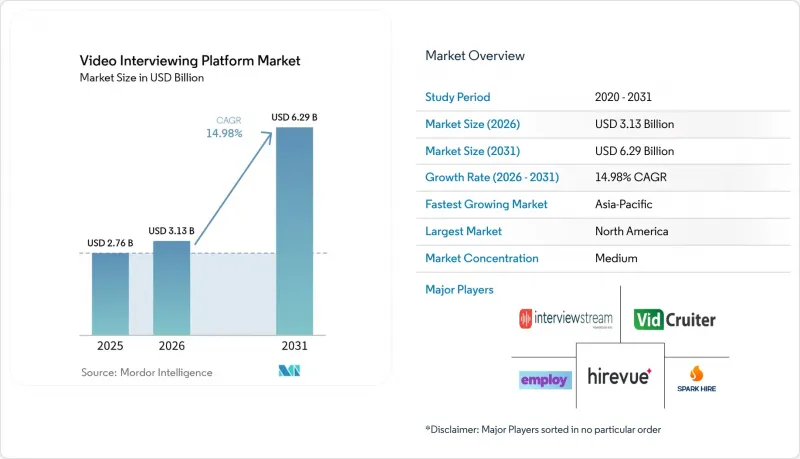
據 Mordor Intelligence 稱,2025 年視訊面試平台市場價值為 27.6 億美元,預計到 2031 年將從 2026 年的 31.3 億美元成長至 62.9 億美元,預測期(2026-2031 年)的複合年成長率為 14.98%。
本報告按平台介面(網頁平台、行動應用)、部署模式(雲端、本地部署、混合部署)、組織規模(中小企業、大型企業)、最終用戶產業(IT與電信、銀行、金融服務和保險、醫療保健、零售、人力資源、教育、政府、製造業及其他)和地區進行細分。市場預測以美元計價。
全球視訊面試平台市場趨勢及洞察
公司向結構化遠端招募轉型
視訊面試平台市場的發展動力源於招聘方式的穩步轉變,即從非正式的線上面試轉向結構化的遠端招聘系統,以便雇主能夠統一應用於大量候選人。分散式辦公室的普及使得不受地理限制的招聘成為常態,迫使雇主對面試問題、評估標準和評估材料的收集進行標準化,而不是依賴於因面試官和時間而異的即時通話。大型企業現在要求所有候選人都經歷相同的流程,這提升了結構化視訊工作流程在高度監管的行業和多地點招聘專案中的效用。近年來,雇主加快了在招募活動中採用人工智慧 (AI) 的速度,許多組織已將 AI 整合到招募流程中。這一趨勢反映了招募框架向更結構化、技術主導的轉變,其中自動化、候選人智慧和預測分析是人才獲取策略的關鍵要素。這種變化也改變了買家對視訊面試平台市場的期望,因為他們需要的不再只是基本的視訊連接,而是一個能夠管理評估標準、儲存記錄並支援可複現評估的系統。隨著視訊面試平台市場從單純的面試便利性轉向流程管理和可審計性,無法提供企業級標準化工作流程的供應商正在失去其相關性。
對更快的篩檢速度和更短的招募時間的需求
視訊面試平台市場也受惠於雇主縮短早期篩檢流程的壓力,尤其是在多個候選人競相發出錄用通知、難以招募到合適人選的情況下。非同步面試將負責人和候選人的時間表分開,使團隊能夠並行審核更多申請人,並在候選人興趣消退之前將其推進到下一階段。這種柔軟性的日程安排在科技、醫療保健和其他勞動力短缺行業中尤為重要,因為速度往往決定雇主是否能最終發出錄用通知。 SmartRecruiters 在《2025-2026 年招募基準報告》中指出,結構化評分卡的使用將在高績效招募團隊中幾乎普及。這表明,在現代招募流程中,標準化和速度之間的連結日益緊密。其商業優勢不僅限於簡化流程,因為加快初步篩選還能提高申請人的回覆率,減少各步驟之間的等待時間,並幫助負責人與多個相關人員協調決策,同時最大限度地減少摩擦。隨著視訊面試平台市場的成熟,結合非同步篩選、嵌入式評估結構和人工智慧驅動的摘要功能的供應商正在填補手寫筆記和非結構化評估仍然存在的時間空白。
人工智慧驅動的招募流程增加了合規性和偏見審計的負擔。
合規壓力是視訊面試平台市場最明顯的阻礙因素之一,尤其對於在北美和歐洲營運的買家和供應商而言更是如此。紐約市第144號地區法案強制要求對自動化招聘決策工具進行年度獨立偏見審計,公佈審計結果,並事先通知候選人,這使得管治和文件記錄成為平台評估的標準內容。歐盟人工智慧法案又增加了一項要求:被歸類為高風險人工智慧的招募系統必須滿足合規性、文件記錄和上市後監測義務,這些義務將於2026年8月全面實施。雖然這些規定不會阻止此類工具的採用,但它們會延長採購審查時間,並提高產品合法性證明的門檻。對於無法證明其擁有管治治理結構的小規模供應商而言,這種影響尤其顯著。買家現在期望在產品本身而非單獨的政策文件中看到審計日誌、人工審核查核點、與評估標準掛鉤的評分以及清晰的課責。因此,視訊面試平台市場的限制因素與其說是監管禁令,不如說是證明招聘系統安全、可解釋且適用於僱用目的的成本和複雜性不斷增加。
細分市場分析
預計到2025年,基於網路的平台將佔據57.98%的市場佔有率,而基於瀏覽器的存取方式仍將是整個視訊面試平台市場的主導營運模式。這種主導地位反映了企業負責人和招募經理更傾向於使用桌面端的審核環境,這種環境能夠與現有的ATS(應徵者追蹤系統)工作流程整合,且無需額外安裝設備。此外,基於瀏覽器的交付方式也更符合企業內部的IT政策,因為許多大型企業對受管設備上的應用程式安裝有著更嚴格的控制。從這個意義上講,即使買家對自動化和合規性的期望不斷提高,網路存取仍然是視訊面試平台市場穩定的核心。這種模式對於負責人在審核、小組協調和管理評估記錄方面尤其有用,因為在這些情況下,螢幕大小、多任務處理能力和報告可見度比便攜性更為重要。
同時,行動技術正迅速改變視訊面試平台市場的求職者端,預計到2031年,行動應用將以15.37%的複合年成長率成長。這一成長反映了外勤人員、小時工和遠端招聘項目佔比的不斷提高,求職者擴大將智慧型手機作為搜尋和初步篩選的預設工具。關鍵的轉變不僅在於面試現在可以在更小的螢幕上進行,還在於面試完成率現在高度依賴於行動友善的錄製功能、快速的載入時間和便捷的登入流程。對於那些不在辦公桌前或無法方便使用筆記型電腦的求職者來說,那些減少應用程式下載要求並允許在瀏覽器中無縫錄製的平台更加合適。這造成了視訊面試平台產業的結構性失衡,因為負責人的工作流程仍然嚴重依賴網頁訪問,而求職者的體驗卻越來越受到「行動優先」設計理念的影響。
到2025年,基於雲端的部署將佔視訊面試平台市場佔有率的61.24%,成為按部署模式分類的最大佔有率。預計到2031年,該細分市場還將以14.88%的複合年成長率成長,顯示雲端採用不僅維持了現有基本客群,而且還在持續擴張。買家繼續青睞雲端產品,因為他們可以避免硬體採購、縮短升級週期,並利用可根據部署規模靈活調整的定價模式。當部署需求因季節、專案或業務擴展階段而快速變化時,這些優勢尤其重要。此外,雲端架構使視訊面試平台市場的供應商能夠輕鬆交付新的AI功能、工作流程調整和合規性管理功能,而無需等待客戶的升級週期。
在高度監管的環境中,由於資料儲存位置和內部管治法規的擔憂,完全遷移到雲端較為困難,因此混合部署仍然發揮作用。雖然本地部署模式在一些政府和國防相關應用中仍然很重要,但在整個視訊面試平台市場,其在新用戶選擇中的支援率正在下降。如今,真正的競爭格局不再在於軟體的託管位置,而在於其託管模式對生態系統參與的支援程度。 HireVue 與 Workday 在 2026 年的合作表明,雲端原生設計正日益成為實現互聯人力資源工作流程深度整合的基本要求。隨著這一趨勢的蔓延,擁有雲端優先產品的供應商將繼續比傳統的基於基礎設施的部署模式更具優勢,因為他們能夠更快地響應整合、自動化和區域合規性配置的需求。
區域分析
到2025年,北美將佔據視訊面試平台44.36%的市場佔有率,這一優勢歸功於企業早期採用、強大的供應商基礎以及雇主對數位化招聘工具的更深入了解。美國仍然是區域需求的中心,科技、金融服務和醫療保健行業的雇主正在將縮短招募時間和結構化的遠端篩選納入其常規人才招募流程。加拿大也正沿著類似的路徑發展,而墨西哥則受益於近岸製造業和技術服務相關招募的成長,這些產業越來越依賴遠端預篩檢。監管政策的明確化也鞏固了北美的地位,因為該地區的雇主正在累積評估人工智慧驅動的招聘系統中偏見審計、通知和管治要求的經驗。歐洲仍然是視訊面試平台市場的第二大地區,德國、英國和法國的採用率很高。在這些國家,企業人才招聘團隊正逐步適應「影片優先」的工作流程。
歐洲的發展趨勢不僅受不斷成長的需求影響,也受合規架構的影響。 GDPR 的義務正在影響整個錄製面試流程中如何處理同意、儲存、保留和處理等問題,進而影響供應商的設計和買家的選擇。歐盟人工智慧法進一步提高了對就業相關人工智慧的期望,將可解釋性、文件記錄和監控置於高風險系統市場准入的核心位置。這些因素正推動歐洲視訊面試平台市場向那些兼具強大工作流程功能和可靠管治管理能力的供應商靠攏。語言支援、定價和合規功能的在地化,有助於在西歐主要經濟體以外的地區部署,這也促進了區域成長。
預計到2031年,亞太地區將以15.93%的複合年成長率成長,成為視訊面試平台市場成長最快的區域板塊。這一成長主要得益於印度龐大的入門級和專業招募規模、東南亞雲端人力資源工具的日益普及,以及跨境招聘中對多語言工作流程日益成長的需求。新加坡、印尼和越南等市場正受惠於更有效率地管理分散式招募專案的需求,而澳洲、紐西蘭、日本、韓國和中國則透過企業現代化和人工智慧的應用,擴大了該地區的需求基礎。南美洲和中東及非洲的市場規模雖然仍然較小,但隨著雇主招聘流程的數位轉型以及對跨越語言、地理和基礎設施差異的更一致的篩選標準的需求,視訊面試平台市場正在擴張。在南美洲,巴西和阿根廷是需求的主要驅動力,而阿拉伯聯合大公國和沙烏地阿拉伯則在投資人工智慧驅動的人力資源系統。在非洲部分地區,早期應用正在推進,但頻寬品質和設備限制仍然阻礙其廣泛普及。
其他好處:
- Excel格式的市場預測(ME)表
- 3個月的分析師支持
目錄
第1章:引言
- 研究假設和市場定義
- 調查範圍
第2章:調查方法
第3章執行摘要
第4章 市場狀況
- 市場概覽
- 宏觀經濟因素對市場的影響
- 市場促進因素
- 公司向遠端招募的系統性過渡
- 對更快的甄選流程和更短的招募時間的需求。
- ATS和HRIS的整合是採購的先決條件
- 引入人工智慧驅動的訪談摘要分析
- 對可審計的人工監控工作流程的需求。
- 擴大跨境招募專案和多語言招募專案。
- 市場限制因素
- 人工智慧驅動的招聘中合規性偏見審計的負擔日益加重。
- 與傳統人力資源技術堆疊整合的複雜性
- 候選人因單方面面試而感到疲勞,最終退出。
- 低頻寬、低品質設備環境下的可靠性差距
- 產業價值鏈分析
- 監理情勢
- 技術展望
- 波特五力分析
第5章 市場規模與成長預測
- 透過平台介面
- 網路為基礎的平台
- 行動應用
- 按部署模式
- 基於雲端的
- 現場
- 混合
- 按組織規模
- 小型企業
- 大公司
- 按最終用戶行業分類
- IT/通訊
- BFSI
- 醫療保健和生命科學
- 零售與電子商務
- 人員配備和招聘
- 教育和大學入學考試
- 政府/公共部門
- 製造業
- 其他
- 按地區
- 北美洲
- 美國
- 加拿大
- 墨西哥
- 南美洲
- 巴西
- 阿根廷
- 其他南美國家
- 歐洲
- 德國
- 英國
- 法國
- 義大利
- 西班牙
- 俄羅斯
- 其他歐洲國家
- 亞太地區
- 中國
- 印度
- 日本
- 韓國
- 澳洲和紐西蘭
- 東南亞
- 其他亞太國家
- 中東
- 沙烏地阿拉伯
- 阿拉伯聯合大公國
- 土耳其
- 以色列
- 其他中東國家
- 非洲
- 南非
- 埃及
- 奈及利亞
- 肯亞
- 其他非洲國家
- 北美洲
第6章 競爭情勢
- 市場集中度
- 策略趨勢
- 市佔率分析
- 公司簡介
- HireVue, Inc.
- Employ, Inc.
- VidCruiter Inc.
- Spark Hire, Inc.
- interviewstream, Inc.
- Talview Inc.
- iCIMS, Inc.
- Radancy, Inc.
- SHL Group Limited
- Harver BV
- Jobma, Inc.
- Phenom People, Inc.
- TestGorilla BV
- Cangrade, Inc.
- Kira Talent, Inc.
- Recright Oy
- Willo Technologies Ltd.
- ClearCompany, LLC
- Yello.co, Inc.
- Wamly(Pty)Ltd.
第7章 市場機會與未來展望
According to Mordor Intelligence, the video interviewing platform market size was valued at USD 2.76 billion in 2025 and estimated to grow from USD 3.13 billion in 2026 to reach USD 6.29 billion by 2031, at a CAGR of 14.98% during the forecast period (2026-2031).
This report is Segmented by Platform Interface (Web-Based Platforms, and Mobile Applications), Deployment Model (Cloud-Based, On-Premises, and Hybrid), Organization Size (SMEs, and Large Enterprises), End-User Industry (IT and Telecom, BFSI, Healthcare, Retail, Staffing, Education, Government, Manufacturing, and More), and Geography. The Market Forecasts are Provided in Terms of Value (USD).
Global Video Interviewing Platform Market Trends and Insights
Enterprise Shift To Structured Remote Hiring
The video interviewing platform market is being lifted by the steady move from informal virtual interviewing to structured remote hiring systems that employers can apply consistently across large candidate pools. Distributed work has made location-flexible recruiting normal, and that has pushed employers to standardize questions, evaluation criteria, and evidence capture instead of depending on live calls that vary by interviewer and time slot. Large organizations now want every candidate to move through the same process, which makes structured video workflows more useful in regulated sectors and multi-site hiring programs. In recent years, employers have increasingly adopted artificial intelligence in recruitment, with numerous organizations integrating AI into their hiring processes. This trend reflects a broader transition toward a more structured and technology-driven recruitment framework, where automation, candidate intelligence, and predictive analytics have become integral to talent acquisition strategies. This shift is changing what buyers expect from the video interviewing platform market, because the requirement is no longer basic video connectivity but a system that can hold rubrics, preserve records, and support repeatable evaluation. Vendors that cannot deliver standardized workflows at enterprise scale are losing relevance as the video interviewing platform market moves toward process control and auditability instead of simple interview convenience
Demand For Faster Screening and Lower Time-To-Hire
The video interviewing platform market is also benefiting from employer pressure to reduce early-stage screening delays, especially where hard-to-fill roles attract multiple competing offers. Asynchronous interviewing separates recruiter availability from candidate availability, which lets teams review more applicants in parallel and move stronger candidates forward before interest fades. That scheduling flexibility matters most in technology, healthcare, and other labor-tight fields where speed often determines whether an employer even reaches the offer stage. SmartRecruiters reported in its 2025-2026 recruiting benchmarks that structured scorecard adoption is now close to universal among high-performing hiring teams, which shows how standardization and speed are increasingly linked in modern recruitment operations. The commercial effect is broader than calendar efficiency, because a faster first screen improves response momentum, reduces idle time between steps, and helps recruiters coordinate decisions across several stakeholders with less friction. As the video interviewing platform market matures, vendors that combine async screening with built-in review structure and AI-assisted summaries are closing the remaining time gaps that manual note-taking and unstructured review still create.
Rising AI Hiring Compliance And Bias Audit Burden
Compliance pressure is one of the clearest checks on the video interviewing platform market, especially for buyers and vendors operating across North America and Europe. New York City's Local Law 144 requires annual independent bias audits for automated employment decision tools, public disclosure of results, and advance notice to candidates, which has made governance and documentation part of normal platform review. The EU AI Act adds another layer, because recruitment systems classified as high-risk AI must meet conformity, documentation, and post-market monitoring obligations that became fully applicable in August 2026. These rules do not stop adoption, but they do lengthen procurement reviews and raise the threshold for product defensibility, especially when smaller vendors cannot show mature governance controls. Buyers now expect audit logs, human review checkpoints, rubric-linked scoring, and clear accountability inside the product rather than in separate policy documents. The restraint on the video interviewing platform market, therefore, comes less from regulatory prohibition and more from the rising cost and complexity of proving that a hiring system is safe, explainable, and fit for employment use.
Other drivers and restraints analyzed in the detailed report include:
- ATS And HRIS Integration as a Buying Prerequisite
- Adoption Of AI-Assisted Summaries And Interview Intelligence
- Integration Complexity With Legacy HR Tech Stacks
For complete list of drivers and restraints, kindly check the Table Of Contents.
Segment Analysis
Web-based platforms held 57.98% of the market in 2025, which kept browser access as the main operating model across the video interviewing platform market. That lead reflects the preference of enterprise recruiters and hiring managers for desktop review environments that fit existing ATS workflows and do not require additional device-level installation. Browser delivery also aligns better with internal IT policies, because many large organizations place tighter controls on app installation across managed devices. In that sense, web access remains the stable operating center of the video interviewing platform market even as buyer expectations around automation and compliance continue to rise. The format is especially useful for recruiter-side review, panel coordination, and evaluation record keeping, where screen size, multitasking, and reporting visibility matter more than portability.
Mobile, however, is reshaping the candidate side of the video interviewing platform market at a faster pace, and mobile applications are projected to grow at a 15.37% CAGR through 2031. That growth reflects the rising share of frontline, hourly, and distributed hiring programs where candidates increasingly default to smartphones for job search activity and first-stage screening. The important shift is not simply that interviews can happen on smaller screens, it is that completion rates depend more heavily on mobile-friendly recording, short load times, and minimal sign-in friction. Platforms that reduce app-download requirements and offer smooth in-browser capture are better positioned for candidate populations that do not sit at desks or have easy access to laptops. This has created a structural asymmetry in the video interviewing platform industry, because recruiter workflows still lean toward web access while candidate experience is increasingly shaped by mobile-first design choices.
Cloud-based deployment accounted for 61.24% of the market in 2025, giving it the largest position in the video interviewing platform market by deployment model. The same segment is also projected to grow at a 14.88% CAGR through 2031, which shows that cloud adoption is still widening rather than simply defending an installed base. Buyers continue to prefer cloud delivery because it avoids hardware provisioning, shortens upgrade cycles, and supports pricing models that can flex with hiring volume. Those advantages matter when recruitment demand changes quickly across seasons, projects, or expansion phases. Cloud architecture also makes it easier for vendors in the video interviewing platform market to push new AI features, workflow adjustments, and compliance controls without waiting for a customer-side upgrade cycle.
Hybrid deployment still has a place in highly regulated environments where data residency concerns or internal governance rules complicate full migration to the cloud. On-premises models remain relevant in parts of government and defense-related hiring, but they are losing momentum in new buying decisions across the broader video interviewing platform market. The real competitive divide is now less about where software is hosted and more about how well that hosting model supports ecosystem participation. HireVue's Workday partnership in 2026 showed that cloud-native design increasingly serves as the base requirement for deeper orchestration across connected HR workflows. As that pattern spreads, vendors with cloud-first products will continue to hold the stronger position because they can move faster on integration, automation, and regional compliance configuration than deployment models built around older infrastructure.
Geography Analysis
North America held 44.36% of the video interviewing platform market share in 2025, and that lead came from early enterprise adoption, a deep vendor base, and more developed employer familiarity with digital hiring tools. The United States remains the center of regional demand because technology, financial services, and healthcare employers have made time-to-hire reduction and structured remote screening part of normal talent acquisition practice. Canada is moving on a similar enterprise adoption path, while Mexico is benefiting from hiring growth tied to nearshore manufacturing and technology services that increasingly rely on remote pre-screening. Regulatory clarity also strengthens North America's position, because employers there are becoming more practiced at evaluating bias audit, notice, and governance requirements in AI-assisted hiring systems. Europe remains the second-largest region in the video interviewing platform market, with strong adoption in Germany, the United Kingdom, and France, where enterprise talent acquisition teams have matured into more video-first workflows.
Europe's path is being shaped as much by compliance architecture as by demand expansion. GDPR obligations influence how platforms handle consent, storage, retention, and processing across recorded interview workflows, which affects both vendor design and buyer selection. The EU AI Act is now further tightening expectations around employment-related AI by making explainability, documentation, and monitoring central to market access for higher-risk systems. These conditions are pushing the video interviewing platform market in Europe toward vendors that can combine strong workflow capability with credible governance controls. Regional growth is also being helped by localization of language support, pricing, and compliance features that make adoption easier beyond the largest Western European economies.
Asia-Pacific is projected to advance at a 15.93% CAGR, making it the fastest-growing regional block in the video interviewing platform market through 2031. Growth is being supported by India's scale of graduate and professional hiring, Southeast Asia's rising adoption of cloud HR tools, and stronger interest in multilingual workflows for cross-border recruitment. Markets such as Singapore, Indonesia, and Vietnam are benefiting from the need to manage distributed hiring programs more efficiently, while Australia, New Zealand, Japan, South Korea, and China broaden the region's demand base through different mixes of enterprise modernization and AI adoption. South America, the Middle East, and Africa remain smaller in absolute terms, but the video interviewing platform market is expanding there as employers digitize recruitment and seek more consistent screening across language, location, and infrastructure gaps. Brazil and Argentina lead South American demand, the United Arab Emirates and Saudi Arabia are investing in AI-enabled HR systems, and parts of Africa are showing early adoption even though bandwidth quality and device limitations still restrain broader rollout.
- HireVue, Inc.
- Employ, Inc.
- VidCruiter Inc.
- Spark Hire, Inc.
- interviewstream, Inc.
- Talview Inc.
- iCIMS, Inc.
- Radancy, Inc.
- SHL Group Limited
- Harver B.V.
- Jobma, Inc.
- Phenom People, Inc.
- TestGorilla B.V.
- Cangrade, Inc.
- Kira Talent, Inc.
- Recright Oy
- Willo Technologies Ltd.
- ClearCompany, LLC
- Yello.co, Inc.
- Wamly (Pty) Ltd.
Additional Benefits:
- The market estimate (ME) sheet in Excel format
- 3 months of analyst support
TABLE OF CONTENTS
1 INTRODUCTION
- 1.1 Study Assumptions and Market Definition
- 1.2 Scope of the Study
2 RESEARCH METHODOLOGY
3 EXECUTIVE SUMMARY
4 MARKET LANDSCAPE
- 4.1 Market Overview
- 4.2 Impact of Macroeconomic Factors on the Market
- 4.3 Market Drivers
- 4.3.1 Enterprise Shift to Structured Remote Hiring
- 4.3.2 Demand for Faster Screening and Lower Time-to-Hire
- 4.3.3 ATS and HRIS Integration as a Buying Prerequisite
- 4.3.4 Adoption of AI-Assisted Summaries and Interview Intelligence
- 4.3.5 Demand for Audit-Ready Human Oversight Workflows
- 4.3.6 Growth of Cross-Border and Multilingual Hiring Programs
- 4.4 Market Restraints
- 4.4.1 Rising AI Hiring Compliance and Bias Audit Burden
- 4.4.2 Integration Complexity With Legacy HR Tech Stacks
- 4.4.3 Candidate Drop-Off From One-Way Interview Fatigue
- 4.4.4 Reliability Gaps in Low-Bandwidth and Low-Device-Quality Environments
- 4.5 Industry Value Chain Analysis
- 4.6 Regulatory Landscape
- 4.7 Technological Outlook
- 4.8 Porter's Five Forces Analysis
- 4.8.1 Threat of New Entrants
- 4.8.2 Bargaining Power of Buyers
- 4.8.3 Bargaining Power of Suppliers
- 4.8.4 Threat of Substitutes
- 4.8.5 Intensity of Competitive Rivalry
5 MARKET SIZE AND GROWTH FORECASTS (VALUE)
- 5.1 By Platform Interface
- 5.1.1 Web-Based Platforms
- 5.1.2 Mobile Applications
- 5.2 By Deployment Model
- 5.2.1 Cloud-Based
- 5.2.2 On-Premises
- 5.2.3 Hybrid
- 5.3 By Organization Size
- 5.3.1 Small Medium Enterprises (SMEs)
- 5.3.2 Large Enterprises
- 5.4 By End-User Industry
- 5.4.1 IT and Telecom
- 5.4.2 BFSI
- 5.4.3 Healthcare and Life Sciences
- 5.4.4 Retail and E-Commerce
- 5.4.5 Staffing and Recruiting
- 5.4.6 Education and University Admissions
- 5.4.7 Government and Public Sector
- 5.4.8 Manufacturing
- 5.4.9 Other End-User Industries
- 5.5 By Geography
- 5.5.1 North America
- 5.5.1.1 United States
- 5.5.1.2 Canada
- 5.5.1.3 Mexico
- 5.5.2 South America
- 5.5.2.1 Brazil
- 5.5.2.2 Argentina
- 5.5.2.3 Rest of South America
- 5.5.3 Europe
- 5.5.3.1 Germany
- 5.5.3.2 United Kingdom
- 5.5.3.3 France
- 5.5.3.4 Italy
- 5.5.3.5 Spain
- 5.5.3.6 Russia
- 5.5.3.7 Rest of Europe
- 5.5.4 Asia-Pacific
- 5.5.4.1 China
- 5.5.4.2 India
- 5.5.4.3 Japan
- 5.5.4.4 South Korea
- 5.5.4.5 Australia and New Zealand
- 5.5.4.6 Southeast Asia
- 5.5.4.7 Rest of Asia-Pacific
- 5.5.5 Middle East
- 5.5.5.1 Saudi Arabia
- 5.5.5.2 United Arab Emirates
- 5.5.5.3 Turkey
- 5.5.5.4 Israel
- 5.5.5.5 Rest of Middle East
- 5.5.6 Africa
- 5.5.6.1 South Africa
- 5.5.6.2 Egypt
- 5.5.6.3 Nigeria
- 5.5.6.4 Kenya
- 5.5.6.5 Rest of Africa
- 5.5.1 North America
6 COMPETITIVE LANDSCAPE
- 6.1 Market Concentration
- 6.2 Strategic Moves
- 6.3 Market Share Analysis
- 6.4 Company Profiles (includes Global Level Overview, Market Level Overview, Core Segments, Financials as available, Strategic Information, Market Rank/Share, Products and Services, Recent Developments)
- 6.4.1 HireVue, Inc.
- 6.4.2 Employ, Inc.
- 6.4.3 VidCruiter Inc.
- 6.4.4 Spark Hire, Inc.
- 6.4.5 interviewstream, Inc.
- 6.4.6 Talview Inc.
- 6.4.7 iCIMS, Inc.
- 6.4.8 Radancy, Inc.
- 6.4.9 SHL Group Limited
- 6.4.10 Harver B.V.
- 6.4.11 Jobma, Inc.
- 6.4.12 Phenom People, Inc.
- 6.4.13 TestGorilla B.V.
- 6.4.14 Cangrade, Inc.
- 6.4.15 Kira Talent, Inc.
- 6.4.16 Recright Oy
- 6.4.17 Willo Technologies Ltd.
- 6.4.18 ClearCompany, LLC
- 6.4.19 Yello.co, Inc.
- 6.4.20 Wamly (Pty) Ltd.
7 MARKET OPPORTUNITIES AND FUTURE OUTLOOK
- 7.1 White-Space and Unmet-Need Assessment


