


 |
市場調查報告書
商品編碼
2116963
印度氯氣市場:市場佔有率分析、產業趨勢與統計、成長預測(2026-2031)India Chlorine - Market Share Analysis, Industry Trends & Statistics, Growth Forecasts (2026 - 2031) |
||||||

※ 本網頁內容可能與最新版本有所差異。詳細情況請與我們聯繫。
據 Mordor Intelligence 稱,2025 年印度氯氣市場價值為 492 萬噸,預計到 2031 年將達到 734 萬噸,而 2026 年為 526 萬噸,預測期(2026-2031 年)複合年成長率為 6.89%。
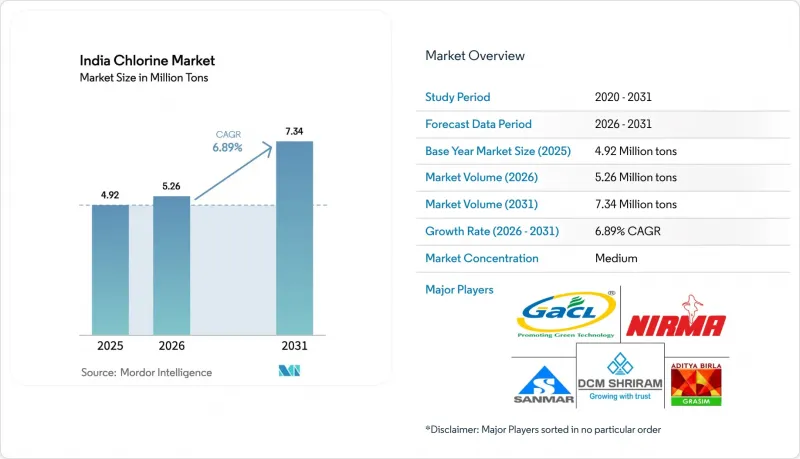
本報告按形式(液氯、氣氯(鋼瓶)和衍生的次氯酸溶液)、製造流程和技術(膜電解槽、隔膜電解槽、汞電解槽(舊型號))、應用(EDC/PVC、氯甲烷等)和最終用戶產業(化學品、水處理等)進行分類。
印度氯氣市場趨勢與洞察
PVC和CPVC產能擴張計劃
新建的PVC和CPVC工廠將成為印度氯氣市場下一波成長的核心。預計2024年印度國內PVC需求將成長9%,阿達尼集團和信實集團等公司正計分類階段擴大其PVC業務,以滿足自身對氯氣的需求。 Epigral公司的CPVC樹脂產能預計在2024年將成長近三倍,達到7.5萬噸/年,這將擴大高溫管道的國內供應,同時降低對進口的依賴。這項產能擴張計畫透過吸收通用氯氣並穩定綜合生產商的實際價格,正在改變供需平衡。儘管全球PVC價格週期帶來的利潤波動風險依然存在,但西部叢集憑藉其節能工廠和毗鄰港口的物流網路,具有結構性優勢。政策制定者將PVC進口替代視為基礎設施建設的策略挑戰,這將進一步增強氯氣生產商銷售量的穩定性。
地方政府水處理基礎設施的快速擴張
「飲用水生命線計畫」(Jal Jeevan Mission)已使農村地區的供水覆蓋率在2025年3月達到79.74%,從而為氯基消毒劑創造了非週期性的需求管道。地方政府營運部門傾向於使用次氯酸鹽,因為其在分散式系統中易於儲存和使用。隨著都市區污水量的增加,污水處理廠也必須注入氯氣以達到印度標準局(BIS)所製定的病原體基準值。隨著供水擴展到服務不足的東部地區,氯的使用也變得更加分散,從而緩解了過去集中在以古吉拉突邦為中心的工業走廊的局面。長期預算撥款進一步將水處理需求與影響常用化學品的宏觀經濟波動隔離。
嚴格的環境和職業安全法規
中央污染控制委員會將氯鹼列為「紅色類別」產品,任何擴建項目都需要進行全面的影響評估。零液體排放標準要求安裝高成本的蒸發器和結晶器,推高了單位資本投資成本。使用老式汞電解槽的工廠面臨資產擱淺問題,必須大量投資於鹽水過濾、薄膜技術和氣體處理設備才能符合法規要求。職業安全標準要求配備專用個人防護設備、洩漏偵測系統和現場緊急應變小組。小規模個體生產商往往難以承擔沉重的資本負擔,導致印度氯氣產業集中了規模更大、財力更雄厚的企業。
細分市場分析
預計到2025年,液氯將佔據印度氯氣市場64.55%的佔有率。這得歸功於古吉拉突邦完善的鐵路和油罐車基礎設施,這些基礎設施將生產基地與下游用戶連接起來。然而,市政規劃表明,隨著更易於物流處理且更安全的稀釋產品更受青睞,印度次氯酸鈉溶液市場將迅速擴張。對於更注重精確計量而非大規模處理經濟效益的小規模使用者而言,氣瓶仍然是小眾選擇。
在需要持續供應高純度原料的大規模電子染料加工廠中,液氯仍佔主導地位。西部港口促進了粗鹽的供應,而達赫杰和俾路支的管道則可實現向乙烯基製造廠的直接輸送。同時,為了降低氯氣處理的風險,醫療機構和公共工程項目擴大採用次氯酸鹽。各州水務部門正在進行競標,明確優先考慮本地採購的次氯酸鹽,從而將部分需求從加壓氣體轉向次氯酸鹽。整體而言,不同形態氯氣偏好的多樣化進一步豐富了一體化生產商的價值提案。
預計到2025年,膜分離技術將佔印度氯氣總產量的69.70%,並有望以每年6.94%的速度成長至2031年,這反映了其在印度氯氣市場的重要地位。在一些對鹽水純度控制相對容易的工廠中,仍使用隔膜電解槽,而汞電解槽正被迅速淘汰。
隨著膜分離裝置採用先進的整流器,印度氯氣市場效率顯著提升,這些整流器能夠在不過熱的情況下提高電流密度。業者正投資奈米過濾以去除硫酸鹽和鈣,從而將鹽水排放量減少高達90%。膜分離裝置中單獨生產的氫氣正被供應給新安裝的過氧化氫生產線和現場鍋爐,從而開闢新的收入來源。先前專注於隔膜系統維修的設備供應商,正將重心轉向承包膜分離裝置,以應對不斷上漲的電力成本,從而獲得更快的投資回報。
其他好處:
- Excel格式的市場預測(ME)表
- 3個月的分析師支持
目錄
第1章:引言
- 研究假設和市場定義
- 調查範圍
第2章:調查方法
第3章執行摘要
第4章 市場狀況
- 市場概覽
- 市場促進因素
- PVC和CPVC產能擴張計劃
- 市政水處理基礎設施快速擴張
- 在藥品和農藥生產方面進行強而有力的合作
- 在氯氣價格下跌期間,本公司採取了以下消費策略。
- 膜電池技術的轉型正在加速,能源成本也正在下降。
- 市場限制因素
- 嚴格的環境和職業安全法規
- 苛性鈉產能過剩導致氯氣供應過剩。
- 下游整合有限(廢棄物處理成本)
- 價值鏈分析
- 監理情勢
- 波特五力模型
第5章 市場規模與成長預測
- 按形式
- 液氯
- 氣態氯(鋼瓶)
- 衍生的次氯酸溶液
- 透過製造程序和技術
- 膜細胞
- 膈肌細胞
- 汞電池(傳統型)
- 透過使用
- EDC/PVC
- 異氰酸酯和含氧化合物
- 氯甲烷
- 溶劑和環氧氯丙烷
- 無機化學品
- 其他用途
- 按最終用戶行業分類
- 化學品
- 水處理
- 製藥
- 紙漿和造紙
- 塑膠
- 殺蟲劑
- 其他終端用戶產業
第6章 競爭情勢
- 市場集中度
- 策略趨勢
- 市佔率和排名分析
- 公司簡介
- Chemfab Alkalis Limited
- Chemplast Sanmar Limited
- DCM Shriram
- DCW Ltd.
- De Nora India Limited
- Durgapur Chemicals Ltd.
- Epigral Limited
- Finolex Industries Limited(FIL)
- Grasim Industries Limited(Aditya Birla)
- Gujarat Alkalies and Chemicals Limited
- Gujarat Fluorochemicals Ltd.
- Kutch Chemical Industries Ltd.
- Lords Chloro Alkali Limited
- Meghmani Finechem Limited
- NIRMA
- Reliance Industries Limited
- Tata Chemicals Limited
- The Andhra Sugars Limited
第7章 市場機會與未來展望
According to Mordor Intelligence, the india chlorine market size was valued at 4.92 Million tons in 2025 and estimated to grow from 5.26 Million tons in 2026 to reach 7.34 Million tons by 2031, at a CAGR of 6.89% during the forecast period (2026-2031).
This report is Segmented by Form (Liquid Chlorine, Gaseous Chlorine (Cylinders), and Derived Hypochlorite Solutions), Production Process and Technology (Membrane Cell, Diaphragm Cell, and Mercury Cell (legacy)), and Application (EDC/PVC, Chloromethanes, and More), End-User Industry (Chemical, Water Treatment, and More)
India Chlorine Market Trends and Insights
Expansion of PVC and CPVC Capacity Pipeline
New PVC and CPVC plants are central to the next growth wave in the India chlorine market. Domestic PVC demand climbed 9% in 2024, encouraging firms such as Adani and Reliance to schedule multi-stage vinyl expansions that will lift captive chlorine offtake. CPVC resin capacity at Epigral nearly tripled to 75,000 TPA in 2024, widening domestic supply for high-temperature piping and lowering import dependence. The capacity pipeline shifts the supply-demand balance by absorbing merchant chlorine and stabilizing realizations for integrated producers. Margin exposure to global vinyl price cycles remains, yet energy-efficient plants and port-adjacent logistics give western clusters a structural edge. Policymakers view vinyl import substitution as strategic for infrastructure, reinforcing offtake security for chlorine producers.
Rapid Growth in Municipal Water-Treatment Infrastructure
The Jal Jeevan Mission lifted rural piped-water coverage to 79.74% of households by March 2025, creating a non-cyclical demand channel for chlorine disinfectants. Municipal operators favor hypochlorite because it simplifies storage and dosing in decentralized schemes. Rising urban wastewater volumes also require chlorine dosing at sewage plants to meet pathogen limits prescribed by the Bureau of Indian Standards. As water coverage expands into underserved eastern districts, chlorine usage disperses geographically and lowers the historic concentration in Gujarat-centered industrial corridors. Long-term budget allocations further insulate water-treatment demand from macro swings that affect commodity chemicals.
Stringent Environmental and Worker-Safety Regulations
The Central Pollution Control Board includes chlor-alkali in its red category, requiring comprehensive impact assessments for any expansion. Zero-liquid-discharge norms add costly evaporators and crystallizers, pushing up unit capital cost. Plants using legacy mercury cells face stranded assets and must invest heavily in brine-filtration, membranes, and gas handling equipment to comply. Worker-safety norms mandate specialized personal protective gear, leak-detection systems, and on-site emergency response teams. Smaller standalone producers often struggle with the capital load, tilting the India chlorine industry toward larger, better-funded operators.
Other drivers and restraints analyzed in the detailed report include:
- Strong Pharmaceuticals and Agro-Chemicals Output Linkage
- Captive Consumption Strategy Amid Negative Chlorine Pricing
- Excess Caustic-Soda Capacity Creating Chlorine Oversupply
For complete list of drivers and restraints, kindly check the Table Of Contents.
Segment Analysis
Liquid chlorine accounted for 64.55% of the India chlorine market share in 2025, anchored by well-developed rail and tanker infrastructure between Gujarat's production hubs and downstream consumers. The India chlorine market size for hypochlorite solutions is, however, set to expand briskly as municipal schemes prefer safer, diluted products with simpler logistics. Gaseous cylinders remain a niche choice for small-scale users who value precise dosing over bulk-handling economics.
Liquid chlorine continues to dominate large EDC plants that require uninterrupted, high-purity feedstock. Western ports simplify raw salt supply, and pipelines in Dahej and Bharuch enable direct transfers to vinyl units. Meanwhile, hypochlorite gains ground in health-care facilities and public utilities seeking low-risk chlorine handling. State water boards issue tenders that explicitly favor local hypochlorite supply, redirecting some volume away from pressurized gas formats. Overall, diversifying form preferences enrich the value proposition for integrated producers.
Membrane technology captured 69.70% of overall output in 2025 and is projected to grow at 6.94% through 2031, reflecting its critical role in the India chlorine market. Diaphragm cells hang on in a few plants where brine purity is easier to manage, while mercury cells are fast approaching retirement.
The India chlorine market size gains efficiency as membrane units roll out advanced rectifiers that raise current density without overheating. Operators invest in nanofiltration to strip sulfates and calcium, cutting brine purge volumes by up to 90%. Hydrogen co-produced from membrane plants feeds new hydrogen-peroxide lines and onsite boilers, securing incremental revenue streams. Equipment suppliers betting on diaphragm retrofits are pivoting toward turnkey membrane packages that promise quick payback under high power tariffs.
Complete Report Scope:
- By Form
- Liquid Chlorine
- Gaseous Chlorine (Cylinders)
- Derived Hypochlorite Solutions
- By Production Process and Technology
- Membrane Cell
- Diaphragm Cell
- Mercury Cell (legacy)
- By Application
- EDC/PVC
- Isocyanates and Oxygenates
- Chloromethanes
- Solvents and Epichlorohydrin
- Inorganic Chemicals
- Other Applications
- By End-user Industry
- Chemical
- Water Treatment
- Pharmaceutical
- Pulp and Paper
- Plastics
- Pesticides
- Other End-user Industries
List of Companies Covered in this Report:
- Chemfab Alkalis Limited
- Chemplast Sanmar Limited
- DCM Shriram
- DCW Ltd.
- De Nora India Limited
- Durgapur Chemicals Ltd.
- Epigral Limited
- Finolex Industries Limited (FIL)
- Grasim Industries Limited (Aditya Birla)
- Gujarat Alkalies and Chemicals Limited
- Gujarat Fluorochemicals Ltd.
- Kutch Chemical Industries Ltd.
- Lords Chloro Alkali Limited
- Meghmani Finechem Limited
- NIRMA
- Reliance Industries Limited
- Tata Chemicals Limited
- The Andhra Sugars Limited
Additional Benefits:
- The market estimate (ME) sheet in Excel format
- 3 months of analyst support
TABLE OF CONTENTS
1 Introduction
- 1.1 Study Assumptions and Market Definition
- 1.2 Scope of the Study
2 Research Methodology
3 Executive Summary
4 Market Landscape
- 4.1 Market Overview
- 4.2 Market Drivers
- 4.2.1 Expansion of PVC and CPVC Capacity Pipeline
- 4.2.2 Rapid Growth in Municipal Water-Treatment Infrastructure
- 4.2.3 Strong Pharmaceuticals and Agro-Chemicals Output Linkage
- 4.2.4 Captive Consumption Strategy Amid Negative Chlorine Pricing
- 4.2.5 Accelerated Switch to Membrane-Cell Technology Lowering Energy Cost
- 4.3 Market Restraints
- 4.3.1 Stringent Environmental and Worker-Safety Regulations
- 4.3.2 Excess Caustic-Soda Capacity Creating Chlorine Oversupply
- 4.3.3 Limited Downstream Integration (Disposal Logistics Cost)
- 4.4 Value Chain Analysis
- 4.5 Regulatory Landscape
- 4.6 Porter's Five Forces
- 4.6.1 Threat of New Entrants
- 4.6.2 Bargaining Power of Suppliers
- 4.6.3 Bargaining Power of Buyers
- 4.6.4 Threat of Substitutes
- 4.6.5 Degree of Competition
5 Market Size and Growth Forecasts (Volume)
- 5.1 By Form
- 5.1.1 Liquid Chlorine
- 5.1.2 Gaseous Chlorine (Cylinders)
- 5.1.3 Derived Hypochlorite Solutions
- 5.2 By Production Process and Technology
- 5.2.1 Membrane Cell
- 5.2.2 Diaphragm Cell
- 5.2.3 Mercury Cell (legacy)
- 5.3 By Application
- 5.3.1 EDC/PVC
- 5.3.2 Isocyanates and Oxygenates
- 5.3.3 Chloromethanes
- 5.3.4 Solvents and Epichlorohydrin
- 5.3.5 Inorganic Chemicals
- 5.3.6 Other Applications
- 5.4 By End-user Industry
- 5.4.1 Chemical
- 5.4.2 Water Treatment
- 5.4.3 Pharmaceutical
- 5.4.4 Pulp and Paper
- 5.4.5 Plastics
- 5.4.6 Pesticides
- 5.4.7 Other End-user Industries
6 Competitive Landscape
- 6.1 Market Concentration
- 6.2 Strategic Moves
- 6.3 Market Share (%)/Ranking Analysis
- 6.4 Company Profiles (includes Global level Overview, Market level overview, Core Segments, Financials as available, Strategic Information, Market Rank/Share, Products and Services, Recent Developments)
- 6.4.1 Chemfab Alkalis Limited
- 6.4.2 Chemplast Sanmar Limited
- 6.4.3 DCM Shriram
- 6.4.4 DCW Ltd.
- 6.4.5 De Nora India Limited
- 6.4.6 Durgapur Chemicals Ltd.
- 6.4.7 Epigral Limited
- 6.4.8 Finolex Industries Limited (FIL)
- 6.4.9 Grasim Industries Limited (Aditya Birla)
- 6.4.10 Gujarat Alkalies and Chemicals Limited
- 6.4.11 Gujarat Fluorochemicals Ltd.
- 6.4.12 Kutch Chemical Industries Ltd.
- 6.4.13 Lords Chloro Alkali Limited
- 6.4.14 Meghmani Finechem Limited
- 6.4.15 NIRMA
- 6.4.16 Reliance Industries Limited
- 6.4.17 Tata Chemicals Limited
- 6.4.18 The Andhra Sugars Limited
7 Market Opportunities and Future Outlook
- 7.1 White-space and Unmet-Need Assessment

 氯氣:市佔率分析、產業趨勢與統計、成長預測(2026-2031)
 氯氣市場:依生產技術、形態、純度等級、應用、終端用戶產業及通路分類-2026-2032年全球市場預測
 氯氣市場預測至2034年—按類型、最終用戶和地區分類的全球分析
 氯氣市場規模、佔有率和趨勢分析報告:按形態、應用、地區和細分市場預測(2026-2033 年)
 氯氣市場:依形態、包裝、應用及地區分類二氧化氯發生器市場:按類型、最終用戶、方法、技術、容量和應用分類-2026-2032年全球市場預測
 次氯酸鈉產生器市場規模、佔有率和成長分析:按產品類型、產能、應用、技術、最終用戶、分銷管道和地區分類 - 2026-2033 年行業預測
 2026-2034年全球氯氣市場規模、佔有率、趨勢和成長分析報告
 2025-2029年全球氯氣市場
 二氧化氯發生器市場-全球產業規模、佔有率、趨勢、機會、預測:按類型、應用、地區和競爭格局分類,2021-2031年