


 |
市場調查報告書
商品編碼
2116962
美國地板塗料:市場佔有率分析、行業趨勢和統計數據以及成長預測(2026-2031 年)United States Floor Coatings - Market Share Analysis, Industry Trends & Statistics, Growth Forecasts (2026 - 2031) |
||||||

※ 本網頁內容可能與最新版本有所差異。詳細情況請與我們聯繫。
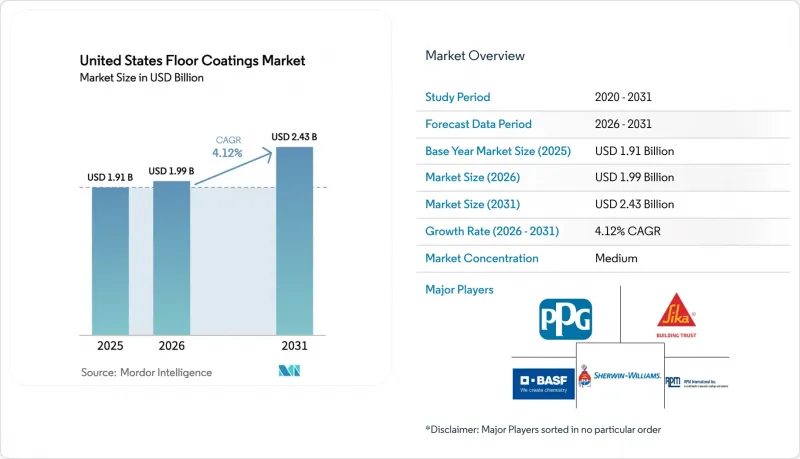
據 Mordor Intelligence 稱,美國地板塗料市場預計到 2026 年價值 19.9 億美元,高於 2025 年的 19.1 億美元,預計到 2031 年將達到 24.3 億美元。
預計 2026 年至 2031 年的複合年成長率為 4.12%。
本報告按產品類型(環氧樹脂、聚氨酯、聚天冬氨酸、丙烯酸酯及其他)、地板材料(混凝土、木材及其他)和最終用途行業(工業/公共、商業、住宅)進行細分。市場預測以美元計價。
美國地板塗料市場趨勢與洞察
商業和工業建築業強勁成長
預計到2025年,美國商業建築業將成長8.6%,這將對地坪塗料的需求產生連鎖反應,尤其是在需要特殊性能的領域。在德克薩斯州,建設產業透過德克薩斯州交通部(TxDOT)開展了約400億美元的在建和即將開工項目,其中包括耗資30億美元的達拉斯/沃斯堡國際機場擴建項目。基礎設施建設的激增不僅總合傳統用途,而且與能源基礎設施項目中對導電和散熱地板塗料的需求成長直接相關,因為美國勞工統計局已將發電和電氣承包商行業列為就業成長成長的關鍵領域。預計到2033年,建設產業的就業成長將達到4.7%,這表明對地板材料的需求將持續存在,但勞動力短缺可能會促使人們轉向使用固化速度更快的聚天冬胺酸體系。醫療設施建設佔預計項目的 27%,這有利於抗菌塗料行業的發展,因為在後疫情時代的設施設計中,注重預防感染的表面處理被優先考慮。
由於環氧樹脂體系具有耐久性,因此其應用越來越廣泛。
環氧樹脂在2024年佔據42.35%的市場佔有率,這反映了其優異的耐化學性和生命週期性能,這些特性在熱循環和高負荷等高負荷應用的先進製造業中備受重視。由於反傾銷措施促使採購轉向美國工廠,國內產量不斷成長,縮短了前置作業時間,但也推高了投入成本。生物基樹脂等創新技術符合永續性目標,且不會影響薄膜的完整性。環氧樹脂地板因其能夠滿足靜電放電 (ESD) 和地板材料標準,仍然是汽車電池和航太組裝無塵室環境的首選材料。
環氧樹脂和原料價格波動
原料價格波動正對利潤率構成壓力,並導致專案成本的不確定性,從而限制市場成長。在目前反傾銷調查重塑環氧樹脂供應鏈的環境下,這種影響尤其顯著。美國國際貿易委員會 (ITC) 認定,來自韓國、台灣和泰國的補貼進口產品對美國國內產業造成了重大損害,因此對這些產品徵收關稅,這可能會增加地板塗料製造商的投入成本。環氧樹脂生產集中在亞洲,造成了供應鏈的脆弱性,在地緣政治緊張局勢和物流中斷期間,價格波動會加劇這個問題。中小塗料製造商在應對投入成本波動方面面臨尤為嚴峻的挑戰,因為它們缺乏大型競爭對手的購買力和供應鏈多元化優勢。雖然轉向國內生產環氧樹脂可以減少對進口的依賴,但由於生產規模較小且人事費用高於亞洲生產基地,這可能會從根本上增加成本。
細分市場分析
環氧地坪塗料憑藉其在工廠、倉庫和飛機庫等領域的良好口碑,預計到2025年將保持美國地坪塗料市場41.70%的佔有率。同時,聚天冬胺酸系統預計將以5.52%的複合年成長率成長,這得益於其一夜運作、低或零VOC排放以及能夠承受基材移動等優勢。儘管美國環氧地板塗料市場依然強勁,但隨著用戶權衡降低生命週期成本與延長施工週期之間的關係,其成長速度正在放緩。聚氨酯塗料在成本和性能之間取得了良好的平衡,尤其與丙烯酸塗料相比,其耐化學性更佳,因此在預算限制無法採用高階解決方案的情況下,聚氨酯塗料是一個不錯的選擇。在「其他」類別中,石墨烯增強型和生物基化學產品預計將分別在對靜電放電(ESD)敏感的項目和符合能源與環境設計先鋒獎(LEED)標準的項目中獲得小眾市場需求成長。
環氧樹脂的需求依然強勁,這主要得益於電動車電池工廠和化工加工廠工業設備的持續現代化改造。同時,零售連鎖店和體育場館業者傾向於使用聚天冬胺酸酯樹脂覆蓋層,這種覆蓋層允許在單班次內完成地面重新開放。能夠同時供應這兩種化學樹脂的製造商,使承包商能夠根據專案進度和環境限制柔軟性選擇系統方案。供應鏈的穩定性,特別是進口原料衍生的胺基固化劑的供應鏈穩定性,仍然是所有樹脂系統通用的戰略問題。
其他好處:
- Excel格式的市場預測(ME)表
- 3個月的分析師支持
目錄
第1章:引言
- 研究假設和市場定義
- 調查範圍
第2章:調查方法
第3章執行摘要
第4章 市場狀況
- 市場概覽
- 市場促進因素
- 商業和工業建築業強勁成長
- 擴大環氧樹脂體系的應用以提高耐久性
- 居家裝潢中對美觀裝潢塗料的需求
- 向低揮發性有機化合物、高固態含量配方過渡
- 電動車超級工廠和資料中心的建設需要使用防靜電地板材料。
- 市場限制因素
- 環氧樹脂和原料價格波動劇烈
- 各州實施更嚴格的VOC(揮發性有機化合物)法規,導致合規成本增加。
- 合格的樹脂基地地板材料安裝工短缺
- 價值鏈分析
- 波特五力模型
第5章 市場規模與成長預測
- 依產品類型
- 環氧樹脂
- 聚氨酯
- 聚天門冬胺酸
- 丙烯酸纖維
- 其他
- 按地板材料
- 具體的
- 樹
- 其他
- 按最終用途行業分類
- 工業和公共機構
- 商業的
- 住宅
第6章 競爭情勢
- 市場集中度
- 策略趨勢
- 市佔率(%)/排名分析
- 公司簡介
- Akzo Nobel NV
- Armorpoxy Inc
- BASF
- Henkel AG & Co. KGaA
- ICP Group
- Jotun
- Kansai Nerolac Paints Limited
- LATICRETE International Inc.
- Mapei SpA
- Nippon Paint Holdings Co., Ltd.
- PPG Industries Inc.
- RPM International Inc.
- Sika AG
- Tambour
- Teknos Group
- The Euclid Chemical Company
- The Sherwin-Williams Company
第7章 市場機會與未來展望
According to Mordor Intelligence, united states floor coatings market size in 2026 is estimated at USD 1.99 billion, growing from 2025 value of USD 1.91 billion with 2031 projections showing USD 2.43 billion, growing at 4.12% CAGR over 2026-2031.
This report is Segmented by Product Type (Epoxy, Polyurethane, Polyaspartic, Acrylic, and Others), Floor Material (Concrete, Wood, and Others), and End-Use Industry (Industrial/Institutional, Commercial, and Residential). The Market Forecasts are Provided in Terms of Value (USD).
United States Floor Coatings Market Trends and Insights
Robust Growth in Commercial and Industrial Construction
The United States' commercial construction's projected 8.6% growth in 2025 creates a multiplier effect for floor coatings demand, particularly in sectors requiring specialized performance characteristics. The Texas construction industry maintains nearly USD 40 Billion in ongoing and upcoming projects through TxDOT, including a USD 3 Billion expansion at Dallas-Fort Worth International Airport. This infrastructure surge extends beyond traditional applications, as the U.S. Bureau of Labor Statistics identifies power generation and electrical contractor segments as key employment growth areas, directly correlating with increased demand for conductive and dissipative floor coatings in energy infrastructure projects. The construction industry's 4.7% employment growth projection through 2033 indicates sustained demand for flooring installations, though labor constraints may shift preferences toward faster-curing polyaspartic systems. Healthcare construction's 27% share of anticipated projects benefits antimicrobial coating segments, as post-pandemic facility design prioritizes infection control surfaces.
Rising Adoption of Epoxy Systems for Durability
Epoxy's 42.35% share in 2024 reflects its chemical resistance and lifecycle performance, qualities prized in advanced manufacturing where thermal cycling and heavy loads are routine. Domestic output is growing as anti-dumping actions redirect sourcing toward U.S. plants, trimming lead times but lifting input costs. Innovations such as bio-based resins align with sustainability goals without sacrificing film integrity. Clean-room settings in automotive battery and aerospace assembly continue to specify epoxy floors for their ability to meet both Electrostatic Discharge (ESD) and sanitary standards.
Volatile Epoxy and Raw-material Prices
Raw material price volatility creates margin pressure and project cost uncertainty that constrains market growth, particularly as anti-dumping investigations reshape epoxy resin supply chains. The U.S. International Trade Commission's determination that the domestic industry suffers material injury from subsidized imports from South Korea, Taiwan, and Thailand resulted in potential duties that could increase input costs for floor coating manufacturers. The concentration of epoxy production in Asia creates supply chain vulnerabilities that manifest as price volatility during geopolitical tensions or logistics disruptions. Smaller coating manufacturers face particular challenges in managing input cost fluctuations, as they lack larger competitors' purchasing power and supply chain diversification. The shift toward domestic epoxy production, while reducing import dependence, may result in structurally higher costs due to smaller production scales and higher labor costs compared to Asian facilities.
Other drivers and restraints analyzed in the detailed report include:
- Demand for Aesthetic Decorative Coatings in Remodeling
- Shift Toward Low-VOC, High-solids Formulations
- Stricter State VOC Limits Raise Compliance Costs
For complete list of drivers and restraints, kindly check the Table Of Contents.
Segment Analysis
Epoxy retained a 41.70% United States floor coatings market share in 2025 thanks to its entrenched performance record in factories, warehouses, and aviation hangars. Polyaspartic systems, however, are projected to expand at a 5.52% CAGR, propelled by overnight-curing capability that limits facility downtime, low to zero VOC profiles, and elasticity that tolerates substrate movement. The United States floor coatings market size for epoxy remains healthy, yet its expansion is moderating as users weigh lifecycle savings against longer application windows. Polyurethane coatings straddle cost and performance, especially where chemical resistance outstrips acrylics but budgets preclude premium solutions. Graphene-enhanced and bio-based chemistries in the "Others" segment promise niche traction in ESD-sensitive and Leadership in Energy and Environmental Design (LEED)-driven projects, respectively.
Sustained industrial upgrades, notably at EV battery plants and chemical processing hubs, keep epoxy relevant, while retail chains and stadium operators gravitate to polyaspartic overlays that can reopen floors within a single shift. Manufacturers able to supply both chemistries offer contractors the flexibility to choose system packages based on project timelines and environmental constraints. Supply-chain security, particularly for amine hardeners derived from imported feedstocks, remains a strategic concern shared across all resin systems.
Complete Report Scope:
- By Product Type
- Epoxy
- Polyurethane
- Polyaspartic
- Acrylic
- Others
- By Floor Material
- Concrete
- Wood
- Others
- By End-use Industry
- Industrial/Institutional
- Commercial
- Residential
List of Companies Covered in this Report:
- Akzo Nobel N.V.
- Armorpoxy Inc
- BASF
- Henkel AG & Co. KGaA
- ICP Group
- Jotun
- Kansai Nerolac Paints Limited
- LATICRETE International Inc.
- Mapei S.p.A
- Nippon Paint Holdings Co., Ltd.
- PPG Industries Inc.
- RPM International Inc.
- Sika AG
- Tambour
- Teknos Group
- The Euclid Chemical Company
- The Sherwin-Williams Company
Additional Benefits:
- The market estimate (ME) sheet in Excel format
- 3 months of analyst support
TABLE OF CONTENTS
1 Introduction
- 1.1 Study Assumptions & Market Definition
- 1.2 Scope of the Study
2 Research Methodology
3 Executive Summary
4 Market Landscape
- 4.1 Market Overview
- 4.2 Market Drivers
- 4.2.1 Robust Growth in Commercial and Industrial Construction
- 4.2.2 Rising Adoption of Epoxy Systems for Durability
- 4.2.3 Demand for Aesthetic Decorative Coatings in Remodeling
- 4.2.4 Shift Toward Low-VOC, High-solids Formulations
- 4.2.5 EV Gigafactory and Data-center Builds Need ESD Flooring
- 4.3 Market Restraints
- 4.3.1 Volatile Epoxy and Raw-material Prices
- 4.3.2 Stricter State VOC Limits Raise Compliance Costs
- 4.3.3 Shortage of Certified Resinous-flooring Applicators
- 4.4 Value Chain Analysis
- 4.5 Porter's Five Forces
- 4.5.1 Threat of New Entrants
- 4.5.2 Bargaining Power of Buyers
- 4.5.3 Bargaining Power of Suppliers
- 4.5.4 Threat of Substitute Products
- 4.5.5 Degree of Competition
5 Market Size & Growth Forecasts (Value)
- 5.1 By Product Type
- 5.1.1 Epoxy
- 5.1.2 Polyurethane
- 5.1.3 Polyaspartic
- 5.1.4 Acrylic
- 5.1.5 Others
- 5.2 By Floor Material
- 5.2.1 Concrete
- 5.2.2 Wood
- 5.2.3 Others
- 5.3 By End-use Industry
- 5.3.1 Industrial/Institutional
- 5.3.2 Commercial
- 5.3.3 Residential
6 Competitive Landscape
- 6.1 Market Concentration
- 6.2 Strategic Moves
- 6.3 Market Share(%)/ Ranking Analysis
- 6.4 Company Profiles (includes Global level Overview, Market level overview, Core Segments, Financials as available, Strategic Information, Market Rank/Share for key companies, Products & Services, and Recent Developments)
- 6.4.1 Akzo Nobel N.V.
- 6.4.2 Armorpoxy Inc
- 6.4.3 BASF
- 6.4.4 Henkel AG & Co. KGaA
- 6.4.5 ICP Group
- 6.4.6 Jotun
- 6.4.7 Kansai Nerolac Paints Limited
- 6.4.8 LATICRETE International Inc.
- 6.4.9 Mapei S.p.A
- 6.4.10 Nippon Paint Holdings Co., Ltd.
- 6.4.11 PPG Industries Inc.
- 6.4.12 RPM International Inc.
- 6.4.13 Sika AG
- 6.4.14 Tambour
- 6.4.15 Teknos Group
- 6.4.16 The Euclid Chemical Company
- 6.4.17 The Sherwin-Williams Company
7 Market Opportunities & Future Outlook
- 7.1 White-space & Unmet-need Assessment
- 7.2 Antimicrobial Epoxy Floor Coatings

 地板塗料:市場佔有率分析、產業趨勢與統計、成長預測(2026-2031)
 地板塗料市場-2026-2032年全球市場預測工業地坪塗料市場:2026-2032年全球市場預測(依樹脂類型、施工方法、基材種類、塗料種類及最終用戶分類)
 全球地板清潔劑市場規模、佔有率、趨勢和成長分析報告(2026-2034年)
 美國地板清潔產品市場規模、佔有率和趨勢分析報告:按產品、供應形式、最終用戶、類型、公司規模和細分市場預測(2026-2033 年)
 地板塗料市場報告:按黏合劑類型、塗料成分、地板結構、配方、最終用戶和地區分類(2026-2034 年)地板塗料市場規模、佔有率和趨勢分析報告:按產品、成分、應用、最終用途、地區和細分市場預測(2026-2033 年)
 地板配件市場:依產品類型、材質、最終用戶、通路及地區分類全球工業地坪塗料市場規模、佔有率、趨勢及成長分析報告:2026-2034年
 2026年全球工業地板塗料市場報告