


 |
市場調查報告書
商品編碼
2114129
地板塗料:市場佔有率分析、產業趨勢與統計、成長預測(2026-2031)Floor Coatings - Market Share Analysis, Industry Trends & Statistics, Growth Forecasts (2026 - 2031) |
||||||

※ 本網頁內容可能與最新版本有所差異。詳細情況請與我們聯繫。
根據 Mordor Intelligence 估計,2026 年地板塗料市場價值為 114.7 億美元,預計在預測期(2026-2031 年)內將以 4.52% 的複合年成長率成長,到 2031 年達到 143.1 億美元。
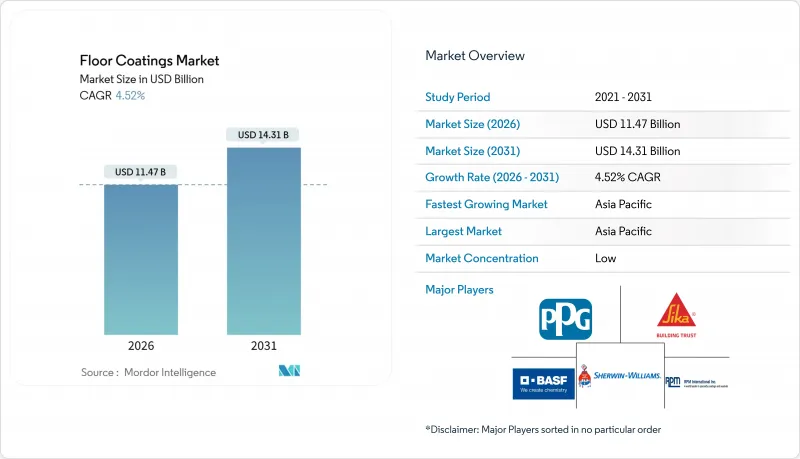
本報告按產品類型(環氧樹脂、聚氨酯、聚天冬胺酸酯等)、技術(溶劑型、水性、粉末型、UV固化型)、地板材料(混凝土等)、終端用戶產業(工業和公共設施、商業設施等)以及地區(亞太地區、北美地區、歐洲地區、南美地區、中東和非洲地區)進行細分。市場預測以美元計價。
全球地板塗料市場趨勢及洞察
冷藏倉庫的快速擴張對抗菌塗層提出了更高的要求。
冷藏倉庫業者正在指定使用能夠承受反覆凍融和高壓清洗的抗菌環氧塗層。佐敦的「Jotafloor Hygiene」可在24小時內達到99.9%的細菌去除率,並符合美國食品藥物管理局(FDA)食品法規§3-304.14關於無孔、可清洗表面的要求。 Flowcrate的「Flowfresh」聚氨酯塗料添加了銀離子殺菌劑,可在地板的整個使用壽命期間保持其有效性,並符合美國農業部(USDA)9 CFR Part 416關於防潮結構的要求。全球食品安全舉措(GFSI)的監管審核正在加速更換2020年之前安裝的、未添加抗菌劑的舊地板材料,從而縮短了重新塗漆的周期。這一趨勢是全球性的,但在北美和歐洲的物流中心尤其明顯,這些地區的食品零售商正在致力於擴大冷藏保管能力。隨著低溫運輸物流一體化程度的提高,單一供應商簽訂跨多個地點的塗裝合約的趨勢日益明顯,擁有廣泛服務網路的供應商也獲得了優先考慮。
電子商務履約中心正在推動耐磨環氧樹脂的需求。
履約中心地面每天承受超過 10,000 次堆高機循環、自動導引運輸車(AGV) 和機器人分類機的作業,這些作業產生的集中負荷超過 5,000 psi。以酚醛樹脂和骨材固化劑配製的環氧樹脂體係可提供超過 10,000 psi 的抗壓強度,防止因反覆衝擊而導致的分層。剪切機司的 Macropoxy 646 快速固化環氧樹脂在 70°F (21°C) 的溫度下 16 小時內即可完全固化,因此可以分階段施工,而不會中斷正常運作中的通道。隨著線上零售商將庫存分散到不同地區以縮短交貨時間,新建倉庫和維修需要能夠快速施工的塗料,以最大限度地減少運作損失。亞洲開發銀行預測,到 2025 年,亞洲開發中國家的GDP 成長率將達到 4.9%,這將刺激物流基礎設施的擴張。儘管短期經濟波動,但對自動化和高承載能力地板材料標準的長期承諾仍然不變。
原物料價格波動
2025年1月,德國環氧樹脂價格上漲,美國供應商也在同月宣布漲價。這主要是由於雙酚A供應緊張以及對中國進口產品的反傾銷調查。同時,由於煉油廠維護,甲苯成本上漲,擠壓了聚氨酯的利潤空間。美國國際貿易委員會已啟動程序,擬對進口環氧樹脂徵收15%至35%的臨時關稅,迫使經銷商在基準價格上漲的情況下轉向本地供應商。BASF將其塗料業務分拆並出售給卡萊爾集團,凸顯了綜合性製造商退出低利潤業務的趨勢,增加了下游混配商在現貨樹脂市場面臨的風險。價格波動導致採購負責人延長合約期限並增加庫存,造成營運資金佔用,並延緩了向下一代化學品的轉型。
細分市場分析
預計到2025年,環氧樹脂將佔總收入的50.15%,並將以每年4.71%的速度成長至2031年。製藥業的無塵室指定使用無縫環氧樹脂,以滿足FDA 21 CFR §211.56關於堅硬、易於清潔表面的要求。類似的系統也用於食品加工廠,以滿足USDA FSIS 9 CFR Part 416關於防潮地板的要求。聚氨酯因其抗熱衝擊性,能夠防止開裂,因此在冷庫中市場佔有率不斷成長。在多戶住宅翻新中,裝飾性聚天冬醯胺的需求日益成長,因為它允許在入住當天交付,避免租戶因臨時搬遷而遭受罰款。丙烯酸和甲基丙烯酸甲酯產品仍然是輕型零售商店的小眾產品。在地板塗料市場,環氧樹脂因在高壓環境下缺乏可比擬的成本績效而繼續受到青睞,預計將保持主導地位直至 2031 年。
由於承包商對該技術的廣泛熟悉、完善的配套產品體係以及數十年來公開可用的應用指南,環氧樹脂在地面塗料市場佔據了穩固的地位。奈米碳管管導電填料和抗菌添加劑等創新技術正在拓展環氧樹脂的終端應用範圍,同時又不增加承包商的操作複雜性。聚氨酯樹脂生產商正嘗試使用銀離子抗菌劑來解決這個問題,但由於原料成本高昂,其應用推廣緩慢。總體而言,樹脂在高價值混配領域的競爭預計將會加劇,但環氧樹脂仍有望保持其在地面塗料市場50%的佔有率。
預計到2025年,UV固化塗料的市佔率將達到35.22%,並以每年4.82%的速度成長至2031年。採用LED燈進行即時固化可降低烘箱能源成本,並有助於實現ISO 14001認證目標。剪切機司已證實其固化效率高達99%,與熱處理製程相比,能耗最多可降低70%。在歐洲,由於溶劑稅和VOC排放上限導致傳統雙組分系統成本上升,水性環氧塗料的採用正在加速。 Teknos公司的「Teknofloor 7300」已證明,水性塗料的耐磨性可與溶劑型塗料媲美,而VOC排放量僅為25克/公升。粉末塗料目前僅限於資料中心的金屬面板。與紫外線固化和水性技術相關的地板塗料市場規模將會擴大,尤其是在北歐國家,因為公共部門採購負責人要求符合生態標籤的要求。
生產經理們列舉了採用紫外線固化技術的兩個主要原因:消除長時間停機時間和固化深度不受環境濕度影響的可預測性。包裝線、藥品填充和包裝廠以及食品裝瓶廠正利用這些優勢,在周末維護期間升級設備。銷售燈具系統和塗料套裝的供應商也因此獲得了額外收入。隨著LED價格的下降,即使是小規模代工製造商現在也能負擔得起移動式紫外線固化設備,從而擴大了地板塗料行業的潛在基本客群。
區域分析
預計到2025年,亞太地區將佔全球銷售額的38.27%,並預計到2031年將以4.78%的年均成長率成長。 2024年,東南亞國協吸引了2,260億美元的外國直接投資(FDI),其中一半用於需要工業級地板材料的製造設施。儘管中國、印度、日本和韓國仍然是主要貢獻者,但印尼、馬來西亞、泰國和越南正在崛起為應用IEC 61340-5-1標準的電池供應鏈中心。受對採用粉末塗層或UV固化塗層的架空系統需求的推動,該地區的資料中心容量預計將從2019年的800兆瓦增加到2023年的1700兆瓦。政府對本地樹脂生產的誘因正促使跨國複合材料製造商在出口加工區建造工廠,從而確保接近性終端用戶。
北美的需求主要受新建物流設施和活躍的公寓維修項目的推動。預計到2023年,倉庫建設將超過商業建築開工總量的一半,超過辦公室和零售設施的建設速度。白宮撥款100億美元用於適應性再利用維修,進一步推高了對自我調整、低氣味產品的需求。然而,技術純熟勞工的短缺導致工程工期延長,進而增加了工會地板施工團隊的薪資。加拿大也出現了與美國類似的趨勢,但更注重低碳混凝土基材,因此需要與之相容的水性或水泥基底漆。
在歐洲,隨著VOC(揮發性有機化合物)法規日益嚴格,技術變遷正在發生。瑞典取消了高溶劑含量塗料的豁免,丹麥徵收了溶劑稅,歐盟的「裝飾塗料指令」規定雙組分塗料的VOC含量上限為500克/公升。在公共採購中,VOC排放量低於30克/公升的「北歐白天鵝」認證產品正日益受到優先考慮。德國、法國和義大利正在推廣節能型生產線,加速了汽車和包裝廠對紫外線固化技術的應用。東歐資料中心的建設推動了對導電架空地板的需求成長,但勞動力外流至西歐限制了當地承包商滿足需求的能力。
在中東和非洲,政府主導的基礎建設發展計畫正加速推進。 「沙烏地阿拉伯2030願景」正在投資建造諸如NEOM等大型企劃,該項目日產2萬立方米混凝土,帶動了環氧樹脂的大量消耗。國際貨幣基金組織(IMF)預測,沙烏地阿拉伯2025年和2026年的GDP成長率分別為3.5%和3.9%,這將支撐建設業的持續成長。阿拉伯聯合大公國、奈及利亞和埃及正透過建造無製造業區域來降低對石油的依賴,而這些區域需要使用耐化學腐蝕的地板材料。拉丁美洲的成長則較為穩健,巴西和墨西哥正對農產品加工廠進行現代化改造,採用抗菌環氧樹脂,以符合出口檢驗規定。
其他好處:
- Excel格式的市場預測(ME)表
- 3個月的分析師支持
目錄
第1章:引言
- 研究假設和市場定義
- 調查範圍
第2章:調查方法
第3章執行摘要
第4章 市場狀況
- 市場概覽
- 市場促進因素
- 冷藏倉庫的快速擴張對抗菌塗層提出了更高的要求。
- 電子商務履約中心正在推動耐磨環氧樹脂的需求。
- 多用戶住宅翻新工程的蓬勃發展帶動了對裝飾性聚天冬胺酸樹脂的需求。
- 電動車電池超級工廠強制實施的靜電防護措施正在推動對導電地板材料的需求。
- 北歐國家政府對不含揮發性有機化合物(VOC)的水系統提供誘因
- 市場限制因素
- 原物料價格波動
- 新興國家缺乏熟練的安裝技術人員
- PFAS法規限制了高性能含氟面漆的廣泛使用。
- 價值鏈分析
- 波特五力模型
第5章 市場規模與成長預測
- 依產品類型
- 環氧樹脂
- 聚氨酯
- 聚天門冬胺酸
- 丙烯酸纖維
- 其他
- 透過技術
- 溶劑型
- 水溶液
- 粉末
- 紫外線固化型
- 按地板材料
- 具體的
- 樹
- 其他
- 產業最終用途
- 對於行業和機構
- 商業
- 住宅
- 按地區
- 亞太地區
- 中國
- 印度
- 日本
- 韓國
- 馬來西亞
- 泰國
- 印尼
- 越南
- 其他亞太國家
- 北美洲
- 美國
- 加拿大
- 墨西哥
- 歐洲
- 德國
- 英國
- 法國
- 義大利
- 西班牙
- 北歐國家
- 土耳其
- 俄羅斯
- 其他歐洲國家
- 南美洲
- 巴西
- 阿根廷
- 哥倫比亞
- 其他南美國家
- 中東和非洲
- 沙烏地阿拉伯
- 阿拉伯聯合大公國
- 奈及利亞
- 埃及
- 南非
- 其他中東和非洲國家
- 亞太地區
第6章 競爭情勢
- 市場集中度
- 策略趨勢
- 市佔率分析
- 公司簡介
- Akzo Nobel NV
- Ardex Group
- Arkema(Bostik)
- Asian Paints
- Axalta Coating Systems
- BASF
- Hempel A/S
- Henkel AG & Co. KGaA
- Jotun
- Kansai Nerolac Paints Limited
- LATICRETE International Inc.
- MAPEI SpA
- Nippon Paint Holdings Co., Ltd.
- PPG Industries Inc.
- RPM International Inc.
- Sika AG
- Sto SE & Co. KGaA
- Teknos Group
- Tennant Company
- The Sherwin-Williams Company
- Tikkurila
第7章 市場機會與未來展望
According to Mordor Intelligence, the floor coatings market size is estimated at USD 11.47 billion in 2026, and is expected to reach USD 14.31 billion by 2031, at a CAGR of 4.52% during the forecast period (2026-2031).
This report is Segmented by Product Type (Epoxy, Polyurethane, Polyaspartic, and More), Technology (Solvent-Borne, Water-Borne, Powder, and UV Cured), Floor Material (Concrete, and More), End-Use Industry (Industrial/Institutional, Commercial, and More), and Geography (Asia-Pacific, North America, Europe, South America, and Middle East and Africa). The Market Forecasts are Provided in Terms of Value (USD).
Global Floor Coatings Market Trends and Insights
Rapid Expansion of Cold-Storage Warehousing Needing Antimicrobial Coatings
Cold-storage operators specify antimicrobial epoxies that withstand freeze-thaw cycling and high-pressure washdowns. Jotun's Jotafloor Hygiene achieves a 99.9% bacterial reduction within 24 hours, aligning with FDA Food Code §3-304.14 on non-porous, cleanable surfaces. Flowcrete's Flowfresh polyurethane embeds silver-ion biocides that remain active for the life of the floor, satisfying USDA 9 CFR Part 416 on moisture-impervious construction. Regulatory audits under the Global Food Safety Initiative have accelerated the replacement of legacy floors installed before 2020 that lack integrated antimicrobial agents, thereby shortening recoating cycles. The trend is global but most pronounced in North American and European distribution hubs where grocery retailers pledge to expand chilled capacity. As consolidation in cold-chain logistics continues, single operators increasingly award multi-site coating contracts, favoring suppliers with large geographic service networks.
E-Commerce Fulfillment Centers Boosting Abrasion-Resistant Epoxies
Fulfillment centers expose floors to forklift traffic exceeding 10,000 cycles per day, automated guided vehicles, and robotic sorters that generate concentrated loads above 5,000 psi. Epoxy systems formulated with novolac resins and aggregate hardeners deliver compressive strengths above 10,000 psi, preventing delamination under repetitive impacts. Sherwin-Williams' Macropoxy 646 Fast Cure Epoxy reaches full cure in 16 hours at 70°F, allowing phased installations without shutting down active aisles. As online retailers regionalize inventory to cut delivery times, new warehouses and retrofits demand quick-turn coatings that minimize lost operational hours. The Asian Development Bank projects 4.9% GDP growth for developing Asia in 2025, supporting logistics infrastructure expansion. Short-cycle economic fluctuations have not altered long-range commitments to automation and high-throughput flooring standards.
Raw-Material Price Volatility
Epoxy resin prices in Germany rose in January 2025, and the US suppliers posted an increase in the same month, largely due to tighter bisphenol-A availability and anti-dumping investigations on Chinese imports. Concurrent refinery maintenance lifted toluene costs, squeezing polyurethane margins. The US International Trade Commission has initiated provisional duties of 15-35% on imported epoxy, pushing distributors toward regional supply despite higher base prices. BASF's carve-out of its coatings division to the Carlyle Group underscores how integrated producers are exiting lower-margin businesses, heightening exposure of downstream formulators to spot resin markets. Price swings drive purchasing managers to extend contracts and hold higher inventories, which ties up working capital and slows specification shifts toward next-generation chemistries.
Other drivers and restraints analyzed in the detailed report include:
- Renovation Boom in Multifamily Housing Driving Decorative Polyaspartics
- Antistatic Mandates in EV-Battery Gigafactories Stimulating Conductive Floors
- Skilled-Installer Shortage in Emerging Economies
For complete list of drivers and restraints, kindly check the Table Of Contents.
Segment Analysis
Epoxy resins generated 50.15% of 2025 revenue and are forecast to expand at 4.71% to 2031. Pharmaceutical cleanrooms specify seamless epoxy to meet FDA 21 CFR §211.56 for hard, easily cleanable surfaces. Food-processing plants use similar systems to satisfy USDA FSIS 9 CFR Part 416 on moisture-impervious floors. Polyurethane earns a share in cold storage, where thermal-shock resistance prevents cracking. Decorative polyaspartic demand rises in multifamily refurbishments because same-day occupancy avoids tenant displacement penalties. Acrylic and methyl methacrylate variants remain niche for light-duty retail. The floor coatings market continues to favor epoxy because no alternative matches its cost-to-performance ratio for heavy-load environments, preserving the segment's leadership through 2031.
Epoxy's grip on the floor coatings market is also reinforced by extensive installer familiarity, a deep accessories ecosystem, and decades of published application guides. Innovations such as carbon-nanotube conductive fillers and antimicrobial additives extend the chemistry's addressable end uses without raising complexity for contractors. Polyurethane formulators are responding with silver-ion antibacterial grades, but adoption is slower due to higher raw-material costs. Overall, resin competition will intensify around high-value formulations, yet the epoxy segment is well positioned to defend its 50% floor coatings market share.
UV-cured coatings captured a 35.22% share in 2025 and will grow at 4.82% through 2031. Instant curing under LED lamps eliminates oven energy costs and supports ISO 14001 certification goals. Sherwin-Williams documents 99% curing efficiency, trimming energy use by up to 70% compared with thermal processes. Water-borne epoxies are accelerating in Europe as solvent taxes and VOC caps raise costs on traditional two-component systems. Teknos' Teknofloor 7300, emitting just 25 g/L VOC, demonstrates that water-borne options can rival solvent-borne abrasion resistance. Powder coatings are limited to metal panels in data centers. The floor coatings market size tied to UV-cured and water-borne technologies will widen as public buyers require ecolabel compliance, particularly in the Nordics.
Production managers cite two factors for adopting UV-cure: elimination of extended shutdowns and predictable cure depth regardless of ambient humidity. Packaging lines, pharma fill-finish suites, and food bottling halls leverage those benefits to upgrade during weekend maintenance windows. Suppliers that bundle lamp systems with coatings capture incremental revenue. As LED prices fall, smaller job-shops can afford mobile UV units, expanding the addressable floor coatings industry customer base.
Complete Report Scope:
- By Product Type
- Epoxy
- Polyurethane
- Polyaspartic
- Acrylic
- Others
- By Technology
- Solvent-borne
- Water-borne
- Powder
- UV cured
- By Floor Material
- Concrete
- Wood
- Others
- By End-use Industry
- Industrial/Institutional
- Commercial
- Residential
- By Geography
- Asia-Pacific
- China
- India
- Japan
- South Korea
- Malaysia
- Thailand
- Indonesia
- Vietnam
- Rest of Asia-Pacific
- North America
- United States
- Canada
- Mexico
- Europe
- Germany
- United Kingdom
- France
- Italy
- Spain
- Nordic Countries
- Turkey
- Russia
- Rest of Europe
- South America
- Brazil
- Argentina
- Colombia
- Rest of South America
- Middle East and Africa
- Saudi Arabia
- United Arab Emirates
- Nigeria
- Egypt
- South Africa
- Rest of Middle East and Africa
- Asia-Pacific
Geography Analysis
Asia Pacific generated 38.27% of global revenue in 2025 and is forecast to grow at 4.78% through 2031. ASEAN attracted USD 226 billion of foreign direct investment in 2024, with half destined for manufacturing facilities that require industrial-grade flooring. China, India, Japan, and South Korea remain core contributors, while Indonesia, Malaysia, Thailand, and Vietnam emerge as battery-supply-chain hubs enforcing IEC 61340-5-1 standards. Data-center capacity in the sub-region climbed from 800 MW in 2019 to 1,700 MW in 2023, bolstering demand for raised-floor systems finished with powder or UV-cured coatings. Government incentives for local resin production are attracting multinational formulators who build plants in export-processing zones, ensuring proximity to end users.
North American demand is powered by new logistics facilities and high apartment renovation activity. Warehouse construction exceeded half of all commercial starts in 2023 and continues to outpace offices and retail. The White House's USD 10 billion allocation for adaptive-reuse conversions adds a pipeline that values fast-cure, low-odor products. Skilled-labor deficits, however, stretch project timelines and increase the premium paid for unionized flooring crews. Canada mirrors US trends, with an added push toward low-carbon concrete substrates that require compatible water-borne or cementitious primers.
Europe undergoes a technology pivot as VOC limits tighten. Sweden terminated its exemption for solvent-rich coatings, Denmark applies a solvent tax, and the EU Decopaint Directive imposes 500 g/L caps on two-component systems. Public tenders increasingly favor Nordic Swan-certified products emitting fewer than 30 g/L VOC. Germany, France, and Italy promote energy-efficient production lines; consequently, UV-cure adoption accelerates in auto plants and packaging factories. Eastern European data-center builds add conductive raised-floor opportunities, but labor migration to Western Europe constrains local installer capacity.
The Middle East and Africa gain momentum from sovereign infrastructure programs. Saudi Vision 2030 funnels capital into megaprojects such as NEOM, whose 20,000 m3-per-day concrete output drives large-volume epoxy consumption. The International Monetary Fund projects Saudi GDP growth of 3.5% in 2025 and 3.9% in 2026, supporting sustained construction. United Arab Emirates, Nigeria, and Egypt diversify away from oil dependence with manufacturing free-zones that demand chemically resistant floors. Latin America's growth is steadier; Brazil and Mexico modernize agro-processing plants using antimicrobial epoxies to comply with export inspection regimes.
- Akzo Nobel N.V.
- Ardex Group
- Arkema (Bostik)
- Asian Paints
- Axalta Coating Systems
- BASF
- Hempel A/S
- Henkel AG & Co. KGaA
- Jotun
- Kansai Nerolac Paints Limited
- LATICRETE International Inc.
- MAPEI S.p.A
- Nippon Paint Holdings Co., Ltd.
- PPG Industries Inc.
- RPM International Inc.
- Sika AG
- Sto SE & Co. KGaA
- Teknos Group
- Tennant Company
- The Sherwin-Williams Company
- Tikkurila
Additional Benefits:
- The market estimate (ME) sheet in Excel format
- 3 months of analyst support
TABLE OF CONTENTS
1 Introduction
- 1.1 Study Assumptions & Market Definition
- 1.2 Scope of the Study
2 Research Methodology
3 Executive Summary
4 Market Landscape
- 4.1 Market Overview
- 4.2 Market Drivers
- 4.2.1 Rapid expansion of cold-storage warehousing needing antimicrobial coatings
- 4.2.2 E-commerce fulfilment centres boosting abrasion-resistant epoxies
- 4.2.3 Renovation boom in multifamily housing driving decorative polyaspartics
- 4.2.4 Antistatic mandates in EV-battery gigafactories stimulating conductive floors
- 4.2.5 Government incentives for VOC-free water-borne systems in Nordics
- 4.3 Market Restraints
- 4.3.1 Raw-material price volatility
- 4.3.2 Skilled-installer shortage in emerging economies
- 4.3.3 PFAS bans limiting high-performance fluorinated top-coats
- 4.4 Value Chain Analysis
- 4.5 Porter's Five Forces
- 4.5.1 Bargaining Power of Suppliers
- 4.5.2 Bargaining Power of Buyers
- 4.5.3 Threat of New Entrants
- 4.5.4 Threat of Substitutes
- 4.5.5 Degree of Competition
5 Market Size & Growth Forecasts (Value)
- 5.1 By Product Type
- 5.1.1 Epoxy
- 5.1.2 Polyurethane
- 5.1.3 Polyaspartic
- 5.1.4 Acrylic
- 5.1.5 Others
- 5.2 By Technology
- 5.2.1 Solvent-borne
- 5.2.2 Water-borne
- 5.2.3 Powder
- 5.2.4 UV cured
- 5.3 By Floor Material
- 5.3.1 Concrete
- 5.3.2 Wood
- 5.3.3 Others
- 5.4 By End-use Industry
- 5.4.1 Industrial/Institutional
- 5.4.2 Commercial
- 5.4.3 Residential
- 5.5 By Geography
- 5.5.1 Asia-Pacific
- 5.5.1.1 China
- 5.5.1.2 India
- 5.5.1.3 Japan
- 5.5.1.4 South Korea
- 5.5.1.5 Malaysia
- 5.5.1.6 Thailand
- 5.5.1.7 Indonesia
- 5.5.1.8 Vietnam
- 5.5.1.9 Rest of Asia-Pacific
- 5.5.2 North America
- 5.5.2.1 United States
- 5.5.2.2 Canada
- 5.5.2.3 Mexico
- 5.5.3 Europe
- 5.5.3.1 Germany
- 5.5.3.2 United Kingdom
- 5.5.3.3 France
- 5.5.3.4 Italy
- 5.5.3.5 Spain
- 5.5.3.6 Nordic Countries
- 5.5.3.7 Turkey
- 5.5.3.8 Russia
- 5.5.3.9 Rest of Europe
- 5.5.4 South America
- 5.5.4.1 Brazil
- 5.5.4.2 Argentina
- 5.5.4.3 Colombia
- 5.5.4.4 Rest of South America
- 5.5.5 Middle East and Africa
- 5.5.5.1 Saudi Arabia
- 5.5.5.2 United Arab Emirates
- 5.5.5.3 Nigeria
- 5.5.5.4 Egypt
- 5.5.5.5 South Africa
- 5.5.5.6 Rest of Middle East and Africa
- 5.5.1 Asia-Pacific
6 Competitive Landscape
- 6.1 Market Concentration
- 6.2 Strategic Moves
- 6.3 Market Share Analysis
- 6.4 Company Profiles (includes Global Overview, Market-level Overview, Core Segments, Financials, Strategic Info, Products & Services, Recent Developments)
- 6.4.1 Akzo Nobel N.V.
- 6.4.2 Ardex Group
- 6.4.3 Arkema (Bostik)
- 6.4.4 Asian Paints
- 6.4.5 Axalta Coating Systems
- 6.4.6 BASF
- 6.4.7 Hempel A/S
- 6.4.8 Henkel AG & Co. KGaA
- 6.4.9 Jotun
- 6.4.10 Kansai Nerolac Paints Limited
- 6.4.11 LATICRETE International Inc.
- 6.4.12 MAPEI S.p.A
- 6.4.13 Nippon Paint Holdings Co., Ltd.
- 6.4.14 PPG Industries Inc.
- 6.4.15 RPM International Inc.
- 6.4.16 Sika AG
- 6.4.17 Sto SE & Co. KGaA
- 6.4.18 Teknos Group
- 6.4.19 Tennant Company
- 6.4.20 The Sherwin-Williams Company
- 6.4.21 Tikkurila
7 Market Opportunities & Future Outlook
- 7.1 White-space & Unmet-Need Assessment

 美國地板塗料:市場佔有率分析、行業趨勢和統計數據以及成長預測(2026-2031 年)
 地板塗料市場-2026-2032年全球市場預測工業地坪塗料市場:2026-2032年全球市場預測(依樹脂類型、施工方法、基材種類、塗料種類及最終用戶分類)
 全球地板清潔劑市場規模、佔有率、趨勢和成長分析報告(2026-2034年)
 美國地板清潔產品市場規模、佔有率和趨勢分析報告:按產品、供應形式、最終用戶、類型、公司規模和細分市場預測(2026-2033 年)
 地板塗料市場報告:按黏合劑類型、塗料成分、地板結構、配方、最終用戶和地區分類(2026-2034 年)地板塗料市場規模、佔有率和趨勢分析報告:按產品、成分、應用、最終用途、地區和細分市場預測(2026-2033 年)
 地板配件市場:依產品類型、材質、最終用戶、通路及地區分類全球工業地坪塗料市場規模、佔有率、趨勢及成長分析報告:2026-2034年
 2026年全球工業地板塗料市場報告