


 |
市場調查報告書
商品編碼
2116961
中東垂直農業:市場佔有率分析、產業趨勢與統計及成長預測(2026-2031 年)Middle East Vertical Farming - Market Share Analysis, Industry Trends & Statistics, Growth Forecasts (2026 - 2031) |
||||||

※ 本網頁內容可能與最新版本有所差異。詳細情況請與我們聯繫。
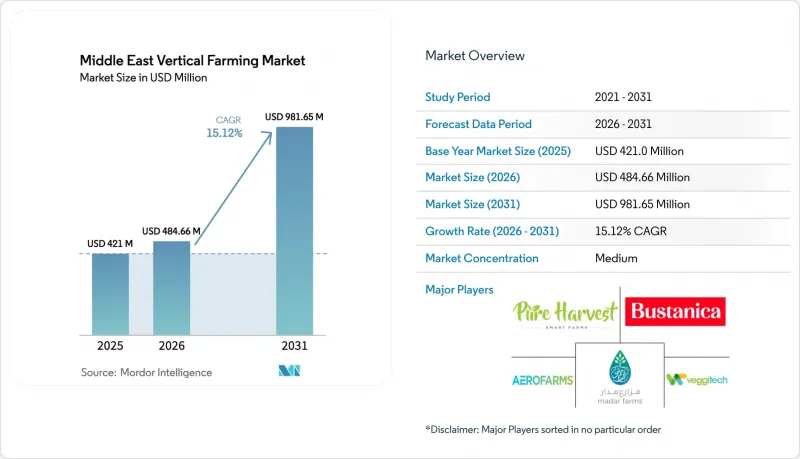
據 Mordor Intelligence 稱,中東垂直農業市場預計到 2026 年價值 4.8466 億美元,高於 2025 年的 4.21 億美元,預計到 2031 年將達到 9.8165 億美元。
預計從 2026 年到 2031 年,其複合年成長率將達到 15.12%。
本報告按成長機制(例如,氣耕)、結構(例如,建築型垂直農場、貨櫃型垂直農場)、作物類型(例如,水果和蔬菜)以及地區(沙烏地阿拉伯、阿拉伯聯合大公國、埃及、卡達、科威特、阿曼、巴林、約旦和其他中東國家)進行細分。市場預測以美元計價。
中東垂直農業市場趨勢與洞察
政府在保障糧食安全方面採取的積極措施
中東各國政府正將垂直農業納入國家糧食戰略,以減少對進口的依賴,並保護其糧食系統免受地緣政治動盪的影響。阿拉伯聯合大公國的糧食安全計畫包含針對可控環境農業的具體目標,而沙烏地阿拉伯的發展願景則將公共投資分配給室內農業計畫。埃及的農業計畫將垂直農業納入其中,以應對尼羅河Delta耕地減少的問題。這些政策簡化了農產品的許可和海關程序,並透過農業銀行提供優惠貸款。區域氣候變遷減緩措施正在增加對永續農業系統的資金投入。監管機構目前正在為符合永續性標準的水耕系統提供快速認證。
節水潛力
由於沿岸地區水資源短缺,垂直農業被視為永續農業的實際解決方案。這些系統利用循環水耕和封閉回路型營養液系統來減少用水量並消除徑流,從而符合環境法規。由於人工降雨等傳統方法的效果有限,政策制定者正優先考慮水耕技術以實現持續節水。一些新技術,例如由可再生能源驅動的根區冷卻系統,正在測試中,旨在減少高價值作物的用水量。這些方法在乾旱環境中展現了資源利用效率和商業性可行性。
受控環境農業領域當地勞動力短缺
在中東,儘管近年來開展了能力建設工作,但可控環境農業領域熟練人才的嚴重短缺仍然是一個主要問題。教育機構缺乏專業課程,迫使經營者依賴外國顧問來管理複雜的系統。這種依賴增加了營運成本,並阻礙了長期永續性。語言障礙降低了培訓效果,而移民政策限制了熟練種植者的長期停留和貢獻。如果沒有充足的本地人才供應,垂直農業企業難以有效地擴大營運規模。該地區需要協調投資於教育、職業培訓和政策改革,以培養農業創新的本地專業人才。
細分市場分析
到2025年,水耕技術將佔據中東垂直農業市場59.84%的佔有率。這得歸功於其運行的可預測性和成熟的營養液技術。沙烏地阿拉伯和阿拉伯聯合大公國擁有完善的供應鏈和豐富的技術專長,因此水耕技術在這兩個國家特別受益。由於投資回收期短且預期產量穩定,該領域正吸引許多投資。水耕系統的擴充性對關注糧食安全的商業和機構相關人員極具吸引力。
預計到2031年,氣耕產業將以15.55%的複合年成長率成長。其噴霧技術能夠促進氧氣吸收,加速植物生長,並提高產量。與水耕法相比,此方法用水量減少約10%,從而緩解了部分地區缺水的問題。研究機構和餐飲企業正在測試使用適應沙漠環境的作物進行氣耕系統種植。儘管魚菜共生系統目前仍處於小規模市場,但其作為循環系統的優勢正在推動高階市場消費者對其需求的成長。
其他好處:
- Excel格式的市場預測(ME)表
- 3個月的分析師支持
目錄
第1章:引言
- 研究假設和市場定義
- 調查範圍
第2章:調查方法
第3章執行摘要
第4章 市場狀況
- 市場概覽
- 市場促進因素
- 政府有關糧食安全的政策
- 節水潛力
- 零售業中本地品牌「零公里」農產品快速成長
- 整合基於物聯網的空調控制平台
- 透過公私合營擴大大型農場項目
- 面向飯店和校園的模組化「農場即服務」模式
- 市場限制因素
- 與其他溫室系統相比,每平方公尺的資本投資更高。
- 受控環境農業領域本地技術人員短缺
- 對營養液和培養基的進口依賴
- 微型菜苗導致低溫運輸物流碎片化
- 監理情勢
- 技術展望
- 波特五力分析
第5章 市場規模與成長預測
- 透過生長機制
- 氣耕
- 水耕法
- 水耕法
- 按結構
- 建築型垂直農場
- 用於運輸的貨櫃式垂直農場
- 按作物類型
- 水果和蔬菜
- 香草和微型菜苗
- 花卉和觀賞植物
- 按地區
- 沙烏地阿拉伯
- 阿拉伯聯合大公國
- 埃及
- 卡達
- 科威特
- 阿曼
- 巴林
- 約旦
- 其他中東國家
第6章 競爭情勢
- 市場集中度
- 策略趨勢
- 市佔率分析
- 公司簡介
- AeroFarms
- Madar Farms
- Bustanica(Emirates Crop One LLC)
- Pure Harvest Smart Farms Ltd.
- VeggiTech Hydroponic Technologies Private Limited(SNASCO Holding Company)
- Badia Farms(Gulf Islamic Investments)
- Geap Group(Oasis Greens)
- Armela Farms
- GreenFactory Emirates
- Mowreq Specialized Agriculture Co.
- iFarm Corp.
- Vertical Field Ltd.
- Emirates Hydroponics Farms
第7章 市場機會與未來展望
According to Mordor Intelligence, the middle east vertical farming market size in 2026 is estimated at USD 484.66 million, growing from 2025 value of USD 421.0 million with 2031 projections showing USD 981.65 million, growing at 15.12% CAGR over 2026-2031.
This report is Segmented by Growth Mechanism (Aeroponics, and More), by Structure (Building-Based Vertical Farms, and Shipping-Container Vertical Farms), by Crop Type (Fruits and Vegetables, and More), and by Geography (Saudi Arabia, United Arab Emirates, Egypt, Qatar, Kuwait, Oman, Bahrain, Jordan, and Rest of Middle East). The Market Forecasts are Provided in Terms of Value (USD).
Middle East Vertical Farming Market Trends and Insights
Favorable Food-security Mandates by Governments
Middle Eastern governments are integrating vertical farming into national food strategies to reduce import dependence and protect food systems from geopolitical disruptions. The United Arab Emirates' food security plan includes specific targets for controlled-environment agriculture, while Saudi Arabia's development vision allocates public investment to indoor farming projects. Egypt's agricultural plan incorporates vertical farms to address land loss in the Nile Delta. These policies simplify licensing and customs procedures for farm inputs while providing concessional financing through agricultural banks. Regional climate initiatives have increased funding for sustainable farming systems. Regulatory authorities now provide expedited certification for nutrient solutions meeting sustainability standards.
Water-saving Potential
Water scarcity in the Gulf region has positioned vertical farming as a practical solution for sustainable agriculture. These systems utilize recirculating hydroponics and closed-loop nutrient systems to reduce water consumption and eliminate runoff, meeting environmental regulations. With traditional methods like cloud seeding showing limited effectiveness, policymakers are prioritizing hydroponic technologies for consistent water conservation. New developments, such as renewable energy-powered root-zone cooling systems, are being tested to decrease water usage in high-value crops. These methods demonstrate both resource efficiency and commercial feasibility in arid environments.
Scarce Regional Skill for Controlled-environment Agronomy
The Middle East faces a significant talent shortage in controlled-environment agriculture, despite recent capacity-building efforts. Academic institutions lack specialized curricula, forcing operators to rely on foreign consultants for managing advanced systems. This dependence increases operational costs and impedes long-term sustainability. Training effectiveness suffers due to language barriers, while immigration policies restrict skilled growers from long-term residency and contribution. Vertical farming ventures struggle to scale efficiently without a robust local talent pipeline. The region requires coordinated investments in education, vocational training, and policy reform to develop local expertise in agricultural innovation.
Other drivers and restraints analyzed in the detailed report include:
- Rapid Retail Adoption of Locally Branded "Zero-mile" Produce
- Expansion of Public-private Mega Farm Projects
- Fragmented Cold-chain Logistics for Micro-greens
For complete list of drivers and restraints, kindly check the Table Of Contents.
Segment Analysis
Hydroponics accounted for 59.84% of the Middle East vertical farming market share in 2025, driven by its operational predictability and established nutrient solutions. The method benefits from developed supply chains and widespread technical expertise, particularly in Saudi Arabia and the United Arab Emirates. The segment attracts investment due to shorter payback periods and reliable yields. The scalability of hydroponic systems appeals to commercial and institutional stakeholders focused on food security.
The aeroponic segment is projected to grow at a 15.55% CAGR through 2031. Its misting technique improves oxygen absorption, resulting in faster plant growth and higher yields. The method uses approximately 10% less water than hydroponics, addressing regional water scarcity concerns. Research institutions and restaurants are testing aeroponic systems with desert-adapted crops. Aquaponics remains a small segment but is growing among premium market consumers due to its circular system benefits.
Complete Report Scope:
- By Growth Mechanism
- Aeroponics
- Hydroponics
- Aquaponics
- By Structure
- Building-based Vertical Farms
- Shipping-Container Vertical Farms
- By Crop Type
- Fruits and Vegetables
- Herbs and Micro-greens
- Flowers and Ornamentals
- By Geography
- Saudi Arabia
- United Arab Emirates
- Egypt
- Qatar
- Kuwait
- Oman
- Bahrain
- Jordan
- Rest of Middle East
List of Companies Covered in this Report:
- AeroFarms
- Madar Farms
- Bustanica (Emirates Crop One LLC)
- Pure Harvest Smart Farms Ltd.
- VeggiTech Hydroponic Technologies Private Limited (SNASCO Holding Company)
- Badia Farms (Gulf Islamic Investments)
- Geap Group (Oasis Greens)
- Armela Farms
- GreenFactory Emirates
- Mowreq Specialized Agriculture Co.
- iFarm Corp.
- Vertical Field Ltd.
- Emirates Hydroponics Farms
Additional Benefits:
- The market estimate (ME) sheet in Excel format
- 3 months of analyst support
TABLE OF CONTENTS
1 Introduction
- 1.1 Study Assumptions and Market Definition
- 1.2 Scope of the Study
2 Research Methodology
3 Executive Summary
4 Market Landscape
- 4.1 Market Overview
- 4.2 Market Drivers
- 4.2.1 Favorable Food-security Mandates by Governments
- 4.2.2 Water-saving Potential
- 4.2.3 Rapid Retail Adoption of Locally Branded "Zero-mile" Produce
- 4.2.4 Integration of IoT-driven Climate Control Platforms
- 4.2.5 Expansion of Public-private Mega Farm Projects
- 4.2.6 Modular Farm-as-a-service Models for Hotels and Campuses
- 4.3 Market Restraints
- 4.3.1 High Capex per Meter Square Relative to Greenhouse Alternatives
- 4.3.2 Scarce Regional Skill for Controlled-environment Agronomy
- 4.3.3 Import Dependence on Nutrient Solutions and Substrates
- 4.3.4 Fragmented Cold-chain Logistics for Micro-greens
- 4.4 Regulatory Landscape
- 4.5 Technological Outlook
- 4.6 Porter's Five Forces Analysis
- 4.6.1 Bargaining Power of Suppliers
- 4.6.2 Bargaining Power of Buyers
- 4.6.3 Threat of New Entrants
- 4.6.4 Threat of Substitute Products
- 4.6.5 Intensity of Competitive Rivalry
5 Market Size and Growth Forecasts (Value)
- 5.1 By Growth Mechanism
- 5.1.1 Aeroponics
- 5.1.2 Hydroponics
- 5.1.3 Aquaponics
- 5.2 By Structure
- 5.2.1 Building-based Vertical Farms
- 5.2.2 Shipping-Container Vertical Farms
- 5.3 By Crop Type
- 5.3.1 Fruits and Vegetables
- 5.3.2 Herbs and Micro-greens
- 5.3.3 Flowers and Ornamentals
- 5.4 By Geography
- 5.4.1 Saudi Arabia
- 5.4.2 United Arab Emirates
- 5.4.3 Egypt
- 5.4.4 Qatar
- 5.4.5 Kuwait
- 5.4.6 Oman
- 5.4.7 Bahrain
- 5.4.8 Jordan
- 5.4.9 Rest of Middle East
6 Competitive Landscape
- 6.1 Market Concentration
- 6.2 Strategic Moves
- 6.3 Market Share Analysis
- 6.4 Company Profiles (Includes Global Level Overview, Market Level Overview, Core Segments, Financials as Available, Strategic Information, Market Rank/Share for Key Companies, Products and Services, and Recent Developments)
- 6.4.1 AeroFarms
- 6.4.2 Madar Farms
- 6.4.3 Bustanica (Emirates Crop One LLC)
- 6.4.4 Pure Harvest Smart Farms Ltd.
- 6.4.5 VeggiTech Hydroponic Technologies Private Limited (SNASCO Holding Company)
- 6.4.6 Badia Farms (Gulf Islamic Investments)
- 6.4.7 Geap Group (Oasis Greens)
- 6.4.8 Armela Farms
- 6.4.9 GreenFactory Emirates
- 6.4.10 Mowreq Specialized Agriculture Co.
- 6.4.11 iFarm Corp.
- 6.4.12 Vertical Field Ltd.
- 6.4.13 Emirates Hydroponics Farms
7 Market Opportunities and Future Outlook

 超本地化農場直銷市場:預測至 2034 年 -產品類型、分銷模式、消費者細分、農場類型、價值提案、市場區域細分和地區分類的全球分析
 全球垂直農業市場規模、佔有率、趨勢和成長分析報告(2026-2034年)到 2034 年,城市垂直農業向超本地化供應市場發展趨勢的市場預測——按作物類型、耕作系統、技術、基礎設施類型、供應模式和地區進行全球分析。垂直農業市場規模、佔有率、成長、全球產業分析、區域趨勢以及 2026 年至 2034 年的預測。
 垂直農業市場:2026-2032年全球市場預測(按產品、照明類型、作物類型、系統、農場規模、安裝類型和最終用戶分類)
 垂直農業:市場佔有率分析、產業趨勢與統計、成長預測(2026-2031)美國垂直農業:市場佔有率分析、產業趨勢與統計及成長預測(2026-2031 年)
 垂直農業市場機會、成長要素、產業趨勢分析及2026-2035年預測
 垂直農業市場分析與預測(至2035年):按類型、產品、服務、技術、組件、應用、最終用戶、安裝方法、設備和解決方案分類垂直漿果種植市場預測至2034年—全球分析(按漿果類型、栽培技術、組件、自動化程度、設施類型、應用、最終用戶、分銷管道和地區分類)