


 |
市場調查報告書
商品編碼
2116950
戶外太陽能LED:市場佔有率分析、產業趨勢與統計及成長預測(2026-2031年)Outdoor Solar LED - Market Share Analysis, Industry Trends & Statistics, Growth Forecasts (2026 - 2031) |
||||||

※ 本網頁內容可能與最新版本有所差異。詳細情況請與我們聯繫。
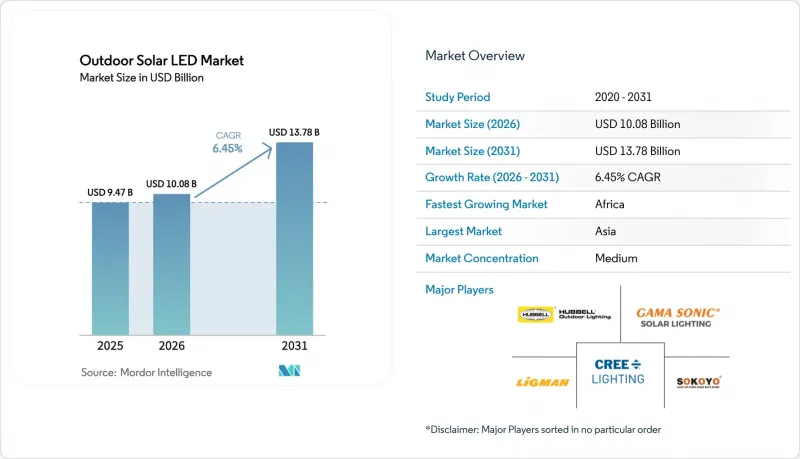
據 Mordor Intelligence 稱,戶外太陽能 LED 市場預計到 2026 年價值 100.8 億美元,高於 2025 年的 94.7 億美元,預計到 2031 年將達到 137.8 億美元。
預計 2026 年至 2031 年的複合年成長率為 6.45%。
本報告按應用領域(太陽能LED路燈、太陽能花園LED照明、太陽能LED泛光燈等)、功率消耗(小於39瓦、40瓦至149瓦、大於150瓦)、終端用戶行業(住宅、商業、工業)、組件(照明燈具(LED模組)、太陽能電池板、電池組等)和地區進行細分。市場預測以美元(USD)計價。
全球戶外太陽能LED市場趨勢與洞察
撒哈拉以南非洲強制推行太陽能LED道路照明
面臨能源貧窮的各國政府如今在道路建設合約中明確規定使用太陽能LED燈,不僅創造了可預測的需求,也促進了當地組裝廠的發展。世界銀行350億美元的電氣化計劃也意識到,太陽能發電比擴建電網更快、更經濟。與此同時,尼日的私人供應商已經開始以低於75美元的價格銷售高品質的太陽能組件,這證實了太陽能產品已經進入了價格可負擔的區間。
歐洲和北美的「暗夜保護條例」正在推動市政照明昇級。
緬因州的LD 1934法案等法規對亮度和色溫做出了限制,迫使市政當局從一開始就用符合向下光束和流明限制的太陽能LED燈替換高壓鈉燈。像佛羅裡達州格羅夫蘭這樣的先行者已經累計數十萬美元的預算用於分階段維修,並正在建立優先考慮具有內建控制功能的離網系統的更換週期。
發展中地區有電池被竊和人為破壞的風險
為了防止銅線被盜,一些市政當局安裝了太陽能發電系統,但如今卻面臨新的風險:竊賊將目標轉向了鋰離子電池組。洛杉磯市每年花費2,000萬美元用於電纜維修,並已安裝了900套太陽能發電系統。然而,投資離網系統的成本正在增加,尤其是在撒哈拉以南非洲地區,由於需要防竄改房屋和警報系統,轉售獎勵力道很大。
細分市場分析
預計到2025年,路燈將佔戶外太陽能LED市場38.9億美元的佔有率,維持41.12%的市場佔有率。這主要歸功於城市優先採用成熟的採購模式。市政採購負責人指出,三年內即可收回成本,並能提升公共安全,以此作為支持城市採購的理由。例如,塞維利亞安裝了20組「SunStay」路燈,每套路燈可提供3000流明的光照,光效高達175流明/瓦。隨著太陽能LED泛光燈在工業區和體育場館的普及,以及保險公司對加強夜間監控的需求,其年複合成長率(CAGR)正以8.32%的速度成長。
不斷變化的需求正促使照明配置趨於融合。 Fonroche在塞內加爾的67,000套燈具專案保證了全年365個夜晚的自主運作,展現了其在大規模公共部署中的可靠性。校園管理人員正將路燈、區域照明燈和花園燈整合到一個統一的控制平台,在非尖峰時段調暗燈光,從而在不增加營運和維護成本的情況下拓展應用場景。隨著暗夜保護法規的日益普及,向下照射的泛光燈正逐漸獲得優勢,在保持銷售的同時,透過政策主導的維修增加了智慧功能。
到2025年,功率在40瓦至149瓦之間的照明燈具市場規模將達到43.6億美元,佔戶外太陽能LED市場46.05%的佔有率。這些燈具在亮度、面板尺寸和電池容量方面實現了良好的平衡。它們照亮了主要幹道和零售商店的停車場,標準化也確保了安裝成本的可預測性。對於功率超過150瓦的產品,磷酸鐵鋰電池的成本預計將達到一個閾值,隨著高桅港口和貨運場成為重點應用區域,該市場預計將以7.55%的複合年成長率成長。
科銳(Cree)的XFL10K二極體可提供20,000流明的光通量和更遠的照射距離,從而減少所需的燈桿數量和土木工程量。散熱器和石墨複合材料的技術進步降低了熱應力,尤其是在墨西哥灣沿岸和赤道附近的安裝地點。功率低於39瓦的燈具由於光通量輸出有限,商業性應用受到限制,目前仍限於裝飾景觀照明這一小眾市場。但隨著價格的下降,智慧家庭生態系統可能會刺激新的需求。
區域分析
預計到2025年,亞洲將佔全球銷售額的44.75%,這主要得益於強大的供應鏈、政府補貼以及大規模電網擴建的缺口——而離網照明仍將是解決這一缺口最有效途徑。中國是組件出口中心,而印度的「國家太陽能計畫」正在支持村莊微電網的建設,將通訊、居民和路燈負載整合到一個統一的服務包中。日本20GW鈣鈦礦太陽能電池藍圖展現了其在區域研發方面的領先地位,有望帶來更輕的組件和更大的屋頂安裝面積。東南亞輸電塔的維修正在推動混合照明套件的訂單成長,這些套件可以共用無線設備和電池組,同時也提高了物流效率。
非洲表現尤為突出,預計到2031年將維持7.2%的複合年成長率,這得益於世界銀行的貸款項目和私人租賃模式,這些模式惠及了6億仍缺乏夜間照明的人口。尼日爾售價低於100美元的太陽能電池板零售熱潮表明,其價格優勢已超越了消費者的接受度;而塞內加爾創紀錄的路燈安裝量則表明,國家政策正迅速訂單為實際訂單。埃及和肯亞新建的組裝廠憑藉其高在地採購率的優勢,加快了競標流程。
在中東,隨著石油出口國實現經濟多元化,太陽能發電量在過去五年增加了兩倍。沙烏地阿拉伯的目標是到2030年實現58吉瓦的太陽能發電裝置容量,該地區的LED工廠年產量現已超過3吉瓦,從而降低了交付成本並縮短了前置作業時間。夏季高溫推動了對耐熱照明設備和智慧冷卻系統的需求。在北美和歐洲,重點更放在現有設施的升級改造而非新建項目上,但由於暗夜保護法規、打擊銅盜竊的措施以及稅額扣抵的實施,預算撥款得以保障,太陽能發電量仍保持著穩定的個位數成長。
其他好處:
- Excel格式的市場預測(ME)表
- 3個月的分析師支持
目錄
第1章:引言
- 研究假設和市場定義
- 調查範圍
第2章:調查方法
第3章執行摘要
第4章 市場狀況
- 市場概覽
- 市場促進因素
- 強制在撒哈拉以南非洲地區使用太陽能LED道路照明
- 「暗夜星空保護條例」正在推動歐洲和北美的市政照明昇級。
- 南亞採用太陽能LED技術升級混合通訊塔
- 農村電氣化計畫旨在加速推廣離網燈(印度、肯亞)
- 磷酸鐵鋰電池價格的大幅下降使得製造高功率產品成為可能。
- 市場限制因素
- 發展中地區有電池被竊和人為破壞的風險
- 高緯度、低太陽能城市維運成本高。
- 中型商業設施資金籌措模式的限制因素
- 功率超過 150 瓦的照明燈具面臨的溫度控管挑戰
- 產業生態系分析
- 技術概述
- 波特五力分析
第5章 市場規模與成長預測
- 透過使用
- 太陽能LED路燈
- 太陽能花園LED燈
- 太陽能LED泛光燈
- 太陽能LED區域燈
- 太陽能LED聚光燈
- 按能耗
- 小於 39 瓦
- 40 W~149 W
- 150瓦或以上
- 按最終用戶行業分類
- 住宅
- 商業的
- 產業
- 按組件
- 照明燈具(LED模組)
- 太陽能板
- 單晶
- 多晶
- 薄膜
- 電池組
- Li-ion
- LiFePO4
- 鉛酸
- 充電控制器和智慧感測器單元
- 桿和安裝結構
- 按地區
- 北美洲
- 美國
- 加拿大
- 墨西哥
- 歐洲
- 德國
- 英國
- 法國
- 北歐的
- 其他歐洲國家
- 南美洲
- 巴西
- 其他南美國家
- 亞太地區
- 中國
- 日本
- 印度
- 東南亞
- 其他亞太國家
- 中東和非洲
- 中東
- 波灣合作理事會(GCC)成員國
- 土耳其
- 其他中東國家
- 非洲
- 南非
- 其他非洲國家
- 中東
- 北美洲
第6章 競爭情勢
- 市場集中度
- 策略性措施(併購、合資、合作、授權)
- 市佔率分析
- 公司簡介
- Signify Holding
- Hubbell Outdoor Lighting
- Sokoyo Solar Lighting Co. Ltd
- Sunna Design SA
- Greenshine New Energy
- CREE Lighting
- Gamasonic
- Ligman Lighting
- Jiawei Renewable Energy
- LEADSUN
- OkSolar
- SBM-SolarTech
- SEPCO Solar Electric Power Company
- Solar Street Lights USA
- Acuity Brands(Holophane)
- Fonroche Lighting
- Sol Inc.(Carmanah Technologies)
- SolarOne Solutions
- Evluma
- ELEDLIGHTS
第7章 市場機會與未來展望
According to Mordor Intelligence, outdoor solar LED market size in 2026 is estimated at USD 10.08 billion, growing from 2025 value of USD 9.47 billion with 2031 projections showing USD 13.78 billion, growing at 6.45% CAGR over 2026-2031.
This report is Segmented by Application (Solar LED Street Lights, Solar Garden LED Lights, Solar LED Floodlights, and More), Wattage (Less Than 39 W, 40 W To 149 W, and More Than 150 W), End User Industry (Residential, Commercial, and Industrial), Component (Luminaire (LED Module), Solar Panel, Battery Pack, and More), and Geography. The Market Forecasts are Provided in Terms of Value (USD).
Global Outdoor Solar LED Market Trends and Insights
Mandatory Solar-LED Road-Illumination Mandates in Sub-Saharan Africa
Governments confronting energy poverty now specify solar LEDs in road contracts, creating predictable demand that encourages local assembly plants. The World Bank's USD 35 billion electrification drive recognizes solar as faster and cheaper than extending grids, while private suppliers in Niger already sell quality modules below USD 75, confirming affordability thresholds.
Dark-Sky Regulations Fueling Municipal Retrofits in Europe and North America
Statutes such as Maine's LD 1934 cap brightness and color temperature, forcing municipalities to swap high-pressure sodium units for compliant solar LEDs that natively meet downward-facing and lumen limits. Early adopters like Groveland, Florida, budget six-figure sums for phased retrofits, anchoring a replacement cycle that favors off-grid systems with built-in controls.
Battery Theft and Vandalism Risk in Developing Regions
Municipalities that adopted solar to stop copper wire theft now face new risks as thieves target Li-ion packs. Los Angeles spends USD 20 million yearly on cable repairs, prompting a 900-unit solar rollout, yet tamper-proof housings and alarms raise capex for off-grid systems, particularly in Sub-Saharan Africa where resale incentives remain high.
Other drivers and restraints analyzed in the detailed report include:
- Hybrid Telecom-Tower Upgrades Adopting Solar LEDs in South Asia
- Rural Electrification Programs Accelerating Off-Grid Street Lighting
- High O&M Costs in High-Latitude, Low-Irradiance Cities
For complete list of drivers and restraints, kindly check the Table Of Contents.
Segment Analysis
Street lights contributed USD 3.89 billion to the Outdoor solar LED market size in 2025 and retained 41.12% share as cities favored proven procurement templates. Municipal buyers cite 3-year payback periods and improved citizen safety, illustrated by Seville's 20 SunStay units delivering 3,000 lumens at 175 lm/W. Solar LED floodlights gained traction in industrial yards and stadiums, growing at 8.32% CAGR as insurers demand better night-time surveillance.
Evolving priorities trigger convergence across lighting forms. Fonroche's 67,000-unit Senegal project guarantees 365-night autonomy, validating reliability for large public rolls-outs. Campus managers now blend street, area, and garden fixtures inside a single control platform that dims during low-traffic hours, widening use cases without ballooning O&M costs. As dark-sky rules proliferate, downward-directed floodlights gain an edge, and policy-driven retrofits sustain volume while adding smart features.
Fixtures rated 40 W-149 W represented USD 4.36 billion and 46.05% Outdoor solar LED market share in 2025, balancing brightness with panel size and battery depth. They light most collector roads and retail lots, and standardization keeps installation costs predictable. Units exceeding 150 W are forecast to climb 7.55% CAGR as LiFePO4 packs hit cost thresholds that bring high-mast ports and freight yards into scope.
Cree's XFL10K diode provides 20,000 lumens with longer throw distance, cutting pole counts and civil works. Heat-sink advances and graphite composites alleviate thermal stress, especially in Gulf Coast and equatorial sites. Sub-39 W devices stay niche in decorative landscapes because limited lumen output restricts commercial uptake, yet smart-home ecosystems could unlock incremental demand as prices fall.
Complete Report Scope:
- By Application
- Solar LED Street Lights
- Solar Garden LED Lights
- Solar LED Floodlights
- Solar LED Area Lights
- Solar LED Spot Lights
- By Wattage
- Less than 39 W
- 40 W - 149 W
- Above 150 W
- By End-User Industry
- Residential
- Commercial
- Industrial
- By Component
- Luminaire (LED Module)
- Solar Panel
- Monocrystalline
- Polycrystalline
- Thin-Film
- Battery Pack
- Li-ion
- LiFePO4
- Lead-acid
- Charge Controller and Smart Sensor Unit
- Pole and Mounting Structure
- By Geography
- North America
- United States
- Canada
- Mexico
- Europe
- Germany
- United Kingdom
- France
- Nordics
- Rest of Europe
- South America
- Brazil
- Rest of South America
- Asia-Pacific
- China
- Japan
- India
- South-East Asia
- Rest of Asia-Pacific
- Middle East and Africa
- Middle East
- Gulf Cooperation Council Countries
- Turkey
- Rest of Middle East
- Africa
- South Africa
- Rest of Africa
- Middle East
- North America
Geography Analysis
Asia delivered 44.75% of global revenue in 2025 due to deep supply chains, government subsidies, and massive grid-extension gaps still best solved through off-grid lighting. China anchors module exports, while India's National Solar Mission sponsors village micro-grids that combine telecom, household, and street-light loads into single service packages. Japan's 20 GW perovskite roadmap signals regional R&D leadership that could lower panel weight and broaden rooftop sites. Southeast Asian tower retrofits amplify orders for hybrid lighting kits that share battery strings with radio equipment, improving logistics efficiency.
Africa stands out with a projected 7.2% CAGR through 2031, underpinned by the World Bank loan program and private leasing models targeting 600 million people still without evening light. Niger's retail boom in sub-USD 100 panels proves that affordability has crossed consumer thresholds, while Senegal's record-scale street-light rollout shows how national mandates translate to immediate orders. Emerging assembly plants in Egypt and Kenya add local-content advantages that speed tenders.
The Middle East tripled solar generation in five years as oil exporters diversify. Saudi Arabia targets 58 GW of PV by 2030, and regional LED factories now top 3 GW yearly output, lowering landed costs and shortening lead times. Harsh summer temperatures spur demand for high-thermal-tolerance luminaires and smart cooling. North America and Europe focus on replacement rather than greenfield installations, yet dark-sky ordinances, copper-theft countermeasures, and tax-credit transfers keep budgets flowing, sustaining steady mid-single-digit growth.
- Signify Holding
- Hubbell Outdoor Lighting
- Sokoyo Solar Lighting Co. Ltd
- Sunna Design SA
- Greenshine New Energy
- CREE Lighting
- Gamasonic
- Ligman Lighting
- Jiawei Renewable Energy
- LEADSUN
- OkSolar
- SBM-SolarTech
- SEPCO Solar Electric Power Company
- Solar Street Lights USA
- Acuity Brands (Holophane)
- Fonroche Lighting
- Sol Inc. (Carmanah Technologies)
- SolarOne Solutions
- Evluma
- ELEDLIGHTS
Additional Benefits:
- The market estimate (ME) sheet in Excel format
- 3 months of analyst support
TABLE OF CONTENTS
1 INTRODUCTION
- 1.1 Study Assumptions and Market Definition
- 1.2 Scope of the Study
2 RESEARCH METHODOLOGY
3 EXECUTIVE SUMMARY
4 MARKET LANDSCAPE
- 4.1 Market Overview
- 4.2 Market Drivers
- 4.2.1 Mandatory Solar-LED Road-Illumination Mandates in Sub-Saharan Africa
- 4.2.2 Dark-Sky Regulations Fueling Municipal Retrofits in Europe and North America
- 4.2.3 Hybrid Telecom-Tower Upgrades Adopting Solar LEDs in South Asia
- 4.2.4 Rural Electrification Programs Accelerating Off-Grid Street Lighting (India, Kenya)
- 4.2.5 Rapid Decline in LiFePO4 Battery Prices Enabling High-Wattage Units
- 4.3 Market Restraints
- 4.3.1 Battery Theft and Vandalism Risk in Developing Regions
- 4.3.2 High O&M Costs in High-Latitude, Low-Irradiance Cities
- 4.3.3 Limited Financing Models for Mid-Sized Commercial Campuses
- 4.3.4 Thermal Management Challenges Beyond 150 W Fixtures
- 4.4 Industry Ecosystem Analysis
- 4.5 Technology Snapshot
- 4.6 Porter's Five Forces Analysis
- 4.6.1 Threat of New Entrants
- 4.6.2 Bargaining Power of Buyers
- 4.6.3 Bargaining Power of Suppliers
- 4.6.4 Threat of Substitute Products
- 4.6.5 Intensity of Competitive Rivalry
5 MARKET SIZE AND GROWTH FORECASTS (VALUES)
- 5.1 By Application
- 5.1.1 Solar LED Street Lights
- 5.1.2 Solar Garden LED Lights
- 5.1.3 Solar LED Floodlights
- 5.1.4 Solar LED Area Lights
- 5.1.5 Solar LED Spot Lights
- 5.2 By Wattage
- 5.2.1 Less than 39 W
- 5.2.2 40 W - 149 W
- 5.2.3 Above 150 W
- 5.3 By End-User Industry
- 5.3.1 Residential
- 5.3.2 Commercial
- 5.3.3 Industrial
- 5.4 By Component
- 5.4.1 Luminaire (LED Module)
- 5.4.2 Solar Panel
- 5.4.2.1 Monocrystalline
- 5.4.2.2 Polycrystalline
- 5.4.2.3 Thin-Film
- 5.4.3 Battery Pack
- 5.4.3.1 Li-ion
- 5.4.3.2 LiFePO?
- 5.4.3.3 Lead-acid
- 5.4.4 Charge Controller and Smart Sensor Unit
- 5.4.5 Pole and Mounting Structure
- 5.5 By Geography
- 5.5.1 North America
- 5.5.1.1 United States
- 5.5.1.2 Canada
- 5.5.1.3 Mexico
- 5.5.2 Europe
- 5.5.2.1 Germany
- 5.5.2.2 United Kingdom
- 5.5.2.3 France
- 5.5.2.4 Nordics
- 5.5.2.5 Rest of Europe
- 5.5.3 South America
- 5.5.3.1 Brazil
- 5.5.3.2 Rest of South America
- 5.5.4 Asia-Pacific
- 5.5.4.1 China
- 5.5.4.2 Japan
- 5.5.4.3 India
- 5.5.4.4 South-East Asia
- 5.5.4.5 Rest of Asia-Pacific
- 5.5.5 Middle East and Africa
- 5.5.5.1 Middle East
- 5.5.5.1.1 Gulf Cooperation Council Countries
- 5.5.5.1.2 Turkey
- 5.5.5.1.3 Rest of Middle East
- 5.5.5.2 Africa
- 5.5.5.2.1 South Africa
- 5.5.5.2.2 Rest of Africa
- 5.5.5.1 Middle East
- 5.5.1 North America
6 COMPETITIVE LANDSCAPE
- 6.1 Market Concentration
- 6.2 Strategic Moves (M&A, JV, Partnerships, Licensing)
- 6.3 Market Share Analysis
- 6.4 Company Profiles (includes Global-level Overview, Market-level Overview, Core Segments, Financials, Strategic Information, Market Rank/Share, Products and Services, and Recent Developments)
- 6.4.1 Signify Holding
- 6.4.2 Hubbell Outdoor Lighting
- 6.4.3 Sokoyo Solar Lighting Co. Ltd
- 6.4.4 Sunna Design SA
- 6.4.5 Greenshine New Energy
- 6.4.6 CREE Lighting
- 6.4.7 Gamasonic
- 6.4.8 Ligman Lighting
- 6.4.9 Jiawei Renewable Energy
- 6.4.10 LEADSUN
- 6.4.11 OkSolar
- 6.4.12 SBM-SolarTech
- 6.4.13 SEPCO Solar Electric Power Company
- 6.4.14 Solar Street Lights USA
- 6.4.15 Acuity Brands (Holophane)
- 6.4.16 Fonroche Lighting
- 6.4.17 Sol Inc. (Carmanah Technologies)
- 6.4.18 SolarOne Solutions
- 6.4.19 Evluma
- 6.4.20 ELEDLIGHTS
7 MARKET OPPORTUNITIES AND FUTURE OUTLOOK
- 7.1 White-Space and Unmet-Need Assessment

 戶外太陽能LED市場規模、佔有率和成長分析:按產品類型、電池類型、應用、分銷管道和地區分類-2026-2033年產業預測
 戶外太陽能吊掛市場按產品類型、材質、功率輸出、工作模式、應用和最終用戶分類,全球預測(2026-2032年)
 戶外太陽能LED市場-全球產業規模、佔有率、趨勢、機會及預測(依產品類型、電壓、最終用途、地區及競爭格局分類,2021-2031年)
 全球戶外太陽能LED市場
 全球戶外太陽能 LED 市場:成長、展望與競爭分析(2025-2033年)
 戶外太陽能 LED 市場機會、成長動力、產業趨勢分析及 2025 - 2034 年預測
 全球戶外太陽能 LED 市場規模研究,按應用、功率(低於 39W、40W 至 149W、高於 150W)、按最終用途(住宅、商業、工業)和區域預測 2022-2032 年
 戶外太陽能 LED 市場規模、佔有率、趨勢分析報告:按應用、瓦數、最終用途、地區、細分預測,2025-2030 年