


 |
市場調查報告書
商品編碼
2116633
氨綸:市佔率分析、產業趨勢與統計、成長預測(2026-2031)Spandex - Market Share Analysis, Industry Trends & Statistics, Growth Forecasts (2026 - 2031) |
||||||

※ 本網頁內容可能與最新版本有所差異。詳細情況請與我們聯繫。
據 Mordor Intelligence 稱,2025 年氨綸市場價值為 141 萬噸,預計到 2031 年將從 2026 年的 149 萬噸成長至 196 萬噸,預測期(2026-2031 年)複合年成長率為 5.63%。
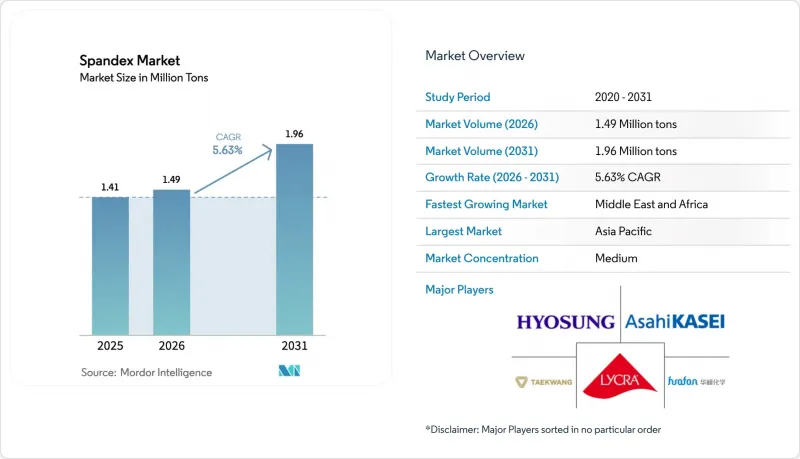
本報告按製造方法(溶液乾紡、溶液濕紡及其他)、應用領域(服裝、醫療及其他應用)和地區(亞太、北美、歐洲、南美以及中東和非洲)進行細分。市場預測以數量(噸)為單位。
全球氨綸市場趨勢及洞察
休閒和功能性服裝越來越受歡迎
隨著休閒從小眾走向主流,對氨綸的需求早已超越了傳統運動服的範疇。功能性服裝的成長源自於消費者對百搭性的需求,這種服裝能夠適應從辦公室到健身房等各種場合。遠距辦公文化鞏固了休閒服裝規範,而D2C(直接面對消費者)品牌則透過重視能夠提供穩定彈性、耐用性和吸濕排汗性能的紡織品供應商,加速了創新週期。像Lululemon這樣的高階品牌,其功能性布料新品發布量同比成長了25%,這表明高性能布料不再被排除在外,即使是高階品牌也不例外。
政府主導的紡織產業叢集投資
在埃及、越南和孟加拉國,國家產業政策正透過低成本資金籌措、稅收優惠和勞動力發展,推動綜合性紡織產業園區的發展。這些叢集將紡紗、織造和後整理工序集中在同一地點,縮短了前置作業時間,並提高了品管。這鞏固了對擁有成熟本地原料和紡織設施的氨綸供應商的長期需求。土耳其和印度的類似激勵措施正在加強紡織業在創造就業方面的結構性作用,並確保在整個經濟週期中對氨綸的強勁需求。
非政府組織對微塑膠污染的關注度日益提高
環保組織正密切關注微纖維脫落問題,每次洗滌最多可脫落70萬個微纖維顆粒,促使歐盟制定過濾和標籤法規。消費者偏好正轉向天然和再生材料,迫使品牌採用低脫落或可生物分解的氨綸產品。這可能會增加生產商的合規成本,例如增加塗層製程或投資可生物分解技術,從而降低其相對於其他纖維的價格競爭力。
細分市場分析
至2025年,溶液乾式紡絲將佔據氨綸市場91.78%的佔有率。這主要歸功於其卓越的纖維均勻性、拉伸強度和染色性能。該領域受益於能夠最大限度減少丹尼爾差異的製程控制系統,而丹尼爾差異是高性能穿戴產品的關鍵參數。為了實現永續性目標,新一代乾式紡絲生產線可降低高達20%的能耗,並減少單位碳排放量。其他替代方法(歸類為「其他」)預計將以6.08%的複合年成長率成長至2031年,這主要得益於無溶劑熔融靜電紡絲和離心分離技術的成熟,但其成長基數較低。
在新興製程中,封閉回路型溶劑回收和生物基聚合物的整合是優先考慮的因素,但規模化生產仍面臨挑戰。熔融靜電紡絲有望透過消除溶劑來應對揮發性有機化合物(VOC)排放的監管壓力,但如何在工業規模下確保纖維均勻性仍然是一個難題。離心紡絲雖然產量高,但不足以滿足高階內衣和醫療設備所需的精細旦數控制。因此,現有的乾式紡絲企業正在投資建造混合式試驗生產線,同時透過採用具有特定彈性保持性能的專有聚氨酯配方來維持其市場主導地位。
區域分析
預計到2025年,亞太地區將維持63.88%的氨綸市佔率。這得歸功於中國從原料到布料的完整供應鏈、韓國先進的聚合物研發能力以及印度不斷擴大的紡絲產能。區域生產商受益於接近性石化產業叢集和密集的出口物流網路。然而,中國產能過剩經常導致平均售價下降,迫使紡絲企業提高營運效率並實現產品多元化。加強符合修訂後排放標準的環保措施需要資本投入,這可能會加速該地區的產業結構調整。
預計2026年至2031年間,中東和非洲地區的複合年成長率將達到6.11%,為全球最高。埃及的綜合紡織園區計畫和沙烏地阿拉伯的「2030願景」激勵措施正吸引尋求免稅進入歐美市場的外國投資者。具有競爭力的電價和現代化的港口基礎設施進一步鞏固了該地區作為新興氨綸市場生產中心的地位。
歐盟的「數位產品護照」和生產者延伸責任制(EPR)框架正在刺激對環保彈性體和本地回收循環的需求。墨西哥和中歐的近岸外包趨勢正在補充而非取代以亞洲為中心的大規模供應鏈,並具有快速補貨的優勢。在以巴西為中心的南美洲,由於本土運動服裝品牌的擴張以及公共醫療保健系統中壓迫療法的日益普及,預計將實現溫和成長。
其他好處:
- Excel格式的市場預測(ME)表
- 3個月的分析師支持
目錄
第1章:引言
- 研究假設和市場定義
- 調查範圍
第2章:調查方法
第3章執行摘要
第4章 市場狀況
- 市場概覽
- 市場促進因素
- 休閒和功能性服裝越來越受歡迎
- 政府主導的紡織產業叢集投資
- 新冠疫情後,醫用壓力服的需求激增。
- 無縫針織技術在服裝業的迅速普及
- 生物基二異氰酸酯的技術進步減少了碳足跡。
- 市場限制因素
- 來自非政府組織的關於微塑膠污染的壓力越來越大。
- 石化原料價格波動
- 中國產能增加導致供需失衡
- 價值鏈分析
- 波特五力分析
第5章 市場規模與成長預測
- 透過製造方法
- 溶液乾紡
- 溶液濕式紡絲
- 其他
- 透過使用
- 服飾
- 醫學領域
- 其他用途
- 按地區
- 亞太地區
- 中國
- 印度
- 日本
- 韓國
- 其他亞太國家
- 北美洲
- 美國
- 加拿大
- 墨西哥
- 歐洲
- 德國
- 英國
- 法國
- 義大利
- 俄羅斯
- 其他歐洲國家
- 南美洲
- 巴西
- 阿根廷
- 其他南美國家
- 中東和非洲
- 沙烏地阿拉伯
- 南非
- 其他中東和非洲國家
- 亞太地區
第6章 競爭情勢
- 市場集中度
- 策略趨勢
- 市佔率和排名分析
- 公司簡介
- Asahi Kasei Corporation
- Huafon Chemical Co., Ltd.
- HYOSUNG
- Indorama Corporation
- Jining Ruyi High-tech Fibre Co.,Ltd.
- Mitsui Chemicals, Inc.
- TAEKWANG INDUSTRIAL CO., LTD
- The LYCRA Company
- TK CHEMICAL CORPORATION
- TORAY INDUSTRIES, INC.
- Xiamen Lilong Spandex Co., Ltd.
- Yantai Tayho Advanced Materials Co., Ltd.
第7章 市場機會與未來展望
According to Mordor Intelligence, the spandex market size was valued at 1.41 million tons in 2025 and estimated to grow from 1.49 million tons in 2026 to reach 1.96 million tons by 2031, at a CAGR of 5.63% during the forecast period (2026-2031).
This report is Segmented by Production Method (Solution Dry Spinning, Solution Wet Spinning, and Others), Application (Apparels, Medical, and Other Applications), and Geography (Asia-Pacific, North America, Europe, South America, and Middle-East and Africa). The Market Forecasts are Provided in Terms of Volume (Tons).
Global Spandex Market Trends and Insights
Rising Penetration of Athleisure and Performance Wear
Athleisure's rise from niche to mainstream has pushed spandex demand far beyond traditional sportswear. Performance apparel growth is driven by consumers who expect office-to-gym versatility. Remote-work culture reinforced casual dress codes, while direct-to-consumer brands accelerated innovation loops that reward fiber suppliers able to deliver consistent stretch, recovery, and moisture-management performance. Luxury labels such as Lululemon logged 25% year-over-year increases in technical fabric launches, underscoring how premium positioning no longer excludes high-function textiles.
Government-Backed Investments in Textile Clusters
National industrial policies in Egypt, Vietnam, and Bangladesh channel low-cost financing, tax holidays, and workforce training into integrated textile parks. These clusters shorten lead times and improve quality control by co-locating spinning, weaving, and finishing operations, thereby anchoring long-term demand for spandex suppliers that establish local feedstock and fiber facilities. Similar incentives in Turkey and India reinforce the structural role of textiles in employment generation, ensuring that spandex market demand remains resilient across economic cycles.
Intensifying NGO Pressure Over Micro-Plastic Pollution
Environmental groups spotlight microfiber shedding-up to 700,000 particles per wash-driving European Union rules on filtration and labeling. Consumer sentiment shifts toward natural or recycled options, compelling brands to specify low-shedding or biodegradable spandex variants. Compliance costs rise as producers add coating steps or invest in intrinsic biodegradation technologies, potentially narrowing price competitiveness versus alternative fibers.
Other drivers and restraints analyzed in the detailed report include:
- Medical Compression Garments Demand Surge Post-COVID
- Rapid Uptake of Seamless Knitting Technology
- Petrochemical Feedstock Price Volatility
For complete list of drivers and restraints, kindly check the Table Of Contents.
Segment Analysis
Solution dry spinning commanded 91.78% spandex market share in 2025, reflecting its superior fiber uniformity, tensile strength, and dye uptake. The segment benefits from process control systems that minimize denier variability, a critical parameter for high-performance wearables. Aligning with sustainability targets, next-generation dry spinning lines reduce energy consumption by up to 20%, lowering specific carbon emissions. Alternative methods grouped under "Others" are projected to expand at a 6.08% CAGR through 2031 as solvent-free melt electrospinning and centrifugal techniques mature, albeit from a low base.
Emerging processes prioritize closed-loop solvent recovery and bio-based polymer integration, but scalability hurdles persist. Melt electrospinning's promise of solvent elimination suits regulatory pressure on VOC emissions, yet faces fiber-uniformity challenges at industrial speeds. Centrifugal spinning delivers high throughput but falls short on fine-denier control required for premium intimates and medical devices. Accordingly, established dry-spinning producers invest in hybrid pilot lines while safeguarding their dominant positions through proprietary polyurethane formulations that embed specific elasticity-retention profiles.
Complete Report Scope:
- By Production Method
- Solution Dry Spinning
- Solution Wet Spinning
- Others
- By Application
- Apparels
- Medical
- Other Applications
- By Geography
- Asia-Pacific
- China
- India
- Japan
- South Korea
- Rest of Asia-Pacific
- North America
- United States
- Canada
- Mexico
- Europe
- Germany
- United Kingdom
- France
- Italy
- Russia
- Rest of Europe
- South America
- Brazil
- Argentina
- Rest of South America
- Middle-East and Africa
- Saudi Arabia
- South Africa
- Rest of Middle-East and Africa
- Asia-Pacific
Geography Analysis
Asia-Pacific retained a 63.88% share of the spandex market size in 2025, underpinned by China's integrated feedstock-to-fabric chain, South Korea's advanced polymer research and development, and India's expanding spinning capacity. Regional producers benefit from proximity to petrochemical clusters and dense export logistics networks. Yet Chinese overcapacity periodically depresses average selling prices, pushing mills to chase operational efficiency and product diversification. Environmental upgrades mandated by updated emission norms require capital expenditure that may accelerate regional consolidation.
The Middle-East and Africa are forecast to deliver the highest CAGR at 6.11% during 2026-2031. Egypt's integrated textile park projects and Saudi Arabia's Vision 2030 incentives attract overseas investors keen on duty-free access to European and U.S. markets. Competitive electricity tariffs and modern port infrastructure further elevate the region as an emerging spandex market production hub.
The European Union's Digital Product Passport and extended producer responsibility frameworks stimulate demand for low-impact elastomers and localized recycling loops. Nearshoring trends in Mexico and Central Europe offer quick-turn replenishment advantages that complement, rather than replace, Asia-centric bulk supply chains. South America, anchored by Brazil, shows moderate growth as domestic sportswear brands scale and public healthcare systems embrace compression therapies.
- Asahi Kasei Corporation
- Huafon Chemical Co., Ltd.
- HYOSUNG
- Indorama Corporation
- Jining Ruyi High-tech Fibre Co.,Ltd.
- Mitsui Chemicals, Inc.
- TAEKWANG INDUSTRIAL CO., LTD
- The LYCRA Company
- TK CHEMICAL CORPORATION
- TORAY INDUSTRIES, INC.
- Xiamen Lilong Spandex Co., Ltd.
- Yantai Tayho Advanced Materials Co., Ltd.
Additional Benefits:
- The market estimate (ME) sheet in Excel format
- 3 months of analyst support
TABLE OF CONTENTS
1 Introduction
- 1.1 Study Assumptions and Market Definition
- 1.2 Scope of the Study
2 Research Methodology
3 Executive Summary
4 Market Landscape
- 4.1 Market Overview
- 4.2 Market Drivers
- 4.2.1 Rising penetration of athleisure and performance wear
- 4.2.2 Government-backed investments in textile clusters
- 4.2.3 Medical compression garments demand surge post-COVID
- 4.2.4 Rapid uptake of seamless knitting technology in apparel
- 4.2.5 Bio-based diisocyanate breakthroughs lowering carbon footprint
- 4.3 Market Restraints
- 4.3.1 Intensifying NGO pressure over micro-plastic pollution
- 4.3.2 Petrochemical feedstock price volatility
- 4.3.3 Supply-demand imbalance due to China capacity additions
- 4.4 Value Chain Analysis
- 4.5 Porter's Five Forces Analysis
- 4.5.1 Bargaining Power of Suppliers
- 4.5.2 Bargaining Power of Buyers
- 4.5.3 Threat of New Entrants
- 4.5.4 Threat of Substitutes
- 4.5.5 Degree of Competition
5 Market Size and Growth Forecasts (Volume)
- 5.1 By Production Method
- 5.1.1 Solution Dry Spinning
- 5.1.2 Solution Wet Spinning
- 5.1.3 Others
- 5.2 By Application
- 5.2.1 Apparels
- 5.2.2 Medical
- 5.2.3 Other Applications
- 5.3 By Geography
- 5.3.1 Asia-Pacific
- 5.3.1.1 China
- 5.3.1.2 India
- 5.3.1.3 Japan
- 5.3.1.4 South Korea
- 5.3.1.5 Rest of Asia-Pacific
- 5.3.2 North America
- 5.3.2.1 United States
- 5.3.2.2 Canada
- 5.3.2.3 Mexico
- 5.3.3 Europe
- 5.3.3.1 Germany
- 5.3.3.2 United Kingdom
- 5.3.3.3 France
- 5.3.3.4 Italy
- 5.3.3.5 Russia
- 5.3.3.6 Rest of Europe
- 5.3.4 South America
- 5.3.4.1 Brazil
- 5.3.4.2 Argentina
- 5.3.4.3 Rest of South America
- 5.3.5 Middle-East and Africa
- 5.3.5.1 Saudi Arabia
- 5.3.5.2 South Africa
- 5.3.5.3 Rest of Middle-East and Africa
- 5.3.1 Asia-Pacific
6 Competitive Landscape
- 6.1 Market Concentration
- 6.2 Strategic Moves
- 6.3 Market Share (%)/Ranking Analysis
- 6.4 Company Profiles (includes Global level Overview, Market level overview, Core Segments, Financials as available, Strategic Information, Market Rank/Share for key companies, Products and Services, and Recent Developments)
- 6.4.1 Asahi Kasei Corporation
- 6.4.2 Huafon Chemical Co., Ltd.
- 6.4.3 HYOSUNG
- 6.4.4 Indorama Corporation
- 6.4.5 Jining Ruyi High-tech Fibre Co.,Ltd.
- 6.4.6 Mitsui Chemicals, Inc.
- 6.4.7 TAEKWANG INDUSTRIAL CO., LTD
- 6.4.8 The LYCRA Company
- 6.4.9 TK CHEMICAL CORPORATION
- 6.4.10 TORAY INDUSTRIES, INC.
- 6.4.11 Xiamen Lilong Spandex Co., Ltd.
- 6.4.12 Yantai Tayho Advanced Materials Co., Ltd.
7 Market Opportunities and Future Outlook
- 7.1 White-space and unmet-need assessment

 氨綸纖維市場:全球市場預測,2026-2032年
 氨綸市場:依布料種類、應用及地區分類
 氨綸纖維市場報告:按織物類型、生產方法、應用和地區分類(2026-2034 年)
 2025-2029年全球氨綸纖維市場全球再生氨綸纖維市場(按產品類型、回收製程、材料來源、通路和最終用途產業分類)預測(2026-2032年)全球氨綸市場(按纖維含量、紗線類型、製造流程、等級、最終用途和分銷管道分類)預測(2026-2032年)
 氨綸市場規模、佔有率和成長分析(按技術、類型、製造流程、應用和地區分類)-2026-2033年產業預測
 氨綸纖維市場-全球產業規模、佔有率、趨勢、機會及預測(依生產流程、最終用途產業、地區及競爭狀況分類,2020-2030 年預測)
 2026-2032 年氨綸市場(依生產製程、產品種類、最終用途產業及地區分類)
 氨綸纖維市場規模、佔有率和成長分析(按生產流程、最終用途行業和地區)- 2025-2032 年行業預測