


 |
市場調查報告書
商品編碼
2116607
紡紗機械:市場佔有率分析、產業趨勢與統計、成長預測(2026-2031)Spinning Machinery - Market Share Analysis, Industry Trends & Statistics, Growth Forecasts (2026 - 2031) |
||||||

※ 本網頁內容可能與最新版本有所差異。詳細情況請與我們聯繫。
據 Mordor Intelligence 稱,紡紗機械市場預計到 2026 年價值 144 億美元,高於 2025 年的 137.7 億美元,預計到 2031 年將達到 180.1 億美元。
預計從 2026 年到 2031 年,其複合年成長率將達到 4.57%。
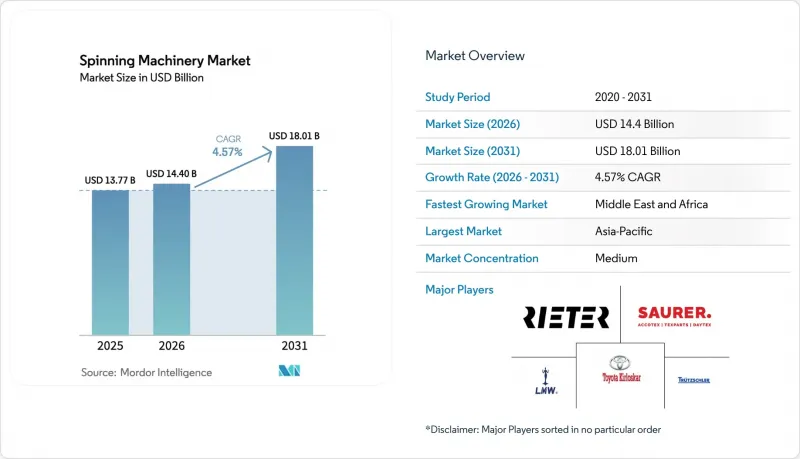
本報告按機器類型(環式、轉子/開口式等)、材料(天然纖維、合成纖維、再生纖維)、應用領域(服裝時尚、家紡等)、自動化程度(傳統型等)以及地區(北美、南美、歐洲、亞太、中東和非洲)進行細分。市場預測以美元計價。
全球紡紗機械市場趨勢及洞察
符合工業4.0標準的紡紗生產線正快速普及。
目前,紡紗廠正在應用物聯網感測器和雲端分析技術來減少運作並穩定產品品質。 Reeter 的「ESSENTIAL」套件可即時提供錠子數據,從而減少 30% 的操作人員,並將原料利用率提高 1-2%。西門子和 Spinova 合作推出的數位孿生技術實現了虛擬試運行,加快了生產推出,並避免了代價高昂的返工。亞太地區許多紡紗廠的錠運作超過 10 萬錠,即使是微小的效率提升也能帶來數百萬美元的年度成本節約。軟體訂閱收入也在不斷成長,即使在硬體銷售成熟後,也能為機械製造商提供持續的收入來源。儘管實施成本仍然很高,但由於貸款機構更傾向於成本節約可追蹤的項目,因此其商業價值正變得越來越有吸引力。
對功能性及技術性紡織品的需求正在激增。
汽車、醫療和地工織物行業對能夠承受嚴苛環境的紗線需求日益成長,促使紡紗廠採用能夠提供更優異均勻性的緊密紡紗機和噴氣紡紗機。印度已批准168個技術紡織品項目,總投資額達509卡羅爾印度盧比(約6130萬美元),作為其國家技術紡織品計劃的一部分,這充分體現了公眾對特種纖維的大力支持。歐洲一級供應商也正從生產用於安全氣囊織物的梭織材料轉向針織材料,從而催生了對高強度聚醯胺紡紗生產線的新需求。技術紡織品的利潤率比普通紗線高出20-30%,這促使紡紗廠加大對自動化設備的投資,以確保產品品質的穩定性。
資本密集度高且投資報酬率不確定
一條擁有10萬錠的全自動生產線造價可能超過4000萬美元,對中小企業的財務狀況帶來壓力。聚酯纖維和棉花價格的波動擠壓了毛利率,延長了投資回收期,阻礙了設備現代化。此外,貸款機構現在要求企業在提供資金之前披露ESG資訊並提交數位化藍圖,這增加了企業的行政負擔。產能過剩地區的紡紗廠往往會延後設備升級,轉而選擇分階段維修。因此,全球環錠紡紗機的平均使用壽命仍超過12年,遠低於最佳效率水準。
細分市場分析
環錠紡紗機在2025年佔總銷售額的49.20%。其對多種纖維的應對力使工廠無需更換設備即可在棉紗、聚酯紗和混紡紗之間切換生產,從而保持運轉率。瑞特(Reeter)的緊密紡紗生產線提高了紗線均勻度,減少了廢棄物,並為擁有數十萬錠的紡紗廠每年額外創造了730萬元人民幣(103萬美元)的現金流。這一切實的成本降低鞏固了公司在紡紗機械市場的地位。儘管在渦流/緊密紡紗領域規模較小,但隨著產業用紡織品消費量的成長,預計其複合年成長率將達到5.78%。據稱,紹爾(Sauer)的Autocoro 11轉杯紡紗機比其前代產品節能10%,使其成為旨在減少範圍3排放的紡紗廠的理想選擇。與特殊聚丙烯和粘膠纖維相容的噴氣系統,為尋求向上游轉移價值鏈的紡紗廠提供了更多選擇。
二線供應商正將核心紡紗機與吹氣室、梳棉機和併條機捆綁銷售,以促進一站式購買。在大規模合約中,確保整條生產線的效率變得越來越重要,而不再只專注於單一機器的規格。由於許多買家考慮端到端的升級,提供類比工具和虛擬試運行的供應商正在獲得競爭優勢。在此背景下,即使紗線價格出現波動,紡紗機械市場預計仍將繼續穩步推進現代化進程。
到2025年,合成纖維將佔總加工量的61.90%,這反映了聚酯纖維的成本優勢和耐用性。纖維長度和細度的均勻性使得紡錠轉速可以更高,從而降低了紡紗機械市場的單位成本。儘管目前再生和回收材料的市場佔有率較小,但預計到2030年,隨著各品牌承諾將再生材料含量提高到25-50%,其複合年成長率將達到6.14%。安德里茲的切碎機線每小時可處理高達3000公斤的消費後廢棄物,提供適用於開端紗的纖維片。精煉再生纖維混紡的紡紗廠可以設定15-20%的溢價,以抵消產量的輕微下降。
由於再生纖維的纖維長度較短,加工這些纖維對傳統的梳理設備提出了更高的要求,但配備自適應自動勻整平機的設備正變得越來越普及。 Reeter 的再生纖維分級工具可根據投入指標預測紗線質量,幫助買家降低投資風險。預計天然纖維將在高階襯衫布料和床單市場保持一定的市場佔有率,但氣候風險和水資源短缺將限制其產能的快速擴張。持續的政策獎勵,例如歐盟範圍內的生產者延伸責任制 (EPR) 計劃,將在整個預測期內維持再生纖維的發展勢頭。
區域分析
至2025年,亞太地區將佔全球紡紗機械市場54.10%的佔有率。中國運作約9,400萬錠的紡紗機,印度將擁有約6,300萬錠的紡紗機,兩國都將為全球供應提供支援。目前,中國正將資本投資轉向小型化紡紗機,以抵消不斷上漲的人事費用;而印度則依靠政府激勵措施,免除無梭織機的進口關稅。聯邦政府6.352億美元的支出以及泰米爾納德邦提供的6020萬美元補貼,凸顯了印度政府打造具有全球競爭力的產業叢集的政治決心。能夠實現關鍵零件本地化的供應商正享受關稅優惠,並從古吉拉突邦、山東省和浙江省的綜合紡紗廠獲得大規模訂單。
由於埃及、衣索比亞和海灣國家的新資本流入,預計中東和非洲將錄得最高成長率,到2031年複合年成長率將達到5.83%。 Eroglu在埃及投資1.2億美元的工廠涵蓋從紡紗到縫紉的全部工序,從而降低了物流成本並縮短了從潮流到商店的周期。土耳其已從國際金融公司(IFC)資金籌措,用於建造一條聚酯切片生產線和一個再生紡紗裝置,這象徵著多邊對循環生產能力的支持。該地區的買家正在尋求包含供應商融資的承包工程方案,允許在首次出貨前延期支付本金,這種模式非常適合希望在飽和的國內市場以外拓展銷售量的歐洲原始設備製造商(OEM)。北美和歐洲目前仍更處於技術升級而非待開發區市場的階段。歐盟的紡紗廠正準備遵守碳邊境調節機制(CBAM),該機制正在加速向可再生能源驅動的紡錠馬達和減少化學品使用的染色製程轉型。美國的棉紡業屬於小眾領域,主要針對高階運動服飾的近岸外包。這兩個地區都強調可追溯性,並敦促原始設備製造商(OEM)獲得基於區塊鏈的認證。南美的需求雖然不大但穩定,巴西生產商為了避免外匯波動風險,選擇租紡紗機而非直接購買。這些不同的情況使得紡紗機械市場在擴張需求和更新換代需求之間形成了地理平衡。
其他好處:
- Excel格式的市場預測(ME)表
- 3個月的分析師支持
目錄
第1章:引言
- 研究假設和市場定義
- 調查範圍
第2章:調查方法
第3章執行摘要
第4章 市場狀況
- 市場概覽
- 市場促進因素
- 快速採用符合工業4.0標準的紡紗生產線
- 將生產能力轉移到亞洲具有成本競爭力的生產基地
- 對技術/功能性紡織品的需求正在激增。
- 政府對現代化的獎勵
- 低能耗設備的ESG掛鉤融資
- 為支持循環纖維回收而進行的修改
- 市場限制因素
- 高資本密集度和不確定的投資報酬率
- 具備數位技能的操作人員短缺
- 氣候因素導致棉花供應波動
- 碳邊境課稅的風險
- 價值供應鏈分析
- 監理情勢
- 技術展望
- 產業吸引力—五力分析
- 供應商的議價能力
- 買方的議價能力
- 新進入者的威脅
- 替代品的威脅
- 競爭公司之間的競爭
第5章 市場規模與成長預測
- 按機器類型
- 戒指
- 轉子/開口端
- 噴射機
- 渦旋/緊湊型
- 其他(吹氣室、梳棉機、併條機、轉換裝置、捲繞機)
- 材料
- 天然纖維(棉、黃麻、亞麻/麻布、大麻、椰子纖維、羊毛、絲綢、羊駝毛、羊絨、馬海毛等)
- 合成纖維(聚酯纖維、尼龍纖維、腈綸纖維、烯烴/聚丙烯纖維、彈性纖維/氨綸纖維、芳香聚醯胺等)
- 再生纖維(黏膠纖維、莫代爾纖維、Lyocell纖維/天絲纖維、銅氨纖維、醋酸纖維、再生聚酯纖維(rPET)、再生尼龍、PLA纖維等)
- 透過使用
- 服裝與時尚
- 家用紡織品
- 技術及工業紡織品
- 按自動化級別
- 傳統的
- 半自動
- 全數位化/智慧工廠
- 按地區
- 北美洲
- 美國
- 加拿大
- 墨西哥
- 南美洲
- 巴西
- 阿根廷
- 其他南美國家
- 歐洲
- 英國
- 德國
- 法國
- 義大利
- 西班牙
- 比荷盧經濟聯盟(比利時、荷蘭、盧森堡)
- 北歐國家(丹麥、芬蘭、冰島、挪威、瑞典)
- 其他歐洲國家
- 亞太地區
- 中國
- 印度
- 日本
- 澳洲
- 韓國
- 東協(印尼、泰國、菲律賓、馬來西亞、越南)
- 其他亞太國家
- 中東和非洲
- 沙烏地阿拉伯
- 阿拉伯聯合大公國
- 卡達
- 科威特
- 土耳其
- 埃及
- 南非
- 奈及利亞
- 其他中東和非洲國家
- 北美洲
第6章 競爭情勢
- 市場集中度分析
- 策略趨勢
- 市佔率分析
- 公司簡介
- Rieter
- Saurer Intelligent Technology AG
- Toyota Industries(Kirloskar Toyota)
- Lakshmi Machine Works
- Trutzschler Group SE
- Murata Machinery
- Savio Macchine Tessili
- Marzoli Spinning Solutions
- Itema SpA
- ATE Pvt Ltd
- Crosrol
- Jingwei Textile Machinery
- RIFA
- Tsudakoma
- Haijia Machinery
- Qingdao Dongjia
- Premier Mills
- Vardhman Textiles(Machinery division)
- Nahar Spinning
- Bajaj Steel Industries(Ginning)
第7章 市場機會與未來展望
According to Mordor Intelligence, the spinning machinery market size in 2026 is estimated at USD 14.4 billion, growing from 2025 value of USD 13.77 billion with 2031 projections showing USD 18.01 billion, growing at 4.57% CAGR over 2026-2031.
This report is Segmented by Machine Type (Ring, Rotor/Open-End, and More), by Material (Natural Fibers, Synthetic Fibers, Regenerated Fibers), by Application (Apparel & Fashion, Home & Household Textiles, and More), by Automation Level (Conventional, and More), and by Geography (North America, South America, Europe, Asia-Pacific, Middle East and Africa). The Market Forecasts are Provided in Terms of Value (USD).
Global Spinning Machinery Market Trends and Insights
Surging Adoption of Industry 4.0 Enabled Spinning Lines
Mills now deploys IoT sensors and cloud analytics to cut idle time and stabilize quality. Rieter's ESSENTIAL suite streams real-time spindle data that trims operator headcount by 30% and lifts raw-material yield by 1-2%. Digital twins, showcased through a Siemens-Spinnova collaboration, allow virtual commissioning that accelerates ramp-up and avoids costly rework. Because many APAC mills run 100,000+ spindles, even fractional efficiency gains translate into seven-figure annual savings. Software subscription revenues are also rising, giving machinery OEMs recurring income once hardware sales mature. Implementation costs remain high, but lenders favor projects with traceable resource savings, making the business case more attractive.
Technical/Functional Textile Demand Boom
Automotive, medical, and geotextile segments require yarns that can endure extreme conditions, pushing mills toward compact and air-jet equipment that delivers superior evenness. India approved 168 technical-textile projects worth INR 509 crore (USD 61.3 million) under its National Technical Textiles Mission, underscoring public support for specialty fibers. European Tier-1 suppliers are also shifting from woven to knit airbag fabrics, adding new demand for high-tenacity polyamide spinning lines. Because technical textiles fetch margin premiums of 20-30% over commodity yarns, mills are more willing to invest in automation that assures repeatable quality.
High Capital Intensity & Uncertain ROI
Fully automated lines with 100,000 spindles can cost over USD 40 million, stretching SME balance sheets. Fluctuating polyester and cotton prices compress gross margins and extend payback, deterring modernization. Lenders now request ESG disclosures and digital roadmaps before releasing capital, adding administrative burden. Mills in over-capacity regions often defer upgrades, choosing incremental repairs instead. This dynamic keeps the average global ring frame age above 12 years, well beyond optimal efficiency levels.
Other drivers and restraints analyzed in the detailed report include:
- Capacity Shift to Cost-Competitive Asian Hubs
- Government Modernization Incentives
- Shortage of Digital-Skill Operators
For complete list of drivers and restraints, kindly check the Table Of Contents.
Segment Analysis
Ring frames generated 49.20% of 2025 revenue. Their broad fiber compatibility allows mills to toggle between cotton, polyester, and blends without retooling, safeguarding utilization rates. Rieter's compact line improves yarn evenness and cuts waste, generating an incremental cash flow of CNY 7.3 million (USD 1.03 million) annually at a 100,000-spindle mill. This tangible saving reinforces their position in the spinning machinery market. The vortex/compact niche, although smaller, will outpace at a 5.78% CAGR as technical textile consumption grows. Saurer's Autocoro 11 rotor machine claims 10% lower energy use than its predecessor, appealing to mills chasing Scope-3 emission cuts. Air-jet systems serve specialty polypropylene and viscose, expanding option sets for mills repositioning up the value chain.
Second-tier vendors bundle blow-room, carding, and draw-frame units with the core spinning element, promoting one-stop procurement. Larger contracts increasingly hinge on total-line efficiency guarantees rather than individual machine specs. With many buyers contemplating end-to-end upgrades, vendors that offer simulation tools and virtual commissioning secure competitive leverage. This environment should keep the spinning machinery market on a steady modernization course, even if yarn prices fluctuate.
Synthetic fibers represented 61.90% of total throughput in 2025, mirroring polyester's cost advantage and durability attributes. Consistency in staple length and fineness allows higher spindle speeds, lowering unit costs in the spinning machinery market. Recycled and regenerated inputs, while only a minor share, will clock a 6.14% CAGR because brands pledge to hit 25-50% recycled content by 2030. ANDRITZ's shredding line processes up to 3,000 kg per hour of post-consumer waste, supplying flake suitable for open-end yarns. Mills that refine recycled fiber blends can command 15-20% price premiums, offsetting modest yield losses.
Processing reclaimed fibers strains traditional carding settings due to short staple lengths, so equipment with adaptive auto-levellers is gaining traction. Rieter's recycling classification tool forecasts yarn quality based on input metrics, helping buyers de-risk investments. Natural fibers will hold niche positions in luxury shirting and bed linen, yet climatic risks and water scarcity limit aggressive capacity additions. Persistent policy incentives, such as EU-wide EPR schemes, should perpetuate recycled fiber momentum through the forecast horizon.
Complete Report Scope:
- By Machine Type
- Ring
- Rotor / Open-End
- Air-Jet
- Vortex / Compact
- Others (Blow-room, Carding, Draw-frame, Comber, Winder)
- By Material
- Natural Fibers (Cotton, Jute, Flax/Linen, Hemp, Coir, Wool, Silk, Alpaca, Cashmere, Mohair, etc.)
- Synthetic Fibers (Polyester, Nylon, Acrylic, Olefin/Polypropylene, Elastane/Spandex, Aramid, etc.)
- Recycled / Regenerated Fibers (Viscose Rayon, Modal, Lyocell/Tencel, Cupro, Acetate, Recycled Polyester (rPET), Recycled Nylon, PLA Fiber, etc.)
- By Application
- Apparel & Fashion
- Home & Household Textiles
- Technical & Industrial Textiles
- By Automation Level
- Conventional
- Semi-Automated
- Fully Digital / Smart Factory
- By Geography
- North America
- United States
- Canada
- Mexico
- South America
- Brazil
- Argentina
- Rest of South America
- Europe
- United Kingdom
- Germany
- France
- Italy
- Spain
- BENELUX (Belgium, Netherlands, and Luxembourg)
- NORDICS (Denmark, Finland, Iceland, Norway, and Sweden)
- Rest of Europe
- Asia-Pacific
- China
- India
- Japan
- Australia
- South Korea
- ASEAN (Indonesia, Thailand, Philippines, Malaysia, Vietnam)
- Rest of Asia-Pacific
- Middle East and Africa
- Saudi Arabia
- United Arab Emirates
- Qatar
- Kuwait
- Turkey
- Egypt
- South Africa
- Nigeria
- Rest of Middle East and Africa
- North America
Geography Analysis
Asia-Pacific commanded 54.10% of the spinning machinery market in 2025. China operated roughly 94 million spindle equivalents and India 63 million, together anchoring global supply. China now channels capex into compact-frame retrofits to offset higher wages, whereas India leans on state incentives that waive import duties on shuttle-less looms. The USD 635.2 million federal outlay and USD 60.2 million Tamil Nadu subsidy underline the political will to create globally competitive clusters. Suppliers able to localize key components enjoy tariff relief, winning big orders from integrated mills in Gujarat, Shandong, and Zhejiang.
The Middle East and Africa will post the fastest 5.83% CAGR through 2031 because fresh capital pours into Egypt, Ethiopia, and the Gulf. Eroglu's USD 120 million Egyptian plant links spinning to garmenting, which cuts logistics cost and speeds trend-to-shelf cycles. Turkey tapped USD 50 million from IFC for a polyester chip line and recycling spin unit, illustrating multilateral backing for circular capacity. Buyers here seek turnkey packages with vendor-financed options that defer principal until first shipment, a model suiting European OEMs chasing volume growth outside saturated home markets. North America and Europe remain technology upgrade zones rather than greenfield arenas. EU mills brace for the Carbon Border Adjustment Mechanism, incentivizing the shift to renewable-powered spindle motors and low-chem dye routes. U.S. cotton-spinning activity is niche, aimed at near-shoring premium athletic wear. Both regions value traceability, pushing OEMs to certify blockchain readiness. South America's demand is modest but stable; Brazilian producers hedge currency swings by leasing rather than buying frames outright. These varied profiles ensure the spinning machinery market retains geographic balance between expansion and replacement revenues.
- Rieter
- Saurer Intelligent Technology AG
- Toyota Industries (Kirloskar Toyota)
- Lakshmi Machine Works
- Trutzschler Group SE
- Murata Machinery
- Savio Macchine Tessili
- Marzoli Spinning Solutions
- Itema S.p.A.
- A.T.E. Pvt Ltd
- Crosrol
- Jingwei Textile Machinery
- RIFA
- Tsudakoma
- Haijia Machinery
- Qingdao Dongjia
- Premier Mills
- Vardhman Textiles (Machinery division)
- Nahar Spinning
- Bajaj Steel Industries (Ginning)
Additional Benefits:
- The market estimate (ME) sheet in Excel format
- 3 months of analyst support
TABLE OF CONTENTS
1 Introduction
- 1.1 Study Assumptions & Market Definition
- 1.2 Scope of the Study
2 Research Methodology
3 Executive Summary
4 Market Landscape
- 4.1 Market Overview
- 4.2 Market Drivers
- 4.2.1 Surging adoption of Industry 4.0 enabled spinning lines
- 4.2.2 Capacity shift to cost-competitive Asian hubs
- 4.2.3 Technical/functional textile demand boom
- 4.2.4 Government modernization incentives
- 4.2.5 ESG-linked financing for low-energy machines
- 4.2.6 Circular-fiber recycling compatible retrofits
- 4.3 Market Restraints
- 4.3.1 High capital intensity & uncertain ROI
- 4.3.2 Shortage of digital-skill operators
- 4.3.3 Climate-driven cotton supply volatility
- 4.3.4 Carbon-border taxation risk
- 4.4 Value / Supply-Chain Analysis
- 4.5 Regulatory Landscape
- 4.6 Technological Outlook
- 4.7 Industry Attractiveness - Porter's Five Forces Analysis
- 4.7.1 Bargaining Power of Suppliers
- 4.7.2 Bargaining Power of Buyers
- 4.7.3 Threat of New Entrants
- 4.7.4 Threat of Substitutes
- 4.7.5 Competitive Rivalry
5 Market Size & Growth Forecasts (Value, In USD Billion)
- 5.1 By Machine Type
- 5.1.1 Ring
- 5.1.2 Rotor / Open-End
- 5.1.3 Air-Jet
- 5.1.4 Vortex / Compact
- 5.1.5 Others (Blow-room, Carding, Draw-frame, Comber, Winder)
- 5.2 By Material
- 5.2.1 Natural Fibers (Cotton, Jute, Flax/Linen, Hemp, Coir, Wool, Silk, Alpaca, Cashmere, Mohair, etc.)
- 5.2.2 Synthetic Fibers (Polyester, Nylon, Acrylic, Olefin/Polypropylene, Elastane/Spandex, Aramid, etc.)
- 5.2.3 Recycled / Regenerated Fibers (Viscose Rayon, Modal, Lyocell/Tencel, Cupro, Acetate, Recycled Polyester (rPET), Recycled Nylon, PLA Fiber, etc.)
- 5.3 By Application
- 5.3.1 Apparel & Fashion
- 5.3.2 Home & Household Textiles
- 5.3.3 Technical & Industrial Textiles
- 5.4 By Automation Level
- 5.4.1 Conventional
- 5.4.2 Semi-Automated
- 5.4.3 Fully Digital / Smart Factory
- 5.5 By Geography
- 5.5.1 North America
- 5.5.1.1 United States
- 5.5.1.2 Canada
- 5.5.1.3 Mexico
- 5.5.2 South America
- 5.5.2.1 Brazil
- 5.5.2.2 Argentina
- 5.5.2.3 Rest of South America
- 5.5.3 Europe
- 5.5.3.1 United Kingdom
- 5.5.3.2 Germany
- 5.5.3.3 France
- 5.5.3.4 Italy
- 5.5.3.5 Spain
- 5.5.3.6 BENELUX (Belgium, Netherlands, and Luxembourg)
- 5.5.3.7 NORDICS (Denmark, Finland, Iceland, Norway, and Sweden)
- 5.5.3.8 Rest of Europe
- 5.5.4 Asia-Pacific
- 5.5.4.1 China
- 5.5.4.2 India
- 5.5.4.3 Japan
- 5.5.4.4 Australia
- 5.5.4.5 South Korea
- 5.5.4.6 ASEAN (Indonesia, Thailand, Philippines, Malaysia, Vietnam)
- 5.5.4.7 Rest of Asia-Pacific
- 5.5.5 Middle East and Africa
- 5.5.5.1 Saudi Arabia
- 5.5.5.2 United Arab Emirates
- 5.5.5.3 Qatar
- 5.5.5.4 Kuwait
- 5.5.5.5 Turkey
- 5.5.5.6 Egypt
- 5.5.5.7 South Africa
- 5.5.5.8 Nigeria
- 5.5.5.9 Rest of Middle East and Africa
- 5.5.1 North America
6 Competitive Landscape
- 6.1 Market Concentration Analysis
- 6.2 Strategic Moves
- 6.3 Market Share Analysis
- 6.4 Company Profiles (includes Global level Overview, Market level overview, Core Segments, Financials as available, Strategic Information, Products & Services, Recent Developments)
- 6.4.1 Rieter
- 6.4.2 Saurer Intelligent Technology AG
- 6.4.3 Toyota Industries (Kirloskar Toyota)
- 6.4.4 Lakshmi Machine Works
- 6.4.5 Trutzschler Group SE
- 6.4.6 Murata Machinery
- 6.4.7 Savio Macchine Tessili
- 6.4.8 Marzoli Spinning Solutions
- 6.4.9 Itema S.p.A.
- 6.4.10 A.T.E. Pvt Ltd
- 6.4.11 Crosrol
- 6.4.12 Jingwei Textile Machinery
- 6.4.13 RIFA
- 6.4.14 Tsudakoma
- 6.4.15 Haijia Machinery
- 6.4.16 Qingdao Dongjia
- 6.4.17 Premier Mills
- 6.4.18 Vardhman Textiles (Machinery division)
- 6.4.19 Nahar Spinning
- 6.4.20 Bajaj Steel Industries (Ginning)
7 Market Opportunities & Future Outlook
- 7.1 White-space & Unmet-Need Assessment

 2026年全球噴射織布機市場報告2026年全球環錠紡紗機市場報告
 紡紗機械市場:按運作類型、機器類型、材料、紡紗工藝、最終用戶和地區分類
 全球紡紗機械市場規模、佔有率、趨勢和成長分析報告(2026-2034年)
 紡紗機械市場:依技術、材料、自動化程度、速度及應用分類-2026-2032年全球市場預測全球搖籃鋪放機市場(按機器類型、自動化程度、加工材料、動力來源、分銷管道和最終用戶產業分類)預測(2026-2032年)全球緊湊型紡織拉幅定型機市場:依自動化程度、加熱類型、配置、操作方式、織物類型、幅寬能力、最終用戶和銷售管道分類,2026-2032年預測
 織布機市場機會、成長要素、產業趨勢分析及2026年至2035年預測BCF紡絲機械市場按機器類型、纖維類型、自動化程度、應用和最終用戶分類,全球預測,2026-2032年
 紡紗機械市場:全球產業分析、規模、佔有率、成長、趨勢及預測(2025-2032)