


 |
市場調查報告書
商品編碼
1928989
織布機市場機會、成長要素、產業趨勢分析及2026年至2035年預測Weaving Machine Market Opportunity, Growth Drivers, Industry Trend Analysis, and Forecast 2026 - 2035 |
||||||

全球織造機械市場預計到 2025 年將達到 70 億美元,到 2035 年將達到 108 億美元,年複合成長率為 4.5%。
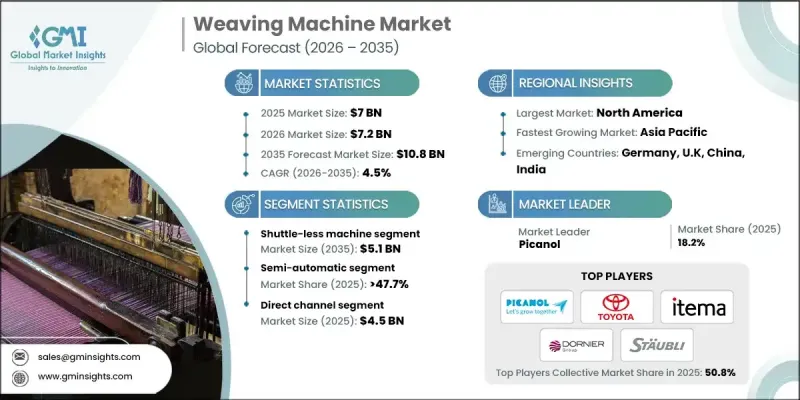
市場成長的驅動力來自多個終端使用者產業(包括交通運輸、運動服和服裝)對耐用、高性能布料日益成長的需求。製造商正擴大整合先進的數位技術,例如人工智慧控制和連接系統,以簡化操作並提高生產精度。這些技術透過減少人工干預、降低錯誤率和提高整體生產效率來支援自動化。政府主導的旨在促進工業自動化和現代化的措施也推動了先進織造設備的普及。自動化生產環境能夠提高產量,同時減少對勞力密集流程的依賴。同時,永續性因素也在影響採購決策,製造商正轉向使用節能型織造機以降電力消耗量和排放。旨在促進清潔生產的環境法規和獎勵持續支持市場的長期擴張,並推動對現代紡織解決方案的投資。
| 市場覆蓋範圍 | |
|---|---|
| 開始年份 | 2025 |
| 預測年份 | 2026-2035 |
| 起始值 | 70億美元 |
| 預測金額 | 108億美元 |
| 複合年成長率 | 4.5% |
預計到 2025 年,無梭織機市場規模將達到 33 億美元,到 2035 年將達到 51 億美元。由於對技術先進的紡織機械的需求不斷成長,無梭織機系統的應用正在加速,該系統能夠提高產量一致性,同時提高生產效率,減少材料廢棄物,降低營運成本。
截至2025年,半自動紡織品市佔率為47.7%。在製造商尋求提高效率並減少資本投入的地區,半自動紡織品仍被廣泛採用。半自動系統使生產商能夠在不實現完全自動化的情況下擴大產能,並滿足不斷成長的紡織品需求。
預計到2025年,美國織造機械市佔率將達到65.5%。紡織企業持續大力推動生產現代化和自動化,鞏固了其市場領先地位。旨在提升國內製造業能力的公共部門舉措,也為先進織造技術和數位化生產系統的投資提供了動力。
目錄
第1章調查方法和範圍
第2章執行摘要
第3章業界考察
- 生態系分析
- 供應商情況
- 利潤率
- 每個階段的附加價值
- 影響價值鏈的因素
- 產業影響因素
- 促進要素
- 自動化技術進步
- 對客製化布料的需求不斷成長
- 提高生產效率和速度
- 產業潛在風險與挑戰
- 高昂的初始投資成本
- 原物料價格波動
- 機會
- 促進永續性政策和循環經濟
- 整合物聯網和預測性維護解決方案
- 促進要素
- 成長潛力分析
- 未來市場趨勢
- 科技與創新趨勢
- 當前技術趨勢
- 新興技術
- 價格趨勢
- 按類型
- 按地區
- 監管環境
- 標準和合規要求
- 區域法規結構
- 認證標準
- 貿易統計(HS編碼8446)
- 主要進口國
- 主要出口國
- 差距分析
- 風險評估與緩解
- 波特分析
- PESTEL 分析
第4章 競爭情勢
- 介紹
- 公司市佔率分析
- 按地區
- 企業矩陣分析
- 主要市場公司的競爭分析
- 競爭定位矩陣
- 重大進展
- 併購
- 夥伴關係與合作
- 新產品發布
- 擴張計劃
第5章 按類型分類的市場估算與預測,2022-2035年
- 梭式機
- 無梭式機器
- 專用機械
- 其他
第6章 2022-2035年各細分市場的估計與預測
- 手動的
- 半自動
- 自動的
第7章 按應用領域分類的市場估算與預測,2022-2035年
- 家具布料
- 汽車紡織品
- 運動服
- 其他
第8章 按分銷管道分類的市場估算與預測,2022-2035年
- 直銷
- 間接
第9章 2022-2035年各地區市場估算與預測
- 北美洲
- 美國
- 加拿大
- 歐洲
- 德國
- 法國
- 英國
- 義大利
- 西班牙
- 亞太地區
- 中國
- 印度
- 日本
- 韓國
- 澳洲
- 拉丁美洲
- 巴西
- 墨西哥
- 阿根廷
- 中東和非洲
- 南非
- 沙烏地阿拉伯
- 阿拉伯聯合大公國
第10章:公司簡介
- Bonas
- Dornier
- Itema
- Jingwei
- Laxmi
- Lohia
- Picanol
- Qingdao Dongjia
- Rifa
- Smit
- Staubli
- Toyota
- Tsudakoma
- Van de Wiele
- Zhejiang Hengtai
The Global Weaving Machine Market was valued at USD 7 billion in 2025 and is estimated to grow at a CAGR of 4.5% to reach USD 10.8 billion by 2035.
Market growth is driven by rising demand for durable and high-performance fabrics across multiple end-use industries, including transportation, sportswear, and apparel. Manufacturers are increasingly integrating advanced digital technologies such as AI-enabled controls and connected systems to streamline operations and improve production accuracy. These technologies support automation by reducing manual intervention, lowering error rates, and improving overall manufacturing efficiency. Government-backed initiatives that encourage industrial automation and modernization are also contributing to higher adoption of advanced weaving equipment. Automated production environments enable higher output levels while reducing dependence on labor-intensive processes. At the same time, sustainability considerations are influencing purchasing decisions, with manufacturers shifting toward energy-efficient looms to lower power consumption and emissions. Environmental regulations and incentives promoting cleaner manufacturing practices continue to support long-term market expansion, reinforcing investment in modern weaving solutions.
| Market Scope | |
|---|---|
| Start Year | 2025 |
| Forecast Year | 2026-2035 |
| Start Value | $7 Billion |
| Forecast Value | $10.8 Billion |
| CAGR | 4.5% |
The shuttle-less weaving machine segment generated USD 3.3 billion in 2025 and is projected to reach USD 5.1 billion by 2035. Growing demand for technologically advanced textile machinery is accelerating the adoption of shuttle-less systems, as they enhance productivity, reduce material waste, and lower operating expenses while delivering higher output consistency.
The semi-automatic segment accounted for 47.7% share in 2025. These machines remain widely adopted in regions where manufacturers seek to balance efficiency improvements with controlled capital investment. Semi-automatic systems allow producers to expand capacity and meet rising textile demand without transitioning to fully automated setups.
United States Weaving Machine Market held 65.5% share in 2025. Strong focus on manufacturing modernization and automation across textile facilities continues to support market leadership. Public-sector initiatives aimed at strengthening domestic manufacturing capabilities are enabling investments in advanced weaving technologies and digital production systems.
Key companies active in the Global Weaving Machine Market include Picanol, Itema, Toyota, Staubli, Dornier, Tsudakoma, Van de Wiele, Laxmi, Smit, Rifa, Jingwei, Qingdao Dongjia, Bonas, Zhejiang Hengtai, and Lohia. Companies operating in the Global Weaving Machine Market are strengthening their market position through continuous technology upgrades and automation-focused product development. Many players are investing heavily in research to improve machine speed, precision, and energy efficiency. Expanding product portfolios to address both high-volume industrial users and mid-scale manufacturers is a common strategy. Firms are also enhancing after-sales services, including maintenance support and digital monitoring solutions, to build long-term customer relationships. Strategic collaborations with textile producers and equipment distributors are helping improve regional reach. Additionally, manufacturers are emphasizing sustainability by designing machines that reduce energy consumption and material waste.
Table of Contents
Chapter 1 Methodology & Scope
- 1.1 Market scope and definition
- 1.2 Research design
- 1.2.1 Research approach
- 1.2.2 Data collection methods
- 1.3 Data mining sources
- 1.3.1 Global
- 1.3.2 Regional/Country
- 1.4 Base estimates and calculations
- 1.4.1 Base year calculation
- 1.4.2 Key trends for market estimation
- 1.5 Primary research and validation
- 1.5.1 Primary sources
- 1.6 Forecast model
- 1.7 Research assumptions and limitations
Chapter 2 Executive Summary
- 2.1 Industry 360° synopsis
- 2.2 Key market trends
- 2.2.1 Regional
- 2.2.2 Type
- 2.2.3 Operation
- 2.2.4 Usage
- 2.2.5 Distribution channel
- 2.3 CXO perspectives: Strategic imperatives
- 2.3.1 Key decision points for industry executives
- 2.3.2 Critical success factors for market players
- 2.4 Future outlook and strategic recommendations
Chapter 3 Industry Insights
- 3.1 Industry ecosystem analysis
- 3.1.1 Supplier landscape
- 3.1.2 Profit margin
- 3.1.3 Value addition at each stage
- 3.1.4 Factor affecting the value chain
- 3.2 Industry impact forces
- 3.2.1 Growth drivers
- 3.2.1.1 Technological advancements in automation
- 3.2.1.2 Rising demand for customized fabrics
- 3.2.1.3 Increased production efficiency and speed
- 3.2.2 Industry pitfalls & challenges
- 3.2.2.1 High initial investment costs
- 3.2.2.2 Fluctuating raw material prices
- 3.2.3 Opportunities
- 3.2.3.1 Sustainability policies & circular economy push
- 3.2.3.2 Integration of iot & predictive maintenance solutions
- 3.2.1 Growth drivers
- 3.3 Growth potential analysis
- 3.4 Future market trends
- 3.5 Technology and innovation landscape
- 3.5.1 Current technological trends
- 3.5.2 Emerging technologies
- 3.6 Price trends
- 3.6.1 By Type
- 3.6.2 By Region
- 3.7 Regulatory landscape
- 3.7.1 Standards and compliance requirements
- 3.7.2 Regional regulatory frameworks
- 3.7.3 Certification standards
- 3.8 Trade statistics (HS code 8446)
- 3.8.1 Major importing countries
- 3.8.2 Major exporting countries
- 3.9 Gap analysis
- 3.10 Risk assessment and mitigation
- 3.11 Porter';s analysis
- 3.12 PESTEL analysis
Chapter 4 Competitive Landscape, 2025
- 4.1 Introduction
- 4.2 Company market share analysis
- 4.2.1 By Region
- 4.2.1.1 North America
- 4.2.1.2 Europe
- 4.2.1.3 Asia Pacific
- 4.2.1.4 Latin America
- 4.2.1.5 Middle East and Africa
- 4.2.1 By Region
- 4.3 Company matrix analysis
- 4.4 Competitive analysis of major market players
- 4.5 Competitive positioning matrix
- 4.6 Key developments
- 4.6.1 Mergers & acquisitions
- 4.6.2 Partnerships & collaborations
- 4.6.3 New product launches
- 4.6.4 Expansion plans
Chapter 5 Market Estimates & Forecast, By Type, 2022-2035 (USD Billion) (Thousand Units)
- 5.1 Key trends
- 5.2 Shuttle machines
- 5.3 Shuttle-less machines
- 5.4 Specialized machines
- 5.5 Others
Chapter 6 Market Estimates & Forecast, By Operation, 2022-2035 (USD Billion) (Thousand Units)
- 6.1 Key trends
- 6.2 Manual
- 6.3 Semi-automatic
- 6.4 Automatic
Chapter 7 Market Estimates & Forecast, By Usage, 2022-2035 (USD Billion) (Thousand Units)
- 7.1 Key trends
- 7.2 Upholstery fabric
- 7.3 Automotive textiles
- 7.4 Sportswear
- 7.5 Other
Chapter 8 Market Estimates & Forecast, By Distribution Channel, 2022-2035 (USD Billion) (Thousand Units)
- 8.1 Key trends
- 8.2 Direct
- 8.3 Indirect
Chapter 9 Market Estimates & Forecast, By Region, 2022-2035 (USD Billion) (Thousand Units)
- 9.1 Key trends
- 9.2 North America
- 9.2.1 U.S.
- 9.2.2 Canada
- 9.3 Europe
- 9.3.1 Germany
- 9.3.2 France
- 9.3.3 UK
- 9.3.4 Italy
- 9.3.5 Spain
- 9.4 Asia Pacific
- 9.4.1 China
- 9.4.2 India
- 9.4.3 Japan
- 9.4.4 South Korea
- 9.4.5 Australia
- 9.5 Latin America
- 9.5.1 Brazil
- 9.5.2 Mexico
- 9.5.3 Argentina
- 9.6 MEA
- 9.6.1 South Africa
- 9.6.2 Saudi Arabia
- 9.6.3 UAE
Chapter 10 Company Profiles
- 10.1 Bonas
- 10.2 Dornier
- 10.3 Itema
- 10.4 Jingwei
- 10.5 Laxmi
- 10.6 Lohia
- 10.7 Picanol
- 10.8 Qingdao Dongjia
- 10.9 Rifa
- 10.10 Smit
- 10.11 Staubli
- 10.12 Toyota
- 10.13 Tsudakoma
- 10.14 Van de Wiele
- 10.15 Zhejiang Hengtai

 2026年全球噴射織布機市場報告
 紡紗機械:市場佔有率分析、產業趨勢與統計、成長預測(2026-2031)2026年全球環錠紡紗機市場報告
 紡紗機械市場:按運作類型、機器類型、材料、紡紗工藝、最終用戶和地區分類
 全球紡紗機械市場規模、佔有率、趨勢和成長分析報告(2026-2034年)
 紡紗機械市場:依技術、材料、自動化程度、速度及應用分類-2026-2032年全球市場預測全球搖籃鋪放機市場(按機器類型、自動化程度、加工材料、動力來源、分銷管道和最終用戶產業分類)預測(2026-2032年)全球緊湊型紡織拉幅定型機市場:依自動化程度、加熱類型、配置、操作方式、織物類型、幅寬能力、最終用戶和銷售管道分類,2026-2032年預測BCF紡絲機械市場按機器類型、纖維類型、自動化程度、應用和最終用戶分類,全球預測,2026-2032年
 紡紗機械市場:全球產業分析、規模、佔有率、成長、趨勢及預測(2025-2032)