


 |
市場調查報告書
商品編碼
2116605
羧甲基纖維素(CMC):市場佔有率分析、行業趨勢和統計數據、成長預測(2026-2031)Carboxymethyl Cellulose (CMC) - Market Share Analysis, Industry Trends & Statistics, Growth Forecasts (2026 - 2031) |
||||||

※ 本網頁內容可能與最新版本有所差異。詳細情況請與我們聯繫。
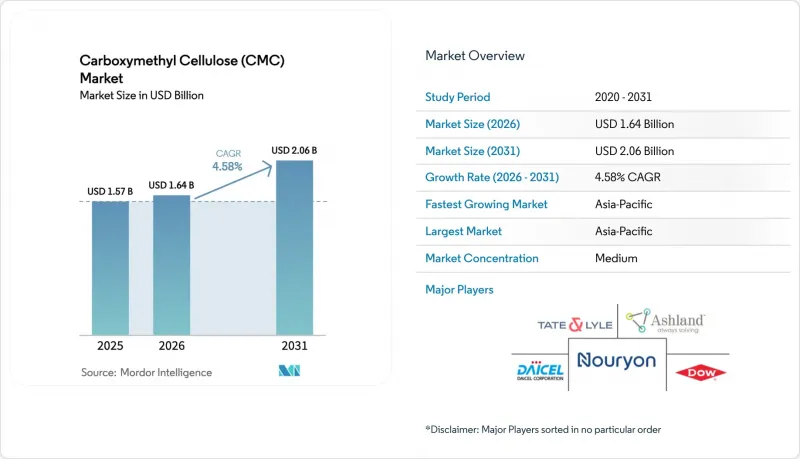
根據 Mordor Intelligence 預測,羧甲基纖維素市場規模將從 2025 年的 15.7 億美元成長到 2026 年的 16.4 億美元,然後在 2031 年達到 20.6 億美元,2026 年至 2031 年的複合年成長率為 4.58%。
本報告按純度/等級(高純度、技術級、工業級)、應用領域(食品飲料、石油天然氣、化妝品及個人護理、醫藥、清潔劑、造紙及其他應用)和地區(亞太、北美、歐洲、南美、中東和非洲)進行細分。市場預測以美元計價。
全球羧甲基纖維素(CMC)市場趨勢及洞察
市場對潔淨標示、低脂質地改善方案的需求正在飆升。
食品生產商正在最佳化產品配方,以簡化配料標籤並減少飽和脂肪酸含量,同時保持產品的適口性。這種高純度聚合物能夠取代脂肪並保持黏度,有助於生產低熱量調味品、乳製品替代品和植物來源肉品。此外,研究表明,CMC 可用於製造智慧抗菌食品包裝薄膜,該薄膜能夠檢測食品腐敗變質,預計其應用範圍將遠超簡單的增稠劑功能。品牌商願意為化學殘留量極低且獲得國際認證的產品支付更高的價格,從而提高每公斤產品的收益。北美和歐洲的零售商透過收緊標籤審核要求並在包裝正面推廣「潔淨標示」展示,進一步推動了這一趨勢。
擴大在中東沙漠高鹽度油氣天然氣田的鑽探活動
沙烏地阿拉伯、阿拉伯聯合大公國和科威特的石油作業者正在探勘鹽度和溫度極高的深層儲存。羧甲基纖維素(CMC)能夠維持流體黏度並控制過濾,確保油井穩定性,而瓜爾膠和天然澱粉則無法勝任此類工作。格拉斯哥大學的實驗表明,這種聚合物能夠分散奈米顆粒,從而增強導熱性和潤滑性。服務公司正在對電池級CMC進行鑽井液認證,透過減少化學品總用量來降低廢棄物成本。傳統型油田鑽井鑽機數量的增加直接推動了市場需求,而面臨類似鹽度挑戰的德克薩斯州和新墨西哥州頁岩盆地也出現了相應的需求。
一氯乙酸原料價格快速波動
根據REACH法規,一氯乙酸被列為“高毒性關注物質”,這限制了生產的柔軟性並增加了遵循成本。歐洲苛性鈉供不應求和港口擁塞導致現貨價格在六個月內波動超過30%,迫使CMC生產商在利潤率波動的情況下運作。垂直一體化生產商透過運作自己的氯乙酸工廠進行避險,而中國的獨立工廠則在價格飆升期間停產,進一步加劇了全球供應緊張。與該酸相關的交易所交易衍生性商品流動性依然良好,限制了避險策略的應用。
細分市場分析
預計到2025年,高純度羧甲基纖維素將佔據42.76%的市場佔有率,複合年成長率(CAGR)為5.36%。美國食品藥物管理局(FDA)、歐洲藥典(EU Pharmacopoeia)和中國國家藥品監督管理局等監管機構正在實施嚴格的純度標準,這使得小規模生產商難以達到標準。因此,大型生產商正在投資升級其過濾、漂白和離子交換系統。醫藥和特種食品行業的合約確保了多年的銷售量,並有可預測的設備運轉率作為支撐。雖然每增加一道純度提升工序都會增加廢水處理成本,但價格溢價可抵銷營運成本,進而維持該細分市場的獲利優勢。
區域分析
預計到2025年,亞太地區將佔全球銷售額的41.78%,年複合成長率達4.96%。儘管中國產能領先,但印度的加工食品產業正在推動強勁的消費成長。日本和韓國正在加大對醫藥和電池研發的投入,這提振了國內對高純度和電池級產品的需求。在優惠關稅政策的支持下,越南和印尼等東南亞國家正在進口羧甲基纖維素(CMC),用於泡麵、乳製品和紡織品等領域。
在北美,羧甲基纖維素市場依然龐大,主要由醫藥添加劑和頁岩油開採所驅動。大型綜合生產商的工廠都靠近苛性鈉和氯乙酸的產地,降低了原物料價格波動的風險。在歐洲,食品安全和綠色化學備受重視,推動了對永續等級產品的需求。歐盟法規 EC 1333/2008 對添加劑的純度和標籤進行了規定,這有利於那些擁有成熟資料的企業。
南美洲、中東和非洲地區有尚未開發的潛在需求。在巴西的農產品中,CMC 被用作果汁飲料的增稠劑,但進口關稅和外匯波動使得採購困難。
其他好處:
- Excel格式的市場預測(ME)表
- 3個月的分析師支持
目錄
第1章:引言
- 研究假設和市場定義
- 調查範圍
第2章:調查方法
第3章執行摘要
第4章 市場狀況
- 市場概覽
- 市場促進因素
- 對潔淨標示、低脂質地改良解決方案的需求激增
- 擴大在中東沙漠地區高鹽油氣天然氣田的鑽探活動
- 製藥業向防濫用口服劑型包衣的過渡
- 用於電動車鋰離子電池的負極黏合劑,採用羧甲基纖維素。
- 加工食品及即食食品需求量大
- 市場限制因素
- 一氯乙酸原料價格快速波動
- 酵素處理瓜爾膠和黃原膠混合物的興起
- 市場上替代品的供應情況
- 價值鏈分析
- 波特五力模型
第5章 市場規模與成長預測
- 按純度/等級
- 高純度(99.5%或以上)
- 技術(90-99.5%)
- 工業用途(50-90%)
- 透過使用
- 食品/飲料
- 石油和天然氣
- 化妝品和個人護理
- 製藥
- 清潔劑
- 紙張加工
- 其他用途(採礦、建築、陶瓷等)
- 按地區
- 亞太地區
- 中國
- 印度
- 日本
- 韓國
- 其他亞太國家
- 北美洲
- 美國
- 加拿大
- 墨西哥
- 歐洲
- 德國
- 英國
- 法國
- 義大利
- 其他歐洲國家
- 南美洲
- 巴西
- 阿根廷
- 其他南美國家
- 中東和非洲
- 沙烏地阿拉伯
- 南非
- 其他中東和非洲國家
- 亞太地區
第6章 競爭情勢
- 市場集中度
- 策略趨勢
- 市佔率和排名分析
- 公司簡介
- Amtex Chemicals, LLC
- Ashland
- Chongqing Xishan Science & Technology Co., Ltd.,
- Daicel Corporation
- DKS Co. Ltd.
- Dow
- IFF
- Jining Fortune Biotech Co.,Ltd.
- Lamberti SpA
- MIKEM
- Mikro Technik GmbH.
- NIPPON PAPER INDUSTRIES CO., LTD.
- Nouryon
- Qingdao Fangjinlong Technology Development Co., Ltd.
- SINOCMC CHEMICAL CO., LTD.
- Tate & Lyle
- Tianjin Eray Industrial Co.
- Zibo Hailan Chemical Co., Ltd.
第7章 市場機會與未來展望
According to Mordor Intelligence, the carboxymethyl cellulose market size is expected to grow from USD 1.57 billion in 2025 to USD 1.64 billion in 2026 and is forecast to reach USD 2.06 billion by 2031 at 4.58% CAGR over 2026-2031.
This report is Segmented by Purity/Grade (Highly Purified, Technical, and Industrial), Application (Food and Beverages, Oil and Gas, Cosmetics and Personal Care, Pharmaceuticals, Detergents, Paper Processing, and Other Applications), and Geography (Asia-Pacific, North America, Europe, South America, and Middle-East and Africa). The Market Forecasts are Provided in Terms of Value (USD).
Global Carboxymethyl Cellulose (CMC) Market Trends and Insights
Surge in Demand for Clean-Label, Low-Fat Texturising Solutions
Food manufacturers reformulate products to shorten ingredient labels and reduce saturated fat while preserving mouthfeel. Highly purified grades of the polymer replace fat yet maintain viscosity, which supports low-calorie dressings, dairy alternatives, and plant-based meat. Research also shows CMC enabling smart antimicrobial food packaging films that signal spoilage, broadening functionality beyond simple thickening. Brands pay premium prices for grades produced with minimal chemical residues and full international approvals, strengthening revenue per kilogram. North American and European retailers reinforce momentum by tightening label audit requirements and promoting clean-label front-of-pack claims.
Expansion of High-Salinity Oil and Gas Drilling in the Middle East Deserts
Operators in Saudi Arabia, the United Arab Emirates, and Kuwait explore deep reservoirs with extreme salinity and temperature. CMC maintains fluid viscosity and filtration control where guar or native starches fail, safeguarding wellbore stability. Laboratory work at the University of Glasgow demonstrates the polymer's capacity to disperse nanoparticulates that enhance thermal conductivity and lubricity. Service companies qualify battery-grade CMC grades for drilling fluids to lower overall chemical loading, which cuts disposal costs. Rising rig counts in unconventional plays create immediate volume pull, while secondary demand flows to shale basins in Texas and New Mexico, facing similar salinity challenges.
Rapid Price Swings in Monochloroacetic Acid Feedstock
Monochloroacetic acid is classified as a high toxicological concern under REACH, which limits production flexibility and heightens compliance expenses. Spot prices have moved more than 30% within six months due to caustic soda shortages and port congestion in Europe, forcing CMC makers to accept volatile profit margins. Vertically integrated producers hedge by operating captive chloroacetic plants, whereas stand-alone Chinese facilities suspend production during price spikes, tightening global supply. Hedging strategies are limited because exchange-traded derivatives for the acid remain illiquid.
Other drivers and restraints analyzed in the detailed report include:
- Pharma Shift Toward Abuse-Deterrent Oral Dosage Coatings
- Electric-Vehicle Li-ion Anode Binders Adopting Carboxymethyl Cellulose
- Rise of Enzymatically-Modified Guar and Xanthan Gum Blends
For complete list of drivers and restraints, kindly check the Table Of Contents.
Segment Analysis
Highly Purified grades held 42.76% carboxymethyl cellulose market share in 2025 and posted a 5.36% CAGR outlook. Regulatory bodies, including the US Food and Drug Administration, EU Pharmacopoeia, and China National Medical Products Administration, enforce tight purity specifications that smaller manufacturers struggle to match. As a result, top producers allocate capital to upgrade filtration, bleaching, and ion exchange systems. Pharmaceutical and specialty food contracts lock in multi-year volumes and support predictable capacity utilization. Wastewater treatment costs rise with each purity step, but the price premium offsets operating expenses and maintains segment margin leadership.
Complete Report Scope:
- By Purity/Grade
- Highly Purified (Greater than 99.5%)
- Technical (90-99.5%)
- Industrial (50-90%)
- By Application
- Food and Beverages
- Oil and Gas
- Cosmetics and Personal Care
- Pharmaceuticals
- Detergents
- Paper Processing
- Other Applications (Mining, Construction and Ceramics, etc.)
- By Geography
- Asia-Pacific
- China
- India
- Japan
- South Korea
- Rest of Asia-Pacific
- North America
- United States
- Canada
- Mexico
- Europe
- Germany
- United Kingdom
- France
- Italy
- Rest of Europe
- South America
- Brazil
- Argentina
- Rest of South America
- Middle-East and Africa
- Saudi Arabia
- South Africa
- Rest of Middle-East and Africa
- Asia-Pacific
Geography Analysis
Asia-Pacific accounted for 41.78% of global revenue in 2025 and is projected to advance at a 4.96% CAGR. China leads in capacity, but India's processed food sector adds robust incremental consumption. Japan and South Korea invest in pharmaceutical and battery research and development, which elevates local demand for Highly Purified and battery-grade variants. Southeast Asian nations such as Vietnam and Indonesia import CMC for instant noodle, dairy, and textile applications, supported by favorable tariff regimes.
North America maintains a sizable carboxymethyl cellulose market driven by pharmaceutical excipients and shale oil drilling. Large integrated producers operate plants near caustic soda and monochloroacetic acid sources, which mitigates raw-material volatility. Europe emphasizes food safety and green chemistry, which sustains demand for sustainable grades. Regulation EC 1333/2008 prescribes additive purity and labeling, favoring incumbents with established dossiers.
South America, and Middle East and Africa offer untapped potential. Brazilian agribusiness requires CMC as a thickener in fruit-based beverages, but import tariffs and currency swings complicate procurement.
List of Companies Covered in this Report:
- Amtex Chemicals, LLC
- Ashland
- Chongqing Xishan Science & Technology Co., Ltd.,
- Daicel Corporation
- DKS Co. Ltd.
- Dow
- IFF
- Jining Fortune Biotech Co.,Ltd.
- Lamberti S.p.A.
- MIKEM
- Mikro Technik GmbH.
- NIPPON PAPER INDUSTRIES CO., LTD.
- Nouryon
- Qingdao Fangjinlong Technology Development Co., Ltd.
- SINOCMC CHEMICAL CO., LTD.
- Tate & Lyle
- Tianjin Eray Industrial Co.
- Zibo Hailan Chemical Co., Ltd.
Additional Benefits:
- The market estimate (ME) sheet in Excel format
- 3 months of analyst support
TABLE OF CONTENTS
1 Introduction
- 1.1 Study Assumptions and Market Definition
- 1.2 Scope of the Study
2 Research Methodology
3 Executive Summary
4 Market Landscape
- 4.1 Market Overview
- 4.2 Market Drivers
- 4.2.1 Surge in Demand for Clean-Label, Low-Fat Texturising Solutions
- 4.2.2 Expansion of High-Salinity Oil and Gas Drilling in Middle East Deserts
- 4.2.3 Pharma Shift Toward Abuse-Deterrent Oral Dosage Coatings
- 4.2.4 Electric-Vehicle Li-ion Anode Binders Adopting Carboxymethyl Cellulose
- 4.2.5 High Demand from Processed and Convenient Food
- 4.3 Market Restraints
- 4.3.1 Rapid Price Swings in Monochloroacetic Acid Feedstock
- 4.3.2 Rise of Enzymatically-Modified Guar and Xanthan Gum Blends
- 4.3.3 Availability of Substitutes in the Market
- 4.4 Value Chain Analysis
- 4.5 Porter's Five Forces
- 4.5.1 Bargaining Power of Suppliers
- 4.5.2 Bargaining Power of Buyers
- 4.5.3 Threat of New Entrants
- 4.5.4 Threat of Substitute Products and Services
- 4.5.5 Degree of Competition
5 Market Size and Growth Forecasts (Value)
- 5.1 By Purity/Grade
- 5.1.1 Highly Purified (Greater than 99.5%)
- 5.1.2 Technical (90-99.5%)
- 5.1.3 Industrial (50-90%)
- 5.2 By Application
- 5.2.1 Food and Beverages
- 5.2.2 Oil and Gas
- 5.2.3 Cosmetics and Personal Care
- 5.2.4 Pharmaceuticals
- 5.2.5 Detergents
- 5.2.6 Paper Processing
- 5.2.7 Other Applications (Mining, Construction and Ceramics, etc.)
- 5.3 By Geography
- 5.3.1 Asia-Pacific
- 5.3.1.1 China
- 5.3.1.2 India
- 5.3.1.3 Japan
- 5.3.1.4 South Korea
- 5.3.1.5 Rest of Asia-Pacific
- 5.3.2 North America
- 5.3.2.1 United States
- 5.3.2.2 Canada
- 5.3.2.3 Mexico
- 5.3.3 Europe
- 5.3.3.1 Germany
- 5.3.3.2 United Kingdom
- 5.3.3.3 France
- 5.3.3.4 Italy
- 5.3.3.5 Rest of Europe
- 5.3.4 South America
- 5.3.4.1 Brazil
- 5.3.4.2 Argentina
- 5.3.4.3 Rest of South America
- 5.3.5 Middle-East and Africa
- 5.3.5.1 Saudi Arabia
- 5.3.5.2 South Africa
- 5.3.5.3 Rest of Middle-East and Africa
- 5.3.1 Asia-Pacific
6 Competitive Landscape
- 6.1 Market Concentration
- 6.2 Strategic Moves
- 6.3 Market Share(%)/Ranking Analysis
- 6.4 Company Profiles (includes Global level Overview, Market level overview, Core Segments, Financials as available, Strategic Information, Market Rank/Share, Products and Services, Recent Developments)
- 6.4.1 Amtex Chemicals, LLC
- 6.4.2 Ashland
- 6.4.3 Chongqing Xishan Science & Technology Co., Ltd.,
- 6.4.4 Daicel Corporation
- 6.4.5 DKS Co. Ltd.
- 6.4.6 Dow
- 6.4.7 IFF
- 6.4.8 Jining Fortune Biotech Co.,Ltd.
- 6.4.9 Lamberti S.p.A.
- 6.4.10 MIKEM
- 6.4.11 Mikro Technik GmbH.
- 6.4.12 NIPPON PAPER INDUSTRIES CO., LTD.
- 6.4.13 Nouryon
- 6.4.14 Qingdao Fangjinlong Technology Development Co., Ltd.
- 6.4.15 SINOCMC CHEMICAL CO., LTD.
- 6.4.16 Tate & Lyle
- 6.4.17 Tianjin Eray Industrial Co.
- 6.4.18 Zibo Hailan Chemical Co., Ltd.
7 Market Opportunities and Future Outlook
- 7.1 White-space and Unmet-Need Assessment

 聚陰離子纖維素(PAC)市場規模、佔有率和成長分析:按等級、黏度、應用、最終用途產業、形態和地區分類-2026-2033年產業預測
 羧甲基纖維素市場-2026-2032年全球市場預測
 2026-2030年全球羧甲基纖維素(CMC)市場
 羧甲基纖維素全球市場規模、佔有率、趨勢和成長分析報告(2026-2034)
 羧甲基纖維素市場:按最終用戶和地區分類全球羧甲基纖維素市場:市場規模、佔有率、成長率、產業分析、按類型、應用和地區劃分的考量、未來預測(2026-2034)
 羧甲基纖維素市場:市場機會、成長促進因素、產業趨勢分析及預測(2026-2035)
 羧甲基纖維素 (CMC) 市場預測至 2032 年:按性質類型、純度、應用和地區分類的全球分析
 羧甲基纖維素市場規模、佔有率、趨勢分析報告:純度、最終用途、地區、細分市場預測,2025-20302030 年羧甲基纖維素市場預測:按等級、形式、功能、應用、最終用戶和地區進行的全球分析