


 |
市場調查報告書
商品編碼
2116597
氟化聚醯亞胺:市場佔有率分析、產業趨勢與統計資料、成長預測(2026-2031)Fluorinated Polyimide - Market Share Analysis, Industry Trends & Statistics, Growth Forecasts (2026 - 2031) |
||||||

※ 本網頁內容可能與最新版本有所差異。詳細情況請與我們聯繫。
據 Mordor Intelligence 稱,2026 年氟化聚醯亞胺市場規模估計為 12.8 億美元,預計在預測期(2026-2031 年)內將以 5.21% 的複合年成長率成長,到 2031 年達到 16.5 億美元。
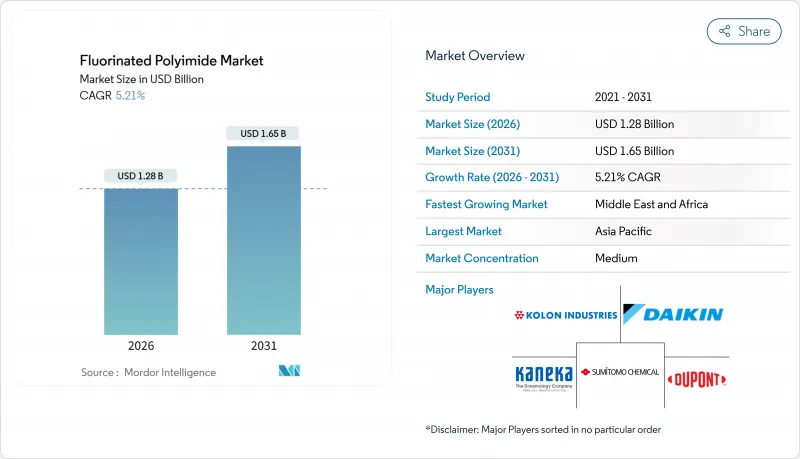
本報告按應用領域(軟性顯示器材料、電絕緣材料、結構樹脂、太陽能電池、照明設備及其他應用)、終端用戶產業(電子、航太與國防、太陽能、汽車、醫療及其他終端用戶產業)及地區(亞太地區、北美地區及其他地區)進行細分。市場預測以美元計價。
全球氟化聚醯亞胺市場趨勢及洞察
消費者對軟性顯示器設備的需求激增
折疊式智慧型手機已從概念走向主流,目前韓國和中國已有超過15家工廠引進了軟性OLED生產線。每條生產線都使用厚度小於50微米的無色氟化聚醯亞胺薄膜,這種薄膜需要能夠承受20萬次折疊式循環而不開裂。氟化處理降低了屈光並抑制了泛黃,從而使設備在其使用壽命內保持色域。三星的「Galaxy Z」系列在2025年出貨量達數百萬部。隨著折疊式外形規格擴展到中階價位,面板製造商預計到2028年其基板產能將翻倍。結合超薄玻璃和氟化聚醯亞胺的混合堆疊結構兼顧了耐刮擦性和柔軟性,預計這一趨勢將擴展到汽車叢集和穿戴式設備螢幕領域。
隨著 5G/高頻基礎設施的擴展,低介電常數薄膜正變得不可或缺。
工作頻率高於 24 GHz 的毫米波天線需要低介電常數和低介電損耗角正切。氟化聚醯亞胺具有較高的玻璃化轉變溫度,因此可以無縫整合到天線封裝 (AIP) 模組中,而不會發生翹曲變形。 2025 年基地台部署量的激增以及小型基地台密度不斷提高的趨勢,進一步推動了對低損耗軟性電路基板的需求。 IEEE 層壓板指南縮短了認證週期,使材料供應商能夠比以往無線技術更快地將先導工廠生產過渡到商業化規模。
生產成本高和原物料價格波動
由於六氟異丙叉酸酐的合成過程複雜,需要多步驟操作和特殊的密閉處理,因此其價格比傳統芳香族化合物高出數倍。單一供應商的意外停產可能導致現貨價格在數週內飆升。此外,由於許多合約以歐元或日圓計價,外匯波動會進一步加劇價格波動。像杜邦和大金這樣的垂直整合型公司可以透過反向整合單體生產來減輕供應中斷的影響,但小規模的加工商缺乏這種對沖機制,在市場供應緊張時面臨分配風險。
細分市場分析
到2025年,軟性顯示器材料將佔銷售額的38.46%,這反映了折疊式和可捲曲OLED產品的普及。韓國和中國製造廠正在擴建其第六代生產線,汽車OEM廠商也在試驗曲面儀表板,這些都為氟化聚醯亞胺市場的這一細分領域提供了支撐。由於電力公司更傾向於使用成熟的介電材料而不是更便宜的替代品,電絕緣線塗層、電機槽襯墊和變壓器膠帶的銷售量保持穩定。
由於中東地區衛星群和聚光型太陽光電對耐輻射和抗紫外線背板的需求,預計太陽能電池將成為應用領域中複合年成長率最高的領域,達到 6.34%。用於建築和汽車環境照明的薄透明薄膜市場,例如 OLED 燈具,也呈現小幅但穩定的成長。從醫用導管到高頻連接器等小眾應用領域,進一步豐富了該材料的應用前景,凸顯了其多功能性。
區域分析
預計到2025年,亞太地區將佔據全球市場規模的49.28%,主要得益於韓國在軟性OLED市場的領先地位以及中國5G的快速部署。三星顯示、LG顯示和京東方控制著全球大部分折疊式面板的生產,並消耗大量的無色薄膜。日本在單體合成方面擁有豐富的經驗,而像KANEKA和宇部化學工業株式會社這樣的供應商則提供高純度的原料,從而支撐起一個在成本和品質方面都優於其他地區的區域生態系統。儘管印度的電子組裝正在蓬勃發展,但基板仍然嚴重依賴進口基板。
北美地區的成長主要由航太和衛星計畫驅動。杜邦公司正在俄亥俄州瑟克維爾擴建其聚亞醯胺膜和派餅生產線,以提高產能,目標客戶是電動車電池和5G天線模組的佈線材料。在美國,由於《綜合環境反應、賠償和責任法》(CERCLA)適用於PFAS,監管限制正在擠壓利潤空間,並促使一些加工商將二次加工轉移到海外。
在歐洲,市場主要分為兩大領域:德國的汽車電子領域、法國和英國的航太複合材料領域以及其他專業工業領域。雖然南美和中東及非洲地區的銷售額合計相對小規模,但隨著沙烏地阿拉伯和阿拉伯聯合大公國部署吉瓦級太陽能發電廠,預計該地區的銷售額將成長5.92%,因為這些發電廠將需要耐高溫、低揮發性背板。
其他好處:
- Excel格式的市場預測(ME)表
- 3個月的分析師支持
目錄
第1章:引言
- 研究假設和市場定義
- 調查範圍
第2章:調查方法
第3章執行摘要
第4章 市場狀況
- 市場概覽
- 市場促進因素
- 消費者對軟性顯示器設備的需求激增
- 隨著 5G/高頻基礎設施的擴展,低 Dk 薄膜變得不可或缺。
- 電子元件小型化需要超薄耐熱基板。
- 需要抗輻射加強FPI的空間用太陽能電池陣列基板
- 積層製造技術能夠實現航太零件的現場客製化生產。
- 市場限制因素
- 生產成本高和原物料價格波動
- 針對 PFAS 的嚴格環境法規
- 氟離子遷移引起的OLED影像老化缺陷。
- 價值鏈分析
- 波特五力模型
第5章 市場規模與成長預測
- 透過使用
- 用於軟性顯示器的材料
- 電氣絕緣
- 結構樹脂
- 太陽能電池
- 照明設備
- 其他用途
- 按最終用戶行業分類
- 電子設備
- 航太/國防
- 太陽能
- 車
- 醫學領域
- 其他終端用戶產業
- 按地區
- 亞太地區
- 中國
- 印度
- 日本
- 韓國
- 其他亞太國家
- 北美洲
- 美國
- 加拿大
- 墨西哥
- 歐洲
- 德國
- 英國
- 法國
- 義大利
- 其他歐洲國家
- 南美洲
- 巴西
- 阿根廷
- 其他南美國家
- 中東和非洲
- 沙烏地阿拉伯
- 南非
- 其他中東和非洲國家
- 亞太地區
第6章 競爭情勢
- 市場集中度
- 策略趨勢
- 市佔率和排名分析
- 公司簡介
- AGC Inc.
- Arkema
- Capchem
- CAPCHEM
- Daikin Industries Ltd.
- DuPont
- IST Corporation
- Kaneka Corporation
- Kolon Industries
- Mitsubishi Gas Chemical Company, Inc.
- Nexolve
- SKC
- Solstice Advanced Materials
- Solvay
- Sumitomo Chemical Co. Ltd.
- Taimide Tech. Inc.,
- Toray TCAC Holding BV
- UBE Corporation
- Zhuzhou Times New Material Technology Co., Ltd.(TMT)
第7章 市場機會與未來展望
According to Mordor Intelligence, the fluorinated polyimide market size is estimated at USD 1.28 billion in 2026, and is expected to reach USD 1.65 billion by 2031, at a CAGR of 5.21% during the forecast period (2026-2031).
This report is Segmented by Application (Flexible Display Materials, Electrical Insulation, Structural Resins, Solar Cells, Lighting Devices, and Other Applications), End-User Industry (Electronics, Aerospace and Defense, Solar Energy, Automotive, Medical, and Other End-User Industries), and Geography (Asia-Pacific, North America, and More). The Market Forecasts are Provided in Terms of Value (USD).
Global Fluorinated Polyimide Market Trends and Insights
Surge in Consumer Demand for Flexible Display Devices
Foldable smartphones have shifted from concept to mainstream, and the installed base of flexible OLED lines now exceeds 15 plants in South Korea and China. Each line consumes colorless fluorinated polyimide films thinner than 50 µm that must survive 200,000-fold cycles without cracking. Fluorination lowers the refractive index and curbs yellowing, helping devices maintain color gamut across their service life. Samsung's Galaxy Z series shipped several million units in 2025; by extending foldable form factors to mid-tier price points, panel makers expect to double substrate throughput by 2028. Hybrid stacks combining ultra-thin glass and fluorinated polyimide balance scratch resistance with flexibility, a trend likely to spread to automotive clusters and wearable screens.
Ramp-up of 5G/High-Frequency Infrastructure Necessitating Low-Dk Films
Millimeter-wave antennas operating beyond 24 GHz demand low dielectric constants and dissipation factors. Fluorinated polyimides maintain a high glass-transition temperature, allowing for seamless integration into antenna-in-package modules without the risk of warpage. In 2025, base station deployments surged, and the trend of densifying with small cells further amplified the demand for low-loss flex circuits. IEEE laminate guidelines have shortened qualification cycles, permitting material suppliers to convert pilot-plant output to commercial scale faster than in prior wireless generations.
High Production Costs and Raw-Material Volatility
Hexafluoroisopropylidene-based dianhydrides command multiples of conventional aromatics, reflecting multi-step syntheses and specialized containment. An unplanned outage at a single supplier can spike spot prices within weeks, and currency swings magnify volatility because many contracts are denominated in euros or yen. Integrated players such as DuPont and Daikin can buffer disruptions by back-integrating into monomers, but smaller converters lack this hedge and face allocation risk during tight markets.
Other drivers and restraints analyzed in the detailed report include:
- Electronics Miniaturization Demanding Ultra-Thin, Heat-Resistant Substrates
- Space-Grade Solar-Array Substrates Requiring Radiation-Hardened FPIs
- Stringent PFAS-Related Environmental Regulations
For complete list of drivers and restraints, kindly check the Table Of Contents.
Segment Analysis
Flexible display materials captured 38.46% of 2025 revenue, mirroring the proliferation of foldable and rollable OLED products. This slice of the fluorinated polyimide market is sustained by South Korean and Chinese fabs expanding Gen-6 lines and by automotive OEMs piloting curved dashboards. Electrical insulation-wire coatings, motor slot liners, transformer tapes-delivers stable volume because utilities favor proven dielectrics over cheaper substitutes.
Solar cells are projected to log a 6.34% CAGR, the highest among applications, as mega-constellations and Middle East concentrator farms demand radiation-hardened and UV-stable backsheets. Lighting devices such as OLED luminaires adopt thin, transparent films for architectural and automotive ambient lighting, a modest but rising outlet. Niche uses-from medical catheters to high-frequency connectors-round out the application mix, underscoring material versatility.
Complete Report Scope:
- By Application
- Flexible Display Materials
- Electrical Insulation
- Structural Resins
- Solar Cells
- Lighting Devices
- Other Applications
- By End-User Industry
- Electronics
- Aerospace and Defense
- Solar Energy
- Automotive
- Medical
- Other End-User Industries
- By Geography
- Asia-Pacific
- China
- India
- Japan
- South Korea
- Rest of Asia-Pacific
- North America
- United States
- Canada
- Mexico
- Europe
- Germany
- United Kingdom
- France
- Italy
- Rest of Europe
- South America
- Brazil
- Argentina
- Rest of South America
- Middle-East and Africa
- Saudi Arabia
- South Africa
- Rest of Middle-East and Africa
- Asia-Pacific
Geography Analysis
Asia-Pacific held 49.28% of the 2025 value on the back of South Korea's flexible OLED dominance and China's 5G rollout. Samsung Display, LG Display, and BOE collectively control most of the world's foldable-panel throughput, consuming large volumes of colorless films. Japan retains expertise in monomer synthesis; suppliers like Kaneka and Ube provide high-purity feedstocks, sustaining a regional ecosystem unbeatable on cost and quality. India is ramping up electronics assembly, though substrates remain largely imported.
Growth in North America is propelled by aerospace and satellite projects. DuPont's Circleville, Ohio, expansion added Kapton and Pyralux capacity, targeting EV battery interconnects and 5G antenna modules. Regulatory drag in the United States-where CERCLA liability applies to PFAS-pressures margins and encourages some converters to shift secondary processing offshore.
In Europe, the market is divided between Germany's in-car electronics, France and the UK's aerospace composites, and specialized industrial niches. The broad PFAS restriction proposal lengthens approval cycles and deters greenfield investment. Airbus and satellite primes continue to specify fluorinated films, but consumer-electronics manufacturing remains minimal compared with Asia. South America and the Middle East and Africa together account for small revenue; the latter will expand at 5.92% as Saudi Arabia and the UAE roll out gigawatt-scale solar farms that mandate heat-stable, low-outgassing backsheets.
- AGC Inc.
- Arkema
- Capchem
- CAPCHEM
- Daikin Industries Ltd.
- DuPont
- I.S.T Corporation
- Kaneka Corporation
- Kolon Industries
- Mitsubishi Gas Chemical Company, Inc.
- Nexolve
- SKC
- Solstice Advanced Materials
- Solvay
- Sumitomo Chemical Co. Ltd.
- Taimide Tech. Inc.,
- Toray TCAC Holding B.V.
- UBE Corporation
- Zhuzhou Times New Material Technology Co., Ltd. (TMT)
Additional Benefits:
- The market estimate (ME) sheet in Excel format
- 3 months of analyst support
TABLE OF CONTENTS
1 Introduction
- 1.1 Study Assumptions and Market Definition
- 1.2 Scope of the Study
2 Research Methodology
3 Executive Summary
4 Market Landscape
- 4.1 Market Overview
- 4.2 Market Drivers
- 4.2.1 Surge in consumer demand for flexible display devices
- 4.2.2 Ramp-up of 5G/high-frequency infrastructure necessitating low-Dk films
- 4.2.3 Electronics miniaturization demanding ultra-thin, heat-resistant substrates
- 4.2.4 Space-grade solar-array substrates requiring radiation-hardened FPIs
- 4.2.5 Additive manufacturing unlocks on-site custom aerospace components
- 4.3 Market Restraints
- 4.3.1 High production costs and raw-material volatility
- 4.3.2 Stringent PFAS-related environmental regulations
- 4.3.3 OLED image-sticking failures linked to fluoride-ion migration
- 4.4 Value Chain Analysis
- 4.5 Porter's Five Forces
- 4.5.1 Bargaining Power of Suppliers
- 4.5.2 Bargaining Power of Buyers
- 4.5.3 Threat of New Entrants
- 4.5.4 Threat of Substitutes
- 4.5.5 Degree of Competition
5 Market Size and Growth Forecasts(Value)
- 5.1 By Application
- 5.1.1 Flexible Display Materials
- 5.1.2 Electrical Insulation
- 5.1.3 Structural Resins
- 5.1.4 Solar Cells
- 5.1.5 Lighting Devices
- 5.1.6 Other Applications
- 5.2 By End-User Industry
- 5.2.1 Electronics
- 5.2.2 Aerospace and Defense
- 5.2.3 Solar Energy
- 5.2.4 Automotive
- 5.2.5 Medical
- 5.2.6 Other End-User Industries
- 5.3 By Geography
- 5.3.1 Asia-Pacific
- 5.3.1.1 China
- 5.3.1.2 India
- 5.3.1.3 Japan
- 5.3.1.4 South Korea
- 5.3.1.5 Rest of Asia-Pacific
- 5.3.2 North America
- 5.3.2.1 United States
- 5.3.2.2 Canada
- 5.3.2.3 Mexico
- 5.3.3 Europe
- 5.3.3.1 Germany
- 5.3.3.2 United Kingdom
- 5.3.3.3 France
- 5.3.3.4 Italy
- 5.3.3.5 Rest of Europe
- 5.3.4 South America
- 5.3.4.1 Brazil
- 5.3.4.2 Argentina
- 5.3.4.3 Rest of South America
- 5.3.5 Middle-East and Africa
- 5.3.5.1 Saudi Arabia
- 5.3.5.2 South Africa
- 5.3.5.3 Rest of Middle-East and Africa
- 5.3.1 Asia-Pacific
6 Competitive Landscape
- 6.1 Market Concentration
- 6.2 Strategic Moves
- 6.3 Market Share/Ranking Analysis
- 6.4 Company Profiles (includes Global level Overview, Market level overview, Core Segments, Financials as available, Strategic Information, Market Rank/Share, Products and Services, Recent Developments)
- 6.4.1 AGC Inc.
- 6.4.2 Arkema
- 6.4.3 Capchem
- 6.4.4 CAPCHEM
- 6.4.5 Daikin Industries Ltd.
- 6.4.6 DuPont
- 6.4.7 I.S.T Corporation
- 6.4.8 Kaneka Corporation
- 6.4.9 Kolon Industries
- 6.4.10 Mitsubishi Gas Chemical Company, Inc.
- 6.4.11 Nexolve
- 6.4.12 SKC
- 6.4.13 Solstice Advanced Materials
- 6.4.14 Solvay
- 6.4.15 Sumitomo Chemical Co. Ltd.
- 6.4.16 Taimide Tech. Inc.,
- 6.4.17 Toray TCAC Holding B.V.
- 6.4.18 UBE Corporation
- 6.4.19 Zhuzhou Times New Material Technology Co., Ltd. (TMT)
7 Market Opportunities and Future Outlook
- 7.1 White-space and Unmet-Need Assessment

 介電材料市場規模、佔有率、成長率、全球產業分析、區域趨勢及2026年至2034年預測。
 低介電常數材料市場-2026-2032年全球市場預測
 低介電常數材料市場規模、佔有率和成長分析:按材料類型、介電常數、形態、應用、終端用戶產業和地區分類 - 產業預測,2026-2033年
 介電材料市場預測至2034年-按材料類型、介電常數、產品形式、應用、頻率範圍和地區分類的全球分析先進介電材料市場預測至2034年-按材料類型、介電常數、形態、應用、最終用戶和地區分類的全球分析
 介電材料:市場佔有率分析、產業趨勢與統計、成長預測(2026-2031)2026-2034年全球低介電常數材料市場規模、佔有率、趨勢及成長分析報告
 2026年全球低介電常數材料市場報告天然酯絕緣油市場按額定電壓、應用、最終用戶和分銷管道分類-2026-2032年全球預測陶瓷顆粒市場依應用、原料、終端用戶產業、形態、通路及粒徑分類-2026-2032年全球預測