


 |
市場調查報告書
商品編碼
2062446
介電材料:市場佔有率分析、產業趨勢與統計、成長預測(2026-2031)Dielectric Material - Market Share Analysis, Industry Trends & Statistics, Growth Forecasts (2026 - 2031) |
||||||

※ 本網頁內容可能與最新版本有所差異。詳細情況請與我們聯繫。
根據 Mordor Intelligence 預測,介電材料市場規模預計將在 2025 年達到 610.5 億美元,2026 年達到 640.8 億美元,到 2031 年達到 800.6 億美元,2026 年至 2031 年的複合年成長率為 4.55%。
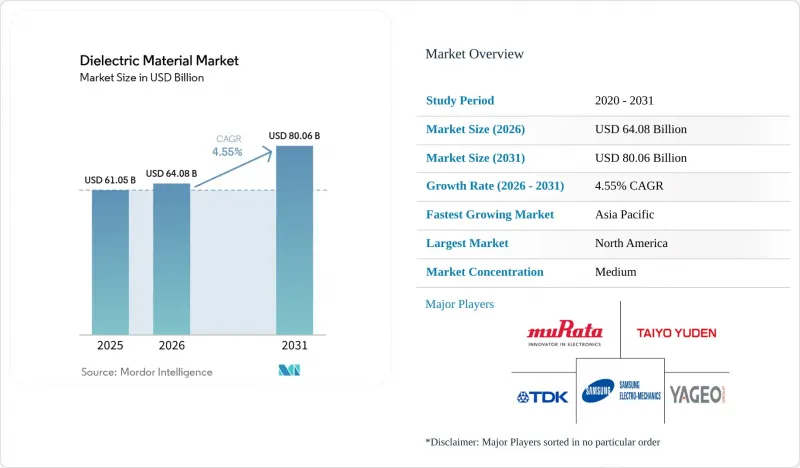
本報告材料類型(陶瓷、聚合物薄膜、玻璃和玻璃陶瓷等)、外形規格(MLCC介質、薄膜/厚膜介質等)、介電常數類別(低介電常數、中介電常數等)、應用(被動電子元件等)、終端用戶產業(消費性電子等)和地區進行細分。市場預測以美元價值表示。
全球介電材料市場趨勢及洞察
電動車的普及推高了對高能量密度薄膜電容器的需求。
電動車向 800V 電池過渡的架構要求薄膜電容器能夠在 900V 直流電壓下儲存超過 5J/cm³ 的能量,在 105 度C 的高溫下不會發生災難性故障。採用奈米鋁電極增強的金屬化聚丙烯繞組符合這些標準,並具有瞬態尖峰後的自癒能力,這讓逆變器製造商對其 15 年保固充滿信心。工作頻率高於 100kHz 的碳化矽開關會增加諧波應力,但多層聚丙烯-聚乙烯薄膜散熱更快,可使逆變器重量減輕 1.5 kg。認證週期包括 1000 次熱衝擊測試和 2000 小時的濕度老化測試,如今已成為影響產品推出計劃的重要因素,訂單集中在能夠進行大規模認證的成熟製造商身上。汽車製造商正透過簽訂多年供應合約來應對這項挑戰,以確保未來 10 年的需求預測。
5G和高頻通訊設備的快速擴張
24 GHz 以上的毫米波無線電需要損耗角正切 (tanδ) 小於 0.002 的基板,因此廣泛採用低溫共燒氧化鋁-玻璃複合材料,將濾波器和耦合器整合到單一層壓模組中。每個大型基地台無線電都需要數百個高頻電容器,預計到 2025 年,中國將安裝超過一百萬個 5G 基地台,因此對高頻電容器的需求將非常高。耐溫性良好的 X7R 層壓板在 -55 度C至 +125 度C的溫度範圍內可將電容值保持在 ±15% 以內,滿足安裝在屋頂和路邊龍門架上的戶外和車載無線電的要求。隨著通訊業者在 2026 年過渡到獨立組網 (SA) 5G 核心網,邊緣伺服器將需要大規模紋波額定值為 100A 的多層陶瓷電容器組,而目前只有少數供應商能夠滿足此規格要求。
高介電常數陶瓷用稀土元素的價格波動與供應限制
受中國出口配額措施的影響,2024年至2025年間,氧化釔和氧化鑭的價格波動了15%至25%,直接導致X7R和X8R疊層材料成本上升。日本和韓國製造商被迫依賴相當於六個月庫存的原料,佔用了流動資金,毛利率下降了200個基點。使用鈦酸鈉鉍和鈮酸鈉鉀取代釔和氧化鑭會使介電常數降低高達30%,導致疊層厚度逐漸增加,削弱了小型化的優勢。在地緣政治風險的背景下,美國能源局正在資助國內分離工廠的建設,但商業規模的生產不太可能在2028年之前啟動,預計介電材料市場在中期內仍將保持波動。
細分市場分析
強度與鈦酸鋇基材料相當的陶瓷級材料,其介電常數超過10,000,符合X5R和X7R標準,預計到2025年將佔據介電材料市場46.11%的佔有率。玻璃和玻璃陶瓷替代品的市佔率預計到2031年將以每年4.96%的速度成長,這主要得益於電力電子設計人員對耐熱衝擊性能的需求,其耐溫範圍為-40 度C至+150 度C。聚合物薄膜在汽車和太陽能逆變器等高壓領域佔有一席之地,其自癒能力可防止失控故障。雲母和氧化鉭仍然專用於航太雷達和嵌入式設備,在這些應用中,使用壽命可靠性比成本更為重要。
鈦酸鋇鍶薄膜技術的進步使得5G可變濾波器成為可能。同時,鈮酸鉀鈉壓電已實現無鉛相容性,但其居里點高達400 度C,面臨挑戰。目前,氮化鎵高電子遷移率電晶體(HEMT)中採用含有矽酸鋰鋁相的玻璃陶瓷基板,由於其近乎零的膨脹係數,可降低晶片應力。聚合物薄膜供應商透過層壓聚丙烯和Polyethylene Naphthalate,將導熱係數提高了35%,這有望使介電材料市場達到足以滿足電動車15年使用壽命的耐久性。
多層陶瓷電容器(MLC)憑藉其無與倫比的體積效率,預計將在2025年佔據39.42%的銷售額,智慧型手機、電動車和工業驅動系統都依賴於此。同時,介電油墨和漿料正以4.81%的複合年成長率快速成長,主要得益於軟性PET基材上捲對卷天線和感測器印刷技術的普及。氧化鋁或氮化鋁基底上的薄膜和厚膜塗層在混合微波模組領域需求旺盛,而燒結塊加工而成的塊狀片材在牽引驅動和脈衝功率實驗室中仍然發揮著至關重要的作用。
含有鈦酸鋇奈米顆粒和銀片的油墨可實現低於0.1 Ω/□的薄片電阻,但900 度C的燒結溫度限制了聚合物基板的應用,因此光子閃燒結成為一項新興技術。然而,其可靠性不如多層陶瓷電容器(MLCC),500次熱循環後會出現15%的漂移,這阻礙了其在汽車產業的應用。塊狀玻璃陶瓷板在中壓真空斷路器中仍然佔據主導地位,這凸顯了每種外形尺寸的介電材料在市場中各自佔據最佳應用領域。
區域分析
預計到2025年,亞太地區將維持47.67%的介電材料市場佔有率,並在2031年之前以5.22%的複合年成長率成長。日本和韓國正透過整合粉末到組裝的生產線支援數十億顆多層陶瓷電容器(MLCC)的生產,這些生產線每月可處理100億顆小於0201尺寸的裝置。中國的風化先進技術和Torch Electron正利用勞動力補貼和地方政府激勵措施擴大其在消費領域的市場佔有率,但它們尚未達到汽車級品質標準。印度的生產連結獎勵計畫計畫正在吸引台灣企業進行被動元件組裝,這有助於緩解供應多元化的影響。
預計到2025年,歐洲和北美地區的銷售額合計將佔總銷售額的約35%。這主要得益於德國的800V驅動系統項目和法國的離岸風力發電電場項目,這兩個項目都指定使用玻璃陶瓷電容器,以應對渦輪機50年的使用壽命。布魯塞爾主導的PFAS法規正在加速從薄膜電容器向陶瓷電容器的轉變,而美國《晶片法案》(CHIPS Act)520億美元的支出正促使高介電常數(High-K)介質的生產集中在亞利桑那州和德克薩斯州的新晶圓廠。加拿大薩斯喀徹爾和魁北克省的稀土元素探勘預計將在2028年以後緩解對釔的依賴,儘管短期供應仍主要集中在亞洲。
到2025年,中東、非洲和南美洲將佔據剩餘的18%市場佔有率,這主要得益於網路密度的提高和可再生能源的普及。沙烏地阿拉伯的NEOM城市發展計畫明確提出使用低損耗陶瓷電容器來實現5G的廣泛部署,而阿拉伯聯合大公國的950兆瓦太陽能發電廠則在串列型逆變器中使用了聚丙烯電容器。南非向電動車的轉型正在加速與區域分銷商建立合作關係,以採購符合AEC-Q200標準的被動元件;巴西的25吉瓦風力發電廠儘管面臨15%的進口關稅(有利於本地組裝),但仍推動了對中壓電容器的需求。阿根廷的鋰礦熱潮吸引了對電池組的投資,從而創造了對電池管理和充電設備用介電材料的需求。
其他好處:
- Excel格式的市場預測(ME)表
- 3個月的分析師支持
目錄
第1章:引言
- 研究假設和市場定義
- 調查範圍
第2章:調查方法
第3章執行摘要
第4章 市場狀況
- 市場概覽
- 市場促進因素
- 5G和高頻通訊設備的快速普及
- 電動車的普及正在推動對高能量薄膜電容器的需求。
- 越來越多的可再生能源設施需要高壓電力電容器。
- 消費性電子產品小型化的趨勢正在推動超薄MLCC介質的發展。
- 鐵電氧化鉿在先進邏輯和儲存晶片的新應用
- 內建介質共振器的無線充電家具已廣泛應用
- 市場限制因素
- 高kT陶瓷用稀土元素的價格波動與供應限制
- 對含氟聚合物電介質的處置有嚴格的環境法規。
- 介電油墨在積層製造上的可靠性所面臨的挑戰。
- 人們對固體電容器組的熱失控問題感到擔憂
- 產業價值鏈分析
- 宏觀經濟因素對市場的影響
- 監理情勢
- 技術展望
- 波特五力分析
第5章 市場規模與成長預測
- 依材料類型
- 陶瓷製品
- 聚合物薄膜
- 玻璃和玻璃陶瓷
- 其他材料類型
- 按外形規格
- 多層陶瓷片式電容器(MLCC)的介電材料
- 薄膜/厚膜介質
- 散裝片材/板材
- 介電油墨和漿料
- 透過介電常數
- Low-K
- Medium-K
- High-K
- 透過使用
- 被動電子元件、電容器、共振器
- 半導體柵極絕緣層
- 電力電子絕緣材料
- 射頻和微波基板
- 印刷和軟性電子產品
- 按最終用途行業分類
- 消費性電子產品
- 汽車和電動旅行
- 能源與電力、可再生能源、輸配電網路
- 電訊
- 工業和製造業
- 航太/國防
- 按地區
- 北美洲
- 美國
- 加拿大
- 墨西哥
- 歐洲
- 德國
- 英國
- 法國
- 俄羅斯
- 其他歐洲國家
- 亞太地區
- 中國
- 日本
- 印度
- 韓國
- 澳洲
- 其他亞太國家
- 中東
- 沙烏地阿拉伯
- 阿拉伯聯合大公國
- 其他中東國家
- 非洲
- 南非
- 埃及
- 其他非洲國家
- 南美洲
- 巴西
- 阿根廷
- 其他南美國家
- 北美洲
第6章 競爭情勢
- 市場集中度
- 策略趨勢
- 市佔率分析
- 公司簡介
- Murata Manufacturing Co., Ltd.
- TDK Corporation
- Taiyo Yuden Co., Ltd.
- Kyocera Corporation
- KEMET Corporation(a Yageo Company)
- Yageo Corporation
- Nippon Chemi-Con Corporation
- Samwha Electric Co., Ltd.
- Vishay Intertechnology, Inc.
- Rubicon Technology, Inc.
- Rogers Corporation
- Showa Denko Materials Co., Ltd.
- Panasonic Holdings Corporation
- Walsin Technology Corporation
- Samsung Electro-Mechanics Co., Ltd.
- Ferro Corporation
- Cangzhou Mingzhu Plastic Co., Ltd.
- Hexagon Energy Materials Limited
- Solvay SA
- AVX Corporation(a Kyocera Group Company)
第7章 市場機會與未來展望
According to Mordor Intelligence, the dielectric material market size is projected to be USD 61.05 billion in 2025, USD 64.08 billion in 2026, and reach USD 80.06 billion by 2031, growing at a CAGR of 4.55% from 2026 to 2031.
This report is Segmented by Material Type (Ceramic, Polymer Film, Glass and Glass-Ceramics, and More), Form Factor (MLCC Dielectric, Thin/Thick Film Dielectric, and More), Dielectric Constant Category (Low-K, Medium-K, and More), Application (Passive Electronic Components, and More), End-Use Industry (Consumer Electronics, and More), and Geography. The Market Forecasts are Provided in Terms of Value (USD).
Global Dielectric Material Market Trends and Insights
Proliferation of Electric Vehicles Boosting Demand for High-Energy Film Capacitors
Electric-vehicle architectures moving to 800-volt batteries need film capacitors that store more than 5 J/cm3 at 900 Vdc without catastrophic failure at 105 °C. Metalized polypropylene winds enhanced with nano-aluminum electrodes meet these thresholds and self-heal after transient spikes, giving inverter makers confidence in 15-year warranties. Silicon-carbide switches that toggle above 100 kHz increase harmonic stress, prompting multilayer polypropylene-polyethylene films to spread heat faster and shave 1.5 kg from inverter weight. Qualification cycles that run 1,000 thermal shocks and 2,000 h humidity aging now dominate launch schedules and tilt volume toward incumbents that can certify at scale. Automakers have responded with multi-year allocation contracts, locking in visibility into demand through the decade.
Rapid Expansion of 5G and High-Frequency Communication Devices
Millimeter-wave radios above 24 GHz impose loss-tangent limits below 0.002 on substrates, propelling low-temperature co-fired alumina-glass composites that condense filters and couplers into a single laminated block. Each macro-cell radio consumes hundreds of high-frequency capacitors, and with over 1 million 5G sites installed in China by 2025, volume pull-through is significant. Temperature-stable X7R stacks maintain +-15% capacitance from -55 °C to +125 °C, meeting the requirements of outdoor and automotive radios deployed on rooftops and roadway gantries. As operators pivot to standalone 5G core networks in 2026, edge servers require large banks of 100 A ripple-rated multilayer ceramic capacitors, a spec only a handful of suppliers can meet today.
Volatile Prices and Limited Supply of Rare-Earth Elements for High-K Ceramics
Yttrium and lanthanum oxides swung 15-25% in price during 2024-2025 after export-quota moves in China, adding direct material inflation to X7R and X8R stacks. Japanese and South Korean producers resorted to six-month stockpiles, tying up working capital and slicing 200 bp off gross margins. Substitution with bismuth-sodium-titanate or potassium-sodium-niobate lowers permittivity by up to 30%, so layer counts creep upward, eroding miniaturization gains. Geopolitical risk has attracted U.S. Department of Energy funding for domestic separation plants, yet commercial volumes are unlikely before 2028, keeping the dielectric material market exposed in the mid-term.
Other drivers and restraints analyzed in the detailed report include:
- Miniaturization Trend in Consumer Electronics Driving Ultra-Thin MLCC Dielectrics
- Growth in Renewable Energy Installations Requiring High-Voltage Power Capacitors
- Stringent Environmental Rules on Fluorinated Polymer Dielectrics Disposal
For complete list of drivers and restraints, kindly check the Table Of Contents.
Segment Analysis
Ceramic grades secured 46.11% of the dielectric material market share in 2025 on the strength of barium-titanate systems that pack dielectric constants above 10,000, meeting X5R and X7R codes. Glass and glass-ceramic alternatives are growing at 4.96% through 2031 as power-electronics designers seek thermal-shock tolerance for -40 °C to +150 °C cycling. Polymer films hold a niche high-voltage territory, where self-healing prevents runaway failure in automotive and solar inverters. Mica and tantalum oxide remain specialized for aerospace radar and implantable devices, where lifetime reliability eclipses cost.
Advances in barium-strontium-titanate thin films support 5G tunable filters, while potassium-sodium-niobate piezoelectrics offer lead-free compliance but face 400 °C Curie points. Glass-ceramic substrates with lithium-aluminum-silicate phases are now being used in gallium-nitride HEMTs, offering near-zero expansion that reduces die stress. Polymer-film suppliers layer polypropylene with polyethylene naphthalate to lift thermal conductivity by 35%, giving the dielectric material market size a shot at durability for 15-year electric-vehicle lifetimes.
Multilayer ceramic capacitor stacks accounted for 39.42% of 2025 revenue, thanks to unmatched volumetric efficiency that smartphones, EVs, and industrial drives rely on. Dielectric inks and pastes, however, are sprinting at a 4.81% CAGR, promoted by roll-to-roll antenna and sensor printing on flexible PET. Thin- and thick-film coatings on alumina or AlN address hybrid microwave modules, while bulk sheets machined from sintered blocks stay relevant for traction drives and pulsed-power labs.
Ink formulations blending barium-titanate nanoparticles with silver flakes hit sheet resistances below 0.1 Ω/□, yet 900 °C sinter limits polymer substrates, so photonic flash sintering is the new frontier. Reliability lags MLCCs, with 15% drift after 500 thermal cycles, delaying automotive adoption. Bulk glass-ceramic plates still dominate medium-voltage vacuum interrupters, underlining how each form factor defends its sweet spot within the dielectric material market.
Geography Analysis
Asia-Pacific retained 47.67% of the dielectric material market share in 2025 and is forecast to grow at a 5.22% CAGR through 2031. Japan and South Korea anchor multibillion-unit MLCC output, leveraging vertically integrated powder-to-placement lines capable of sub-0201 geometries at 10 billion units per month. China's Fenghua Advanced Technology and Torch Electron are buying shares in consumer-grade segments by parlaying labor subsidies and provincial incentives, though they still lag automotive-grade quality metrics. India's production-linked incentive program is attracting passive-component assembly from Taiwan-origin firms, helping cushion the impact of supply diversification.
Europe and North America combined for roughly 35% of revenue in 2025, led by Germany's 800 V drivetrain projects and France's offshore wind farms that specify glass-ceramic capacitors for 50-year turbine lives. Brussels-driven PFAS restrictions are accelerating film-to-ceramic substitution, while the United States CHIPS Act's USD 52 billion outlay is pulling high-K dielectric volume into new Arizona and Texas fabs. Canada's rare-earth exploration in Saskatchewan and Quebec could temper dependence on yttrium post-2028, yet near-term supply remains Asia-centric.
Middle East and Africa, plus South Americ, a, accounted for the remaining 18% in 2025, driven by telecom densification and renewable-energy rollouts. Saudi Arabia's NEOM city blueprint specifies low-loss ceramic nodes for pervasive 5G, and the United Arab Emirates' 950 MW solar park relies on polypropylene capacitors in string inverters. South Africa's EV shift is driving partnerships with regional distributors for AEC-Q200 passives, while Brazil's 25 GW wind fleet is boosting demand for medium-voltage capacitors despite 15% import tariffs that favor local assembly. Argentina's lithium boom is drawing battery-pack investments, creating downstream pull for dielectric materials in battery-management and charging gear.
- Murata Manufacturing Co., Ltd.
- TDK Corporation
- Taiyo Yuden Co., Ltd.
- Kyocera Corporation
- KEMET Corporation (a Yageo Company)
- Yageo Corporation
- Nippon Chemi-Con Corporation
- Samwha Electric Co., Ltd.
- Vishay Intertechnology, Inc.
- Rubicon Technology, Inc.
- Rogers Corporation
- Showa Denko Materials Co., Ltd.
- Panasonic Holdings Corporation
- Walsin Technology Corporation
- Samsung Electro-Mechanics Co., Ltd.
- Ferro Corporation
- Cangzhou Mingzhu Plastic Co., Ltd.
- Hexagon Energy Materials Limited
- Solvay S.A.
- AVX Corporation (a Kyocera Group Company)
Additional Benefits:
- The market estimate (ME) sheet in Excel format
- 3 months of analyst support
TABLE OF CONTENTS
1 INTRODUCTION
- 1.1 Study Assumptions and Market Definition
- 1.2 Scope of the Study
2 RESEARCH METHODOLOGY
3 EXECUTIVE SUMMARY
4 MARKET LANDSCAPE
- 4.1 Market Overview
- 4.2 Market Drivers
- 4.2.1 Rapid Expansion of 5G and High-Frequency Communication Devices
- 4.2.2 Proliferation of Electric Vehicles Boosting Demand for High-Energy Film Capacitors
- 4.2.3 Growth in Renewable Energy Installations Requiring High-Voltage Power Capacitors
- 4.2.4 Miniaturization Trend in Consumer Electronics Driving Ultra-Thin MLCC Dielectrics
- 4.2.5 Emerging Use of Ferroelectric Hafnium-Oxide in Advanced Logic and Memory Chips
- 4.2.6 Rising Adoption of Wireless-Charging Furniture with Embedded Dielectric Resonators
- 4.3 Market Restraints
- 4.3.1 Volatile Prices and Limited Supply of Rare-Earth Elements for High-K Ceramics
- 4.3.2 Stringent Environmental Rules on Fluorinated Polymer Dielectrics Disposal
- 4.3.3 Reliability Issues of Additive-Manufactured Dielectric Inks
- 4.3.4 Thermal-Runaway Concerns in Solid-State Capacitor Banks
- 4.4 Industry Value-Chain Analysis
- 4.5 Impact of Macroeconomic Factors on the Market
- 4.6 Regulatory Landscape
- 4.7 Technological Outlook
- 4.8 Porter's Five Forces Analysis
- 4.8.1 Threat of New Entrants
- 4.8.2 Bargaining Power of Suppliers
- 4.8.3 Bargaining Power of Buyers
- 4.8.4 Threat of Substitutes
- 4.8.5 Intensity of Competitive Rivalry
5 MARKET SIZE AND GROWTH FORECASTS (VALUE)
- 5.1 By Material Type
- 5.1.1 Ceramic
- 5.1.2 Polymer Film
- 5.1.3 Glass and Glass-Ceramics
- 5.1.4 Other Material Type
- 5.2 By Form Factor
- 5.2.1 Multilayer Ceramic Chip Capacitor (MLCC) Dielectric
- 5.2.2 Thin / Thick Film Dielectric
- 5.2.3 Bulk Sheet / Plate
- 5.2.4 Dielectric Ink and Paste
- 5.3 By Dielectric Constant Category
- 5.3.1 Low-K
- 5.3.2 Medium-K
- 5.3.3 High-K
- 5.4 By Application
- 5.4.1 Passive Electronic Components, Capacitors, Resonators
- 5.4.2 Semiconductor Gate Dielectric
- 5.4.3 Power Electronics Insulation
- 5.4.4 RF and Microwave Substrates
- 5.4.5 Printed and Flexible Electronics
- 5.5 By End-Use Industry
- 5.5.1 Consumer Electronics
- 5.5.2 Automotive and E-Mobility
- 5.5.3 Energy and Power, Renewables, Grid
- 5.5.4 Telecommunications
- 5.5.5 Industrial and Manufacturing
- 5.5.6 Aerospace and Defense
- 5.6 By Geography
- 5.6.1 North America
- 5.6.1.1 United States
- 5.6.1.2 Canada
- 5.6.1.3 Mexico
- 5.6.2 Europe
- 5.6.2.1 Germany
- 5.6.2.2 United Kingdom
- 5.6.2.3 France
- 5.6.2.4 Russia
- 5.6.2.5 Rest of Europe
- 5.6.3 Asia-Pacific
- 5.6.3.1 China
- 5.6.3.2 Japan
- 5.6.3.3 India
- 5.6.3.4 South Korea
- 5.6.3.5 Australia
- 5.6.3.6 Rest of Asia-Pacific
- 5.6.4 Middle East
- 5.6.4.1 Saudi Arabia
- 5.6.4.2 United Arab Emirates
- 5.6.4.3 Rest of Middle East
- 5.6.5 Africa
- 5.6.5.1 South Africa
- 5.6.5.2 Egypt
- 5.6.5.3 Rest of Africa
- 5.6.6 South America
- 5.6.6.1 Brazil
- 5.6.6.2 Argentina
- 5.6.6.3 Rest of South America
- 5.6.1 North America
6 COMPETITIVE LANDSCAPE
- 6.1 Market Concentration
- 6.2 Strategic Moves
- 6.3 Market Share Analysis
- 6.4 Company Profiles (includes Global Level Overview, Market Level Overview, Core Segments, Financials as Available, Strategic Information, Market Rank/Share, Products and Services, Recent Developments)
- 6.4.1 Murata Manufacturing Co., Ltd.
- 6.4.2 TDK Corporation
- 6.4.3 Taiyo Yuden Co., Ltd.
- 6.4.4 Kyocera Corporation
- 6.4.5 KEMET Corporation (a Yageo Company)
- 6.4.6 Yageo Corporation
- 6.4.7 Nippon Chemi-Con Corporation
- 6.4.8 Samwha Electric Co., Ltd.
- 6.4.9 Vishay Intertechnology, Inc.
- 6.4.10 Rubicon Technology, Inc.
- 6.4.11 Rogers Corporation
- 6.4.12 Showa Denko Materials Co., Ltd.
- 6.4.13 Panasonic Holdings Corporation
- 6.4.14 Walsin Technology Corporation
- 6.4.15 Samsung Electro-Mechanics Co., Ltd.
- 6.4.16 Ferro Corporation
- 6.4.17 Cangzhou Mingzhu Plastic Co., Ltd.
- 6.4.18 Hexagon Energy Materials Limited
- 6.4.19 Solvay S.A.
- 6.4.20 AVX Corporation (a Kyocera Group Company)
7 MARKET OPPORTUNITIES AND FUTURE OUTLOOK
- 7.1 White-Space and Unmet-Need Assessment

 氟化聚醯亞胺:市場佔有率分析、產業趨勢與統計資料、成長預測(2026-2031)
 介電材料市場規模、佔有率、成長率、全球產業分析、區域趨勢及2026年至2034年預測。
 低介電常數材料市場-2026-2032年全球市場預測
 低介電常數材料市場規模、佔有率和成長分析:按材料類型、介電常數、形態、應用、終端用戶產業和地區分類 - 產業預測,2026-2033年
 介電材料市場預測至2034年-按材料類型、介電常數、產品形式、應用、頻率範圍和地區分類的全球分析先進介電材料市場預測至2034年-按材料類型、介電常數、形態、應用、最終用戶和地區分類的全球分析2026-2034年全球低介電常數材料市場規模、佔有率、趨勢及成長分析報告
 2026年全球低介電常數材料市場報告天然酯絕緣油市場按額定電壓、應用、最終用戶和分銷管道分類-2026-2032年全球預測陶瓷顆粒市場依應用、原料、終端用戶產業、形態、通路及粒徑分類-2026-2032年全球預測