


 |
市場調查報告書
商品編碼
2116548
燃料電池汽車:市場佔有率分析、行業趨勢和統計數據、成長預測(2026-2031 年)Fuel Cell Vehicle - Market Share Analysis, Industry Trends & Statistics, Growth Forecasts (2026 - 2031) |
||||||

※ 本網頁內容可能與最新版本有所差異。詳細情況請與我們聯繫。
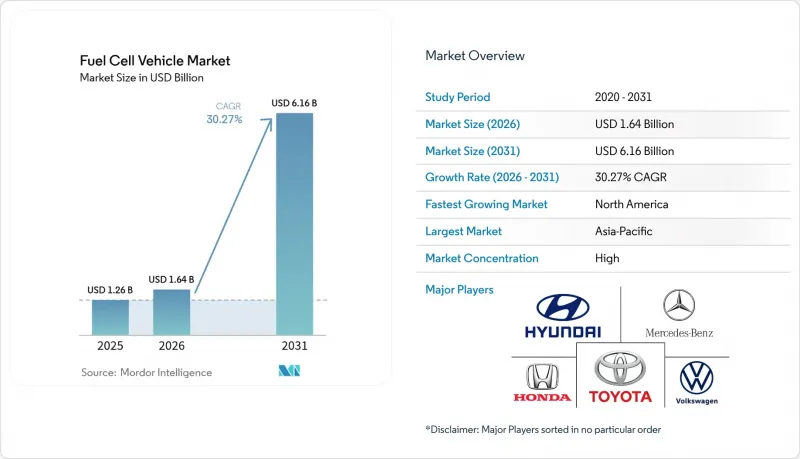
根據 Mordor Intelligence 估計,燃料電池汽車市場在 2026 年的價值將達到 16.4 億美元,高於 2025 年的 12.6 億美元,預計到 2031 年將達到 61.6 億美元。
預計從 2026 年到 2031 年,其複合年成長率將達到 30.27%。
本報告按車輛類型(乘用車和商用車)、燃料電池類型(質子交換膜 (PEM) 燃料電池、固體氧化物燃料電池 (SOFC)增程器)、額定功率(小於 100 kW、100-200 kW、大於 100 kW)、組件(燃料電池堆、輔助設備 (BOP)、測速電力設備和區域電系統進行細分電力系統和區域電系統進行細分。市場預測以價值(美元)和銷售量(單位)表示。
全球燃料電池汽車市場趨勢及洞察
各國制定的零排放汽車和氫能發展藍圖正在推動市場轉型。
政府法規正在透過協調一致的政策框架重塑燃料電池汽車的普及,該框架同時解決了供需限制問題。韓國以14,500輛燃料電池電動車位居世界第一,佔全球部署量的33%。這得歸功於政府的獎勵,旨在將車輛成本降低約50%,並設定了2040年部署620萬輛氫燃料電池汽車的目標。美國能源局的氫能戰略透過《兩黨基礎設施法案》撥款95億美元,目標是到2030年實現年產1,000萬噸氫氣,並預測到2050年將有10%至15%的卡車使用燃料電池。日本的《氫能社會促進法案》規定了一項為期15年的價格支持計劃,並推動生產基地的建設,目標是到2040年實現1200萬噸氫氣供應。這些協調一致的努力正在形成一個良性循環:基礎設施投資促進了車輛的普及,而車輛的普及反過來又為加氫網路的擴張提供了動力。中國撥款 3.21 億美元在該地區推廣氫燃料電池汽車,顯示有針對性的資金可以加速市場形成,超越自然成長模式。
大型燃料電池卡車示範計畫證實了其商業性可行性。
在貨運走廊進行的試點計畫已證實燃料電池卡車在特定應用場景下的營運優勢,並建構了可複製的經營模式,以期實現更廣泛的應用。尼古拉公司引領燃料電池卡車的普及,計劃在2024年第三季交付90輛卡車,年增3000%,並在主要貨運路線上建立了氫燃料加註合作夥伴關係。戴姆勒卡車公司的液氫系統在負載容量45000磅的情況下實現了650英里的續航里程,在長途運輸應用中展現出相對於電池式電動車的競爭優勢,因為重量和加氫時間直接影響盈利。現代汽車的XCIENT卡車已在13個國家行駛超過1300萬公里,證明了其180千瓦燃料電池系統在實際應用中的耐用性和450英里的續航里程。美國國家可再生能源實驗室 (NREL) 預測,到 2035 年,零排放卡車的總擁有成本將與柴油車相當,而燃料電池汽車預計將具有顯著優勢,尤其是在需要快速加氫和高日運轉率的應用中。這些示範成果將為車隊營運商提供資本投資的依據,並加速燃料電池車在早期採用者階段後的普及。
公共 700 巴加油站的推廣速度緩慢,限制了市場擴張。
基礎設施建設落後車輛普及,造成地理限制,使得燃料電池汽車的部署僅限於特定區域和大都會圈。截至2024年底,全球僅有1,369座加氫站,其中79%集中在中國、韓國、日本、法國和德國,導致大片地區無法覆蓋。由於供應和可靠性問題,加州的加氫網路在2024年僅剩62座運作中站點。這迫使汽車製造商下調了燃料電池電動車的銷售預測,預計2030年銷量僅20,500輛。到2034年,加氫站市場需要61.7億美元的投資才能支持預計的車輛普及,但目前的資金籌措機制不足以支持快速擴張。雖然加氫站的平均建設週期已縮短至1.6年(較早工程的4.9年有所改善),但新建加氫站的絕對數量仍低於大規模市場普及所需的水準。
細分市場分析
到2025年,燃料電池汽車市場中乘用車將佔據71.54%的市場。重型卡車憑藉其650英里的續航里程和10分鐘的加氫時間,在貨運方面具有保持效率的優勢。在中國,隨著地方政府整合加氫站和充電中心,線路公車的部署正在迅速增加,已超過1000輛。採用甲醇重整增程器的貨車正在規避加氫站短缺的問題,並有助於城市物流車輛符合零排放法規。向車隊領域的結構性轉變正在支撐燃料電池汽車市場的長期韌性。
到 2031 年,商用車將以 47.10% 的複合年成長率推動成長。同時,儘管乘用車銷量有所成長,但其市場佔有率卻在下降,因為對價格敏感的消費者傾向於選擇純電動車進行短途出行。
至2025年,PEM型燃料電池堆將佔燃料電池堆總量的90.85%,但SOFC型增程器預計將超越PEM型燃料電池堆,到2031年將維持42.10%的複合年成長率。高溫SOFC的工作溫度為500–700 度C,系統效率可達60–72%,並且可以使用甲醇和氨作為燃料,從而減輕基礎設施低度開發地區的燃料物流負擔。 BMW測試車搭載了Ceres Power公司的SOFC模組,顯示汽車製造商對能夠利用現有液體燃料供應鏈的平台表現出濃厚的興趣。
2025年,SOFC解決方案在燃料電池汽車市場規模中所佔佔有率不到2.80%,但隨著供應鏈的柔軟性,到2031年,其佔有率可能超過8.60%。 PEM預計將保持多數市場佔有率,但隨著多燃料能力成為競爭優勢,其佔有率預計將逐漸縮小。
區域分析
亞太地區預計到2025年將維持52.60%的市場佔有率,這主要得益於中國、日本和韓國建構了涵蓋生產、分銷和車輛獎勵等環節的一體化氫能生態系統。中國已部署506兆瓦燃料電池設備,並計畫在2030年部署10萬輛燃料電池卡車,充分利用港口和鋼鐵廠的氫氣產品。在韓國,1.45萬輛汽車受益於一項補貼計劃,可降低車輛標價的50%,韓國國家藍圖的目標是到2040年部署620萬輛燃料電池汽車。日本在固定用途氫能應用領域仍處於全球領先地位,但在交通運輸領域的應用正在加速推進,這得益於為期15年的價格保障計畫。
在北美,《通膨控制法案》中與氫能相關的條款以及加州的零排放法規正推動市場以46.85%的複合年成長率成長,直至2031年。美國能源局正在資助七個區域氫能中心,每個中心都肩負著滿足出行需求的重任,從而確保燃料電池汽車的穩定供應。現代汽車計劃在美國投資210億美元用於燃料電池卡車的生產和基礎設施建設,這充分體現了外國汽車製造商對這些政策穩定性的信心。
在西歐和中歐,氫能市場正在擴張,這主要得益於德國113座公共加氫站以及歐盟1000萬噸的氫氣目標。戴姆勒卡車公司已獲得2.26億歐元的資金,用於部署100輛液氫卡車。同時,清潔氫能聯合計畫(Clean Hydrogen Joint Undertaking)正在投資1.135億歐元用於研發。 BMW和豐田的合作表明,歐洲汽車製造商正在進行更廣泛的合作,以支持氫能作為純電動車的補充。
其他好處:
- Excel格式的市場預測(ME)表
- 3個月的分析師支持
目錄
第1章:引言
- 市場分析與定義的前提條件
- 分析範圍
第2章 分析方法
第3章執行摘要
第4章 市場狀況
- 市場概覽
- 市場促進因素
- 各國(美國、歐盟、中國、韓國)零排放汽車及氫能發展藍圖
- 在主要貨運路線上進行的大型燃料電池卡車示範計畫正在增加。
- 中國的「氫能港口」叢集整合了燃料電池堆高機和場內牽引車。
- 與《工業關係法》和歐盟《淨零排放產業法案》相關的措施/製造業稅額扣抵
- 將氨裂解成氫氣的技術正在不斷進步,為長途駕駛時的燃料補充做好準備。
- OEM廠商正在向送貨貨車過渡,採用甲醇重整燃料電池(FC)增程器。
- 市場限制因素
- 除了加州和首爾以外,700巴公共加油站的推廣速度很慢。
- 電池價格的急劇下降使得總擁有成本 (TCO) 向續航里程低於 350 公里的純電動車傾斜。
- 歐盟對車載氫氣罐的型式認證仍出現延誤。
- 下一代高溫PEM鎳基催化劑的供應風險。
- 價值鍊和供應鏈分析
- 監理情勢
- 技術展望
- 波特五力分析
第5章:預測市場規模與成長率
- 按車輛類型
- 搭乘用車
- 商用車輛
- 依燃料電池類型
- 質子交換膜(PEM)
- 固體氧化物增程器
- 按類型分類的額定輸出
- 小於100千瓦
- 100~200 kW
- 超過200千瓦
- 按組件
- 燃料電池堆
- BOP(輔助設備:周邊設備)
- 氫氣儲存
- 電力電子驅動
- 地區
- 北美洲
- 美國
- 加拿大
- 其他北美國家
- 南美洲
- 巴西
- 阿根廷
- 其他南美國家
- 歐洲
- 德國
- 英國
- 法國
- 西班牙
- 俄羅斯
- 其他歐洲國家
- 亞太地區
- 中國
- 日本
- 韓國
- 印度
- 其他亞太國家
- 中東和非洲
- 阿拉伯聯合大公國
- 沙烏地阿拉伯
- 土耳其
- 埃及
- 南非
- 其他中東和非洲國家
- 北美洲
第6章 競爭情勢
- 市場集中度
- 策略趨勢
- 市佔率分析
- 公司簡介
- Toyota Motor Corporation
- Hyundai Motor Company
- Honda Motor Co., Ltd.
- BMW Group
- Mercedes-Benz Group AG
- General Motors Company
- Volkswagen AG
- SAIC Motor Corporation
- FAW Group
- Stellantis NV
- Daimler Truck AG
- Volvo Group
- MAN Truck & Bus SE
- Ballard Power Systems
- Plug Power Inc.
- Nikola Corporation
- Great Wall Motor Co., Ltd.
- Foton Motor Co., Ltd.
- Doosan Fuel Cell Co., Ltd.
- Horizon Fuel Cell Technologies
第7章 市場機會與未來展望
According to Mordor Intelligence, the fuel cell vehicle market size in 2026 is estimated at USD 1.64 billion, growing from 2025 value of USD 1.26 billion with 2031 projections showing USD 6.16 billion, growing at 30.27% CAGR over 2026-2031.
This report is Segmented by Vehicle Type (Passenger Cars and Commercial Vehicles), Fuel Cell Type (Proton-Exchange-Membrane (PEM) and SOFC Range Extenders), Power Rating (Less Than 100 KW, 100 To 200 KW, and More), Component (Fuel-Cell Stack and Balance-Of-Plant, Hydrogen Storage and Power-Electronics and E-Drive), and Geography. The Market Forecasts are Provided in Terms of Value (USD) and Volume (Units).
Global Fuel Cell Vehicle Market Trends and Insights
National Zero-Emission-Vehicle and Hydrogen Road-maps Drive Market Transformation
Government mandates are reshaping fuel cell vehicle adoption through coordinated policy frameworks that simultaneously address supply and demand constraints. South Korea leads with 14,500 fuel cell electric vehicles, representing 33% of global deployment, supported by incentives reducing vehicle costs by approximately 50% and targets for 6.2 million hydrogen vehicles by 2040. The US Department of Energy's hydrogen strategy allocates USD 9.5 billion through the Bipartisan Infrastructure Law, targeting 10 million metric tons of annual production by 2030, while projecting 10-15% of trucks will utilize fuel cells by 2050. Japan's Hydrogen Society Promotion Act establishes 15-year price support programs and production hub development, aiming for a 12-million-ton hydrogen supply by 2040. These coordinated approaches create self-reinforcing cycles where infrastructure investment enables vehicle deployment, which justifies expanded refueling networks. China's allocation of USD 321 million for regional hydrogen fuel cell vehicle deployment demonstrates how targeted funding accelerates market formation beyond organic growth patterns.
Heavy-Duty Fuel Cell Truck Pilots Establish Commercial Viability
Freight corridor demonstrations prove fuel cell trucks' operational superiority in specific use cases, creating replicable business models for broader deployment. Nikola leads deployment with 90 trucks shipped in Q3 2024, representing 3,000% year-over-year growth, while establishing hydrogen refueling partnerships across key freight routes. Daimler Truck's liquid hydrogen system achieves a 650-mile range with a 45,000-pound payload, demonstrating a competitive advantage over battery-electric alternatives in long-haul applications where weight and refueling time directly impact profitability. Hyundai's XCIENT trucks logged over 13 million kilometers across 13 countries, providing real-world validation of 180 kW fuel cell systems' durability and 450-mile operational range. The National Renewable Energy Laboratory projects zero-emission trucks achieving total cost of ownership parity with diesel by 2035, with fuel cell vehicles particularly advantaged in applications requiring rapid refueling and high daily utilization. These demonstrations establish proof points fleet operators can reference when justifying capital investments, accelerating adoption beyond early-adopter segments.
Slow Roll-out of Public 700-bar Stations Constrains Market Expansion
Infrastructure deployment lags vehicle availability, creating geographic constraints that limit fuel cell vehicle adoption to specific corridors and metropolitan areas. Global hydrogen refueling stations reached only 1,369 by end-2024, with 79% concentrated in China, South Korea, Japan, France, and Germany, leaving vast regions without access. California's hydrogen network decreased to 62 operational stations in 2024 due to supply and reliability issues, forcing automakers to revise FCEV sales projections to only 20,500 vehicles by 2030. The hydrogen fueling station market requires USD 6.17 billion investment by 2034 to support projected vehicle deployment, yet current funding mechanisms remain insufficient for rapid expansion. Station development timelines average 1.6 years compared to 4.9 years for earlier projects, indicating improving processes, yet the absolute number of new stations remains below requirements for mass market adoption.
Other drivers and restraints analyzed in the detailed report include:
- China's Hydrogen Port Clusters Create Industrial Ecosystem
- IRA & EU Net-Zero Industry Act Accelerate Manufacturing Scale
- Battery-Price Plunge Tilts TCO Toward BEVs in Short-Range Applications
For complete list of drivers and restraints, kindly check the Table Of Contents.
Segment Analysis
Passenger Cars had a 71.54% of the 2025 share of the fuel cell vehicle market. Heavy-duty trucks benefit from 650-mile ranges and 10-minute refuels that preserve freight utilization metrics. Transit buses are scaling quickly in China-more than 1,000 units-as municipal authorities integrate hydrogen depots with depot-charging hubs. Delivery vans employing methanol-reforming range-extenders circumvent hydrogen station shortages, advancing zero-emission compliance for urban logistics fleets. The structural tilt toward fleet segments underpins long-term resilience of the fuel cell vehicle market.
Commercial vehicles lead growth with a 47.10% CAGR to 2031. Conversely, passenger cars' share falls despite unit growth as price-sensitive consumers gravitate to battery EVs for short-distance use cases.
PEM units supplied 90.85% of fuel cell stacks in 2025, but SOFC range-extenders are forecast to deliver 42.10% CAGR through 2031, exceeding PEM's. High-temperature SOFCs operate at 500-700 °C, enabling 60-72% system efficiency and tolerance for methanol or ammonia, which eases fuel logistics in infrastructure-poor regions. BMW's pilot vans with Ceres Power SOFC modules illustrate automaker interest in a platform that can piggyback existing liquid-fuel supply chains.
SOFC solutions now commanded less than 2.80% of the 2025 fuel cell vehicle market size, yet could capture above 8.60% by 2031 if supply chains scale. PEM is expected to keep the majority share but face progressive erosion as multi-fuel flexibility becomes a competitive differentiator.
Complete Report Scope:
- By Vehicle Type
- Passenger Cars
- Commercial Vehicles
- By Fuel-cell Type
- Proton-Exchange-Membrane (PEM)
- Solid-Oxide (SOFC) Range-Extenders
- By Power Rating
- Less than 100 kW
- 100 to 200 kW
- More than 200 kW
- By Component
- Fuel-cell Stack
- Balance-of-Plant
- Hydrogen Storage
- Power-Electronics & E-Drive
- Geography
- North America
- United States
- Canada
- Rest of North America
- South America
- Brazil
- Argentina
- Rest of South America
- Europe
- Germany
- United Kingdom
- France
- Spain
- Russia
- Rest of Europe
- Asia-Pacific
- China
- Japan
- South Korea
- India
- Rest of Asia-Pacific
- Middle East and Africa
- United Arab Emirates
- Saudi Arabia
- Turkey
- Egypt
- South Africa
- Rest of Middle East and Africa
- North America
Geography Analysis
Asia-Pacific retained a 52.60% 2025 share because China, Japan, and South Korea built integrated hydrogen ecosystems spanning production, distribution, and vehicle incentives. China installed 506 MW of fuel cell capacity and is targeting 100,000 fuel cell trucks by 2030, leveraging port and steel-plant hydrogen by-products. South Korea's 14,500 vehicles ride on subsidies that cut sticker prices by 50%, while the national roadmap calls for 6.2 million units by 2040. Japan remains the global leader in stationary deployments, but transportation uptake is accelerating under 15-year price guarantees.
North America leading 46.85% CAGR through 2031 thanks to the Inflation Reduction Act's hydrogen provisions and California's zero-emission mandates. The US Department of Energy funds seven regional hydrogen hubs, each required to serve mobility loads, ensuring a pipeline of demand for the fuel cell vehicle market. Hyundai's USD 21 billion plan for US fuel cell truck production and infrastructure exemplifies foreign OEM confidence in policy stability.
Western and Central Europe is growing, spearheaded by Germany's 113 public stations and the EU's 10-million-ton hydrogen target. Daimler Truck secured EUR 226 million to field 100 liquid-hydrogen trucks. At the same time, the Clean Hydrogen Joint Undertaking injects EUR 113.5 million into R&D. BMW's Toyota alliance signals broader European OEM alignment behind hydrogen as a complement to battery EVs.
- Toyota Motor Corporation
- Hyundai Motor Company
- Honda Motor Co., Ltd.
- BMW Group
- Mercedes-Benz Group AG
- General Motors Company
- Volkswagen AG
- SAIC Motor Corporation
- FAW Group
- Stellantis N.V.
- Daimler Truck AG
- Volvo Group
- MAN Truck & Bus SE
- Ballard Power Systems
- Plug Power Inc.
- Nikola Corporation
- Great Wall Motor Co., Ltd.
- Foton Motor Co., Ltd.
- Doosan Fuel Cell Co., Ltd.
- Horizon Fuel Cell Technologies
Additional Benefits:
- The market estimate (ME) sheet in Excel format
- 3 months of analyst support
TABLE OF CONTENTS
1 Introduction
- 1.1 Study Assumptions & Market Definition
- 1.2 Scope of the Study
2 Research Methodology
3 Executive Summary
4 Market Landscape
- 4.1 Market Overview
- 4.2 Market Drivers
- 4.2.1 National ZEV & hydrogen road-maps (US, EU, China, S. Korea)
- 4.2.2 Rising heavy-duty fuel-cell truck pilots on key freight corridors
- 4.2.3 China's "hydrogen port" clusters integrating FC forklifts & yard tractors
- 4.2.4 IRA & EU Net-Zero Industry Act stack/manufacturing tax credits
- 4.2.5 Ammonia-to-hydrogen cracking advances for long-haul refuelling
- 4.2.6 OEM shift to methanol-reforming FC range-extenders for delivery vans
- 4.3 Market Restraints
- 4.3.1 Slow roll-out of public 700-bar stations outside California & Seoul
- 4.3.2 Battery-price plunge tilting TCO in favor of BEVs with less than 350 km range
- 4.3.3 Persistent on-board hydrogen tank homologation delays in EU
- 4.3.4 Nickel-based catalyst supply risk for next-gen high-temp PEM
- 4.4 Value/Supply-Chain Analysis
- 4.5 Regulatory Landscape
- 4.6 Technological Outlook
- 4.7 Porter's Five Forces
- 4.7.1 Threat of New Entrants
- 4.7.2 Bargaining Power of Buyers/Consumers
- 4.7.3 Bargaining Power of Suppliers
- 4.7.4 Threat of Substitute Products
- 4.7.5 Intensity of Competitive Rivalry
5 Market Size & Growth Forecasts (Value (USD) and Volume (Units))
- 5.1 By Vehicle Type
- 5.1.1 Passenger Cars
- 5.1.2 Commercial Vehicles
- 5.2 By Fuel-cell Type
- 5.2.1 Proton-Exchange-Membrane (PEM)
- 5.2.2 Solid-Oxide (SOFC) Range-Extenders
- 5.3 By Power Rating
- 5.3.1 Less than 100 kW
- 5.3.2 100 to 200 kW
- 5.3.3 More than 200 kW
- 5.4 By Component
- 5.4.1 Fuel-cell Stack
- 5.4.2 Balance-of-Plant
- 5.4.3 Hydrogen Storage
- 5.4.4 Power-Electronics & E-Drive
- 5.5 Geography
- 5.5.1 North America
- 5.5.1.1 United States
- 5.5.1.2 Canada
- 5.5.1.3 Rest of North America
- 5.5.2 South America
- 5.5.2.1 Brazil
- 5.5.2.2 Argentina
- 5.5.2.3 Rest of South America
- 5.5.3 Europe
- 5.5.3.1 Germany
- 5.5.3.2 United Kingdom
- 5.5.3.3 France
- 5.5.3.4 Spain
- 5.5.3.5 Russia
- 5.5.3.6 Rest of Europe
- 5.5.4 Asia-Pacific
- 5.5.4.1 China
- 5.5.4.2 Japan
- 5.5.4.3 South Korea
- 5.5.4.4 India
- 5.5.4.5 Rest of Asia-Pacific
- 5.5.5 Middle East and Africa
- 5.5.5.1 United Arab Emirates
- 5.5.5.2 Saudi Arabia
- 5.5.5.3 Turkey
- 5.5.5.4 Egypt
- 5.5.5.5 South Africa
- 5.5.5.6 Rest of Middle East and Africa
- 5.5.1 North America
6 Competitive Landscape
- 6.1 Market Concentration
- 6.2 Strategic Moves
- 6.3 Market Share Analysis
- 6.4 Company Profiles (Includes Global level Overview, Market Level Overview, Core Segments, Financials as Available, Strategic Information, Market Rank/Share for Key Companies, Products & Services, and Recent Developments)
- 6.4.1 Toyota Motor Corporation
- 6.4.2 Hyundai Motor Company
- 6.4.3 Honda Motor Co., Ltd.
- 6.4.4 BMW Group
- 6.4.5 Mercedes-Benz Group AG
- 6.4.6 General Motors Company
- 6.4.7 Volkswagen AG
- 6.4.8 SAIC Motor Corporation
- 6.4.9 FAW Group
- 6.4.10 Stellantis N.V.
- 6.4.11 Daimler Truck AG
- 6.4.12 Volvo Group
- 6.4.13 MAN Truck & Bus SE
- 6.4.14 Ballard Power Systems
- 6.4.15 Plug Power Inc.
- 6.4.16 Nikola Corporation
- 6.4.17 Great Wall Motor Co., Ltd.
- 6.4.18 Foton Motor Co., Ltd.
- 6.4.19 Doosan Fuel Cell Co., Ltd.
- 6.4.20 Horizon Fuel Cell Technologies
7 Market Opportunities & Future Outlook
- 7.1 White-space & Unmet-Need Assessment

 燃料電池商用車:市場佔有率分析、產業趨勢與統計及成長預測(2026-2031)
 燃料電池汽車市場-2026-2032年全球市場預測
 燃料電池電動車(FCEV)全球市場規模、佔有率、趨勢和成長分析報告(2026-2034)
 氫燃料電池卡車市場預測至2034年-全球分析(按卡車類型、續航里程、燃料電池技術、氫氣儲存類型、功率輸出、氫氣來源、應用、最終用戶、銷售管道和地區分類)
 燃料電池卡車市場分析及至2035年的預測:類型、產品類型、技術、組件、應用、部署現況、最終用戶、安裝類型、解決方案燃料電池電動車市場分析與至2035年的預測:類型、產品類型、技術、組件、應用、材料類型、部署模式、最終用戶、安裝模式、解決方案汽車燃料電池市場預測至2034年—全球燃料電池類型、車輛類型、組件、功率、氫氣來源、應用和區域分析
 2026年全球燃料電池汽車市場報告2026年全球燃料電池電動車市場報告2026年燃料電池V2G(車輛到電網)全球市場報告