


 |
市場調查報告書
商品編碼
2113936
燃料電池商用車:市場佔有率分析、產業趨勢與統計及成長預測(2026-2031)Fuel Cell Commercial Vehicle - Market Share Analysis, Industry Trends & Statistics, Growth Forecasts (2026 - 2031) |
||||||

※ 本網頁內容可能與最新版本有所差異。詳細情況請與我們聯繫。
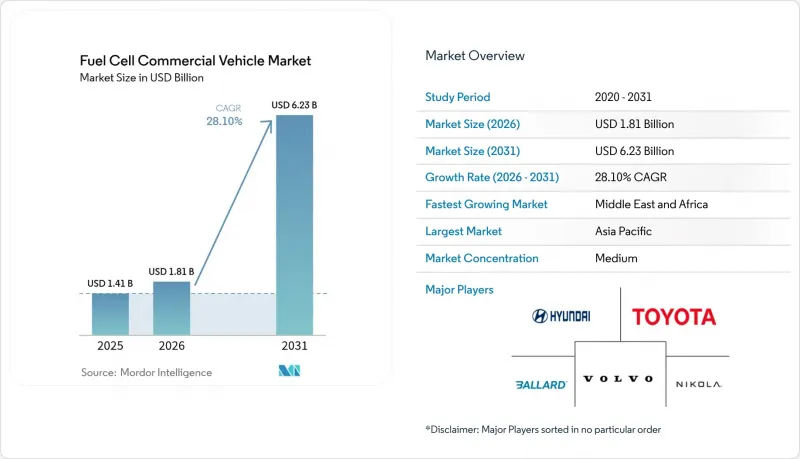
據 Mordor Intelligence 稱,2025 年燃料電池商用車市值為 14.1 億美元,預計到 2031 年將達到 62.3 億美元,而 2026 年為 18.1 億美元,預測期內(2026-2031 年)的複合年成長率為 28.10%。
本報告按車輛類型(例如,公共汽車)、燃料電池類型(例如,質子交換膜燃料電池)、功率輸出範圍(例如,小於100千瓦)、續航里程(例如,小於400公里)、最終用途(例如,公共交通車輛)和地區進行分類。市場預測以美元計價。
全球燃料電池商用車市場趨勢及洞察
商用車輛的嚴格排放氣體法規
歐盟的「Fit-for-55」一攬子計畫要求到2040年將重型車輛的排放量減少90%,並設定了到2030年減少45%、到2035年減少65%的中期目標。為了遏制交通運輸業的排放,修訂後的二氧化碳排放標準涵蓋了更廣泛的重型車輛(HDV)。修訂後的法規現在包括巴士、長途客車、拖車和特殊卡車,這些車輛合計佔重型車輛銷售的90%以上。原始設備製造商(OEM)正在加快推進燃料電池項目,以滿足更嚴格的標準,尤其是在長途運輸領域,電池重量和充電造成的運作仍然是挑戰。
北美強制推行零排放城市公車
加州創新清潔交通法規要求公共運輸業者在2040年實現所有車輛零排放。目前,新購車輛中必須有25%為零排放車輛,到2026年這一比例需達到50%。 2024年,聯邦政府津貼15億美元用於購置約600輛公車,使得全尺寸燃料電池電動公車的部署量比前一年增加了55%。對於超過250公里的線路,各機構傾向於選擇燃料電池平台,因為純電動公車(BEV)需要兩組電池組,會減少座位數量。業者也表示,燃料電池不受環境溫度影響,可以隨時加註燃料,簡化了寒冷北方地區的營運規劃。
人們擔心燃料電池在嚴苛運作循環下的耐久性。
儘管近年來技術取得了長足進步,但重型車輛燃料電池系統的耐用性問題仍然令人擔憂。重型卡車需要至少能運作25,000小時的系統。百萬英里燃料電池卡車聯盟的目標是到2030年實現30,000小時的運行時間。雖然加州大學洛杉磯分校在2025年實驗室測試中取得了超過200,000小時的突破性成果,緩解了人們對系統壽命的擔憂,但全面商業性檢驗的工作仍在進行中。這些技術尚未廣泛的商業化應用,也未在大規模生產的車輛中得到應用。
細分市場分析
到2025年,公車將佔氫燃料電池商用車市場佔有率的45.02%,因為公共交通部門將利用專款取代老舊的柴油車輛。 Solaris在歐洲註冊的燃料電池公車中佔據65%的佔有率,這反映了原始設備製造商(OEM)對以車庫為基礎的營運模式的重視。橘郡交通管理局等機構訂購的40輛燃料電池公車凸顯了該細分市場的強勁勢頭。這種成長勢頭得益於可預測的路線以及返回車庫後便捷的加氫方式,這些特性非常適合350巴壓縮氣體系統,從而簡化了維護團隊的日常操作。將車輛和燃料供應合約捆綁在一起的採購框架進一步提高了公共部門採購者的預算確定性。
預計2026年至2031年間,卡車的複合年成長率將達到30.45%,超過公車,氫燃料電池商用車市場正向貨運物流領域轉型。尼古拉公司續航里程達500英里的TRE FCEV和現代汽車的8級平台「XCIENT」憑藉20分鐘的加氫時間和比純電動車(BEV)更大的負載容量能力,瞄準了樞紐間物流市場。企業貨運聯盟提供的擔保正在幫助銀行決定是否為新建加氫站提供融資。隨著綠色氫氣供應的穩定,預計在400-600公里的運輸路線上,氫燃料電池將實現總成本持平,從而加速其在北歐和中歐整個貨運走廊的部署。
預計到2025年,PEMFC技術將佔據燃料電池商用車市場80.65%的佔有率,其優勢在於啟動迅速且能適應頻繁的負載變化。每個電堆的鉑金含量持續降低,縮小了成本差距,同時也更滿足了城市公車的運作週期。加州的車隊測試表明,即使運作超過2萬小時,PEMFC公車的性能劣化也低於10%,這增強了營運商對多班次營運的信心。
預計到2031年,固體氧化物燃料電池(SOFC)的複合年成長率將達到30.75%。 SOFC的電效率高達60%,且能耐受低純度氫氣,因此可望應用於長距離運輸等整合場景以及作為輔助電源。材料科學的進步已將動作溫度降低至700 度C,從而實現了更快的加熱速度和更小的溫度控管組件。減少對鉑族金屬的依賴有望降低大規模生產的堆疊成本,而30,000小時的使用壽命將為其更廣泛的應用鋪平道路。
區域分析
預計到2025年,亞太地區將以41.05%的市場佔有率引領氫燃料電池商用車市場,這主要得益於中國每年12萬噸的綠色氫氣產能和大規模的零件製造能力。電解槽生產的成本優勢和國內採購配額,催生了一條涵蓋電堆、電力電子設備和儲槽等環節的本土化價值鏈。日本和韓國則憑藉長期研發投入和早期推出的OEM生產線,進一步鞏固了在該地區的領先地位。
歐洲緊隨其後,這得益於具有法律約束力的二氧化碳減排目標,該目標要求到2030年重型車輛的二氧化碳排放量減少45%,到2040年減少90%。截至2024年5月,加氫站數量已達187個,同期註冊的燃料電池公車數量增加了82%。諸如「H2Accelerate」之類的跨國計畫旨在2030年建成150個加氫站,連接斯堪地那維亞和義大利北部。
在北美,聯邦政府的獎勵和各州的法規共同推動了氫能的普及。加州的ARCHES中心已獲得12億美元的資金,目標是到2045年每天供應4.5萬噸氫氣。美國能源局的目標是到2030年,在新售出的中型和重型車輛中,30%為零排放車輛,並正在推動卡車製造商在太平洋西北地區、墨西哥灣沿岸和大湖區部署測試車輛。
預計到2031年,中東和非洲地區的年複合成長率將達到28.60%,這得益於該地區豐富的太陽能和風能資源以及現有的天然氣管道網路。沙烏地阿拉伯和阿拉伯聯合大公國(阿拉伯聯合大公國)正在建造一條連接港口和內陸物流中心的試點卡車運輸走廊,旨在實現貨運部門的脫碳,該部門的排放量佔該地區總排放量的四分之一。
其他好處:
- Excel格式的市場預測(ME)表
- 3個月的分析師支持
目錄
第1章:引言
- 研究假設和市場定義
- 調查範圍
第2章:調查方法
第3章執行摘要
第4章 市場狀況
- 市場概覽
- 市場促進因素
- 商用車輛的嚴格排放氣體法規
- 北美強制推行零排放城市公車
- 中國利用可再生能源電解制氫的成本正在下降。
- 企業淨零排放貨運聯盟正在加速原始設備製造商的採購承諾。
- 北歐國家長途貨車(行駛里程超過400公里)的總擁有成本(TCO)持平
- 以港口為基礎的氫能走廊正在加速引進。
- 市場限制因素
- 氫氣加註站基礎設施成本高昂
- 新興市場綠氫能供應部署緩慢
- 人們擔心燃料電池在惡劣運作條件下的耐久性。
- 在短程運輸領域與電池電動卡車競爭
- 價值供應鏈分析
- 監管和技術展望
- 波特五力模型
第5章 市場規模與成長預測
- 車輛類型
- 公車
- 追蹤
- 範
- 其他車輛類型(例如皮卡)
- 依燃料電池類型
- 質子交換膜燃料電池(PEMFC)
- 磷酸鹽燃料電池(PAFC)
- 固體氧化物燃料電池(SOFC)
- 其他
- 輸出範圍
- 小於100千瓦
- 100 kW~200 kW
- 200度或以上
- 透過練習場
- 不到400公里
- 400 km~600 km
- 超過600公里
- 最終用戶
- 大眾運輸車輛車隊
- 長途貨物運輸/物流
- 最後一公里配送
- 地方政府和公共產業服務
- 其他用途
- 按地區
- 北美洲
- 美國
- 加拿大
- 其他北美國家
- 歐洲
- 德國
- 英國
- 法國
- 義大利
- 其他歐洲國家
- 亞太地區
- 中國
- 印度
- 日本
- 韓國
- 其他亞太國家
- 南美洲
- 巴西
- 阿根廷
- 其他南美國家
- 中東和非洲
- 阿拉伯聯合大公國
- 南非
- 沙烏地阿拉伯
- 其他中東和非洲國家
- 北美洲
第6章 競爭情勢
- 市場集中度
- 策略趨勢
- 市佔率分析
- 公司簡介
- Hyundai Motor Company
- Toyota Motor Corporation
- Ballard Power Systems
- Volvo Group(cellcentric JV)
- Nikola Corporation
- PACCAR Inc.
- Mercedes-Benz Group AG
- Honda Motor Co.
- SAIC Motor Corporation
- Foton Motor Group
- Tata Motors Limited
- Solaris Bus & Coach sp. z oo
- Plug Power Inc.
- Hyzon Motors Inc.
- Cummins Inc.
- Wrightbus Ltd.
- Zhejiang Geely Holding Group
- Dongfeng Motor Corporation
- Xiamen King Long Motor Group
- Gaussin SA
第7章 市場機會與未來展望
According to Mordor Intelligence, the fuel cell commercial vehicle market size was valued at USD 1.41 billion in 2025 and estimated to grow from USD 1.81 billion in 2026 to reach USD 6.23 billion by 2031, at a CAGR of 28.10% during the forecast period (2026-2031).
This report is Segmented by Vehicle Type(Buses and More), Fuel Cell (Proton Exchange Membrane Fuel Cell and More), Power Range (Below 100 KW and More), Driving Range (Below 400km and More), End-Use (Public Transit Fleets and More), and Geography. The Market Forecasts are Provided in Terms of Value (USD).
Global Fuel Cell Commercial Vehicle Market Trends and Insights
Stringent Emission Regulations for Commercial Vehicles
The EU "Fit-for-55" package requires a 90% emissions cut from heavy-duty vehicles by 2040, with interim targets of 45% by 2030 and 65% by 2035. To curb emissions from the transportation sector, revised CO2 standards now encompass a broader spectrum of heavy-duty vehicles (HDVs). The updated regulations now include buses, coaches, trailers, and vocational trucks, collectively accounting for over 90% of HDV sales. OEMs are accelerating fuel-cell programs to meet the tougher standards, particularly for long-haul operations where battery mass and charging downtime remain challenging.
Zero-Emission Mandates for Urban Bus Fleets in North America
California's Innovative Clean Transit Regulation compels transit operators to transition to 100% zero-emission fleets by 2040. Purchases must already be 25% zero-emission, reaching 50% by 2026. Federal grants of USD 1.5 billion in 2024 funded roughly 600 additional buses, and full-size fuel-cell electric bus deployments grew 55% year-over-year. Agencies prefer fuel-cell platforms for blocks above 250 km, requiring dual battery packs if executed with pure BEVs, compromising seating capacity. Operators also report that ambient-temperature-insensitive refuelling simplifies service planning in cold northern climates.
Fuel-Cell Durability Concerns in Heavy-Duty Cycles
Despite recent technological advances, fuel cell systems for heavy-duty applications still grapple with significant durability concerns. Heavy trucks require systems capable of at least 25,000 operating hours. The Million Mile Fuel Cell Truck Consortium targets 30,000 hours by 2030. UCLA's 2025 breakthrough of more than 200,000 hours in lab tests addresses lifetime anxiety but is still moving toward scaled commercial validation. These technologies have yet to be widely commercialized and integrated into production vehicles.
Other drivers and restraints analyzed in the detailed report include:
- Corporate Net-Zero Freight Alliances Accelerating OEM Purchase Commitments
- Port-Centric Hydrogen Corridors Spurring Early Adoption
- Competition from Battery-Electric Trucks in Short-Haul
For complete list of drivers and restraints, kindly check the Table Of Contents.
Segment Analysis
Buses held 45.02% of the hydrogen fuel cell commercial vehicle market share in 2025 as transit agencies tapped dedicated funding lines to replace aging diesel fleets. Solaris captured 65% of European fuel-cell bus registrations, reflecting OEM specialization in depot-based operations. Orders such as Orange County Transportation Authority's 40 FCEBs underscore the segment's traction. Momentum benefits from predictable routes and return-to-depot refueling, traits that fit 350-bar compressed-gas systems and simplify daily operations for maintenance teams. Procurement frameworks that bundle vehicles with fueling contracts further improve budget certainty for public-sector buyers.
Trucks are forecast to outpace buses with a 30.45% CAGR from 2026 to 2031, moving the hydrogen fuel cell commercial vehicle market toward freight logistics. Nikola's 500-mile TRE FCEV and Hyundai's XCIENT class-8 platform are positioned for hub-to-hub logistics, exploiting 20-minute refueling and higher payload headroom over BEVs. Corporate freight alliances provide offtake guarantees that help banks underwrite new refueling stations. As green hydrogen supply stabilizes, total-cost parity on 400-600 km lanes is expected to unlock nationwide rollouts across Nordic and Central European freight corridors.
PEMFC technology commanded 80.65% of the fuel cell commercial vehicle market in 2025, valued for its rapid start-up and tolerance to frequent load changes. Platinum loading per stack continues to fall, closing cost gaps while meeting city-bus duty cycles. Fleet trials in California show PEMFC buses exceeding 20,000 hours with degradation under 10%, reinforcing operator confidence in multi-shift service.
Solid Oxide Fuel Cell (SOFC) is expected to grow at a 30.75% CAGR through 2031. Electrical efficiency up to 60%, combined with tolerance for lower-purity hydrogen, supports long-haul and auxiliary-power integration scenarios. Material science progress has trimmed operating temperatures to 700 °C, allowing quicker heat-up and smaller thermal-management components. Reduced reliance on platinum-group metals promises lower stack costs at scale, setting the stage for expanded adoption once durability reaches 30,000 hours.
Complete Report Scope:
- By Vehicle Type
- Buses
- Trucks
- Vans
- Other Vehicle Types (Pickup Trucks, etc.)
- By Fuel Cell Type
- Proton Exchange Membrane Fuel Cell (PEMFC)
- Phosphoric Acid Fuel Cell (PAFC)
- Solid Oxide Fuel Cell (SOFC)
- Others
- By Power Range
- Below 100 kW
- 100 kW - 200 kW
- Above 200 kW
- By Driving Range
- Below 400 km
- 400 km - 600 km
- Above 600 km
- By End-User
- Public Transit Fleets
- Long-Haul Freight & Logistics
- Last-Mile Delivery
- Municipal & Utility Services
- Other Applications
- By Geography
- North America
- United States
- Canada
- Rest of North America
- Europe
- Germany
- United Kingdom
- France
- Italy
- Rest of Europe
- Asia-Pacific
- China
- India
- Japan
- South Korea
- Rest of Asia-Pacific
- South America
- Brazil
- Argentina
- Rest of South America
- Middle East and Africa
- United Arab Emirates
- South Africa
- Saudi Arabia
- Rest of Middle East and Africa
- North America
Geography Analysis
Asia-Pacific region led the hydrogen fuel cell commercial vehicle market with a 41.05% share in 2025, underpinned by China's 125,000 tpa green-hydrogen capacity and large-scale component manufacturing. Cost advantages in electrolyser production and domestic procurement quotas have built a localised value chain spanning stacks, power electronics, and tanks. Japan and South Korea reinforce the region's edge with long-running R&D programs and early OEM production lines.
Europe follows closely, driven by binding CO2 cuts that require 45% lower heavy-duty emissions by 2030 and 90% by 2040. Refueling coverage reached 187 stations by May 2024, and fuel-cell bus registrations rose 82% during the same period. Cross-border projects, such as the H2Accelerate collaboration, aim to link Scandinavia to Northern Italy with 150 stations by 2030.
North America benefits from a blend of federal incentives and state mandates. California's ARCHES hub, backed by USD 1.2 billion, targets 45,000 tons/day of hydrogen by 2045. The U.S. Department of Energy wants 30% of new medium- and heavy-duty sales to be zero-emission by 2030, propelling truck OEM pilot fleets across the Pacific Northwest, the Gulf Coast, and the Great Lakes.
The Middle East and Africa region is expected to be the forecast to grow at 28.60% CAGR to 2031, is building on abundant solar and wind resources plus existing gas pipeline networks. Saudi Arabia and the UAE are constructing pilot truck corridors linking ports with inland distribution centers, aiming to decarbonize a freight sector that accounts for a quarter of regional emissions.
- Hyundai Motor Company
- Toyota Motor Corporation
- Ballard Power Systems
- Volvo Group (cellcentric JV)
- Nikola Corporation
- PACCAR Inc.
- Mercedes-Benz Group AG
- Honda Motor Co.
- SAIC Motor Corporation
- Foton Motor Group
- Tata Motors Limited
- Solaris Bus & Coach sp. z o.o.
- Plug Power Inc.
- Hyzon Motors Inc.
- Cummins Inc.
- Wrightbus Ltd.
- Zhejiang Geely Holding Group
- Dongfeng Motor Corporation
- Xiamen King Long Motor Group
- Gaussin S.A.
Additional Benefits:
- The market estimate (ME) sheet in Excel format
- 3 months of analyst support
TABLE OF CONTENTS
1 Introduction
- 1.1 Study Assumptions & Market Definition
- 1.2 Scope of the Study
2 Research Methodology
3 Executive Summary
4 Market Landscape
- 4.1 Market Overview
- 4.2 Market Drivers
- 4.2.1 Stringent Emission Regulations for Commercial Vehicles
- 4.2.2 Zero-Emission Mandates for Urban Bus Fleets in North America
- 4.2.3 Hydrogen Production Cost Declines from Renewable Electrolysis in China
- 4.2.4 Corporate Net-Zero Freight Alliances Accelerating OEM Purchase Commitments
- 4.2.5 TCO Parity for Long-Haul Trucks Above 400 km in Nordics
- 4.2.6 Port-Centric Hydrogen Corridors Spurring Early Adoption
- 4.3 Market Restraints
- 4.3.1 High Infrastructure Costs for Hydrogen Refuelling Stations
- 4.3.2 Slow Roll-out of Green Hydrogen Supply in Emerging Markets
- 4.3.3 Fuel-Cell Durability Concerns in Heavy-Duty Cycles
- 4.3.4 Competition from Battery-Electric Trucks in Short-Haul
- 4.4 Value / Supply-Chain Analysis
- 4.5 Regulatory & Technological Outlook
- 4.6 Porter's Five Forces
- 4.6.1 Bargaining Power of Suppliers
- 4.6.2 Bargaining Power of Buyers / Consumers
- 4.6.3 Threat of New Entrants
- 4.6.4 Threat of Substitute Products
- 4.6.5 Intensity of Competitive Rivalry
5 Market Size & Growth Forecasts (Value (USD))
- 5.1 By Vehicle Type
- 5.1.1 Buses
- 5.1.2 Trucks
- 5.1.3 Vans
- 5.1.4 Other Vehicle Types (Pickup Trucks, etc.)
- 5.2 By Fuel Cell Type
- 5.2.1 Proton Exchange Membrane Fuel Cell (PEMFC)
- 5.2.2 Phosphoric Acid Fuel Cell (PAFC)
- 5.2.3 Solid Oxide Fuel Cell (SOFC)
- 5.2.4 Others
- 5.3 By Power Range
- 5.3.1 Below 100 kW
- 5.3.2 100 kW - 200 kW
- 5.3.3 Above 200 kW
- 5.4 By Driving Range
- 5.4.1 Below 400 km
- 5.4.2 400 km - 600 km
- 5.4.3 Above 600 km
- 5.5 By End-User
- 5.5.1 Public Transit Fleets
- 5.5.2 Long-Haul Freight & Logistics
- 5.5.3 Last-Mile Delivery
- 5.5.4 Municipal & Utility Services
- 5.5.5 Other Applications
- 5.6 By Geography
- 5.6.1 North America
- 5.6.1.1 United States
- 5.6.1.2 Canada
- 5.6.1.3 Rest of North America
- 5.6.2 Europe
- 5.6.2.1 Germany
- 5.6.2.2 United Kingdom
- 5.6.2.3 France
- 5.6.2.4 Italy
- 5.6.2.5 Rest of Europe
- 5.6.3 Asia-Pacific
- 5.6.3.1 China
- 5.6.3.2 India
- 5.6.3.3 Japan
- 5.6.3.4 South Korea
- 5.6.3.5 Rest of Asia-Pacific
- 5.6.4 South America
- 5.6.4.1 Brazil
- 5.6.4.2 Argentina
- 5.6.4.3 Rest of South America
- 5.6.5 Middle East and Africa
- 5.6.5.1 United Arab Emirates
- 5.6.5.2 South Africa
- 5.6.5.3 Saudi Arabia
- 5.6.5.4 Rest of Middle East and Africa
- 5.6.1 North America
6 Competitive Landscape
- 6.1 Market Concentration
- 6.2 Strategic Moves
- 6.3 Market Share Analysis
- 6.4 Company Profiles (includes Global-level Overview, Market-level Overview, Core Segments, Financials as available, Strategic Information, Market Rank/Share, Products & Services, Recent Developments)
- 6.4.1 Hyundai Motor Company
- 6.4.2 Toyota Motor Corporation
- 6.4.3 Ballard Power Systems
- 6.4.4 Volvo Group (cellcentric JV)
- 6.4.5 Nikola Corporation
- 6.4.6 PACCAR Inc.
- 6.4.7 Mercedes-Benz Group AG
- 6.4.8 Honda Motor Co.
- 6.4.9 SAIC Motor Corporation
- 6.4.10 Foton Motor Group
- 6.4.11 Tata Motors Limited
- 6.4.12 Solaris Bus & Coach sp. z o.o.
- 6.4.13 Plug Power Inc.
- 6.4.14 Hyzon Motors Inc.
- 6.4.15 Cummins Inc.
- 6.4.16 Wrightbus Ltd.
- 6.4.17 Zhejiang Geely Holding Group
- 6.4.18 Dongfeng Motor Corporation
- 6.4.19 Xiamen King Long Motor Group
- 6.4.20 Gaussin S.A.
7 Market Opportunities & Future Outlook

 燃料電池汽車:市場佔有率分析、行業趨勢和統計數據、成長預測(2026-2031 年)
 燃料電池汽車市場-2026-2032年全球市場預測
 燃料電池電動車(FCEV)全球市場規模、佔有率、趨勢和成長分析報告(2026-2034)
 氫燃料電池卡車市場預測至2034年-全球分析(按卡車類型、續航里程、燃料電池技術、氫氣儲存類型、功率輸出、氫氣來源、應用、最終用戶、銷售管道和地區分類)
 燃料電池卡車市場分析及至2035年的預測:類型、產品類型、技術、組件、應用、部署現況、最終用戶、安裝類型、解決方案燃料電池電動車市場分析與至2035年的預測:類型、產品類型、技術、組件、應用、材料類型、部署模式、最終用戶、安裝模式、解決方案汽車燃料電池市場預測至2034年—全球燃料電池類型、車輛類型、組件、功率、氫氣來源、應用和區域分析
 2026年全球燃料電池汽車市場報告2026年全球燃料電池電動車市場報告2026年燃料電池V2G(車輛到電網)全球市場報告