


 |
市場調查報告書
商品編碼
2116352
英國倉儲和配送物流:市場佔有率分析、行業趨勢和統計數據以及成長預測(2026-2031 年)United Kingdom Warehousing And Distribution Logistics - Market Share Analysis, Industry Trends & Statistics, Growth Forecasts (2026 - 2031) |
||||||

※ 本網頁內容可能與最新版本有所差異。詳細情況請與我們聯繫。
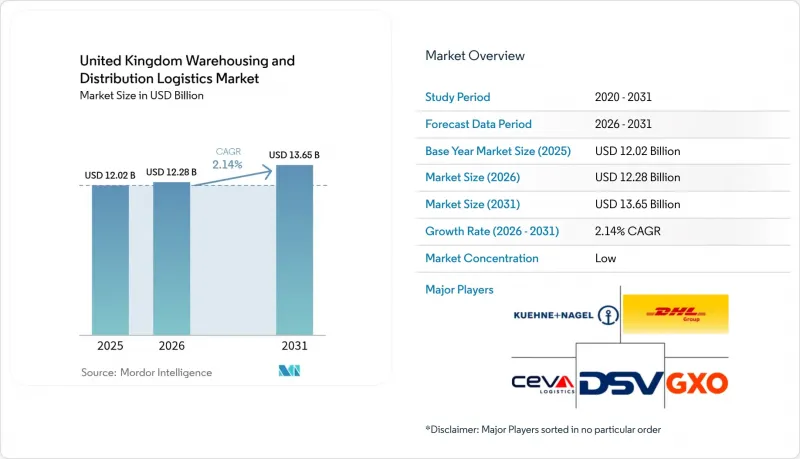
據 Mordor Intelligence 稱,2025 年英國倉儲物流市場價值 120.2 億美元,預計到 2031 年將從 2026 年的 122.8 億美元成長至 136.5 億美元,預測期(2026-2031 年)複合年成長率為 2.14%。
本報告按倉庫類型(普通倉儲、冷藏倉儲)、所有權類型(私人倉庫、公共倉庫)、終端用戶行業(電子商務和零售、食品飲料、醫藥保健、其他)以及地區(英格蘭、蘇格蘭、威爾斯、北愛爾蘭)進行細分。市場預測以美元計價。
英國倉儲、儲存和物流市場的趨勢和洞察。
電子商務履約空間激增
隨著線上零售滲透率的提高,網路規劃正轉向主要都會區方圓 50 英里範圍內的設施。營運商優先考慮建造多層樞紐和微型倉配中心,以縮短最後一公里配送時間並支援退貨。亞馬遜已運行數年的待開發區和棕地項目清晰地展現了投資規模,大型連鎖超市如今也開始預留空間用於揀選線上訂單,以及補充門店庫存。將於 2025 年生效的包裝延伸生產者責任制 (EPR) 法規,在提高營運效率的同時,也增加了資料合規要求。因此,黃金三角地區的產能限制推高了租金,使得英國倉儲和配送物流市場的預租率維持在兩位數水準。
食品和製藥業低溫運輸的發展
受食品雜貨宅配量和藥品緩衝庫存策略的推動,對溫控設施的需求成長速度超過了常溫儲存容量的成長速度。能夠處理從+4 度C冷藏到-20 度C冷凍溫度的雙用途配置,使營運商能夠靈活地跨行業管理並最佳化資產利用率。在連接倫敦、伯明罕和東岸港口的戰略走廊上,多租戶客製化建造(BTS)計畫林立,而全國的配送則需要更靠近消費者的衛星式交叉轉運中心。引入天然冷媒使設施能夠符合未來的永續性法規,如果電力消耗量運作現場太陽能供電,則可以降低營運成本。這些專業功能促使知名品牌簽訂長期合約,即使租金高達20-25%,也改善了英國倉儲和配送物流市場的整體獲利前景。
都市區土地短缺和租金上漲
主要物流子市場的空置率仍低於2%,租金正以每年8%的速度上漲,M25高速公路和M1走廊沿線稀缺土地的競爭日益激烈。開發商擴大採用多層設計,並將過時的大型零售商店改造利用都市區土地。然而,不斷上漲的土地購買成本推高了損益平衡租金租金,中小型零售商難以承擔這些成本,導致市場向大型開發商傾斜。地方政府試圖在就業機會和社區利益之間取得平衡,但為了減少對交通和景觀的影響,他們堅持嚴格的設計標準,導致英國倉儲和配送物流市場的建設週期延長。
細分市場分析
預計到2031年,冷藏倉儲市場將以5.22%的複合年成長率成長,顯著高於英國整體倉儲物流市場2.14%的成長率。儘管到2025年,普通倉儲市佔率仍維持在57.35%,但高規格冷藏單位的空置率幾乎為零,這反映了食品宅配服務和藥品品質保鮮相關法規的結構性變化。雖然冷藏設施的資本密集度高,建設成本比常溫設施高出40%至60%,但業者透過簽訂多年期(與指數掛鉤)合約來保障利潤,從而將這些成本轉嫁給客戶。
節能型冷卻器、基於物聯網的溫度監控和模組化貨架提高了空間利用率和合規性,使供應商能夠根據需要組合冷藏區和冷凍區。同時,普通倉庫正致力於自動化以維持利潤率,並透過實施穿梭車系統和高密度托盤來降低單位搬運成本。能夠切換冷藏和常溫環境的雙重認證設施進一步模糊了不同領域之間的界限,並最佳化了英國倉儲和配送物流市場的季節性尖峰時段利用率。
其他好處:
- Excel格式的市場預測(ME)表
- 3個月的分析師支持
目錄
第1章:引言
- 研究假設和市場定義
- 調查範圍
第2章:調查方法
第3章執行摘要
第4章 市場狀況
- 市場概覽
- 市場促進因素
- 電子商務物流履約空間正在快速成長。
- 食品和製藥業低溫運輸的發展
- 透過自動化和機器人技術提高效率
- 政府對自由港和工業園區的獎勵措施
- 英國脫歐後庫存回流
- 以環境、社會和治理為導向的棕地再開發
- 市場限制因素
- 都市區土地短缺和租金上漲
- 倉庫人手不足和工資上漲
- 電動車/自動化對電網容量的限制
- 建築許可證核准延誤(鄰避效應)
- 價值供應鏈分析
- 監理情勢
- 技術展望
- 價格分析 - 倉庫租金
- 波特五力模型
- 新冠疫情與地緣政治事件的影響
第5章 市場規模與成長預測
- 倉庫類型
- 普通倉庫/存儲
- 冷藏倉庫和存儲
- 依所有權類型
- 私人倉庫
- 公共倉庫
- 按最終用戶行業分類
- 電子商務與零售
- 食品/飲料
- 製藥和醫療保健
- 車
- 製造和工程產品
- 其他
- 按地區
- 英格蘭
- 蘇格蘭
- 威爾斯
- 北愛爾蘭
第6章 競爭情勢
- 市場集中度
- 策略趨勢
- 市佔率分析
- 公司簡介
- DHL Supply Chain
- Kuehne+Nagel
- GXO Logistics
- CEVA Logistics
- DSV
- Rhenus Logistics
- Yusen Logistics
- XPO Logistics
- Segro Logistics
- UPS Supply Chain Solutions
- FedEx Logistics
- Expeditors
- Constellation Cold Logistics
- Magnavale
- Fowler Welch
- DFDS Logistics
- Palletforce
- Fullers Logistics
- Apex Logistics
- CDL Logistics
第7章 市場機會與未來展望
According to Mordor Intelligence, the United Kingdom warehousing and distribution logistics market size was valued at USD 12.02 billion in 2025 and estimated to grow from USD 12.28 billion in 2026 to reach USD 13.65 billion by 2031, at a CAGR of 2.14% during the forecast period (2026-2031).
This report is Segmented by Warehouse Type (General Warehousing and Storage, Refrigerated Warehousing and Storage), Ownership (Private Warehouses, Public Warehouses), End-User Industry (E-Commerce & Retail, Food & Beverage, Pharma & Healthcare, and More), and Geography (England, Scotland, Wales, Northern Ireland). The Market Forecasts are Provided in Terms of Value (USD).
United Kingdom Warehousing And Distribution Logistics Market Trends and Insights
E-commerce Fulfillment Space Surge
Escalating online retail penetration has shifted network planning toward facilities located within 50 miles of the largest urban catchments. Operators prioritize multi-story hubs and micro-fulfillment annexes that compress last-mile delivery times while supporting returns processing. Amazon's multi-year program of green-field and brown-field developments exemplifies the scale of investment, and large grocery chains now dedicate dedicated space to online picking alongside store replenishment. Extended Producer Responsibility rules for packaging, effective in 2025, add data compliance layers but simultaneously drive operational streamlining. Resulting capacity constraints in the Golden Triangle underpin premium rent growth and sustain double-digit pre-leasing rates across the United Kingdom warehousing and distribution logistics market.
Cold-Chain Growth for Grocery and Pharma
Demand for temperature-controlled facilities now outpaces ambient capacity expansion as grocery home-delivery volumes converge with pharmaceutical buffer-stock strategies. Dual-use specifications capable of +4 °C chilled to -20 °C frozen enable operators to flex between sectors and smooth asset utilization. Strategic corridors linking London, Birmingham, and the eastern ports attract multi-tenant build-to-suit projects, while nationwide distribution requires satellite cross-dock nodes closer to consumers. Adoption of natural refrigerants aligns buildings with future sustainability regulation and generates operating-cost benefits once electricity-intensive systems are powered by on-site solar arrays. This specialist capability therefore commands a rental premium of 20-25% but continues to secure long-term commitments from brand-name occupiers, enhancing revenue visibility across the United Kingdom warehousing & distribution logistics market.
Urban Land Scarcity and Rent Inflation
Vacancy across prime logistics sub-markets remains below 2%, propelling rents upward by 8% annually as occupiers compete for scarce plots inside the M25 and along the M1 corridor. Developers increasingly pursue multi-story designs or repurpose obsolete big-box retail to unlock urban footprints. However, higher land outlays translate into elevated breakeven rent thresholds that smaller retailers struggle to absorb, driving polarization toward scale players. Local authorities attempt to balance employment opportunities against community concerns but retain stringent design codes to mitigate traffic and visual impact, slowing start-to-completion cycles within the United Kingdom warehousing and distribution logistics market.
Other drivers and restraints analyzed in the detailed report include:
- Automation and Robotics Efficiency Gains
- Government Freeport and Industrial-Park Incentives
- Warehouse-Labor Shortages and Wage Spikes
For complete list of drivers and restraints, kindly check the Table Of Contents.
Segment Analysis
Refrigerated Warehousing & Storage generated a 5.22% CAGR to 2031, comfortably ahead of the 2.14% overall growth registered by the United Kingdom warehousing & distribution logistics market size. Although General Warehousing & Storage retained 57.35% share in 2025, vacancy for high-spec cold units is virtually nonexistent, reflecting structural shifts in grocery home delivery and pharmaceutical integrity regulations. Capital intensity is higher refrigerated builds cost 40-60% more than ambient equivalents but operators pass through expenses via multi-year indexed contracts that insulate returns.
Energy-efficient chillers, IoT temperature monitoring, and modular racking improve space utilization and compliance, enabling providers to blend chilled and frozen zones on demand. Meanwhile, general warehousing leans on automation to defend margins, integrating shuttle systems and high-density pallets that reduce per-unit handling costs. Dual-certified facilities capable of toggling between cold and ambient regimes further blur segment boundaries, optimizing uptake across seasonal peaks within the United Kingdom warehousing & distribution logistics market.
Complete Report Scope:
- By Warehouse Type (Value)
- General Warehousing and Storage
- Refrigerated Warehousing and Storage
- By Ownership (Value)
- Private Warehouses
- Public Warehouses
- By End-User Industry (Value)
- E-commerce and Retail
- Food and Beverage
- Pharma and Healthcare
- Automotive
- Manufacturing and Engineering Goods
- Others
- By Region
- England
- Scotland
- Wales
- Northern Ireland
List of Companies Covered in this Report:
- DHL Supply Chain
- Kuehne + Nagel
- GXO Logistics
- CEVA Logistics
- DSV
- Rhenus Logistics
- Yusen Logistics
- XPO Logistics
- Segro Logistics
- UPS Supply Chain Solutions
- FedEx Logistics
- Expeditors
- Constellation Cold Logistics
- Magnavale
- Fowler Welch
- DFDS Logistics
- Palletforce
- Fullers Logistics
- Apex Logistics
- CDL Logistics
Additional Benefits:
- The market estimate (ME) sheet in Excel format
- 3 months of analyst support
TABLE OF CONTENTS
1 Introduction
- 1.1 Study Assumptions and Market Definition
- 1.2 Scope of the Study
2 Research Methodology
3 Executive Summary
4 Market Landscape
- 4.1 Market Overview
- 4.2 Market Drivers
- 4.2.1 E-commerce fulfilment space surge
- 4.2.2 Cold-chain growth for grocery and pharma
- 4.2.3 Automation and robotics efficiency gains
- 4.2.4 Government Freeport and industrial-park incentives
- 4.2.5 Re-/near-shoring of inventory post-Brexit
- 4.2.6 ESG-driven brown-field redevelopment
- 4.3 Market Restraints
- 4.3.1 Urban land scarcity and rent inflation
- 4.3.2 Warehouse-labour shortages and wage spikes
- 4.3.3 Grid-capacity limits for EV/automation
- 4.3.4 Planning-permission delays (NIMBY)
- 4.4 Value/Supply-Chain Analysis
- 4.5 Regulatory Landscape
- 4.6 Technological Outlook
- 4.7 Pricing Analysis-Warehouse Rents
- 4.8 Porter's Five Forces
- 4.8.1 Bargaining Power of Buyers
- 4.8.2 Bargaining Power of Suppliers
- 4.8.3 Threat of New Entrants
- 4.8.4 Threat of Substitutes
- 4.8.5 Competitive Rivalry
- 4.9 Impact of COVID-19 and Geo-Political Events
5 Market Size & Growth Forecasts (Value)
- 5.1 By Warehouse Type (Value)
- 5.1.1 General Warehousing and Storage
- 5.1.2 Refrigerated Warehousing and Storage
- 5.2 By Ownership (Value)
- 5.2.1 Private Warehouses
- 5.2.2 Public Warehouses
- 5.3 By End-User Industry (Value)
- 5.3.1 E-commerce and Retail
- 5.3.2 Food and Beverage
- 5.3.3 Pharma and Healthcare
- 5.3.4 Automotive
- 5.3.5 Manufacturing and Engineering Goods
- 5.3.6 Others
- 5.4 By Region
- 5.4.1 England
- 5.4.2 Scotland
- 5.4.3 Wales
- 5.4.4 Northern Ireland
6 Competitive Landscape
- 6.1 Market Concentration
- 6.2 Strategic Moves
- 6.3 Market Share Analysis
- 6.4 Company Profiles (includes Global Level Overview, Market Level Overview, Core Segments, Financials as available, Strategic Information, Market Rank/Share for key companies, Products and Services, and Recent Developments)
- 6.4.1 DHL Supply Chain
- 6.4.2 Kuehne + Nagel
- 6.4.3 GXO Logistics
- 6.4.4 CEVA Logistics
- 6.4.5 DSV
- 6.4.6 Rhenus Logistics
- 6.4.7 Yusen Logistics
- 6.4.8 XPO Logistics
- 6.4.9 Segro Logistics
- 6.4.10 UPS Supply Chain Solutions
- 6.4.11 FedEx Logistics
- 6.4.12 Expeditors
- 6.4.13 Constellation Cold Logistics
- 6.4.14 Magnavale
- 6.4.15 Fowler Welch
- 6.4.16 DFDS Logistics
- 6.4.17 Palletforce
- 6.4.18 Fullers Logistics
- 6.4.19 Apex Logistics
- 6.4.20 CDL Logistics
7 Market Opportunities and Future Outlook
- 7.1 White-space and Unmet-Need Assessment


