


 |
市場調查報告書
商品編碼
1939717
東協倉儲業與配送物流:市場佔有率分析、產業趨勢與統計、成長預測(2026-2031)ASEAN Warehousing And Distribution Logistics - Market Share Analysis, Industry Trends & Statistics, Growth Forecasts (2026 - 2031) |
||||||

※ 本網頁內容可能與最新版本有所差異。詳細情況請與我們聯繫。
預計到 2026 年,東協倉儲業和配送物流市場規模將達到 329.5 億美元,高於 2025 年的 313.1 億美元。
預計到 2031 年,該產業規模將達到 425.2 億美元,2026 年至 2031 年的複合年成長率為 5.23%。
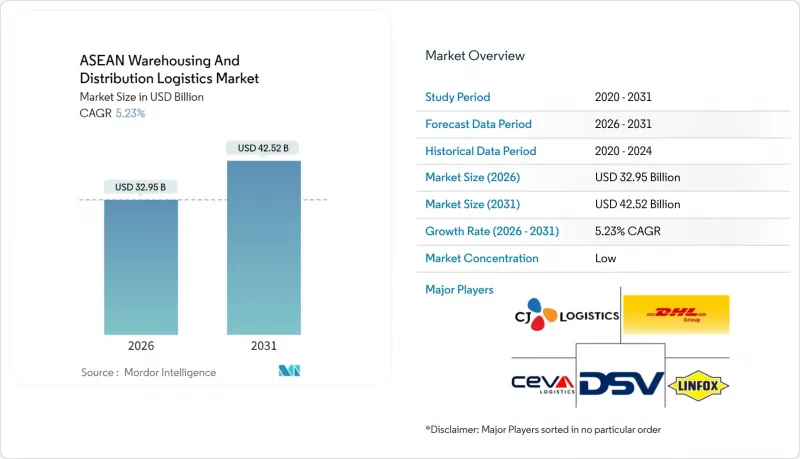
東協地區電子商務的快速成長、大規模基礎設施發展計畫以及不斷擴大的貿易協定,共同推動東協倉儲業物流市場成為全球最具吸引力的供應鏈機會之一。線上零售帶來的需求,加上泰國183億美元的東部經濟走廊計畫和越南到2025年360億美元的基礎建設目標,正推動倉庫向功能更強大的資產轉型。第三方物流(3PL)供應商之間的整合,例如GEODIS收購吉寶物流,持續重塑著服務能力。同時,氣候變遷預計將在2024年對全球供應鏈造成超過1,000億美元的損失,促使東協倉儲業物流市場加大對彈性網路設計和自動化倉庫的投資。
東協倉儲業及配送物流市場趨勢及洞察
電子商務需求激增推動了最後一公里配送。
東協倉儲業和配送物流市場正積極回應線上零售的蓬勃發展,推動東南亞數位經濟在2025年達到1,860億美元。越南的末端配送領域年增率高達39%,預計2024年包裹處理量將達30億件。暗店(dark store)的數量正在增加,營運商計劃到2026年在全部區域建造5000至5500個微型倉配中心,這迫使投資者轉向人口密集城區內緊湊且自動化程度更高的配送點。印尼和泰國的行動商務滲透率超過80%,顯示距離終端消費者3公里以內的地理位置在服務差異化方面發揮決定性作用。
政府對物流基礎建設的投資
大規模公共支出正在建造新的走廊、碼頭和乾線鐵路,刺激倉儲需求。泰國東部經濟走廊正在投資183億美元用於機場、港口和高鐵升級。越南的2025年計畫(總額達360億美元)為公路和深水港建設撥出了創紀錄的資金。同時,馬來西亞巴生港的擴建計畫(年吞吐量達2700萬標準箱)是港口吞吐能力提升如何刺激內陸倉儲擴張的典型例子。在內陸國家柬埔寨,新建的高速公路正在催生新的物流中心群。
海關和監管流程脫節
儘管試點計畫取得成功,東協海關運輸系統目前仍僅限於部分通道。印尼2025年進口法規新增了許可程序,延長了清關週期。越南2025年實施的更新版電子表格需要對平台進行整合調整。超過5000項已確定的非關稅措施增加了合規複雜性,延緩了倉儲網路合理化進程,並推高了營運資金需求。
細分市場分析
受疫苗分發、生鮮食品電商和溫控化學品需求的推動,東協倉儲業物流市場的冷藏設施預計將以5.24%的複合年成長率成長。在印尼,隨著水產品出口商升級設施以符合歐盟可追溯性標準,到2024年,冷藏倉庫面積預計將增加14%。營運商正在維修混合建築,在常溫倉庫內安裝模組化冷庫以保持柔軟性。採用節能冷媒、人工智慧壓縮機和可再生能源,已使營運成本降低了12%,儘管資本密集度較高,但仍能維持利潤率。
隨著零售商為縮短前置作業時間而轉向分散式網路,越南和菲律賓等區域性城市的低溫運輸網路正在不斷擴展。馬來西亞首個碳中和冷庫(由Equalbase營運)的能耗降低了50%,展現了環境、社會和治理(ESG)要求與公用事業成本節約之間的協同效應。跨國公司目前正將溫度保障與庫存融資解決方案結合,以開拓新的收入來源。東協地區的倉儲業和配送物流市場持續呈現這樣的趨勢:與通用倉庫相比,A級冷藏資產的開發預算分配比例明顯偏高。
其他福利:
- Excel格式的市場預測(ME)表
- 分析師支持(3個月)
目錄
第1章 引言
- 研究假設和市場定義
- 調查範圍
第2章調查方法
第3章執行摘要
第4章 市場情勢
- 市場概覽
- 市場促進因素
- 電子商務需求激增推動了最後一公里配送。
- 政府對物流基礎建設的投資
- 低溫運輸產能需求不斷成長
- 透過東協貿易協定(RCEP、CPTPP)加速跨境分銷
- 引進城市暗店和微型倉配
- 以環境、社會和治理(ESG)主導的「綠色倉庫」融資
- 市場限制
- 分散的海關和監管流程
- 主要城市地價上漲
- 自動化職位技術純熟勞工短缺
- 面臨氣候風險(洪水、颱風)
- 價值/供應鏈分析
- 監管環境
- 技術展望
- 倉庫租金洞察
- 自由貿易區和工業園區分析
- 波特五力模型
- 新進入者的威脅
- 供應商的議價能力
- 買方的議價能力
- 替代品的威脅
- 競爭對手之間的競爭
- 新冠疫情與地緣政治事件的影響
第5章 市場規模與成長預測
- 按倉庫類型
- 普通倉庫/存儲
- 冷藏倉庫/存儲
- 依所有權類型
- 私人倉庫
- 公共倉庫
- 按最終用戶行業分類
- 電子商務與零售
- 食品/飲料
- 製藥和醫療保健
- 車
- 製造和工程產品
- 其他
- 按地區
- 新加坡
- 泰國
- 馬來西亞
- 越南
- 印尼
- 菲律賓
- 其他東南亞國協
第6章 競爭情勢
- 市場集中度
- 策略趨勢
- 市佔率分析
- 公司簡介
- DHL Supply Chain
- CEVA Logistics
- CJ Century Logistics
- DSV
- Linfox
- Kuehne+Nagel
- Yusen Logistics(Part of NYK Line)
- Kerry Logistics
- CWT Ltd
- Tiong Nam Logistics
- YCH Group
- Singapore Post
- Geodis
- Ninja Van
- J&T Express
- Pos Malaysia Logistics
- Nippon Express
- WeFreight
- Omni Logistics
- AIT Worldwide Logistics
第7章 市場機會與未來展望
The ASEAN Warehousing And Distribution Logistics Market size in 2026 is estimated at USD 32.95 billion, growing from 2025 value of USD 31.31 billion with 2031 projections showing USD 42.52 billion, growing at 5.23% CAGR over 2026-2031.
The region's rapid e-commerce growth, large-scale infrastructure programs, and expanding trade pacts combine to make the ASEAN warehousing and distribution logistics market one of the most attractive supply-chain opportunities worldwide. Induced demand from online retail, together with Thailand's USD 18.3 billion Eastern Economic Corridor program and Vietnam's USD 36 billion 2025 infrastructure target, is re-ordering warehouse footprints toward higher specification assets. Consolidation among third-party logistics providers (3PLs), exemplified by GEODIS acquiring Keppel Logistics, continues to reshape service capabilities. Meanwhile, climate shocks costing global supply chains more than USD 100 billion in 2024 are prompting resilient network design and automated warehouse investments across the ASEAN warehousing and distribution logistics market.
ASEAN Warehousing And Distribution Logistics Market Trends and Insights
Surge in e-commerce demand boosting last-mile fulfilment
The ASEAN warehousing and distribution logistics market is responding to an online retail boom that propelled Southeast Asia's digital economy toward USD 186 billion in 2025. Vietnam's last-mile delivery segment recorded a 39% annual growth rate with 3 billion parcels handled in 2024. Dark-store footprints are multiplying; operators plan 5,000-5,500 micro-fulfilment sites region-wide by 2026, forcing investors to pivot toward compact, automation-ready nodes inside dense city districts. Indonesia and Thailand, where mobile commerce penetration exceeds 80% demonstrate how proximity facilities within 3 kilometers of end consumers now determine service differentiation.
Government investment in logistics infrastructure
Large public outlays are adding new corridors, terminals, and rail spines that catalyze warehouse demand. Thailand's Eastern Economic Corridor is absorbing USD 18.3 billion for airport, seaport, and high-speed rail upgrades. Vietnam's USD 36 billion 2025 plan allocates record sums for expressways and deep-sea ports, while Malaysia's Port Klang expansion to 27 million TEUs underscores how port capacity growth forces hinterland storage expansion. Landlocked Cambodia benefits from new expressways that open fresh catchments for distribution centers.
Fragmented customs and regulatory processes
Despite pilot successes, the ASEAN Customs Transit System still reaches only selected corridors. Indonesia's 2025 import rules added new licensing layers that lengthen clearance cycles. Vietnam's updated electronic forms introduced in 2025 require platform integration tweaks. Over 5,000 identified non-tariff measures raise compliance complexity, slowing warehouse network rationalization and inflating working capital needs.
Other drivers and restraints analyzed in the detailed report include:
- Growing demand for cold-chain capacity
- ASEAN trade pacts (RCEP, CPTPP) accelerating cross-border flows
- Escalating land prices in tier-1 hubs
For complete list of drivers and restraints, kindly check the Table Of Contents.
Segment Analysis
Refrigerated facilities in the ASEAN warehousing and distribution logistics market are forecast to grow at a 5.24% CAGR. Demand springs from vaccine distribution, fresh food e-commerce, and temperature-controlled chemicals. In Indonesia, cold-store footprints grew 14% in 2024 as seafood exporters upgraded to meet EU traceability protocols. Operators retrofit hybrid buildings, inserting modular chill rooms inside ambient sheds to retain flexibility. Energy-efficient refrigerants, AI-enabled compressors, and renewable power purchasing lower operating costs by 12%, preserving margins despite high capital intensity.
Second-tier cities across Vietnam and the Philippines join the cold-chain map as grocery retailers decentralize networks to shorten lead times. Malaysia's first carbon-neutral cold-store by Equalbase cut energy use 50%, showcasing how ESG mandates and utility savings intersect. Multinationals now bundle temperature assurance with inventory financing solutions, opening ancillary revenue lines. The ASEAN warehousing and distribution logistics market continues to allocate development budgets disproportionately toward Grade-A refrigerated assets to outpace generic stock.
The ASEAN Warehousing and Distribution Logistics Market Report is Segmented by Warehouse Type (General Warehousing and Storage, Refrigerated Warehousing and Storage), Ownership (Private Warehouses, Public Warehouses), End-User Industry (E-Commerce & Retail, Food & Beverage, Pharma & Healthcare, and More), and Geography (Singapore, Thailand, Malaysia, Indonesia, and More). The Market Forecasts are Provided in Terms of Value (USD).
List of Companies Covered in this Report:
- DHL Supply Chain
- CEVA Logistics
- CJ Century Logistics
- DSV
- Linfox
- Kuehne + Nagel
- Yusen Logistics (Part of NYK Line)
- Kerry Logistics
- CWT Ltd
- Tiong Nam Logistics
- YCH Group
- Singapore Post
- Geodis
- Ninja Van
- J&T Express
- Pos Malaysia Logistics
- Nippon Express
- WeFreight
- Omni Logistics
- AIT Worldwide Logistics
Additional Benefits:
- The market estimate (ME) sheet in Excel format
- 3 months of analyst support
TABLE OF CONTENTS
1 Introduction
- 1.1 Study Assumptions and Market Definition
- 1.2 Scope of the Study
2 Research Methodology
3 Executive Summary
4 Market Landscape
- 4.1 Market Overview
- 4.2 Market Drivers
- 4.2.1 Surge in e-commerce demand boosting last-mile fulfilment
- 4.2.2 Government investment in logistics infrastructure
- 4.2.3 Growing demand for cold-chain capacity
- 4.2.4 ASEAN trade pacts (RCEP, CPTPP) accelerating cross-border flows
- 4.2.5 Urban dark-store and micro-fulfilment adoption
- 4.2.6 ESG-driven "green warehouse" financing
- 4.3 Market Restraints
- 4.3.1 Fragmented customs and regulatory processes
- 4.3.2 Escalating land prices in tier-1 hubs
- 4.3.3 Skilled-labour shortage for automated operations
- 4.3.4 Climate-risk exposure (floods, typhoons)
- 4.4 Value / Supply-Chain Analysis
- 4.5 Regulatory Landscape
- 4.6 Technological Outlook
- 4.7 Insights into Warehouse Rents
- 4.8 Free Zones and Industrial Parks Analysis
- 4.9 Porter's Five Forces
- 4.9.1 Threat of New Entrants
- 4.9.2 Bargaining Power of Suppliers
- 4.9.3 Bargaining Power of Buyers
- 4.9.4 Threat of Substitutes
- 4.9.5 Competitive Rivalry
- 4.10 Impact of COVID-19 and Geo-Political Events
5 Market Size and Growth Forecasts (Value)
- 5.1 By Warehouse Type (Value)
- 5.1.1 General Warehousing and Storage
- 5.1.2 Refrigerated Warehousing and Storage
- 5.2 By Ownership (Value)
- 5.2.1 Private Warehouses
- 5.2.2 Public Warehouses
- 5.3 By End-User Industry (Value)
- 5.3.1 E-commerce and Retail
- 5.3.2 Food and Beverage
- 5.3.3 Pharma and Healthcare
- 5.3.4 Automotive
- 5.3.5 Manufacturing and Engineering Goods
- 5.3.6 Others
- 5.4 By Geography
- 5.4.1 Singapore
- 5.4.2 Thailand
- 5.4.3 Malaysia
- 5.4.4 Vietnam
- 5.4.5 Indonesia
- 5.4.6 Philippines
- 5.4.7 Rest of ASEAN
6 Competitive Landscape
- 6.1 Market Concentration
- 6.2 Strategic Moves
- 6.3 Market Share Analysis
- 6.4 Company Profiles (includes Global level Overview, Market level overview, Core Segments, Financials as available, Strategic Information, Market Rank/Share for key companies, Products and Services, and Recent Developments)
- 6.4.1 DHL Supply Chain
- 6.4.2 CEVA Logistics
- 6.4.3 CJ Century Logistics
- 6.4.4 DSV
- 6.4.5 Linfox
- 6.4.6 Kuehne + Nagel
- 6.4.7 Yusen Logistics (Part of NYK Line)
- 6.4.8 Kerry Logistics
- 6.4.9 CWT Ltd
- 6.4.10 Tiong Nam Logistics
- 6.4.11 YCH Group
- 6.4.12 Singapore Post
- 6.4.13 Geodis
- 6.4.14 Ninja Van
- 6.4.15 J&T Express
- 6.4.16 Pos Malaysia Logistics
- 6.4.17 Nippon Express
- 6.4.18 WeFreight
- 6.4.19 Omni Logistics
- 6.4.20 AIT Worldwide Logistics
7 Market Opportunities and Future Outlook
- 7.1 White-space and Unmet-Need Assessment


