


 |
市場調查報告書
商品編碼
2115883
尼龍單絲:市場佔有率分析、產業趨勢與統計、成長預測(2026-2031)Nylon Monofilament - Market Share Analysis, Industry Trends & Statistics, Growth Forecasts (2026 - 2031) |
||||||

※ 本網頁內容可能與最新版本有所差異。詳細情況請與我們聯繫。
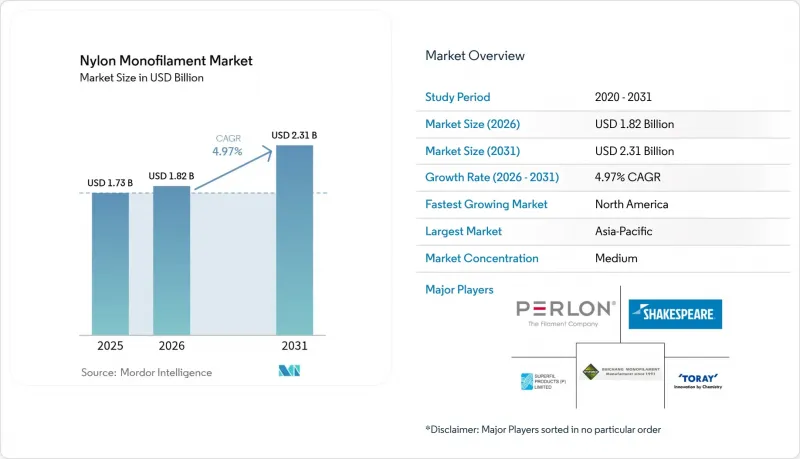
據 Mordor Intelligence 稱,2025 年尼龍單絲市值為 17.3 億美元,預計到 2031 年將達到 23.1 億美元,而 2026 年為 18.2 億美元,預測期(2026-2031 年)複合年成長率為 4.97%。
本報告按共聚物類型(尼龍6、尼龍66及其他)、應用領域(漁網、醫療、汽車布料、消費品、編織繩及其他)和地區(亞太、北美、歐洲、南美、中東和非洲)進行細分。市場預測以美元計價。
全球尼龍單絲市場趨勢及洞察
漁網和水產養殖業需求不斷成長
全球水產養殖業的擴張持續推動尼龍單絲市場成長,因為養殖戶更加重視漁具的耐用性和捕撈效率。尼龍佔漁具所用聚合物的76%,單絲網的性能優於多絲纖維,因為即使長時間暴露於海水中,單絲網也能保持拉伸強度。儘管挪威正在試行使用可生物分解的刺網,但實地數據顯示捕撈效率下降了40%,成本卻增加,這表明短期內替代計畫難以推進。此外,實地研究表明,浸泡在用於水產養殖場消毒的10%過氧乙酸溶液中的漁網僅損失3-6%的強度,進一步證明了尼龍卓越的耐用性。儘管歐洲的環境標準日益嚴格,但由於東南亞市場監管的滯後以及耐用漁具帶來的即時經濟效益,尼龍單絲網的銷售量仍保持成長。新興的、一年內可分解率達92%的可生物分解尼龍產品,由於其機械性能較差,目前仍處於商業性小眾領域。
輕量化汽車零件的激增
汽車電氣化正在加速從金屬轉向工程塑膠的轉變,尼龍單絲產品(例如軸承保持架、電纜束線帶和功能性裝飾件)在減輕重量方面發揮著重要作用。 Domo 的 TECHNYL 4EARTH 可在不影響彈性模量或耐熱性的前提下,將生產過程中的二氧化碳排放量減少高達 80%。塞拉尼斯公司已將玻璃纖維增強 PA66 樹脂推向市場,可直接取代金屬,並提供電動車平台所需的疲勞性能。全球原始設備製造商 (OEM) 更青睞尼龍,因為其供應鏈成熟、定價機制清晰,與新型生物基材料相比,轉換風險更低。高昂的認證成本、嚴格的尺寸公差和監管認證要求仍然是市場准入的重要壁壘,這也使得尼龍單絲市場保持著 1.2 個百分點的穩定複合年成長率 (CAGR)。
政府法規和微塑膠法規
歐盟的目標是將塑膠顆粒排放量減少74%,並要求年處理量超過5噸的加工商必須獲得損失預防協議認證。這項措施可能會增加每公斤銷往歐盟的尼龍單絲的合規成本。在塞內加爾,尼龍單絲刺網於1998年被禁用,儘管執法力度不足,但這顯示法律的不確定性會如何擾亂漁具供應商的投資計畫。在美國,總務署(GSA)正在聯邦政府合約中強制要求使用一次性無塑膠包裝,這可能成為未來採購的潛在障礙。在食用魚貝類中檢測到尼龍纖維,整體強化了對消費品進行更嚴格監管的科學依據。產業因應措施包括加速可堆肥或酵素生物分解聚醯胺的研發,但成本和性能差異阻礙了大規模替代的立即實施,導致尼龍單絲市場的複合年成長率淨下降1.1個百分點。
細分市場分析
由於成熟的全球己內醯胺生產基地,加工成本維持在較低水平,即使到了2025年,尼龍6仍維持著尼龍單絲市場64.62%的佔有率。例如,GSFC在印度的年產7萬至8萬噸的生產設施體現了規模經濟效益,其中約1.7萬噸供應給該公司自身的單絲生產業務。從漁網到家用刷毛等主流應用支撐著尼龍6的基本需求,預計到2031年,尼龍6尼龍單絲市場規模將達到13.9億美元。相較之下,尼龍66的成長速度更快,年複合成長率達5.28%,這主要得益於其優異的耐熱性、耐老化性和尺寸穩定性,這些特性正是電動車零件和工業皮帶所需要的。英威達在上海投資 17.5 億美元進行擴建(將 PA66 產能翻倍至 40 萬噸),顯示該公司對高溫環境用產品市場充滿信心。
長鏈和特種尼龍(尼龍610、612、MXD6)在對吸水性、阻油阻隔性或光學透明度要求極高的領域享有高價。尼龍MXD6作為一種耐化學腐蝕的單絲,在飽和蒸氣暴露後仍能維持60%的初始強度,因此備受青睞。生物基尼龍的生產正在迅速擴張。 LG化學和CJ第一製糖已設定目標,到2028年生產140萬噸可再生尼龍,這意味著全球產能將以每年29%的速度成長。帝斯曼的全生物基產品Stanyl® B-MB可減少50%的碳足跡,並在不影響機械性能的前提下滿足OEM廠商的氣候目標。因此,特種應用領域的成長動能正在擴大尼龍單絲市場整體的高階價值池,同時略微蠶食尼龍6的市場佔有率。
區域分析
憑藉其一體化的石化產業群聚和具成本效益的勞動力,亞太地區預計到2025年將佔據尼龍單絲市場32.88%的佔有率。中國生產商透過其已建立的區域網路向泰國、印尼和印度出口工業紗線。印度的藍圖目標是到2025年實現國內人造纖維消費量3,500億美元,出口量3,000億美元,這將擴大工業纖維單絲的市場。日本早期的海外投資(東麗公司在20世紀60年代於泰國和印尼建廠)持續產生技術漣漪效應。區域挑戰包括微塑膠法規和與苯相關的原料價格上漲,但已形成的規模經濟使亞太地區能夠在基礎級尼龍單絲生產方面保持主導地位。
預計北美地區將呈現最高成長率,2026年至2031年複合年成長率將達到5.55%,主要受電動車強制生產和先進醫療設備供應鏈的推動。英威達(INVISTA)正在運作其位於安大略省的六亞甲基二胺生產設施,並計劃新建一座己二腈生產裝置,以確保PA66前體的供應。BASF)於2024年中期將北美PA66化合物的價格上調了0.15美元/磅,顯示市場需求強勁。 Braschem收購其美國長絲業務將促進3D列印技術的普及,並擴大本地尼龍產能,以滿足航太、牙科和消費品原型製作的需求。 FDA對生物基聚醯胺的核准流程進一步鼓勵原始設備製造商(OEM)指定使用永續等級的產品,從而提振高階市場的需求。
歐洲面臨著許多挑戰,例如更嚴格的監管和不斷上漲的能源成本,但在邁向循環經濟的道路上,它仍處於主導地位。歐盟《微塑膠協議》強制要求對顆粒處理進行認證,這將增加合規成本,但也會為早期採用者帶來競爭優勢。BASF收購DOMO旗下Alsachimie的股份,以及位於法國的全球六亞甲基二胺工廠的運作,凸顯了歐洲對尼龍化學品產業的長期承諾。南美洲、中東和非洲的絕對產量落後於歐洲,但它們在水產養殖和基礎設施領域為新進業者提供了巨大潛力。然而,外匯風險、對進口的依賴以及聚合設備的匱乏限制了這些地區的短期成長。
其他好處:
- Excel格式的市場預測(ME)表
- 3個月的分析師支持
目錄
第1章:引言
- 研究假設和市場定義
- 調查範圍
第2章:調查方法
第3章執行摘要
第4章 市場狀況
- 市場概覽
- 市場促進因素
- 漁網和水產養殖業需求不斷成長
- 輕量化汽車零件的激增
- 醫療和外科縫合線市場的擴張
- 消費品(牙刷刷毛)的成長
- 3D列印和積層製造技術的普及
- 市場限制因素
- 政府對尼龍釣魚線的相關規定
- 原料(己內醯胺)價格波動
- 微塑膠排放法規
- 價值鏈分析
- 波特五力模型
第5章 市場規模與成長預測
- 依共聚物類型
- 尼龍 6
- 尼龍66
- 其他(尼龍 610、612、MXD6、生物基材料)
- 透過使用
- 魚網
- 醫療用品(縫合線、導管)
- 汽車布料
- 消費品(牙刷、球拍線)
- 編織繩
- 其他(食品包裝、運動服等)
- 按地區
- 亞太地區
- 中國
- 印度
- 日本
- 韓國
- 其他亞太國家
- 北美洲
- 美國
- 加拿大
- 墨西哥
- 歐洲
- 德國
- 英國
- 法國
- 義大利
- 其他歐洲國家
- 南美洲
- 巴西
- 阿根廷
- 其他南美國家
- 中東和非洲
- 沙烏地阿拉伯
- 南非
- 其他中東和非洲國家
- 亞太地區
第6章 競爭情勢
- 市場集中度
- 策略趨勢
- 市佔率(%)** / 排名分析
- 公司簡介
- ABC Polymer Industries, LLC
- AstenJohnson
- Atkins & Pearce
- BASF SE
- Celanese Corporation
- ICF Mercantile LLC
- INVISTA
- Nanjing Forever Textile Co.,LTD
- Perlon GmbH
- Radici Partecipazioni SpA
- Ruichang Monofilament
- Shakespeare Company LLC
- Shinkey Monofilament Enterprise Co., LTD
- Superfil
- The Filament Company
- Toray Industries Inc.
第7章 市場機會與未來展望
According to Mordor Intelligence, the nylon monofilament market size was valued at USD 1.73 billion in 2025 and estimated to grow from USD 1.82 billion in 2026 to reach USD 2.31 billion by 2031, at a CAGR of 4.97% during the forecast period (2026-2031).
This report is Segmented by Co-Polymer Type (Nylon 6, Nylon 66, Other Types), Application (Fishing Nets, Medical, Automotive Fabrics, Consumer Goods, Braided Ropes, Other Applications), and Geography (Asia-Pacific, North America, Europe, South America, Middle East and Africa). The Market Forecasts are Provided in Terms of Value (USD).
Global Nylon Monofilament Market Trends and Insights
Growing Demand in Fishing Nets & Aquaculture
Expansion of global aquaculture continues to underpin nylon monofilament market growth as operators prioritize gear durability and catch efficiency. Nylon constitutes 76% of fishing-equipment polymers, and monofilament nets outperform multifilament alternatives by maintaining tensile strength under prolonged saltwater exposure. Although Norway is trialing biodegradable gillnets, field data show a 40% drop in catch efficiency and elevated costs, limiting near-term displacement. Field studies further reveal only 3-6% strength loss when nets are immersed in 10% peracetic-acid baths used in fish-farm disinfection, reinforcing nylon's durability advantage. Regulatory latency in Southeast Asian markets and the immediate economic gains from longer-lasting gear sustain volume growth even as Europe tightens environmental standards. Emerging biodegradable grades that achieve 92% marine degradation within a year remain commercially niche due to inferior mechanical properties.
Surge in Automotive Lightweight Components
Vehicle electrification accelerates the substitution of metal with engineering plastics, and nylon monofilament products such as bearing cages, cable ties, and functional trim contribute measurable weight savings. TECHNYL 4EARTH, manufactured by Domo, delivers up to 80% CO2 reduction during production without sacrificing modulus or heat resistance. Celanese has introduced glass-fiber reinforced PA66 resins that enable direct metal replacement, offering the fatigue performance EV platforms require. Global OEMs favor nylon because its supply chain is entrenched and pricing mechanisms are well understood, reducing the switching risk relative to newer bio-based options. High qualification costs, tight dimensional tolerances, and regulatory certification needs keep entry barriers high and underpin a stable 1.2-point contribution to the nylon monofilament market CAGR.
Government Restrictions & Microplastic Regulations
The EU aims to cut plastic-pellet emissions by 74%, obliging processors handling over 5 tonnes annually to certify loss-prevention protocols-measures that could add compliance costs to every EU-bound kilogram of nylon monofilament. Senegal's 1998 ban on nylon monofilament gillnets, although weakly enforced, illustrates how legal uncertainty can disrupt investment plans for fish-gear suppliers. In the United States, the General Services Administration now mandates single-use-plastic-free packaging on federal contracts, signaling future procurement barriers. Laboratory assessments of edible seafood detected nylon fibers, strengthening the scientific case for tighter controls across consumer goods. Industry responses include accelerated R&D in compostable or enzyme-cleavable polyamides, yet cost and performance gaps hinder immediate large-scale substitution, resulting in a net 1.1-point drag on the nylon monofilament market CAGR.
Other drivers and restraints analyzed in the detailed report include:
- Expansion in Healthcare & Surgical Sutures
- Growth in Consumer Goods & 3D Printing Adoption
- Volatility in Raw-Material (Caprolactam) Prices
For complete list of drivers and restraints, kindly check the Table Of Contents.
Segment Analysis
Nylon 6 retained 64.62% nylon monofilament market share in 2025 thanks to a mature global caprolactam production base that keeps conversion costs low. Plants such as GSFC's 70,000-80,000 tonne facility in India illustrate economies of scale, and roughly 17,000 tonnes feed captive monofilament operations. The nylon monofilament market size for Nylon 6 is projected to reach USD 1.39 billion by 2031 as mainstream applications from fishing nets to consumer bristles uphold baseline demand. In contrast, Nylon 66 is on a steeper 5.28% CAGR trajectory, driven by superior heat-aging and dimensional stability required for EV components and industrial belts. INVISTA's USD 1.75 billion expansion in Shanghai, doubling PA66 output to 400,000 tonnes, signals confidence in high-temperature markets.
Longer-chain and specialty grades-Nylon 610, 612, MXD6-command premium prices where water absorption, fuel-barrier, or optical-clarity performance matters. Nylon-MXD6 retains 60% of initial strength after saturated-steam exposure, making it attractive for chemical-resistant monofilaments. Bio-based output is scaling quickly: LG Chem and CJ CheilJedang target 1.4 million tonnes of renewable nylon by 2028, a 29% annual addition to global capacity. DSM's fully bio-based Stanyl(R) B-MB delivers a 50% smaller carbon footprint, satisfying OEM climate targets without mechanical compromise. Specialty momentum therefore erodes Nylon 6's share at the margin but expands overall premium value pools in the nylon monofilament market.
Complete Report Scope:
- By Co-polymer Type
- Nylon 6
- Nylon 66
- Other Types (Nylon 610, 612, MXD6, Bio-based)
- By Application
- Fishing Nets
- Medical (sutures, catheters)
- Automotive Fabrics
- Consumer Goods (toothbrush, racket strings)
- Braided Ropes
- Other Applications (Food Packaging, Sports Wear, etc.)
- Geography
- Asia-Pacific
- China
- India
- Japan
- South Korea
- Rest of Asia-Pacific
- North America
- United States
- Canada
- Mexico
- Europe
- Germany
- United Kingdom
- France
- Italy
- Rest of Europe
- South America
- Brazil
- Argentina
- Rest of South America
- Middle East and Africa
- Saudi Arabia
- South Africa
- Rest of Middle East and Africa
- Asia-Pacific
Geography Analysis
Asia-Pacific accounted for 32.88% of nylon monofilament market share in 2025, leveraging integrated petrochemical complexes and cost-effective labor. Chinese producers export industrial yarn to Thailand, Indonesia, and India under a well-established intra-Asian network. India's roadmap targeting USD 350 billion in domestic man-made fiber consumption and USD 300 billion in exports by 2025 provides a growing outlet for monofilament in technical textiles. Japan's early overseas investment-Toray built facilities in Thailand and Indonesia in the 1960s-continues to yield technological spillovers. Regional challenges include microplastic regulations and benzene-linked feedstock spikes, yet entrenched scale advantages preserve Asia-Pacific leadership in base-grade volumes.
North America is projected to post the fastest 5.55% CAGR over 2026-2031, propelled by EV manufacturing mandates and an advanced medical-device supply chain. INVISTA is recommissioning hexamethylene-diamine assets in Ontario and planning a new adiponitrile unit to secure PA66 precursors. BASF lifted North-American PA66 compound prices by USD 0.15 per lb in mid-2024, indicating healthy demand elasticity. Braskem's U.S. filament acquisition supports 3D-printing uptake, adding localized nylon capacity for aerospace, dental, and consumer prototypes. FDA pathways for bio-based polyamides further entice OEMs to specify sustainable grades, reinforcing premium-segment pull.
Europe is navigating tighter regulation and energy-cost headwinds yet leads in circular-economy initiatives. The EU microplastic accord forces pellet-handling certification, raising compliance costs but providing a moat for early adopters. BASF's acquisition of DOMO's Alsachimie stake and the startup of a world-scale hexamethylene-diamine plant in France affirm long-term commitment to European nylon chemistry. South America and the Middle East & Africa trail in absolute volume yet present green-field opportunities in aquaculture and infrastructure; however, currency risk, import dependency, and limited polymerization assets temper near-term growth.
- ABC Polymer Industries, LLC
- AstenJohnson
- Atkins & Pearce
- BASF SE
- Celanese Corporation
- ICF Mercantile LLC
- INVISTA
- Nanjing Forever Textile Co.,LTD
- Perlon GmbH
- Radici Partecipazioni SpA
- Ruichang Monofilament
- Shakespeare Company LLC
- Shinkey Monofilament Enterprise Co., LTD
- Superfil
- The Filament Company
- Toray Industries Inc.
Additional Benefits:
- The market estimate (ME) sheet in Excel format
- 3 months of analyst support
TABLE OF CONTENTS
1 Introduction
- 1.1 Study Assumptions & Market Definition
- 1.2 Scope of the Study
2 Research Methodology
3 Executive Summary
4 Market Landscape
- 4.1 Market Overview
- 4.2 Market Drivers
- 4.2.1 Growing demand in fishing nets & aquaculture
- 4.2.2 Surge in automotive lightweight components
- 4.2.3 Expansion in healthcare & surgical sutures
- 4.2.4 Growth in consumer goods (toothbrush bristles)
- 4.2.5 3-D printing & additive manufacturing adoption
- 4.3 Market Restraints
- 4.3.1 Government restrictions on nylon fishing lines
- 4.3.2 Volatility in raw-material (caprolactam) prices
- 4.3.3 Micro-plastic shedding regulations
- 4.4 Value Chain Analysis
- 4.5 Porter's Five Forces
- 4.5.1 Bargaining Power of Suppliers
- 4.5.2 Bargaining Power of Buyers
- 4.5.3 Threat of New Entrants
- 4.5.4 Threat of Substitutes
- 4.5.5 Degree of Competition
5 Market Size & Growth Forecasts (Value)
- 5.1 By Co-polymer Type
- 5.1.1 Nylon 6
- 5.1.2 Nylon 66
- 5.1.3 Other Types (Nylon 610, 612, MXD6, Bio-based)
- 5.2 By Application
- 5.2.1 Fishing Nets
- 5.2.2 Medical (sutures, catheters)
- 5.2.3 Automotive Fabrics
- 5.2.4 Consumer Goods (toothbrush, racket strings)
- 5.2.5 Braided Ropes
- 5.2.6 Other Applications (Food Packaging, Sports Wear, etc.)
- 5.3 Geography
- 5.3.1 Asia-Pacific
- 5.3.1.1 China
- 5.3.1.2 India
- 5.3.1.3 Japan
- 5.3.1.4 South Korea
- 5.3.1.5 Rest of Asia-Pacific
- 5.3.2 North America
- 5.3.2.1 United States
- 5.3.2.2 Canada
- 5.3.2.3 Mexico
- 5.3.3 Europe
- 5.3.3.1 Germany
- 5.3.3.2 United Kingdom
- 5.3.3.3 France
- 5.3.3.4 Italy
- 5.3.3.5 Rest of Europe
- 5.3.4 South America
- 5.3.4.1 Brazil
- 5.3.4.2 Argentina
- 5.3.4.3 Rest of South America
- 5.3.5 Middle East and Africa
- 5.3.5.1 Saudi Arabia
- 5.3.5.2 South Africa
- 5.3.5.3 Rest of Middle East and Africa
- 5.3.1 Asia-Pacific
6 Competitive Landscape
- 6.1 Market Concentration
- 6.2 Strategic Moves
- 6.3 Market Share (%)**/Ranking Analysis
- 6.4 Company Profiles (includes Global level Overview, Market level overview, Core Segments, Financials as available, Strategic Information, Market Rank/Share, Products & Services, Recent Developments)
- 6.4.1 ABC Polymer Industries, LLC
- 6.4.2 AstenJohnson
- 6.4.3 Atkins & Pearce
- 6.4.4 BASF SE
- 6.4.5 Celanese Corporation
- 6.4.6 ICF Mercantile LLC
- 6.4.7 INVISTA
- 6.4.8 Nanjing Forever Textile Co.,LTD
- 6.4.9 Perlon GmbH
- 6.4.10 Radici Partecipazioni SpA
- 6.4.11 Ruichang Monofilament
- 6.4.12 Shakespeare Company LLC
- 6.4.13 Shinkey Monofilament Enterprise Co., LTD
- 6.4.14 Superfil
- 6.4.15 The Filament Company
- 6.4.16 Toray Industries Inc.
7 Market Opportunities & Future Outlook
- 7.1 White-space & Unmet-need Assessment


