


 |
市場調查報告書
商品編碼
2019048
尼龍單絲市場機會、成長要素、產業趨勢分析及2026-2035年預測Nylon Monofilament Market Opportunity, Growth Drivers, Industry Trend Analysis, and Forecast 2026 - 2035 |
||||||

預計到 2025 年,全球尼龍單絲市場價值將達到 15 億美元,並預計以 5.3% 的複合年成長率成長,到 2035 年達到 26 億美元。
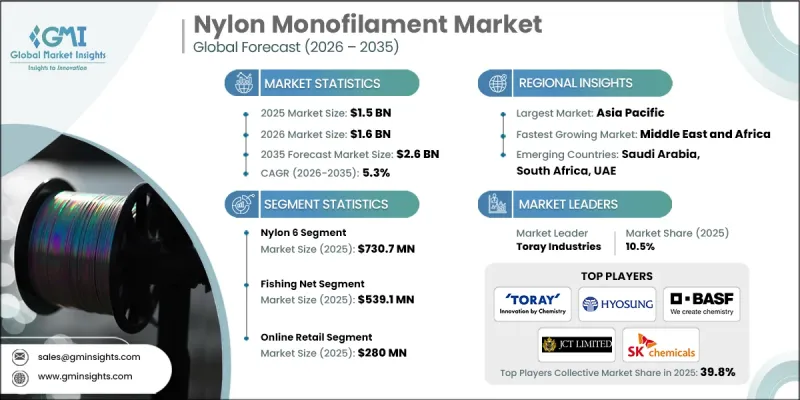
尼龍單絲市場專注於尼龍聚合物製成的單纖維合成纖維的生產和應用。這些單絲具有直徑均勻、質地光滑、機械性能優異的特點,包括高拉伸強度、柔軟性和耐磨性。先進的擠出技術確保了產品在各種終端應用中品質穩定、使用壽命長。尼龍單絲用途廣泛,透過調整加工條件,可以獲得特定的材料性能,例如剛度、彈性和耐化學性,使其適用於各種工業和商業需求。各行業對耐用高性能單絲材料的持續需求推動市場的穩定成長。此外,技術進步也對尼龍單絲市場的發展起到了重要作用,製造商採用改進的擠出系統、精確的直徑控制和先進的冷卻技術,在保持卓越產品性能的同時,最佳化生產效率,最大限度地減少材料浪費。
| 市場範圍 | |
|---|---|
| 開始年份 | 2025 |
| 預測期 | 2026-2035 |
| 上市時的市場規模 | 15億美元 |
| 預測金額 | 26億美元 |
| 複合年成長率 | 5.3% |
預計到2025年,尼龍6市場規模將達到7.307億美元。其廣泛應用得益於其優異的機械性能、易加工性和成本效益,使其成為眾多應用領域的首選材料。尼龍6具有柔軟性和光滑的表面,使其在需要穩定性能的應用上效用。同時,尼龍66因其更高的耐熱性、結構強度和尺寸穩定性,在對耐熱性、結構強度和尺寸穩定性要求更高的環境中日益廣泛的應用。其在不同溫度和應力條件下仍能保持優異性能,使其適用於要求更嚴苛的技術和工業應用,從而進一步提升了其市場佔有率。
預計到2025年,漁網市場規模將達到5.391億美元。該領域的需求預計將保持強勁,主要受對兼具耐用性、強度和長期性能的材料的需求所驅動。尼龍單絲廣泛應用於需要柔軟性、承載力和穩定結構完整性的應用領域。其光滑的表面和均勻的厚度也使其適用於對精度和可靠性要求較高的應用。此外,工業、家庭和維護相關應用領域的持續需求也有助於整體市場的穩定,因為這些領域需要能夠耐磨損並長期維持性能的材料。
北美尼龍單絲市場預計將從2025年的3.762億美元成長到2035年的6.1億美元,主要得益於工業、技術和維護應用領域對可靠材料性能的穩定需求。這一成長更源自於持續的更新換代和持續的營運需求,而非產能的快速擴張。在美國,由於完善的品質標準、規範的監管以及加工和回收技術的不斷改進,市場需求保持穩定。在該地區運營的企業優先考慮性能的一致性和材料的可靠性,以滿足特定產業的需求,這進一步推動了尼龍單絲市場的長期發展。
目錄
第1章:調查方法和範圍
第2章執行摘要
第3章業界考察
- 生態系分析
- 供應商情況
- 利潤率
- 每個階段增加的價值
- 影響價值鏈的因素
- 中斷
- 影響產業的因素
- 促進因素
- 漁業和工業應用領域的需求不斷成長
- 紡織和機械應用領域對性能的一致性要求
- 提供各種等級的尼龍材料,以滿足不同條件的需求。
- 陷阱與挑戰
- 尼龍性能對生產過程中溫度波動的敏感性
- 原物料價格波動
- 機會
- 可回收尼龍單絲材料的開發
- 針對特定行業和技術應用進行客製化
- 促進因素
- 成長潛力分析
- 監理情勢
- 北美洲
- 歐洲
- 亞太地區
- 拉丁美洲
- 中東和非洲
- 波特五力分析
- PESTEL 分析
- 科技與創新趨勢
- 當前技術趨勢
- 新興技術
- 價格趨勢
- 按地區
- 按類型
- 未來市場趨勢
- 專利趨勢
- 貿易統計(HS編碼)
- 主要進口國
- 主要出口國
- 永續性和環境方面
- 永續計劃
- 減少廢棄物策略
- 生產中的能源效率
- 環保意識的舉措
- 考慮碳足跡
第4章 競爭情勢
- 介紹
- 企業市佔率分析
- 按地區
- 北美洲
- 歐洲
- 亞太地區
- 拉丁美洲
- 中東和非洲
- 按地區
- 企業矩陣分析
- 主要市場公司的競爭分析
- 競爭定位矩陣
- 主要進展
- 併購
- 夥伴關係與合作
- 新產品發布
- 業務拓展計劃
第5章 市場估計與預測:依類型分類,2022-2035年
- 尼龍 6
- 尼龍66
- 其他(尼龍 610、尼龍 612、尼龍 11、尼龍 12 等)
第6章 市場估計與預測:依應用領域分類,2022-2035年
- 魚網
- 醫療設備
- 縫紉線
- 刷子
- 體育用品
- 其他物品(繩索、農作物支撐網等)
第7章 市場估價與預測:依通路分類,2022-2035年
- 線上零售
- 實體零售
第8章 市場估計與預測:依地區分類,2022-2035年
- 北美洲
- 美國
- 加拿大
- 歐洲
- 德國
- 英國
- 法國
- 西班牙
- 義大利
- 其他歐洲地區
- 亞太地區
- 中國
- 印度
- 日本
- 澳洲
- 韓國
- 亞太其他地區
- 拉丁美洲
- 巴西
- 墨西哥
- 阿根廷
- 其他拉丁美洲地區
- 中東和非洲
- 沙烏地阿拉伯
- 南非
- 阿拉伯聯合大公國
- 其他中東和非洲地區
第9章:公司簡介
- Toray Industries
- Hyosung
- JCT Limited
- Shakespeare Company, LLC.
- Suzhou Hanyun New Material Technology Co
- BASF SE
- Solvay
- Nurel
- Contifibre
- AdvanSix
- NYCOA
The Global Nylon Monofilament Market was valued at USD 1.5 billion in 2025 and is estimated to grow at a CAGR of 5.3% to reach USD 2.6 billion by 2035.
The nylon monofilament market focuses on the manufacturing and application of single-strand synthetic fibers derived from nylon-based polymers. These filaments are characterized by uniform diameter, smooth texture, and strong mechanical properties, including high tensile strength, flexibility, and resistance to abrasion. Advanced extrusion techniques are used to ensure consistent quality and long service life across various end uses. The versatility of nylon monofilaments allows them to meet a wide range of industrial and commercial requirements, as processing conditions can be adjusted to achieve specific material properties such as rigidity, elasticity, or chemical resistance. Continuous demand from industries that rely on durable and high-performance filament materials is supporting steady market growth. In addition, technological advancements are playing a crucial role in shaping the nylon monofilament market, with manufacturers adopting improved extrusion systems, precise diameter control, and enhanced cooling technologies to optimize production efficiency and minimize material waste while maintaining superior product performance.
| Market Scope | |
|---|---|
| Start Year | 2025 |
| Forecast Year | 2026-2035 |
| Start Value | $1.5 Billion |
| Forecast Value | $2.6 Billion |
| CAGR | 5.3% |
The nylon 6 segment reached USD 730.7 million in 2025. Its widespread adoption is driven by a balanced combination of mechanical performance, ease of processing, and cost-effectiveness, making it a preferred material across multiple applications. Nylon 6 offers flexibility and a smooth surface finish, which enhances its usability in applications requiring consistent performance. On the other hand, Nylon 66 is increasingly utilized in environments that demand higher thermal resistance, structural strength, and dimensional stability. Its ability to maintain performance under varying temperature and stress conditions makes it suitable for more demanding technical and industrial applications, thereby supporting its growing presence within the market.
The fishing net segment captured USD 539.1 million in 2025. Demand across this segment remains steady due to the need for materials that offer durability, strength, and long-term performance. Nylon monofilaments are widely used in applications that require a combination of flexibility and load-bearing capacity, as well as consistent structural integrity. Their smooth surface and uniform thickness also make them suitable for applications that require precision and reliability. In addition, continued demand from industrial, household, and maintenance-related uses is contributing to overall market stability, as these sectors rely on materials that can withstand wear and maintain performance over extended periods.
North America Nylon Monofilament Market is expected to grow from USD 376.2 million in 2025 to USD 610 million by 2035, supported by consistent demand across industrial, technical, and maintenance applications, where reliable material performance is essential. Growth is driven more by ongoing replacement cycles and sustained operational needs rather than rapid capacity expansion. In the United States, demand remains stable due to established quality standards, regulated specifications, and continuous improvements in processing and recycling technologies. Companies operating in the region are prioritizing performance consistency and material reliability to meet industry-specific requirements, further supporting the long-term development of the nylon monofilament market.
Key companies operating in the Global Nylon Monofilament Market include Toray Industries, Hyosung, JCT Limited, SK Chemicals, Suzhou Hanyun New Material Technology Co, BASF SE, Solvay, Nurel, Contifibre, AdvanSix, and NYCOA. Companies in the Nylon Monofilament Market are focusing on enhancing product quality and expanding their application scope to strengthen their competitive position. Investments in advanced manufacturing technologies are enabling improved precision, consistency, and production efficiency. Many players are prioritizing research and development to create materials with enhanced durability, flexibility, and resistance properties. Strategic collaborations and partnerships help companies access new markets and diversify their product offerings. Additionally, firms are emphasizing sustainable practices, including recycling and waste reduction, to align with evolving environmental regulations. Expanding distribution networks and maintaining strict quality standards are also key strategies supporting long-term growth and stronger market presence.
Table of Contents
Chapter 1 Methodology & Scope
- 1.1 Market scope and definition
- 1.2 Research design
- 1.2.1 Research approach
- 1.2.2 Data collection methods
- 1.3 Data mining sources
- 1.3.1 Global
- 1.3.2 Regional/Country
- 1.4 Base estimates and calculations
- 1.4.1 Base year calculation
- 1.4.2 Key trends for market estimation
- 1.5 Primary research and validation
- 1.5.1 Primary sources
- 1.6 Forecast model
- 1.7 Research assumptions and limitations
Chapter 2 Executive Summary
- 2.1 Industry 360° synopsis
- 2.2 Key market trends
- 2.2.1 Type
- 2.2.2 Application
- 2.2.3 Distribution Channel
- 2.2.4 Regional
- 2.3 TAM Analysis, 2026-2035
- 2.4 CXO perspectives: Strategic imperatives
- 2.5 Future outlook and strategic recommendations
Chapter 3 Industry Insights
- 3.1 Industry ecosystem analysis
- 3.1.1 Supplier landscape
- 3.1.2 Profit margin
- 3.1.3 Value addition at each stage
- 3.1.4 Factor affecting the value chain
- 3.1.5 Disruptions
- 3.2 Industry impact forces
- 3.2.1 Growth drivers
- 3.2.1.1 Rising demand from fishing and industrial applications
- 3.2.1.2 Consistent performance needs across textile and mechanical uses
- 3.2.1.3 Availability of nylon grades for diverse conditions
- 3.2.2 Pitfalls/challenge
- 3.2.2.1 Sensitivity of nylon properties to temperature variations during
- 3.2.2.2 Fluctuating raw material prices
- 3.2.3 Opportunities
- 3.2.3.1 Development of recyclable nylon monofilament materials
- 3.2.3.2 Customization for niche industrial and technical applications
- 3.2.1 Growth drivers
- 3.3 Growth potential analysis
- 3.4 Regulatory landscape
- 3.4.1 North America
- 3.4.2 Europe
- 3.4.3 Asia Pacific
- 3.4.4 Latin America
- 3.4.5 Middle East & Africa
- 3.5 Porter's analysis
- 3.6 PESTEL analysis
- 3.7 Technology and innovation landscape
- 3.7.1 Current technological trends
- 3.7.2 Emerging technologies
- 3.8 Price trends
- 3.8.1 By region
- 3.8.2 By type
- 3.9 Future market trends
- 3.10 Patent landscape
- 3.11 Trade statistics (HS code)
- 3.11.1 Major importing countries
- 3.11.2 Major exporting countries
- 3.12 Sustainability and environmental aspects
- 3.12.1 Sustainable practices
- 3.12.2 Waste reduction strategies
- 3.12.3 Energy efficiency in production
- 3.12.4 Eco-friendly initiatives
- 3.13 Carbon footprint consideration
Chapter 4 Competitive Landscape, 2025
- 4.1 Introduction
- 4.2 Company market share analysis
- 4.2.1 By region
- 4.2.1.1 North America
- 4.2.1.2 Europe
- 4.2.1.3 Asia Pacific
- 4.2.1.4 LATAM
- 4.2.1.5 MEA
- 4.2.1 By region
- 4.3 Company matrix analysis
- 4.4 Competitive analysis of major market players
- 4.5 Competitive positioning matrix
- 4.6 Key developments
- 4.6.1 Mergers & acquisitions
- 4.6.2 Partnerships & collaborations
- 4.6.3 New product launches
- 4.6.4 Expansion plans
Chapter 5 Market Estimates and Forecast, By Type, 2022-2035 (USD Million) (Kilo Tons)
- 5.1 Key trends
- 5.2 Nylon 6
- 5.3 Nylon 66
- 5.4 Others (Nylon 6 10, Nylon 6 12, Nylon 11, and Nylon 12, etc.)
Chapter 6 Market Estimates and Forecast, By Application, 2022-2035 (USD Million) (Kilo Tons)
- 6.1 Key trends
- 6.2 Fishing nets
- 6.3 Medical devices
- 6.4 Sewing threads
- 6.5 Brushes
- 6.6 Sports equipment
- 6.7 Other (Ropes, Crop support nets, etc.)
Chapter 7 Market Estimates and Forecast, By Distribution Channel, 2022-2035 (USD Million) (Kilo Tons)
- 7.1 Key trends
- 7.2 Online retail
- 7.3 Offline retail
Chapter 8 Market Estimates and Forecast, By Region, 2022-2035 (USD Million) (Kilo Tons)
- 8.1 Key trends
- 8.2 North America
- 8.2.1 U.S.
- 8.2.2 Canada
- 8.3 Europe
- 8.3.1 Germany
- 8.3.2 UK
- 8.3.3 France
- 8.3.4 Spain
- 8.3.5 Italy
- 8.3.6 Rest of Europe
- 8.4 Asia Pacific
- 8.4.1 China
- 8.4.2 India
- 8.4.3 Japan
- 8.4.4 Australia
- 8.4.5 South Korea
- 8.4.6 Rest of Asia Pacific
- 8.5 Latin America
- 8.5.1 Brazil
- 8.5.2 Mexico
- 8.5.3 Argentina
- 8.5.4 Rest of Latin America
- 8.6 Middle East and Africa
- 8.6.1 Saudi Arabia
- 8.6.2 South Africa
- 8.6.3 UAE
- 8.6.4 Rest of Middle East and Africa
Chapter 9 Company Profiles
- 9.1 Toray Industries
- 9.2 Hyosung
- 9.3 JCT Limited
- 9.4 Shakespeare Company, LLC.
- 9.5 Suzhou Hanyun New Material Technology Co
- 9.6 BASF SE
- 9.7 Solvay
- 9.8 Nurel
- 9.9 Contifibre
- 9.10 AdvanSix
- 9.11 NYCOA


