


 |
市場調查報告書
商品編碼
2115848
印度木地板:市場佔有率分析、產業趨勢與統計、成長預測(2026-2031)India Wood Flooring - Market Share Analysis, Industry Trends & Statistics, Growth Forecasts (2026 - 2031) |
||||||

※ 本網頁內容可能與最新版本有所差異。詳細情況請與我們聯繫。
據 Mordor Intelligence 稱,2025 年印度木地板市場價值 19.7 億美元,預計到 2031 年將從 2026 年的 21.1 億美元成長至 29.4 億美元,預測期(2026-2031 年)複合年成長率為 6.91%。
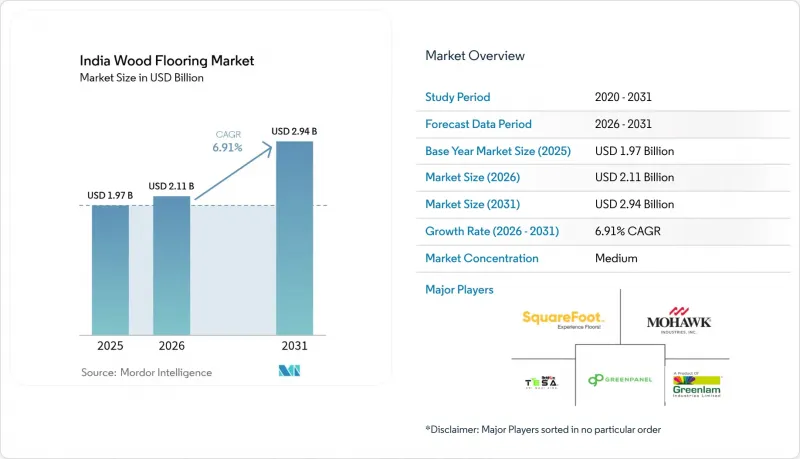
本報告依產品類型(實木、複合木、工程木)、最終用戶(住宅、商業)和分銷管道(家居建材中心、專賣店、線上及其他)對市場進行分類。此外,報告也按地區(印度北部、印度南部、印度西部、印度東部、印度中部和印度東北部)分析市場。市場預測以美元計價。
印度木地板市場的趨勢與洞察
由於快速都市化引發的住宅繁榮
預計未來十年印度將新增1億套住宅,但年供應量僅60萬套,供不應求,支撐了地板市場的強勁需求。到2040年,住宅占地面積預計將超過500億平方米,這意味著到2040年,大多數現有建築仍處於規劃階段。豪華住宅市場經歷了顯著成長,其市佔率從2018年的16%成長到2024年的43%。這種擴張推動了對具有卓越隔音和永續性的高階地板解決方案的需求。富裕客戶的開發人員擴大在其樣品屋中採用標準化工程地板系列,這項策略正在加速潛在買家對產品的認知和接受度。此外,銀行正在擴大年輕一代的房屋抵押貸款管道,改善融資選擇,並使強勁的需求更容易轉化為實際交易。這一趨勢在大都會圈和新興衛星城均有體現,反映了住宅市場消費者偏好和購買力的廣泛轉變。
可支配所得和優質化增加
2024年,高階房地產市場年增,反映出富裕人群購買力的持續提升。這一趨勢由富裕人群的經濟實力和投資意願所驅動,凸顯了高階房地產市場需求的韌性。維修週期的縮短加速了重複購買的需求,尤其是在都市區公寓領域。複合木地板無需大規模拆除,只需一個週末即可更換,因其經濟高效,成為這種環境下的首選。零售商透過提供延長保固和安裝後維修計畫等服務,進一步提升了高階地板材料相對於低價替代品的提案。
加工木材的高額消費稅和進口關稅
木地板需繳納18%的商品及服務稅(GST),而某些類型的複合木地板和膠合板則需繳納28%的GST,這削弱了它們與課稅較低的瓷磚和SPC地磚相比的價格競爭力。儘管港口擴建並實現了24小時清關,但海關延誤仍佔用營運資金,並阻礙了即時庫存管理系統的效率。中型貿易業者在進項稅稅額扣抵面臨嚴重的效率低下問題,迫使他們尋找成本更低的國內替代方案。然而,這些替代品往往達不到耐用性標準,可能對產品品質和顧客滿意度產生負面影響。政策制定者正在積極考慮簡化稅收制度的措施,但未來稅收優惠政策的不確定性造成了市場環境的不確定性。這種不確定性使得經銷商不願制定長期定價策略,進而影響市場穩定與規劃。
細分市場分析
工程木地板憑藉其多層結構,能夠有效應對印度濕度波動,進而推動市場成長,預計年複合成長率將達到10.95%。工程木地板在印度木地板市場的佔有率不斷擴大,在住宅和商業裝修領域均佔據高階地位。複合木地板仍將保持其銷量領先地位,預計到2025年將佔據43.78%的市場佔有率,但其耐磨層和仿木紋壓花飾面的增強性能使其發展勢頭更加強勁。在印度木地板市場,實木地板的使用範圍日益局限於高階小眾項目,這些項目的最終用戶重視天然紋理,並願意投入大量資金進行精心維護。製造商正致力於研發核心材料,包括防水材料、隔音膜和再生材料,以滿足綠建築的要求。
此工程地板產品系列最大隔音效果僅 11 分貝,符合多戶住宅衝擊隔離的新規。防水產品具備 24 小時防漏功能,無需金屬連接條即可在廚房和起居空間連續鋪設。數位印刷技術以四倍解析度顯著還原木節細節,與實木地板完美融合。這項技術進步,加上該系列產品對卓越美觀、高性能和永續性的專注,鞏固了其作為印度木地板市場主要成長驅動力的地位。該系列產品能夠響應不斷變化的消費者偏好和行業需求,進一步彰顯了其在塑造市場動態的領導地位。
其他好處:
- Excel格式的市場預測(ME)表
- 3個月的分析師支持
目錄
第1章:引言
- 研究假設和市場定義
- 調查範圍
第2章:調查方法
第3章執行摘要
第4章 市場狀況
- 市場概覽
- 市場促進因素
- 快速都市化推動的住宅繁榮
- 可支配所得和優質化增加
- 商業地產擴張和辦公大樓維修
- 成本績效實惠的層壓/工程材料方案正引起人們的注意。
- 家具公司QCO正在推動市場對認證木地板的需求。
- 電子商務使人們能夠接觸到二、三線消費者。
- 市場限制因素
- 加工木材的高額消費稅和進口關稅
- 來自陶瓷和乙烯基替代品的激烈競爭。
- 安裝基礎設施分散和技能差距
- 沿海地區濕度相關的耐久性問題
- 價值供應鏈分析
- 監理情勢
- 技術展望
- 波特五力模型
第5章 市場規模與成長預測
- 依產品類型
- 實木
- 層壓木材
- 工程木材
- 最終用戶
- 住宅
- 商業
- 透過分銷管道
- 家居建材商店
- 專賣店
- 線上
- 其他
- 按地區
- 印度北部
- 南印度
- 西印度群島
- 東印度
- 印度中部
- 印度東北部
第6章 競爭情勢
- 市場集中度
- 策略趨勢
- 市佔率分析
- 公司簡介
- Greenlam Industries Ltd.
- Pergo(Mohawk Industries)
- Greenpanel Industries Ltd.
- SquareFoot Flooring Pvt. Ltd.
- Action Tesa
- Century Plyboards(Trevino Floors)
- HIL Ltd.(Parador India)
- Armstrong Flooring(India)
- Egger Group
- Tarkett India
- Welspun Flooring Ltd.
- Ikea India(Flooring Category)
- Merino Laminates(Wood Flooring)
- Florance Laminates & Veneers
- Responsive Industries Ltd.
- AGL(Asian Granito)Wooden Floor line
- Mikasa Floors
- Notion Luxury Flooring
- House of Wooden Flooring
- VOX India
第7章 市場機會與未來展望
According to Mordor Intelligence, the India wood flooring market size was valued at USD 1.97 billion in 2025 and estimated to grow from USD 2.11 billion in 2026 to reach USD 2.94 billion by 2031, at a CAGR of 6.91% during the forecast period (2026-2031).
This report Segments Into by Product Type (Solid Wood, Laminated Wood, Engineered Wood), by End-User Type (Residential, Commercial), and by Distribution Channel (Home Centers, Specialty Stores, Online, Other Distribution Channels). By Geography (North India, South India, West India, East India, Central India, Northeast India). The Market Forecasts are Provided in Terms of Value (USD).
India Wood Flooring Market Trends and Insights
Rapid Urbanization-Led Housing Boom
India is adding 100 million new homes this decade, yet the annual supply of 600,000 units leaves a sizeable gap that keeps flooring demand robust. Residential floor space is set to surpass 50 billion m2 by 2040, meaning most buildings that will exist in 2040 are still on the drawing board. The luxury housing market experienced significant growth, with its share increasing from 16% in 2018 to 43% in 2024. This expansion has driven demand for high-specification flooring solutions that offer enhanced acoustic properties and sustainability benefits. Developers targeting high-net-worth individuals are increasingly incorporating standardized engineered flooring ranges in their show apartments, a strategy that accelerates product awareness and adoption among potential buyers. Additionally, improved financing options, as banks extend mortgage accessibility to younger demographics, have facilitated the conversion of aspirational demand into finalized sales. This trend is evident across both metropolitan areas and emerging satellite towns, reflecting a broader shift in consumer preferences and purchasing power within the housing market.
Rising Disposable Incomes & Premiumization
In 2024, the high-value property market experienced a year-on-year growth, reflecting a sustained increase in purchasing power among affluent consumer segments. This trend highlights the resilience of demand within the premium real estate market, driven by the financial capacity and investment preferences of high-net-worth individuals. Shorter refurbishment cycles are driving repeat demand at a faster pace, particularly in urban apartment settings. Laminated planks, which can be replaced over a weekend without requiring extensive demolition, offer a cost-effective and time-efficient solution, making them a preferred choice for such environments. Retailers bundle extended warranties and post-installation care plans, reinforcing the value proposition of premium surfaces over low-end substitutes.
High GST & Import Duties on Processed Wood
Wood flooring attracts 18% GST, while certain laminated and plywood categories incur 28%, eroding affordability compared with ceramic or SPC tiles taxed at lower slabs. Despite the expansion of 24-hour clearance ports, delays in customs clearance continue to immobilize working capital and disrupt the efficiency of just-in-time inventory systems. Medium-sized traders face significant inefficiencies in reclaiming Input Tax Credit, which drives them to source lower-cost domestic alternatives. However, these substitutes often fail to meet durability standards, potentially impacting product quality and customer satisfaction. Policymakers are actively assessing measures for tax rationalization; however, the lack of clarity regarding future tax relief creates an environment of uncertainty. This uncertainty discourages distributors from committing to long-term pricing strategies, thereby affecting market stability and planning.
Other drivers and restraints analyzed in the detailed report include:
- Commercial Real-Estate Expansion & Office Retrofits
- Cost-Effective Laminated & Engineered Options
- Intense Competition From Ceramic & Vinyl Alternatives
For complete list of drivers and restraints, kindly check the Table Of Contents.
Segment Analysis
Engineered boards anchor growth after recording an 10.95% CAGR outlook, thanks to multilayer constructions that stabilize against India's humidity swings. They account for a rising share of the India wood flooring market size and command premium positioning in both housing and commercial retrofits. Laminated panels, still the volume leader at 43.78% share in 2025, gain fresh life through enhanced wear layers and registered emboss finishes that mirror sawn timber grain. The India wood flooring market share of solid wood narrows to niche luxury projects where end-customers prize natural patina and are willing to fund rigorous maintenance. Manufacturers channel R&D into waterproof treatments, acoustic membranes, and recycled-content cores that align with green-building mandates.
Engineered lines now feature transmission loss up to 11 dB, fulfilling new multi-dwelling rules for impact isolation. Waterproof iterations ensure 24-hour spill protection, permitting continuous installation across kitchens and living spaces without metal junction profiles. Digital printing technology significantly enhances knot details with a 4X resolution, creating a seamless integration with solid planks. This technological advancement, coupled with the segment's focus on delivering superior aesthetics, high performance, and sustainability, strengthens its position as a key driver of growth in India's wood flooring market. The segment's ability to align with evolving consumer preferences and industry demands further underscores its leadership in shaping market dynamics.
Complete Report Scope:
- By Product Type
- Solid Wood
- Laminated Wood
- Engineered Wood
- By End-User Type
- Residential
- Commercial
- By Distribution Channel
- Home Centers
- Specialty Stores
- Online
- Other Distribution Channels
- By Geography
- North India
- South India
- West India
- East India
- Central India
- Northeast India
List of Companies Covered in this Report:
- Greenlam Industries Ltd.
- Pergo (Mohawk Industries)
- Greenpanel Industries Ltd.
- SquareFoot Flooring Pvt. Ltd.
- Action Tesa
- Century Plyboards (Trevino Floors)
- HIL Ltd. (Parador India)
- Armstrong Flooring (India)
- Egger Group
- Tarkett India
- Welspun Flooring Ltd.
- Ikea India (Flooring Category)
- Merino Laminates (Wood Flooring)
- Florance Laminates & Veneers
- Responsive Industries Ltd.
- AGL (Asian Granito) Wooden Floor line
- Mikasa Floors
- Notion Luxury Flooring
- House of Wooden Flooring
- VOX India
Additional Benefits:
- The market estimate (ME) sheet in Excel format
- 3 months of analyst support
TABLE OF CONTENTS
1 Introduction
- 1.1 Study Assumptions & Market Definition
- 1.2 Scope of the Study
2 Research Methodology
3 Executive Summary
4 Market Landscape
- 4.1 Market Overview
- 4.2 Market Drivers
- 4.2.1 Rapid urbanisation-led housing boom
- 4.2.2 Rising disposable incomes & premiumisation
- 4.2.3 Commercial real-estate expansion & office retrofits
- 4.2.4 Cost-effective laminated/engineered options gaining traction
- 4.2.5 Furniture QCOs steering demand toward certified wood flooring
- 4.2.6 E-commerce unlocking Tier-2/3 consumer access
- 4.3 Market Restraints
- 4.3.1 High GST & import duties on processed wood
- 4.3.2 Intense competition from ceramic/vinyl alternatives
- 4.3.3 Fragmented installer base & skills gap
- 4.3.4 Humidity-related durability concerns in coastal belts
- 4.4 Value / Supply-Chain Analysis
- 4.5 Regulatory Landscape
- 4.6 Technological Outlook
- 4.7 Porter's Five Forces
- 4.7.1 Threat of New Entrants
- 4.7.2 Bargaining Power of Suppliers
- 4.7.3 Bargaining Power of Buyers
- 4.7.4 Threat of Substitutes
- 4.7.5 Competitive Rivalry
5 Market Size & Growth Forecasts
- 5.1 By Product Type
- 5.1.1 Solid Wood
- 5.1.2 Laminated Wood
- 5.1.3 Engineered Wood
- 5.2 By End-User Type
- 5.2.1 Residential
- 5.2.2 Commercial
- 5.3 By Distribution Channel
- 5.3.1 Home Centers
- 5.3.2 Specialty Stores
- 5.3.3 Online
- 5.3.4 Other Distribution Channels
- 5.4 By Geography
- 5.4.1 North India
- 5.4.2 South India
- 5.4.3 West India
- 5.4.4 East India
- 5.4.5 Central India
- 5.4.6 Northeast India
6 Competitive Landscape
- 6.1 Market Concentration
- 6.2 Strategic Moves
- 6.3 Market Share Analysis
- 6.4 Company Profiles (includes Global level Overview, Market level overview, Core Segments, Financials as available, Strategic Information, Market Rank/Share for key companies, Products & Services, and Recent Developments)
- 6.4.1 Greenlam Industries Ltd.
- 6.4.2 Pergo (Mohawk Industries)
- 6.4.3 Greenpanel Industries Ltd.
- 6.4.4 SquareFoot Flooring Pvt. Ltd.
- 6.4.5 Action Tesa
- 6.4.6 Century Plyboards (Trevino Floors)
- 6.4.7 HIL Ltd. (Parador India)
- 6.4.8 Armstrong Flooring (India)
- 6.4.9 Egger Group
- 6.4.10 Tarkett India
- 6.4.11 Welspun Flooring Ltd.
- 6.4.12 Ikea India (Flooring Category)
- 6.4.13 Merino Laminates (Wood Flooring)
- 6.4.14 Florance Laminates & Veneers
- 6.4.15 Responsive Industries Ltd.
- 6.4.16 AGL (Asian Granito) Wooden Floor line
- 6.4.17 Mikasa Floors
- 6.4.18 Notion Luxury Flooring
- 6.4.19 House of Wooden Flooring
- 6.4.20 VOX India
7 Market Opportunities & Future Outlook
- 7.1 Sustainable & certified (FSC/PEFC) wood flooring niches
- 7.2 Engineered wood with integrated acoustic/thermal layers for green buildings

 北美木地板市場規模、佔有率和趨勢分析報告:按產品類型、木材類型、應用、最終用途和細分市場預測(2026-2033 年)
 木地板市場-2026-2032年全球市場預測
 木地板:市場佔有率分析、產業趨勢與統計、成長預測(2026-2031)
 2026年全球木地板市場報告
 木地板市場規模、佔有率及成長分析(按產品、應用、分銷及地區分類)-2026-2033年產業預測
 全球地板市場規模(按木材類型、應用、最終用戶、區域範圍、預測)中國地板材料:市場佔有率分析、產業趨勢與統計、成長預測(2025-2030)美國木地板市場規模、佔有率、趨勢分析報告:按產品、木材類型、應用、最終用途、細分市場預測,2025-2030 年