


 |
市場調查報告書
商品編碼
2066521
木地板:市場佔有率分析、產業趨勢與統計、成長預測(2026-2031)Wood Flooring - Market Share Analysis, Industry Trends & Statistics, Growth Forecasts (2026 - 2031) |
||||||

※ 本網頁內容可能與最新版本有所差異。詳細情況請與我們聯繫。
根據 Mordor Intelligence 預測,木地板市場規模預計將從 2025 年的 113.2 億美元成長到 2026 年的 116.6 億美元,到 2031 年達到 144.1 億美元,2026 年至 2031 年的複合年預計成長率為 4.3%。
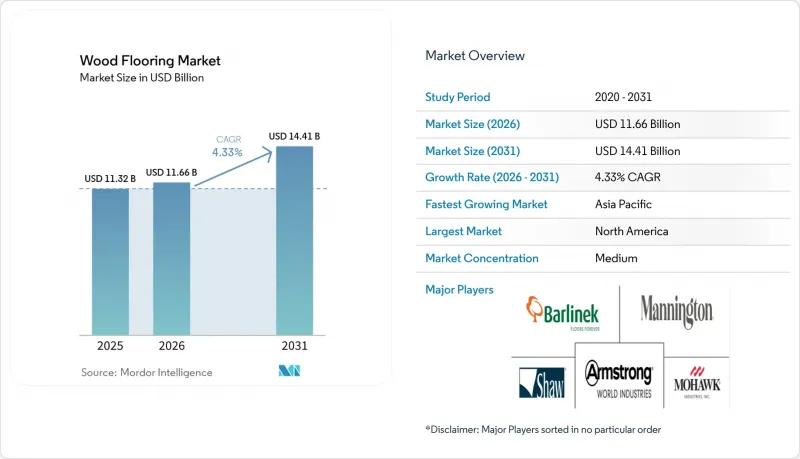
本報告按產品類型(複合地板、實木地板、再生/熱處理材料、其他)、安裝方式(釘裝、膠粘、浮動、其他)、表面處理(預塗漆、未塗漆)、配銷通路(B2C、B2B)、最終用戶(住宅和商業)以及地區(北美、南美、亞太地區、歐洲、中東和非洲)進行細分。市場預測以美元計價。
全球木地板市場趨勢及洞察
經森林管理委員會 (FSC) 認證的工程木板數量激增
FSC認證已成為公共設施和多用戶住宅項目工程木地板供應鏈中的安全隔離網閘,提交的文件必須包含生產歷史證明(監管鏈)。美國國家木地板協會(NWFA)的「Verified」計畫對空氣品質、材料成分和勞工實踐進行審核,與競標規範中的FSC認證相結合,可簡化公共和私人計畫的合規性審核流程。美國環保署(EPA)的《有毒物質控制法》(TSCA)第六版將硬木膠合板單板芯材中的甲醛含量限制在0.05 ppm以內,因此符合排放標準至關重要。製造商透過使用工廠控制的黏合劑和符合「符合TSCA標準的工程地板」標識的芯材來滿足這項要求。歐洲買家經常要求「FloorScore」認證,該認證評估35種揮發性有機化合物(VOC),並證明符合LEED v4.1和WELL等認證標準。 2025年,工廠預製工程木地板的市佔率有所擴大。這是因為預製系統有助於縮短工期,同時避免在居住建築物內進行現場裝修所產生的排放。傳統上,使用人工林楊木作為芯材單板的亞洲出口商享有較低的進口成本,但2025年對等關稅的實施削弱了北美主要製造商所指出的傳統成本優勢。
全球都市區豪華公寓的蓬勃發展
在班加羅爾、雅加達和墨西哥城等都市區的豪華高層公寓中,開發商透過在居住空間中使用實木和複合木地板來打造差異化,以期獲得更高的租賃和銷售業績。 2024年11月,日本組裝木地板(HS 441871-79)的出口量較上月成長超過30%,較上年同期成長約25%。根據《日本木材報告》和市場資訊來源匯總的貿易數據,截至2025年初,中國和越南共同供應了HS 441875出口的大部分,以滿足都市區公寓維修的需求。東南亞的開發商傾向於選擇複合木地板而非實木地板,以降低潮濕氣候下變形的風險,而浮動安裝於混凝土樓板上則有助於水分管理。該地區的設計理念強調自然紋理和淺色調,寬幅複合橡木和山核桃木地板備受青睞。木地板市場持續受益於高層建築中以規格主導的項目,這些項目對公共區域和單一單元的高階裝修要求較高。儘管2024年中國住宅量依然低迷,但印度和東南亞豪華公寓建設的活性化在一定程度上抵消了區域需求疲軟的影響。
原料和建築成本上漲
生產成本取決於硬木的供應量和鋸木廠的加工能力,這會影響實木地板和複合木地板的利潤率。 2022年至2024年間,美國硬木產量下降了29%。這一萎縮與勞動力減少10%(相當於約4萬個工作機會)以及出口額的相應下降有關。製造商正在尋求垂直整合以確保供應,包括收購鋸木廠,以緩解立木價格波動並穩定木地板產品的原料供應。在建築工地,鋪設寬幅實木地板通常需要使用黏合劑釘法以確保穩定性,這導致施工時間比浮動式卡扣複合地板系統更長。由於美國國家木地板協會(NWFA)對基層平整度的容忍度較高,老舊建築對基層準備的要求更為嚴格,有時需要在施工前採取額外的步驟。這些情況給木地板市場的部分項目帶來了短期成本壓力,尤其是在人事費用較高的地區。
細分市場分析
預計到2025年,複合地板將佔據53.37%的市場。這主要得益於其對地上和地下樓層的高度適應性,從而擴大了多戶住宅和都市區維修項目中對木地板的潛在需求。再生木材和熱處理木材預計到2031年將以4.26%的複合年成長率成長,並有望成為細分市場的主要驅動力,因為設計師需要在穩定性、永續性和美觀性之間取得平衡。美國環保署(EPA)於2024年實施的《有毒物質控制法案》(TSCA)第六版甲醛含量上限規定及其對層壓產品的相關規定,使得複合木材製造商能夠在受控的工廠環境中設計符合規定的芯材和黏合劑。預製複合木地板的優點在於,它消除了現場加工過程中產生的排放氣體,並縮短了對已入住建築物租戶的影響期。實木地板在客製化住宅和修復項目中仍然很受歡迎,因為四分之一鋸和升降鋸切割方法能夠滿足歷史還原度和性能標準。
在潮濕氣候地區,熱處理硬木備受維修項目買家青睞。在這些地區,其穩定性使其價格高於標準窯乾橡木,這一趨勢也反映在沿海地區木地板市場的需求上。 2024年,歐洲拼花地板產量縮減至5,150萬平方公尺,其中橡木佔83.8%,多層複合地板產品佔據主導地位,凸顯了工程木地板在該地區的結構性作用。 2025年,美國國家木地板協會(NWFA)成員的訂單顯示,白橡木將成為最常用的國產樹種,反映出消費者偏好明亮自然的色調,以減少眩光並支持親生物設計。在出口趨勢方面,亞洲製造商提供的流行芯材工程木地板歷來進口成本低廉,但美國主要供應商在2025年宣布的報復性關稅削弱了其進口成本優勢。即使在這種情況下,工程木地板仍然在木地板市場佔據核心地位,合規性、速度和穩定性是規格決策的關鍵因素。
到2025年,釘裝將佔據43.38%的市場佔有率,領先傳統施工方法。這反映了在新建獨棟住宅和採用木質底層地板的維修項目中,釘裝方法的持續普及。隨著DIY的興起以及對地下混凝土樓板非穿透式安裝方法的需求,浮動和卡扣式系統預計將以5.33%的複合年成長率成長至2031年,成為成長最快的系統。 NWFA指南規定了浮動安裝中平整度和伸縮縫的公差,使住宅和專業人員能夠以最少的專用工具獲得可預測的效果。膠黏仍然是商業建築和混凝土樓板上工程木地板安裝的重要技術,需要測量含水率,並在揮發率或相對濕度超過閾值時安裝防潮層。對於寬幅實木地板,建議使用黏合劑釘裝以防止翹曲;雖然這會增加安裝時間,但可以提供長期的穩定性。
松鋪式安裝仍然是一個小眾市場,主要集中在商業場所,因為在這些場所,快速更換是首要考慮因素。木地板市場的安裝方式越來越依賴基層類型和最終用途的要求,因此,能夠適應多種安裝方式的工程產品正在興起。視覺化工具可以對浮動安裝進行預安裝檢查,幫助住宅根據台階和房間寬度進行規劃,從而促進了線上訂購。在分銷管道方面,流程自動化和庫存視覺化提高了標準規格地板的訂單交付速度,根據安裝方式的不同,訂單交付時間縮短至兩天。指南、工具和物流的融合,使得浮動和混合式安裝方式在木地板市場中保持成長動能。
區域分析
預計到2025年,北美將佔據31.38%的市場。這主要得益於持續的新建項目和積極的維修計劃,這些計劃投資於可安裝地板的維修。經季節性已調整的後,預計2025年8月美國住宅量將達到130.7萬套,此水準將支撐實木地板和複合木地板市場穩定的銷售量。硬木產業將創造約4.5萬個就業機會,並為GDP貢獻40億美元,凸顯了該地區木地板製造業的實力。 2026年的調查數據顯示,經銷商的預期成長高於零售商,這與市場轉移到B2B的趨勢相符。紐約州的「THIP」(T HIP)等州級計畫也有助於提升房屋維修的便利性,該計畫在2025年為1214住宅提供了支持,這將有利於木地板市場的發展。
預計到2031年,亞太地區將以5.48%的複合年成長率實現最高成長,主要得益於印度、東南亞和日本等地都市區公寓建設的蓬勃發展,這些地區尤其注重高階室內裝修。儘管2024年上半年中國住宅量下降24%,嚴重抑制了國內需求,但周邊市場前景更為樂觀,公寓翻新和新建項目持續進行。 2024年11月,日本組裝木地板進口量較上季成長30%,較去年同期成長25%。其中,中國供應了HS編碼441875項下65%的進口量,越南供應了26%。澳洲2024-2025會計年度的木製品進口額達68億美元,截至2025年9月,季度和年度價格指數均呈上升趨勢,顯示原料成本強勁。這些趨勢正在推動木地板市場中工程地板和浮動地板的普及,而木地板市場濕度較高,混凝土是主要材料。
2024年,歐洲實木複合地板材料市場萎縮了5%,其中FEP地區的產量年減5.3%至5150萬平方公尺,為2000年以來的最低水準。多層複合地板佔總產量的83%,實木地板佔15%,馬賽克地板佔2%。橡木佔所用木材種類的83.8%,這清楚地展現了構成木地板市場的複合地板的組成和木材種類組合。 2024年,歐洲超耐磨地板的總出貨量總合3.135億平方公尺,其中西歐下降2.74%,東歐下降4.97%,北美成長8.85%,拉丁美洲成長8.51%,凸顯了區域競爭的激烈程度。在南美洲,包括巴西地板材料在內的連續成型邊緣、端面或表面木材出口額預計在2024年達到4.8094億美元(HS編碼4409,銷往美國),這反映出對某些稀有樹種的持續需求。在中東和非洲,儘管對阿拉伯聯合大公國等樞紐市場的進口依賴程度仍然很高,但預計2024年至2025年間,非洲內部(尤其是南非)的成品木製品貿易將出現波動,因此,對於區域經銷商而言,確保穩定的供應鏈至關重要。
其他好處:
- Excel格式的市場預測(ME)表
- 3個月的分析師支持
目錄
第1章:引言
- 研究假設和市場定義
- 調查範圍
第2章:調查方法
第3章執行摘要
第4章 市場狀況
- 市場概覽
- 市場促進因素
- FSC認證工程木地板的激增
- 全球都市區豪華公寓的蓬勃發展
- 熱處理橡木的翻新補貼
- 高階親生物室內設計需要寬幅實木板。
- 電子商務AR/VR視覺化工具正在促進DIY產品的線上銷售。
- 在木質辦公大樓專案中,會指定使用統一的地板材料。
- 市場限制因素
- 原料和安裝成本上漲
- 環境問題和對森林砍伐的擔憂
- 對濕度和氣候條件的敏感性
- 替補球員的激烈競爭
- 價值供應鏈分析
- 監理展望
- 技術展望
- 波特五力分析
第5章 市場規模與成長預測
- 依產品類型
- 工程木材
- 實木
- 再生木材/熱處理木材
- 其他
- 透過施工方法
- 明確
- 黏合結構
- 浮動/點擊鎖定
- 鬆散地
- 到最後
- 預製件
- 未完成
- 透過分銷管道
- B2C/零售消費者
- 家居建材商店
- 地板材料專賣店
- 線上
- 其他分銷管道
- B2B/承包商/建築公司
- B2C/零售消費者
- 最終用戶
- 住宅
- 商業
- 按地區
- 北美洲
- 加拿大
- 美國
- 墨西哥
- 南美洲
- 巴西
- 秘魯
- 智利
- 阿根廷
- 其他南美國家
- 亞太地區
- 印度
- 中國
- 日本
- 澳洲
- 韓國
- 東南亞
- 其他亞太國家
- 歐洲
- 英國
- 德國
- 法國
- 西班牙
- 義大利
- 比荷盧經濟聯盟
- 北歐的
- 其他歐洲國家
- 中東和非洲
- 阿拉伯聯合大公國
- 沙烏地阿拉伯
- 南非
- 奈及利亞
- 其他中東和非洲國家
- 北美洲
第6章 競爭情勢
- 市場集中度
- 策略趨勢
- 市佔率分析
- 公司簡介
- Mohawk Industries
- Shaw Industries Group
- Armstrong World Industries
- Mannington Mills Inc.
- Barlinek SA
- AHF Products
- Tarkett SA
- Johnson Hardwood
- Provenza Floors Inc.
- Somerset Hardwood Flooring
- Boise Cascade Company
- Boral Limited
- Bruce Hardwood
- Pergo AB
- Kahrs Group
- Anderson Hardwood Floors
- Galleher LLC
- Floor & Decor Holdings
- Beaulieu International Group
- Mullican Flooring
第7章 市場機會與未來展望
According to Mordor Intelligence, the wood flooring market size is expected to increase from USD 11.32 billion in 2025 to USD 11.66 billion in 2026 and reach USD 14.41 billion by 2031, growing at a CAGR of 4.33% over 2026-2031.
This report is Segmented by Product Type (Engineered, Solid, Reclaimed/Thermally Treated, and Others), Installation Method (Nail Down, Glue Down, Floating, and Others), Finish (Pre Finished and Unfinished), Distribution Channel (B2C and B2B), End User (Residential and Commercial), and Geography (North America, South America, Asia-Pacific, Europe, and Middle East & Africa). Market Forecasts are in Value (USD).
Global Wood Flooring Market Trends and Insights
Surge in Forest Stewardship Council (FSC) Certified Engineered Planks
FSC certification has become a supply chain gatekeeper for engineered wood used in institutional and multifamily projects where submittals require chain of custody documentation. The National Wood Flooring Association's Verified program, which audits air quality, material composition, and labor practices, pairs with FSC in bid specifications to streamline compliance reviews on public and private projects. Emission compliance is a central enabler since the Environmental Protection Agency's (EPA) Toxic Substances Control Act (TSCA) Title VI caps formaldehyde at 0.05 ppm for hardwood plywood veneer core, which manufacturers address with factory-controlled adhesives and cores that fit "TSCA-compliant engineered" positioning. Buyers in Europe frequently require FloorScore certification that evaluates 35 VOCs (Volatile Organic Compounds) and qualifies products for programs such as LEED v4.1 and WELL. Factory-finished engineered planks gained share in 2025 because pre-finished systems help compress job timelines while avoiding on-site finishing emissions in occupied buildings. Asian exporters leveraging plantation grown poplar in core veneers have historically delivered low landed costs, with 2025 reciprocal tariffs narrowing prior import cost advantages disclosed by major North American manufacturers.
Urban Premium Apartment Boom Worldwide
Urban luxury towers in Bengaluru, Jakarta, and Mexico City are specifying hardwood or engineered wood in living areas to differentiate units as developers target premium leasing and sales outcomes. Japan's imports of assembled wooden flooring (HS 441871-79) in November 2024 rose just over 30 % month-on-month and about 25 % year-on-year, with China and Vietnam together supplying the majority of HS 441875 shipments to meet demand in urban condominium retrofits, as reported in trade data compiled from the Japan Lumber Reports and market sources in early 2025 . Southeast Asian developers tend to prefer engineered planks over solid hardwood to mitigate movement risks in humid climates, while floating systems over concrete help manage moisture. Regional design briefs prioritize natural textures and light tones, which favor wide board engineered oak and hickory. The wood flooring market continues to benefit from specification-led projects where high-rise construction seeks premium finishes for common areas and units. Despite persistent weakness in China's residential starts through 2024, rising premium apartment activity in India and Southeast Asia offsets part of the softness in regional demand.
High Cost of Raw Materials and Installation
Production costs are sensitive to hardwood lumber availability and mill throughput, which influences margins for both solid and engineered lines. United States hardwood lumber production decreased 29% between 2022 and 2024, a contraction linked to a 10% workforce decline of about 40,000 jobs and a related reduction in export value. Manufacturers have responded with vertical integration to secure supply, including sawmill acquisitions that mitigate stumpage price volatility and stabilize inputs for wood flooring lines. On the jobsite, wide plank solid installations often require glue-assisted nail-down methods for stability, adding labor time relative to floating click-lock engineered systems. Subfloor flatness tolerances set by NWFA increase preparation requirements in older buildings, which can add steps before installation begins. These conditions create near-term cost headwinds for some projects in the wood flooring market, especially in high labor cost regions.
Other drivers and restraints analyzed in the detailed report include:
- Renovation Wave Subsidies for Thermally Treated Oak
- E Commerce AR/VR Visualizers Boost DIY Online Sales
- Strong Competition from Alternatives
For complete list of drivers and restraints, kindly check the Table Of Contents.
Segment Analysis
Engineered wood flooring held 53.37% in 2025 on the strength of grade-level and below-grade suitability that expands the wood flooring market's addressable space in multifamily and urban retrofits. Reclaimed and thermally treated wood are projected to expand at a 4.26% CAGR through 2031, setting the pace among niche categories as specifiers balance stability, sustainability, and aesthetic goals. EPA TSCA Title VI formaldehyde caps, and aligned laminated product provisions that took effect in 2024, allow engineered wood producers to design compliant cores and adhesives under controlled factory conditions. The wood flooring market benefits as pre-finished engineered planks eliminate on-site finishing emissions and shorten tenant disruption windows in occupied buildings. Solid wood maintains loyalty in custom builds and restorations where quarter-sawn or rift-sawn cuts meet historical fidelity and performance criteria.
Thermally modified hardwoods appeal to retrofit buyers in humid climates where stability justifies a premium over standard kiln-dried oak, and the wood flooring market reflects this preference in coastal demand patterns. European parquet production contracted in 2024 to 51.5 million square meters, with oak at 83.8% of species used and multi-layer formats dominant, highlighting engineered wood's structural role in the region. NWFA member ordering patterns in 2025 show white oak as the most specified domestic species, with a tilt toward light, natural tones that minimize glare and support biophilic design programs. In export flows, Asian manufacturers' popular core engineered planks have historically offered low landed costs, though reciprocal tariffs disclosed by large United States suppliers in 2025 have narrowed import cost advantages. Within this context, engineered formats continue to anchor the wood flooring market where compliance, speed, and stability dictate specification.
Nail-down led legacy formats with a 43.38% share in 2025, reflecting continued use in new construction single-family homes and retrofit projects over wood subfloors. Floating and click lock systems are projected to grow the fastest at a 5.33% CAGR through 2031 as DIY adoption rises and as below-grade concrete applications require non-penetrating methods. NWFA guidance specifies flatness tolerances and expansion gaps for floating assemblies, which enable homeowners and pros to deliver predictable results with fewer specialized tools. Glue-down remains an important method for commercial spaces and for engineered planks over concrete, where moisture testing and vapor retarders are needed if emission rates or RH exceed thresholds. Glue-assisted nail-down is recommended for wide solid planks to counter cupping, trading higher installation time for long-term stability.
Loose lay stays niche and tends to concentrate in commercial areas that prioritize fast replacement. The wood flooring market's method mix is increasingly shaped by subfloor type and end-use conditions, which is why engineered products with cross-method compatibility gain ground. Visualization tools that preview floating installations are also helping homeowners plan around transitions and room spans, which supports online ordering. In distributor channels, process automation and inventory visibility improve the ability to fulfill method-specific jobs in two days or less for standard profiles. This convergence of guidelines, tools, and logistics keeps floating and hybrid assemblies on a growth path in the wood flooring market.
Geography Analysis
North America captured 31.38% in 2025, supported by ongoing new construction and active retrofit programs that channel funds into flooring-ready repairs. United States housing starts posted 1,307,000 units at a seasonally adjusted annual rate in August 2025, a level that supports steady volumes for both solid and engineered formats within the wood flooring market. The hardwood sector employs about 45,000 people and contributes USD 4 billion to GDP, underscoring the regional manufacturing base for wood flooring. Survey data for 2026 indicates that distributors expect stronger gains than retailers, consistent with a pivot toward B2B project pipelines. State programs such as New York's T HIP that assisted 1,214 homeowners in 2025 also contribute to retrofit readiness that benefits the wood flooring market.
Asia-Pacific is projected to record the highest regional CAGR at 5.48% through 2031, driven by urban apartment construction in India, Southeast Asia, and Japan, which prioritizes premium interior finishes. Chinese housing starts contracted 24% in the first half of 2024, weighing on demand there while brightening prospects in neighboring markets where condominium retrofits and new builds continue. Japan's assembled wooden flooring imports increased 30% month over month and 25% year over year in November 2024, with China supplying 65% and Vietnam 26% of HS 441875 shipments. Australia's 2024-25 wood product imports reached USD 6.8 billion, with quarterly and annual price indices moving higher as of September 2025, which signals firm input costs. These dynamics support engineered formats and floating installations across humid and concrete-dominant markets in the wood flooring market.
Europe's parquet market contracted 5% in 2024, with production in the FEP region down 5.3% year over year to 51.5 million square meters, the lowest output since the 2000s. Multi-layer engineered formats account for 83% of production, solid for 15%, and mosaic for 2%, with oak at 83.8% of species used, which illustrates the engineering and species mix shaping the wood flooring market. European laminate shipments totaled 313.5 million square meters in 2024, with Western Europe down 2.74%, Eastern Europe down 4.97%, North America up 8.85%, and Latin America up 8.51%, which frames the competitive interplay across regions. In South America, Brazil's exports of wood, continuously shaped along any edges, ends, or faces, including flooring, reached USD 480.94 million in 2024 for HS 4409 shipments to the United States, reflecting sustained demand for selected exotic species. The Middle East and Africa continue to rely heavily on imports into hub markets such as the United Arab Emirates, while South Africa's intra-African trade in finished wood carpentry shows variability in 2024 - 2025, making consistent supply chains important for regional distributors.
- Mohawk Industries
- Shaw Industries Group
- Armstrong World Industries
- Mannington Mills Inc.
- Barlinek SA
- AHF Products
- Tarkett SA
- Johnson Hardwood
- Provenza Floors Inc.
- Somerset Hardwood Flooring
- Boise Cascade Company
- Boral Limited
- Bruce Hardwood
- Pergo AB
- Kahrs Group
- Anderson Hardwood Floors
- Galleher LLC
- Floor & Decor Holdings
- Beaulieu International Group
- Mullican Flooring
Additional Benefits:
- The market estimate (ME) sheet in Excel format
- 3 months of analyst support
TABLE OF CONTENTS
1 Introduction
- 1.1 Study Assumptions & Market Definition
- 1.2 Scope of the Study
2 Research Methodology
3 Executive Summary
4 Market Landscape
- 4.1 Market Overview
- 4.2 Market Drivers
- 4.2.1 Surge in FSC-certified engineered planks
- 4.2.2 Urban premium apartment boom worldwide
- 4.2.3 Renovation Wave subsidies for thermally-treated oak
- 4.2.4 Luxury biophilic interiors demand wide-plank solids
- 4.2.5 E-commerce AR/VR visualizers boost DIY online sales
- 4.2.6 Mass-timber office projects specify matching floors
- 4.3 Market Restraints
- 4.3.1 High Cost of Raw Materials and Installation
- 4.3.2 Environmental and Deforestation Concerns
- 4.3.3 Susceptibility to Moisture and Climate Conditions
- 4.3.4 Strong Competition from Alternatives
- 4.4 Value / Supply-Chain Analysis
- 4.5 Regulatory Outlook
- 4.6 Technological Outlook
- 4.7 Porter's Five Forces Analysis
- 4.7.1 Threat of New Entrants
- 4.7.2 Bargaining Power of Buyers
- 4.7.3 Bargaining Power of Suppliers
- 4.7.4 Threat of Substitutes
- 4.7.5 Competitive Rivalry
5 Market Size & Growth Forecasts
- 5.1 By Product Type
- 5.1.1 Engineered Wood
- 5.1.2 Solid Wood
- 5.1.3 Reclaimed / Thermally-treated Wood
- 5.1.4 Others
- 5.2 By Installation Method
- 5.2.1 Nail-down
- 5.2.2 Glue-down
- 5.2.3 Floating / Click-lock
- 5.2.4 Loose-Lay
- 5.3 By Finish
- 5.3.1 Pre-finished
- 5.3.2 Unfinished
- 5.4 By Distribution Channel
- 5.4.1 B2C/Retail Consumers
- 5.4.1.1 Home Centers
- 5.4.1.2 Specialty Flooring Stores
- 5.4.1.3 Online
- 5.4.1.4 Other Distribution Channels
- 5.4.2 B2B/Contractors/Builders
- 5.4.1 B2C/Retail Consumers
- 5.5 By End-User
- 5.5.1 Residential
- 5.5.2 Commercial
- 5.6 By Geography
- 5.6.1 North America
- 5.6.1.1 Canada
- 5.6.1.2 United States
- 5.6.1.3 Mexico
- 5.6.2 South America
- 5.6.2.1 Brazil
- 5.6.2.2 Peru
- 5.6.2.3 Chile
- 5.6.2.4 Argentina
- 5.6.2.5 Rest of South America
- 5.6.3 Asia-Pacific
- 5.6.3.1 India
- 5.6.3.2 China
- 5.6.3.3 Japan
- 5.6.3.4 Australia
- 5.6.3.5 South Korea
- 5.6.3.6 South East Asia
- 5.6.3.7 Rest of Asia-Pacific
- 5.6.4 Europe
- 5.6.4.1 United Kingdom
- 5.6.4.2 Germany
- 5.6.4.3 France
- 5.6.4.4 Spain
- 5.6.4.5 Italy
- 5.6.4.6 BENELUX
- 5.6.4.7 NORDICS
- 5.6.4.8 Rest of Europe
- 5.6.5 Middle East and Africa
- 5.6.5.1 United Arab Emirates
- 5.6.5.2 Saudi Arabia
- 5.6.5.3 South Africa
- 5.6.5.4 Nigeria
- 5.6.5.5 Rest of Middle East and Africa
- 5.6.1 North America
6 Competitive Landscape
- 6.1 Market Concentration
- 6.2 Strategic Moves
- 6.3 Market Share Analysis
- 6.4 Company Profiles (includes Global level Overview, Market level overview, Core Segments, Financials as available, Strategic Information, Market Rank/Share for key companies, Products & Services, and Recent Developments)
- 6.4.1 Mohawk Industries
- 6.4.2 Shaw Industries Group
- 6.4.3 Armstrong World Industries
- 6.4.4 Mannington Mills Inc.
- 6.4.5 Barlinek SA
- 6.4.6 AHF Products
- 6.4.7 Tarkett SA
- 6.4.8 Johnson Hardwood
- 6.4.9 Provenza Floors Inc.
- 6.4.10 Somerset Hardwood Flooring
- 6.4.11 Boise Cascade Company
- 6.4.12 Boral Limited
- 6.4.13 Bruce Hardwood
- 6.4.14 Pergo AB
- 6.4.15 Kahrs Group
- 6.4.16 Anderson Hardwood Floors
- 6.4.17 Galleher LLC
- 6.4.18 Floor & Decor Holdings
- 6.4.19 Beaulieu International Group
- 6.4.20 Mullican Flooring
7 Market Opportunities & Future Outlook
- 7.1 White-space & Unmet-need Assessment

 北美木地板市場規模、佔有率和趨勢分析報告:按產品類型、木材類型、應用、最終用途和細分市場預測(2026-2033 年)
 印度木地板:市場佔有率分析、產業趨勢與統計、成長預測(2026-2031)
 木地板市場-2026-2032年全球市場預測
 2026年全球木地板市場報告
 木地板市場規模、佔有率及成長分析(按產品、應用、分銷及地區分類)-2026-2033年產業預測
 全球地板市場規模(按木材類型、應用、最終用戶、區域範圍、預測)中國地板材料:市場佔有率分析、產業趨勢與統計、成長預測(2025-2030)美國木地板市場規模、佔有率、趨勢分析報告:按產品、木材類型、應用、最終用途、細分市場預測,2025-2030 年