


 |
市場調查報告書
商品編碼
2115838
歐洲聯網汽車:市場佔有率分析、產業趨勢與統計及成長預測(2026-2031 年)Europe Connected Cars - Market Share Analysis, Industry Trends & Statistics, Growth Forecasts (2026 - 2031) |
||||||

※ 本網頁內容可能與最新版本有所差異。詳細情況請與我們聯繫。
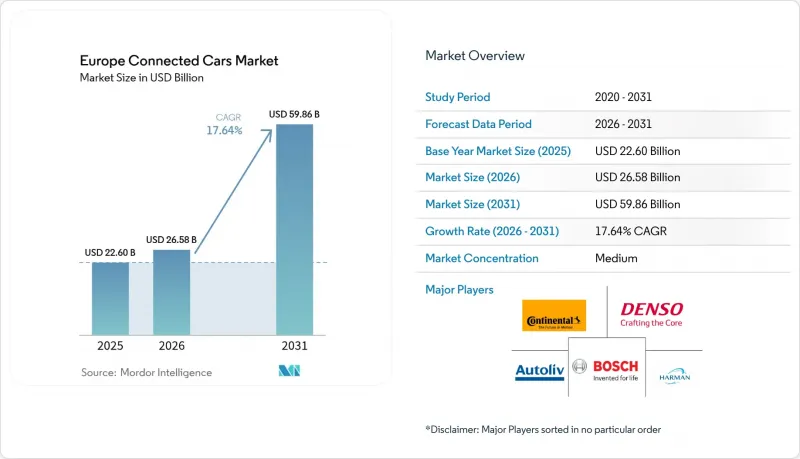
據 Mordor Intelligence 稱,2025 年歐洲聯網汽車市場價值 226 億美元,預計到 2031 年將達到 598.6 億美元,而 2026 年為 265.8 億美元,預測期(2026-2031 年)複合年成長率為 17.64%。
本報告按技術類型(導航、資訊娛樂、安全/ADAS、車輛管理、遠端資訊處理和OTA更新、其他)、連接類型(整合、嵌入式、網路共享、混合)、車輛連接範圍(V2V、V2I、V2X)、最終用戶(OEM原廠安裝、售後市場、其他)和國家進行細分。市場預測以美元(USD)計價。
歐洲聯網汽車市場的趨勢與洞察
促進遵守歐盟電子呼叫系統(eCall)和一般安全法規
根據歐盟於2024年實施的一般安全法規,所有新乘用車和輕型商用車都必須配備依賴持續資料流的高階駕駛輔助功能。因此,汽車製造商(OEM)正將嵌入式連網功能作為車輛的標配而非選配,從而實現規模經濟並降低單車硬體成本。大陸集團新成立的品牌部門Aumovio正是順應市場趨勢的典範,它為多家汽車製造商提供整合感測器和互聯解決方案。該法規涵蓋整個歐洲,消除了市場碎片化,使供應商能夠在所有27個成員國銷售單一平台。對保險公司而言,可靠的事故數據有助於加快理賠處理速度和詐欺偵測。
5G部署可實現低延遲V2X。
來自「連接歐洲設施」(CEF)數位基金的30多億歐元已用於在全長26000公里的高速公路走廊部署5G網路,為實現車聯網(V2X)服務所需的低於20毫秒的延遲奠定了基礎,從而確保了關鍵的安全性能。北歐營運商已實現近乎全覆蓋,丹麥的覆蓋率達到83.4%,挪威接近100%。實地試點表明,車聯網可以將交通號誌的通訊擁塞減少高達30%。歐洲太空總署(ESA)和德國電信提供的衛星備份正在覆蓋農村地區,並填補地面基地台稀疏地區的通訊空白。歐洲在獨立組網(SA)5G的部署方面落後於北美,但預計協調一致的頻率規劃將在2027年之前將核心網路升級覆蓋率提升至40%以上。
GDPR引發的隱私與網路安全問題
2025 年歐盟資料法案強制要求汽車製造商與第三方共用車輛資料。由於這些數據與駕駛員關聯後被歸類為個人訊息,因此 GDPR 的合規範圍正在擴大。 《網路彈性法案》為所有在歐洲銷售的連網產品增加了生命週期安全義務。應對這些重疊的法規導致工程成本增加,尤其是對於中小型二級供應商而言。集體訴訟的風險也增加。單一感測器的錯誤配置就可能導致行車記錄和生物識別資料洩露,監管機構可能處以高達全球銷售額 4% 的罰款。
細分市場分析
到2025年,安全功能和ADAS(高級駕駛輔助系統)將佔歐洲聯網汽車市場31.12%的佔有率。這主要得益於法規強制要求配備自動緊急煞車、車道維持輔助和智慧速度輔助等功能。為了滿足歐洲新車安全評鑑協會(Euro NCAP)的撞擊測試標準,各品牌正在所有配置等級的車輛上配備雙冗餘蜂窩模組、雷射雷達和攝影機陣列,從而降低每輛車的聯網成本,同時為所有購車者提供基準的連網功能。車載資訊服務和OTA(空中下載)更新平台是成長最快的領域,隨著汽車製造商轉向車輛展示室訂閱模式,其複合年成長率(CAGR)高達22.85%。在此背景下,預計2026年至2031年間,歐洲聯網汽車市場的車載資訊服務規模將成長74.2億美元。
對車隊效率日益成長的關注也推動了對車輛管理軟體的需求。保險公司正在利用大量的駕駛遙測數據來最佳化保費,這促進了配送、共享出行和租賃等車隊對車輛管理軟體的採用。這些車隊以前每48個月更新一次車輛,現在每36個月更新一次。大眾汽車、法雷奧和Mobileye等公司的合作表明了ADAS(高級駕駛輔助系統)與軟體貨幣化之間的聯繫,將L2+自動駕駛作為可選的售後功能整合到車輛中。軟體提升銷售、延長保固和按需功能包正在重新定義汽車製造商在每輛聯網汽車的整個生命週期中創造價值的方式。
到2025年,嵌入式連接將佔據歐洲聯網汽車市場51.90%的佔有率,因為工廠預先安裝的數據機將使汽車製造商能夠對車輛進行端到端的控制。這種架構確保了統一的使用者體驗、穩定的空中升級路徑以及符合eCall標準。然而,將嵌入式模組與智慧型手機網路共享結合的混合解決方案正以23.65%的複合年成長率快速成長。這種混合方案既能保持碰撞警報等嵌入式安全功能,又能讓使用者在訊號覆蓋不佳的區域將娛樂流量切換到資料方案。
BMW的「Ubigi Personal eSIM」就是一個很好的例子,該產品已在歐洲15個國家推出。車主可以透過車載資訊娛樂系統購買5G套餐,如果本地漫遊費用飆升,備用路由功能允許他們使用智慧型手機重新路由通訊。這種柔軟性在歐洲聯網汽車市場至關重要,因為該地區的批發漫遊費用差異很大。受混合架構的推動,歐洲聯網汽車市場預計到2030年將成長三倍,這反映了零件價格的下降和消費者接受度的提高。雖然純有線系統的市場佔有率正在下降,但它們在舊款車型的改裝套件和新興市場進口車中仍然佔據著重要地位。
其他好處:
- Excel格式的市場預測(ME)表
- 3個月的分析師支持
目錄
第1章:引言
- 研究假設和市場定義
- 調查範圍
第2章:調查方法
第3章執行摘要
第4章 市場狀況
- 市場概覽
- 市場促進因素
- 為遵守歐盟 eCall 和一般安全法規所做的努力
- 5G的部署將實現低延遲的V2X。
- 向軟體定義車輛和OTA更新過渡
- 電動車的普及推動了對互聯互通的需求。
- 車載資訊娛樂系統和數位駕駛座的需求日益成長
- 按里程計費的保險正在加速車載資訊系統的普及。
- 市場限制因素
- GDPR引發的隱私與網路安全問題
- 嵌入式設備的高昂硬體和訂閱成本
- OEM廠商和MNO廠商在收入分成方面陷入僵局。
- 跨歐洲走廊覆蓋範圍不足
- 價值供應鏈分析
- 監理情勢
- 技術展望
- 波特五力模型
第5章 市場規模與成長預測
- 依技術類型
- 導航
- 資訊娛樂
- 安全/ADAS
- 車輛管理
- 車載資訊服務和OTA更新
- 其他類型
- 按連線類型
- 融合的
- 嵌入式
- 有線連接
- 混合式(整合式+嵌入式)
- 車輛連接範圍
- V2V(車對車通訊)
- V2I(車路通訊)
- V2X(V2C、V2P、V2G)
- 最終用戶
- 出廠時的標準配備。
- 售後市場
- 車隊營運商/旅遊服務供應商
- 國家
- 德國
- 法國
- 英國
- 義大利
- 西班牙
- 荷蘭
- 瑞典
- 挪威
- 其他歐洲國家
第6章 競爭情勢
- 市場集中度
- 策略趨勢
- 市佔率分析
- 公司簡介
- Continental AG
- Robert Bosch GmbH
- Harman International
- Denso Corporation
- Autoliv Inc.
- Aptiv plc
- Valeo SA
- ZF Friedrichshafen AG
- FORVIA(Faurecia)
- Magna International Inc.
- Qualcomm Technologies Inc.
- Ericsson AB
- Vodafone Group plc
- Verizon Communications Inc.
- HERE Technologies
- TomTom NV
- NXP Semiconductors NV
- Audi AG
- BMW Group
- Mercedes-Benz Group AG
第7章 市場機會與未來展望
According to Mordor Intelligence, the european connected car market size was valued at USD 22.60 billion in 2025 and estimated to grow from USD 26.58 billion in 2026 to reach USD 59.86 billion by 2031, at a CAGR of 17.64% during the forecast period (2026-2031).
This report is Segmented by Technology Type (Navigation, Infotainment, Safety/ADAS, Vehicle Management, Telematics and OTA Updates, and Other Types), Connectivity Type (Integrated, Embedded, Tethered, and Hybrid), Vehicle-Connectivity Scope (V2V, V2I, and V2X), End-User (OEM Factory-Fit, Aftermarket, and More), and Country. The Market Forecasts are Provided in Terms of Value (USD).
Europe Connected Cars Market Trends and Insights
EU eCall and General Safety Regulation Compliance Push
The EU's General Safety Regulation, which has been in force since 2024, obliges every new passenger car and light commercial vehicle to ship with advanced driver assistance features that rely on constant data flow. OEMs, therefore, fit embedded connectivity by default rather than as an option, driving economies of scale that lower hardware cost per vehicle. Continental's newly branded division Aumovio illustrates the commercial response, supplying integrated sensors and connectivity stacks to multiple carmakers. The regulation's pan-European scope removes fragmentation, enabling suppliers to market a single platform across 27 member states. Insurance firms benefit from reliable crash data, which speeds claims handling and fraud detection.
5G Roll-out Enabling Low-latency V2X
Over EUR 3 billion in Connecting Europe Facility Digital funds is earmarked for corridor-wide 5G along 26,000 km of highways, underpinning sub-20 ms latency required for safety-critical vehicle-to-everything (V2X) services. Nordic operators already show near-complete coverage; Denmark stands at 83.4% 5G availability, and Norway approaches 100%. Real-world pilots cut congestion up to 30% as vehicles coordinate with traffic lights. Satellite back-up supplied by the European Space Agency and Deutsche Telekom covers rural zones, closing gaps where terrestrial towers are sparse. While Europe trails North America on standalone 5 G roll-outs, coordinated spectrum plans should lift core-network upgrades beyond 40% coverage by 2027.
GDPR-Driven Privacy and Cybersecurity Concerns
The 2025 EU Data Act compels OEMs to share vehicle data with third parties, yet that same data is now classed as personal when linked to a driver, widening GDPR compliance scope. The Cyber Resilience Act adds life-cycle security obligations for every connected product sold in Europe. Meeting overlapping rules raises engineering cost, especially for smaller tier-2 suppliers. Class-action risk grows: a single sensor misconfiguration could expose movement history or biometric data, triggering regulatory fines of up to 4% of global turnover.
Other drivers and restraints analyzed in the detailed report include:
- Shift to Software-Defined Vehicles and OTA Updates
- Rising Demand for Infotainment and Digital Cockpit
- High Hardware and Subscription Cost of Embedded Units
For complete list of drivers and restraints, kindly check the Table Of Contents.
Segment Analysis
Safety and ADAS functions held 31.12% of the European connected car market in 2025, propelled by regulation that mandates automated emergency braking, lane-keeping, and intelligent speed assistance. Across trim lines, brands embed dual-redundant cellular modules, lidar, and camera arrays to meet Euro NCAP targets, lowering per-vehicle connectivity cost and giving every buyer a baseline of connected capability. Telematics and OTA update platforms are the fastest-growing slice, rising at 22.85% CAGR as OEMs shift toward subscription revenue once the vehicle departs the showroom. In this context, the European connected car market size for telematics is projected to add USD 7.42 billion between 2026 and 2031.
A rising focus on fleet efficiency also pushes vehicle-management software. Insurers leverage rich driving telemetry to tailor premiums, supporting adoption in delivery, ride-hailing, and leasing fleets that now refresh vehicles every 36 months instead of the previous 48. Partnerships such as Volkswagen-Valeo-Mobileye illustrate the link between ADAS and software monetization, integrating Level 2+ self-driving as an optional post-purchase feature. Software up-selling, extended warranties, and functional on-demand packages redefine how automakers extract value over the life of each connected car.
Embedded connectivity captured 51.90% of the European connected car market in 2025 because factory-integrated modems give automakers end-to-end control. The architecture ensures uniform user experience, stable over-the-air update paths, and compliance with eCall. However, combining embedded modules with smartphone tethering, hybrid solutions are scaling faster at 23.65% CAGR. This blend preserves embedded safety for crash calls while letting entertainment traffic shift to a user's data plan in weak-coverage regions.
BMW's Ubigi Personal eSIM across 15 European countries is emblematic: a driver can buy a 5G plan through the infotainment screen, while fallback routing leverages the handset if local roaming tariffs spike. Such flexibility is critical in the European connected car market, where wholesale roaming fees vary widely. The European connected car market size attributable to hybrid architectures is expected to triple by 2030, reflecting component price drops and wider consumer acceptance. Tethered-only systems decline in share yet remain relevant in retrofit kits for older fleets and emerging-market imports.
Complete Report Scope:
- By Technology Type
- Navigation
- Infotainment
- Safety/ADAS
- Vehicle Management
- Telematics and OTA Updates
- Other Types
- By Connectivity Type
- Integrated
- Embedded
- Tethered
- Hybrid (Integrated + Embedded)
- By Vehicle-Connectivity Scope
- V2V (Vehicle-to-Vehicle)
- V2I (Vehicle-to-Infrastructure)
- V2X ( V2C, V2P, and V2G)
- By End-User
- OEM Factory-fit
- Aftermarket
- Fleet Operators/Mobility Providers
- By Country
- Germany
- France
- United Kingdom
- Italy
- Spain
- Netherlands
- Sweden
- Norway
- Rest of Europe
List of Companies Covered in this Report:
- Continental AG
- Robert Bosch GmbH
- Harman International
- Denso Corporation
- Autoliv Inc.
- Aptiv plc
- Valeo SA
- ZF Friedrichshafen AG
- FORVIA (Faurecia)
- Magna International Inc.
- Qualcomm Technologies Inc.
- Ericsson AB
- Vodafone Group plc
- Verizon Communications Inc.
- HERE Technologies
- TomTom N.V.
- NXP Semiconductors N.V.
- Audi AG
- BMW Group
- Mercedes-Benz Group AG
Additional Benefits:
- The market estimate (ME) sheet in Excel format
- 3 months of analyst support
TABLE OF CONTENTS
1 Introduction
- 1.1 Study Assumptions and Market Definition
- 1.2 Scope of the Study
2 Research Methodology
3 Executive Summary
4 Market Landscape
- 4.1 Market Overview
- 4.2 Market Drivers
- 4.2.1 EU eCall and General Safety Regulation compliance push
- 4.2.2 5G roll-out enabling low-latency V2X
- 4.2.3 Shift to Software-Defined Vehicles and OTA updates
- 4.2.4 Electric vehicle adoption driving connectivity requirements
- 4.2.5 Rising demand for infotainment and digital cockpit
- 4.2.6 Usage-based insurance accelerating telematics installs
- 4.3 Market Restraints
- 4.3.1 GDPR-driven privacy and cybersecurity concerns
- 4.3.2 High hardware and subscription cost of embedded units
- 4.3.3 OEM-MNO revenue-sharing stalemate
- 4.3.4 Coverage gaps on Trans-European corridors
- 4.4 Value / Supply-Chain Analysis
- 4.5 Regulatory Landscape
- 4.6 Technological Outlook
- 4.7 Porter's Five Forces
- 4.7.1 Bargaining Power of Buyers
- 4.7.2 Bargaining Power of Suppliers
- 4.7.3 Threat of New Entrants
- 4.7.4 Threat of Substitute Products
- 4.7.5 Intensity of Competitive Rivalry
5 Market Size and Growth Forecasts
- 5.1 By Technology Type
- 5.1.1 Navigation
- 5.1.2 Infotainment
- 5.1.3 Safety/ADAS
- 5.1.4 Vehicle Management
- 5.1.5 Telematics and OTA Updates
- 5.1.6 Other Types
- 5.2 By Connectivity Type
- 5.2.1 Integrated
- 5.2.2 Embedded
- 5.2.3 Tethered
- 5.2.4 Hybrid (Integrated + Embedded)
- 5.3 By Vehicle-Connectivity Scope
- 5.3.1 V2V (Vehicle-to-Vehicle)
- 5.3.2 V2I (Vehicle-to-Infrastructure)
- 5.3.3 V2X ( V2C, V2P, and V2G)
- 5.4 By End-User
- 5.4.1 OEM Factory-fit
- 5.4.2 Aftermarket
- 5.4.3 Fleet Operators/Mobility Providers
- 5.5 By Country
- 5.5.1 Germany
- 5.5.2 France
- 5.5.3 United Kingdom
- 5.5.4 Italy
- 5.5.5 Spain
- 5.5.6 Netherlands
- 5.5.7 Sweden
- 5.5.8 Norway
- 5.5.9 Rest of Europe
6 Competitive Landscape
- 6.1 Market Concentration
- 6.2 Strategic Moves
- 6.3 Market Share Analysis
- 6.4 Company Profiles (Includes Global level Overview, Market level overview, Core Segments, Financials as available, Strategic Information, Market Rank/Share for key companies, Products and Services, and Recent Developments)
- 6.4.1 Continental AG
- 6.4.2 Robert Bosch GmbH
- 6.4.3 Harman International
- 6.4.4 Denso Corporation
- 6.4.5 Autoliv Inc.
- 6.4.6 Aptiv plc
- 6.4.7 Valeo SA
- 6.4.8 ZF Friedrichshafen AG
- 6.4.9 FORVIA (Faurecia)
- 6.4.10 Magna International Inc.
- 6.4.11 Qualcomm Technologies Inc.
- 6.4.12 Ericsson AB
- 6.4.13 Vodafone Group plc
- 6.4.14 Verizon Communications Inc.
- 6.4.15 HERE Technologies
- 6.4.16 TomTom N.V.
- 6.4.17 NXP Semiconductors N.V.
- 6.4.18 Audi AG
- 6.4.19 BMW Group
- 6.4.20 Mercedes-Benz Group AG
7 Market Opportunities and Future Outlook
- 7.1 White-space and Unmet-Need Assessment

 聯網汽車市場預測至2034年-全球分析(按組件、連接類型、通訊技術、通訊模型、車輛類型、動力類型、銷售及安裝管道、應用、最終用戶和地區分類)
 汽車eSIM管理市場機會、成長要素、產業趨勢分析及2026-2035年預測連網汽車技術市場機會、成長要素、產業趨勢分析及2026-2035年預測
 印度聯網汽車:市場佔有率分析、產業趨勢與統計及成長預測(2026-2031)
 聯網汽車市場-2026-2032年全球市場預測
 汽車eSIM市場規模、佔有率和成長分析:按eSIM技術類型、應用情境、最終用戶、組件、分銷管道和地區分類-產業預測,2026-2033年
 2026年全球連網汽車技術市場報告互聯公共運輸市場:2034 年預測-按解決方案、組件、交通途徑、連接技術、最終用戶和地區分類的全球分析汽車互聯市場預測(2034 年)—按連接類型、網路類型、技術、通訊方式、硬體、最終用戶和地區分類的全球分析聯網汽車市場:2026-2032年全球市場預測(按組件類型、連接技術、通訊方式、網路類型、應用、車輛類型和最終用戶分類)