


 |
市場調查報告書
商品編碼
2115032
印度聯網汽車:市場佔有率分析、產業趨勢與統計及成長預測(2026-2031)India Connected Car - Market Share Analysis, Industry Trends & Statistics, Growth Forecasts (2026 - 2031) |
||||||

※ 本網頁內容可能與最新版本有所差異。詳細情況請與我們聯繫。
根據 Mordor Intelligence 預測,印度聯網汽車市場規模將從 2025 年的 1.5 億美元成長到 2026 年的 1.8642 億美元,到 2031 年將達到 5.5162 億美元,2026 年至 2031 年的複合年成長率為 24.28%。
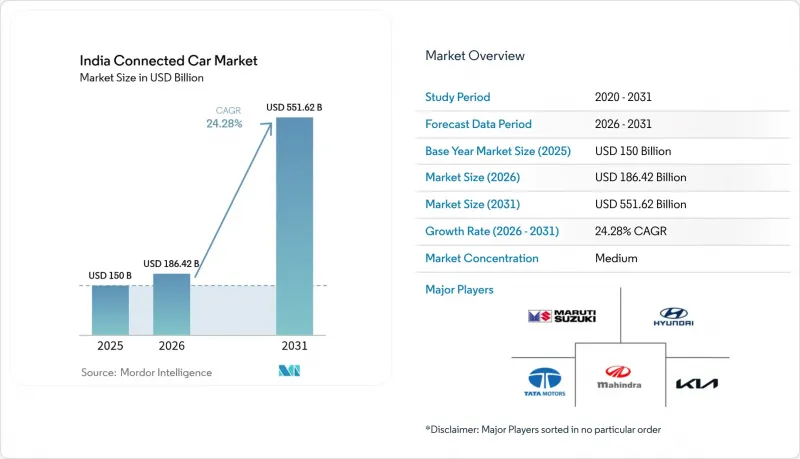
本報告按應用類型(導航、遠端診斷等)、連接類型(嵌入式、整合式等)、通訊模式(車對車通訊等)、車輛類型(乘用車、輕型商用車等)和銷售管道(原廠安裝、售後改裝)進行分類。市場預測以貨幣價值(美元)和銷售(單位)兩種形式呈現。
印度聯網汽車市場的趨勢與洞察
智慧型手機和4G/5G的快速普及
預計到2025年7月,印度的5G用戶將達到3.65億,這將為汽車與智慧型手機的融合奠定基礎,並推動印度聯網汽車市場走向大規模普及。目前,絕大多數購車者在選擇新車時都將互聯功能視為關鍵因素,汽車製造商也積極響應,甚至在小型SUV中也配備了嵌入式eSIM和行動應用程式。例如,起亞在2024年推出的Syros車型中捆綁了Airtel的eSIM,使車主能夠獲取即時路況資訊、地理圍欄和防盜警報。印度聯網汽車市場也受益於雲端交易可以利用現有營運商收費系統,從而將訂閱成本控制在與行動資料通訊費用相當的水平。隨著消費者期望從智慧型手機轉向車載顯示螢幕,資訊娛樂和安全功能正從“錦上添花”變為“決定性因素”,加速了不同車型互聯功能的標準化進程。
政府關於AIS-140和AV-NEXT的法規
AIS-140 強制要求商用車輛安裝追蹤系統和緊急按鈕,而 AV-NEXT藍圖草案則要求乘用車整合 NavIC 系統。這使得合規性成為進入印度聯網汽車市場的關鍵因素。 Bharat NCAP 2.0 評級進一步提升了互聯安全性,該評級對支援遠端資訊處理功能的緊急呼叫和碰撞通知功能給予額外星級獎勵。可預測的需求曲線使得一級供應商能夠在本地大規模生產 ECU,從而降低單位成本並提升國內價值。隨著時間的推移,合規性將成為競爭優勢,因為超越最低要求的品牌將獲得更高的安全評分。
對資料外洩和網路攻擊的擔憂
全球範圍內針對車載資訊娛樂系統的勒索軟體攻擊加劇了印度消費者的擔憂,導致他們不願共用駕駛數據。儘管像SecureThings這樣的新創公司提供異常檢測軟體,但由於印度缺乏符合歐盟WP.29網路安全條款的法規,其普及程度仍參差不齊。缺乏強制性標準意味著小型汽車製造商將網路安全投資視為可選項,從而造成了信任漏洞。如果消費者開始停用SIM卡模組或拒絕同意資料收集,那麼高調的駭客攻擊事件可能會減緩印度聯網汽車市場的成長。
細分市場分析
到2025年,導航將佔印度聯網汽車市場佔有率的27.20%。這主要是由於都市區交通擁擠、路標品質參差不齊,需要即時重新計算路線。像MapMyIndia這樣的本地地圖合作夥伴提供路面坑洼和加油站信息,滿足了日常通勤者的需求。相較之下,空中下載(OTA)更新預計到2031年將以26.15%的複合年成長率成長,因為汽車製造商開始意識到,一次遠端修復就能避免數千次的工廠維修。預計到2031年,印度聯網汽車市場OTA升級的市場規模將顯著擴大,凸顯了軟體在車輛價值中佔比的不斷提升。緊隨其後的是遠端診斷和多媒體串流媒體的成長,這主要得益於營運商將車載資料方案與家庭行動電話捆綁銷售。此外,隨著「Bharat NCAP 2.0」的推出,緊急呼叫的普及率正在逐步提高,安全被定位為銷售中的關鍵主題。
第二波應用部署的重點在於個人化。車內空調設定透過雲端設定檔同步,語音助理還能學習本地方言。這些進步將進一步鞏固印度聯網汽車市場作為軟體平台的地位,在這個平台上,持續交付比車型年度更新周期更為重要。
到2025年,預計46.55%的新型聯網汽車將配備嵌入式eSIM模組。這是因為汽車製造商希望在整個生命週期中管理診斷、韌體和資料路由。在供應鏈成本不斷上漲以及消費者抵制廠商建議零售價(MSRP)上漲的背景下,利用智慧型手機數據線的整合連接方式正以25.1%的複合年成長率(CAGR)實現最快成長。這種混合方案常見於中階車型,車主使用自己的數據線,但車輛配備低頻寬eSIM卡,用於關鍵的安全通訊。
連網系統目前仍屬於小眾市場,主要用於售後市場的加密狗。然而,其低廉的硬體成本使其在車隊改裝應用中持續流行。在整個預測期內,印度的聯網汽車產業預計將採取雙管齊下的策略:嵌入式系統用於高價值或嚴格的監管應用場景,而整合系統則用於價格較低的車型。
其他好處:
- Excel格式的市場預測(ME)表
- 3個月的分析師支持
目錄
第1章:引言
- 研究假設和市場定義
- 調查範圍
第2章:調查方法
第3章執行摘要
第4章 市場狀況
- 市場概覽
- 市場促進因素
- 智慧型手機和4G/5G的快速普及
- 政府強制要求使用 AIS-140 和 AV-NEXT。
- 原始設備製造商和電信業者之間的收益分成模式
- 可支配所得和消費的增加受到人們願望的驅動
- 符合汽車導航標準
- 計量型保險試點項目
- 市場限制因素
- 對資料外洩和網路攻擊的擔憂
- 鄉村地區主要道路沿線LTE覆蓋不均勻
- 聯網服務訂閱的平均每用戶收入較低
- 無法改裝先進ECU的老車輛。
- 價值供應鏈分析
- 監理情勢
- 技術展望
- 波特五力模型
第5章 市場規模與成長預測
- 按應用程式類型
- 導航
- 遠距離診斷
- 多媒體串流媒體
- 社群媒體和其他應用
- OTA 更新
- 道路援助
- 電子呼叫和緊急援助
- 遙控
- 自動停車/連網停車
- 自動駕駛儀
- 家庭整合
- 被竊車輛找回和警報系統
- 按連線類型
- 嵌入式
- 融合的
- 繫繩
- 透過溝通模式
- 車對車通訊(V2V)
- 車路通訊(V2I)
- 車輛與行人(V2P)
- 車聯網(V2C)
- 車輛類型
- 搭乘用車
- 輕型商用車
- 大型商用車輛
- 按銷售管道
- 原廠/廠配備
- 改裝
第6章 競爭情勢
- 策略趨勢
- 市佔率分析
- 公司簡介
- Maruti Suzuki India Ltd
- Hyundai Motor India Ltd
- Tata Motors Ltd
- Mahindra & Mahindra Ltd
- Kia India Pvt Ltd
- Toyota Kirloskar Motor
- MG Motor India
- Nissan Motor India
- Honda Cars India
- Skoda-VW India
- Renault India
- Volvo Eicher Commercial Vehicles
- Ashok Leyland Ltd
- Daimler India Commercial Vehicles
- Force Motors
- Bosch India
- Trimble India
第7章 市場機會與未來展望
According to Mordor Intelligence, the India connected car market size is expected to grow from USD 150 million in 2025 to USD 186.42 million in 2026 and is forecast to reach USD 551.62 million by 2031 at 24.28% CAGR over 2026-2031.
This report is Segmented by Application Type (Navigation, Remote Diagnostics, and More), Connectivity Type (Embedded, Integrated, and More), Communication Model (Vehicle-To-Vehicle and More), Vehicle Type (Passenger Cars, Light Commercial Vehicles, and More), and Sales Channel (OEM-Factory-Fit, Aftermarket Retrofit). The Market Forecasts are Provided in Terms of Value (USD) and Volume (Units).
India Connected Car Market Trends and Insights
Rapid Smartphone and 4G/5G Penetration
India's 5G user base touched 365 million as of July 2025, creating a ready canvas for vehicle-smartphone fusion that steers the India connected car market toward mass adoption . Majority of shoppers now cite connected features as pivotal when selecting a new vehicle, and OEMs respond by equipping even compact SUVs with integrated eSIMs and mobile apps. Kia's 2024 launch of the Syros model bundled an Airtel eSIM, letting owners access live traffic, geo-fencing, and theft alerts. The India connected car market also benefits because cloud transactions ride on existing telco billing rails, keeping subscription costs near mobile-data parity. As consumer expectations migrate from phones to dashboards, infotainment and safety applications move from nice-to-have to deal-breakers, accelerating standard-fit connectivity across model lines.
Government's AIS-140 and AV-NEXT Mandates
AIS-140 demands tracking and emergency buttons on commercial vehicles, while the AV-NEXT draft roadmap insists on NavIC integration in passenger cars, making compliance the main door-opener to the India connected car market. Bharat NCAP 2.0 scoring further elevates connected safety by awarding additional stars for telematics-enabled e-call and crash notification. The predictable demand curve allows Tier-1 suppliers to scale ECUs locally, which trims unit costs and increases domestic value addition. Over time, mandatory compliance morphs into a competitive differentiator as brands that exceed the bare minimum tout higher safety scores.
Data-breach and Cyber-attack Concerns
Ransomware attacks on global infotainment systems raised red flags among Indian buyers who now hesitate to share driving data. While startups like SecureThings offer anomaly-detection software, uptake stays uneven because no India-specific regulation mirrors the EU WP.29 cyber-security clause. Without mandatory standards, small OEMs treat cyber spend as optional, opening gaps that erode trust. High-profile hacks would slow the India connected car market if consumers begin disabling SIM modules or refuse consent for data collection.
Other drivers and restraints analyzed in the detailed report include:
- OEM-Telco Revenue-Share Models
- Rising Disposable Income and Aspirational Spend
- Patchy LTE Coverage on Rural Corridors
For complete list of drivers and restraints, kindly check the Table Of Contents.
Segment Analysis
Navigation accounted for 27.20% of the India connected car market share in 2025 as clogged city grids and mixed-quality road signs made live rerouting vital. Local mapping partners like MapMyIndia curate pothole alerts and fuel-station data that resonate with daily commuters. In contrast, over-the-air updates log a 26.15% CAGR to 2031 as OEMs realize a single remote fix avoids thousands of service-bay visits. The India connected car market size for OTA upgrades is projected to rise significantly by 2031, a gain that highlights software's growing share of vehicle value. Remote diagnostics and multimedia streaming follow, fueled by telco bundling of in-car data plans with family mobiles. Emergency e-call adoption ticks upward under Bharat NCAP 2.0, reinforcing safety as a selling theme.
The second wave of application adoption centers on personalization. Cabin climate presets sync through cloud profiles while voice assistants learn local dialects. Such evolutions will further cement the India connected car market as a software arena in which continuous delivery outranks model-year refresh cycles.
Embedded eSIM modules shipped in 46.55% of new connected vehicles during 2025 because OEMs want lifecycle control over diagnostics, firmware, and data routing. Integrated connectivity, which piggybacks on smartphone data, grows quickest at 25.1% CAGR as supply-chain costs lift and consumers push back against rising MSRPs. The hybrid approach often lands in mid-trim variants where buyers bring their own data but the car retains a low-bandwidth fallback eSIM for critical safety traffic.
Tethered systems remain niche in penetration, used mainly by aftermarket dongles. Yet the low hardware bill keeps them alive for fleet retrofits. Over the forecast horizon, the India connected car industry will likely settle on a dual-core strategy: embedded for high-value or regulatory-heavy use cases, integrated for budget lines.
Complete Report Scope:
- By Application Type
- Navigation
- Remote Diagnostics
- Multimedia Streaming
- Social Media and Other Apps
- OTA Update
- On-Road Assistance
- E-call and SOS Assitance
- Remote Operation
- Auto Parking/Connected Parking
- Autopilot
- Home Integration
- Stolen Vehicle Recovery/Warning
- By Connectivity Type
- Embedded
- Integrated
- Tethered
- By Communication Model
- Vehicle-to-Vehicle (V2V)
- Vehicle-to-Infrastructure (V2I)
- Vehicle-to-Pedestrian (V2P)
- Vehicle-to-Cloud (V2C)
- By Vehicle Type
- Passenger Cars
- Light Commercial Vehicles
- Heavy Commercial Vehicles
- By Sales Channel
- OEM-Factory-Fit
- After-Market Retrofit
List of Companies Covered in this Report:
- Maruti Suzuki India Ltd
- Hyundai Motor India Ltd
- Tata Motors Ltd
- Mahindra & Mahindra Ltd
- Kia India Pvt Ltd
- Toyota Kirloskar Motor
- MG Motor India
- Nissan Motor India
- Honda Cars India
- Skoda-VW India
- Renault India
- Volvo Eicher Commercial Vehicles
- Ashok Leyland Ltd
- Daimler India Commercial Vehicles
- Force Motors
- Bosch India
- Trimble India
Additional Benefits:
- The market estimate (ME) sheet in Excel format
- 3 months of analyst support
TABLE OF CONTENTS
1 Introduction
- 1.1 Study Assumptions & Market Definition
- 1.2 Scope of the Study
2 Research Methodology
3 Executive Summary
4 Market Landscape
- 4.1 Market Overview
- 4.2 Market Drivers
- 4.2.1 Rapid Smartphone and 4G/5G Penetration
- 4.2.2 Government's AIS-140 and AV-NEXT Mandates
- 4.2.3 OEM-Telco Revenue-Share Models
- 4.2.4 Rising Disposable Income and Aspirational Spend
- 4.2.5 On-board NavIC Compliance
- 4.2.6 Pay-per-use Insurance Pilots
- 4.3 Market Restraints
- 4.3.1 Data-breach and Cyber-attack Concerns
- 4.3.2 Patchy LTE Coverage on Rural Corridors
- 4.3.3 Low ARPU on Connected-services Subscriptions
- 4.3.4 Legacy Fleet Unable to Retrofit Advanced ECUs
- 4.4 Value / Supply-Chain Analysis
- 4.5 Regulatory Landscape
- 4.6 Technological Outlook
- 4.7 Porter's Five Forces
- 4.7.1 Threat of New Entrants
- 4.7.2 Bargaining Power of Buyers
- 4.7.3 Bargaining Power of Suppliers
- 4.7.4 Threat of Substitutes
- 4.7.5 Intensity of Competitive Rivalry
5 Market Size & Growth Forecasts (Value (USD) and Volume (Units))
- 5.1 By Application Type
- 5.1.1 Navigation
- 5.1.2 Remote Diagnostics
- 5.1.3 Multimedia Streaming
- 5.1.4 Social Media and Other Apps
- 5.1.5 OTA Update
- 5.1.6 On-Road Assistance
- 5.1.7 E-call and SOS Assitance
- 5.1.8 Remote Operation
- 5.1.9 Auto Parking/Connected Parking
- 5.1.10 Autopilot
- 5.1.11 Home Integration
- 5.1.12 Stolen Vehicle Recovery/Warning
- 5.2 By Connectivity Type
- 5.2.1 Embedded
- 5.2.2 Integrated
- 5.2.3 Tethered
- 5.3 By Communication Model
- 5.3.1 Vehicle-to-Vehicle (V2V)
- 5.3.2 Vehicle-to-Infrastructure (V2I)
- 5.3.3 Vehicle-to-Pedestrian (V2P)
- 5.3.4 Vehicle-to-Cloud (V2C)
- 5.4 By Vehicle Type
- 5.4.1 Passenger Cars
- 5.4.2 Light Commercial Vehicles
- 5.4.3 Heavy Commercial Vehicles
- 5.5 By Sales Channel
- 5.5.1 OEM-Factory-Fit
- 5.5.2 After-Market Retrofit
6 Competitive Landscape
- 6.1 Strategic Moves
- 6.2 Market Share Analysis
- 6.3 Company Profiles (includes Global Level Overview, Market Level Overview, Core Segments, Financials as Available, Strategic Information, Market Rank/Share for Key Companies, Products and Services, SWOT Analysis, and Recent Developments)
- 6.3.1 Maruti Suzuki India Ltd
- 6.3.2 Hyundai Motor India Ltd
- 6.3.3 Tata Motors Ltd
- 6.3.4 Mahindra & Mahindra Ltd
- 6.3.5 Kia India Pvt Ltd
- 6.3.6 Toyota Kirloskar Motor
- 6.3.7 MG Motor India
- 6.3.8 Nissan Motor India
- 6.3.9 Honda Cars India
- 6.3.10 Skoda-VW India
- 6.3.11 Renault India
- 6.3.12 Volvo Eicher Commercial Vehicles
- 6.3.13 Ashok Leyland Ltd
- 6.3.14 Daimler India Commercial Vehicles
- 6.3.15 Force Motors
- 6.3.16 Bosch India
- 6.3.17 Trimble India
7 Market Opportunities & Future Outlook
- 7.1 White-space & Unmet-Need Assessment
- 7.1.1 Bespoke connected-service bundles for tier-2/3 cities
- 7.1.2 EV-specific predictive-maintenance APIs
- 7.1.3 In-car payments & commerce integration
- 7.1.4 Customized solutions by emerging players

 聯網汽車市場預測至2034年-全球分析(按組件、連接類型、通訊技術、通訊模型、車輛類型、動力類型、銷售及安裝管道、應用、最終用戶和地區分類)
 汽車eSIM管理市場機會、成長要素、產業趨勢分析及2026-2035年預測連網汽車技術市場機會、成長要素、產業趨勢分析及2026-2035年預測
 歐洲聯網汽車:市場佔有率分析、產業趨勢與統計及成長預測(2026-2031 年)
 聯網汽車市場-2026-2032年全球市場預測
 汽車eSIM市場規模、佔有率和成長分析:按eSIM技術類型、應用情境、最終用戶、組件、分銷管道和地區分類-產業預測,2026-2033年
 2026年全球連網汽車技術市場報告互聯公共運輸市場:2034 年預測-按解決方案、組件、交通途徑、連接技術、最終用戶和地區分類的全球分析汽車互聯市場預測(2034 年)—按連接類型、網路類型、技術、通訊方式、硬體、最終用戶和地區分類的全球分析聯網汽車市場:2026-2032年全球市場預測(按組件類型、連接技術、通訊方式、網路類型、應用、車輛類型和最終用戶分類)