


 |
市場調查報告書
商品編碼
2115829
北美汽車廢氣後後處理系統:市場佔有率分析、產業趨勢與統計及成長預測(2026-2031 年)North America Automotive Exhaust Aftertreatment Systems - Market Share Analysis, Industry Trends & Statistics, Growth Forecasts (2026 - 2031) |
||||||

※ 本網頁內容可能與最新版本有所差異。詳細情況請與我們聯繫。
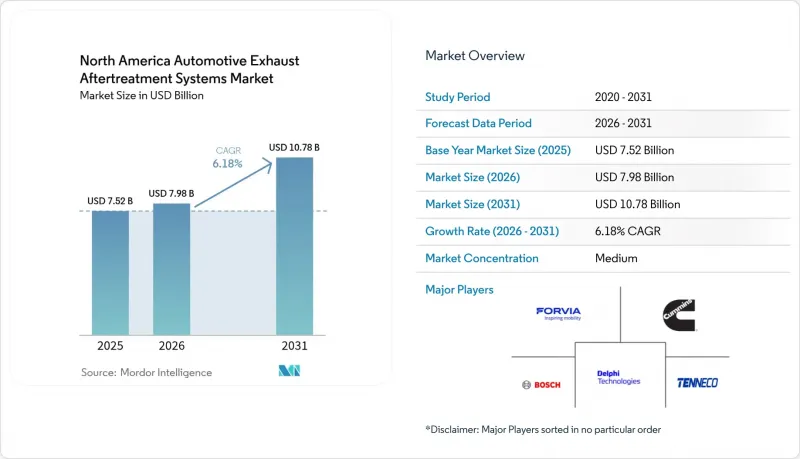
據 Mordor Intelligence 稱,北美汽車廢氣後處理系統市場預計到 2026 年價值 79.8 億美元,高於 2025 年的 75.2 億美元,預計到 2031 年將達到 107.8 億美元。
預計 2026 年至 2031 年的複合年成長率為 6.18%。
本報告按產品類型(選擇性催化還原、柴油顆粒過濾器等)、燃料類型(汽油和柴油)、車輛類型(乘用車、輕型商用車、重型商用車、巴士和長途客車)、最終用途(OEM 和售後市場)以及國家/地區進行細分。市場預測以價值(美元)表示。
北美汽車廢氣後處理系統市場趨勢與洞察。
美國環保署和加州空氣資源委員會第三階段/高負荷第二階段排放標準規定的嚴格排放氣體法規
聯邦三級排放標準和加州空氣資源委員會 (CARB) 的綜合法規降低了氮氧化物 (NOx) 和顆粒物 (PM) 的法定排放基準值,並強制要求所有輕型和重型汽車平臺採用選擇性催化還原 (SCR)、柴油顆粒過濾器 (DPF) 和汽油顆粒過濾器 (GPF) 硬體。聯邦和加州計畫的雙重認證縮短了產品推出時間,並促使高效能催化劑組件的早期應用激增。供應商正在實現塗層和基材生產的本地化,以滿足溫室氣體 (GHG) 和低氮氧化物認證相關的可追溯性要求。由於保固和使用壽命義務現在擴展到更長的里程閾值,重型商用引擎的監管時間表尤其緊張。合規活動也在推動車隊層面的遠端資訊處理整合,因為營運商需要將實際排放與基於實驗室的認證基準進行比較。
美國溫室氣體排放法規第三階段將於 2027 年及以後生產的重型卡車中實施。
第三階段溫室氣體排放標準將8級牽引車的二氧化碳排放目標收緊約18克/噸英里,並強制要求採用高活性選擇性催化還原(SCR)催化劑、電加熱柴油顆粒過濾器(DPF)再生系統以及先進的溫度控管策略。關於平均排放、積分累積和交易的法規將創建一個合規市場,使改裝後的舊卡車能夠獲得額外的積分。因此,擁有者正在權衡下一代後處理系統的成本與兌換積分的潛在效益。原始設備製造商(OEM)的動力傳動系統開發藍圖正在努力平衡短期柴油引擎最佳化與長期交付零排放車輛的目標。零件供應商預計,2027年車型平台對隔熱塗層、小型尿素罐和電動噴油泵的需求將激增。
美國柴油輕型商用車和乘用車市場佔有率下降
柴油車目前在輕型卡車和乘用車中所佔比例不足3%,導致安裝傳統後處理系統的車輛數量大幅減少。聯邦政府對純電動SUV的稅額扣抵以及各州清潔卡車法規的訂定,正促使車隊營運商提前淘汰柴油車。原始設備負責人正在減少半噸皮卡的柴油引擎選項,這將導致未來鉑金含量較高的選擇性催化還原(SCR)催化劑銷售下降。為了彌補柴油車需求的損失,供應商正將業務重心轉向汽油車的燃油顆粒過濾器(GPF)專案和插電式混合動力汽車的增壓冷卻式廢氣系統。符合攤銷條件的新柴油硬體模具數量的減少,也給利潤率前景帶來了壓力。
細分市場分析
選擇性催化還原(SCR)系統是最大的收入來源,預計2025年將佔北美汽車廢氣後處理系統市場38.72%的佔有率。嚴格的氮氧化物(NOx)排放法規目標推動了SCR系統在重型柴油引擎、中型汽油皮卡和長途牽引車等領域的持續應用。 OEM廠商的標定文件越來越依賴雙噴射配置,即在上游和中游噴射尿素,以提高低溫下的轉換效率。柴油顆粒過濾器(DPF)的銷售額預計將以7.05%的複合年成長率成長,這主要得益於垃圾車、港口運輸車輛和市政公車等車輛的法規要求和售後改裝。高灰分截留能力的濾芯基材、最佳化的再生演算法和耐腐蝕金屬外殼材料正在降低整體擁有成本(TCO)。整合模組的趨勢模糊了柴油氧化催化器(DOC)和DPF層之間的界限,使供應商能夠提供最佳化的整體式組件,從而縮短排氣路徑,並使每輛車的重量減輕12-18磅。儘管 SCR 仍將是 OEM 遵守法規的技術基礎直至 2031 年,但受售後市場需求驅動的 DPF 需求提供了不易受經濟週期影響的韌性,從而支持北美汽車廢氣後處理系統市場的穩定成長。
廢氣再循環冷卻器和稀油氮氧化物捕集器等二級產品仍應用於傳統小型汽車,但現在主要作為輔助技術,用於緩解氮氧化物的瞬態峰值。製造商正在改進催化式碳煙過濾器,採用能夠承受更高峰值溫度的工程陶瓷,從而降低再生過程中油耗的增加。柴油氧化催化器(DOC)作為罐體中的第一個整體式過濾器,仍然發揮著重要作用,它燃燒碳氫化合物以提高排氣溫度,促進柴油顆粒過濾器(DPF)的被動再生。然而,隨著複合催化塗層被整合到DPF組件中,它們作為獨立部件的佔有率正在下降,各項功能被整合到一個統一的部件中。投資於塗層層壓技術的供應商聲稱,他們在起步速度方面取得了可衡量的改進,使原始設備製造商(OEM)能夠滿足未來法規設定的排放氣體減排目標。
在北美汽車廢氣後處理系統市場,預計到2025年,柴油動力系統在4級至8級卡車、特殊車輛和非道路機械領域的廣泛應用。當前一代柴油引擎將高效的SCR催化器與採用先進碳化矽通道設計的塗層DPF基板相結合,在保持過濾效率的同時降低了壓力損失。改良的渦輪增壓器幾何結構能夠維持有利於降低煙塵生成率的燃燒溫度,進而進一步延長DPF的更換週期。同時,汽油後處理裝置(包括三元觸媒轉換器(TWC)和GPF的組合)預計將維持6.78%的強勁複合年成長率,這主要得益於GDI引擎在皮卡、SUV和跨界車細分市場創紀錄的市場佔有率。為了保護過濾器的孔隙率,原始設備製造商(OEM)正將嚴格的起燃溫度目標與週期性的主動再生相結合,並輔以精確的噴射映射來限制燃油衍生的煙塵前體。
混合動力傳動系統雖然市佔率較小,但由於頻繁的引擎啟動停止需要快速關閉觸媒轉換器,因此對可程式氣體模組 (PGM) 的需求量更高。該領域為催化劑供應商創造了較高的單車附加價值,部分抵消了某些輕型車細分市場中柴油車銷量下滑的影響。供應商透過精細調整高孔隙率塗層和零間隙磚形墊層,顯著降低滑行過程中的熱損失,從而在反覆的熱循環中保持催化劑的效率。展望未來,小型化渦輪增壓汽油引擎對辛烷值的更高要求預計將收緊排氣熱量預算,進一步加速全部區域車輛採用先進的三元觸媒轉換器 (TWC) + 氣體顆粒過濾器 (GPF) 系統。
其他好處:
- Excel格式的市場預測(ME)表
- 3個月的分析師支持
目錄
第1章:引言
- 研究假設和市場定義
- 調查範圍
第2章:調查方法
第3章執行摘要
第4章 市場狀況
- 市場概覽
- 市場促進因素
- 嚴格的EPA和CARB Tier III/HD Phase 2排放氣體法規
- OEM向整合後處理模組遷移
- 美國針對重型卡車從 2027 年款開始實施新的溫室氣體排放法規(第三階段)。
- 加快在GDI車輛中引入汽油顆粒過濾器
- 用於SCR的新型無氮還原劑
- 以車輛為單位的二氧化碳排放權交易正在推動車輛維修需求。
- 市場限制因素
- 美國柴油輕型商用車和乘用車市場佔有率下降
- 鉑族金屬價格波動劇烈。
- 原始設備製造商正在加大對 2b 級及以下級別純電動車的關注。
- 美國-墨西哥基板供應鏈中斷。
- 價值供應鏈分析
- 監理情勢
- 技術展望
- 波特五力模型
第5章 市場規模與成長預測
- 依產品類型
- 選擇性催化還原(SCR)
- 柴油顆粒過濾器(DPF)
- 柴油氧化催化劑(DOC)
- 廢氣再循環(EGR)
- 按燃料類型
- 柴油引擎
- 汽油
- 車輛類型
- 搭乘用車
- 輕型商用車
- 大型商用車輛
- 巴士和長途汽車
- 按最終用途
- OEM(目的地設備製造商)
- 售後市場
- 國家
- 美國
- 加拿大
- 其他北美國家
第6章 競爭情勢
- 市場集中度
- 策略趨勢
- 市佔率分析
- 公司簡介
- Tenneco Inc.
- Cummins Inc.
- Faurecia(FORVIA)
- BorgWarner(Delphi Technologies)
- Robert Bosch GmbH(Bosch Mobility Solutions)
- Johnson Matthey
- Eberspacher Group
- Donaldson Company, Inc.
- NGK Insulators
- DENSO Corporation
- Hanon Systems
- Marelli Holdings Co., Ltd
- Dinex Emission Inc.
- Topsoe
- Corning Incorporated
第7章 市場機會與未來展望
According to Mordor Intelligence, North America automotive exhaust aftertreatment systems market size in 2026 is estimated at USD 7.98 billion, growing from 2025 value of USD 7.52 billion with 2031 projections showing USD 10.78 billion, growing at 6.18% CAGR over 2026-2031.
This report is Segmented by Product Type (Selective Catalytic Reduction, Diesel Particulate Filter, and More), Fuel Type (Gasoline and Diesel), Vehicle Type (Passenger Cars, LCV, HCV, and Buses and Coaches), End Use (OEM and Aftermarket) and Country. The Market Forecasts are Provided in Terms of Value (USD).
North America Automotive Exhaust Aftertreatment Systems Market Trends and Insights
Stringent EPA and CARB Tier-III / HD Phase-2 Emission Limits
The Federal Tier-III and California Air Resources Board (CARB) Omnibus rules have lowered the legal thresholds for NOx and particulate matter (PM), requiring every light- and heavy-duty platform to adopt SCR, DPF, and GPF hardware. Dual certification between federal and California programs has compressed launch schedules, prompting early adoption spikes for high-efficiency catalyst bricks. Suppliers are localizing wash-coat and substrate production to meet traceability requirements that accompany Greenhouse Gas (GHG) and Low-NOx certification. The regulatory clock is especially aggressive for heavy commercial engines because warranty and useful-life obligations now span longer mileage thresholds. Compliance activity also drives fleet-level telematics integration as operators track real-world emissions against lab-based certification benchmarks .
Upcoming U.S. Phase-3 GHG Rule for MY 2027+ Heavy Trucks
Phase 3 GHG standards tighten CO2 targets by roughly 18 g/ton-mile for Class 8 tractors, compelling the adoption of higher activity SCR catalysts, electrically heated DPF regeneration, and advanced thermal management strategies . Averaging, Banking, and Trading provisions create a compliance market in which retrofitted legacy trucks can generate surplus credits. As a result, fleets weigh the cost of next-generation aftertreatment against the potential upside from credit monetization. OEM powertrain roadmaps now juggle near-term diesel optimization with longer-term zero-emission offerings. Component suppliers anticipate a surge in demand for thermal barrier coatings, compact urea tanks, and electrically driven dosing pumps for MY 2027 platforms.
Declining Diesel LCV/PV Share in the United States
The diesel mix within light trucks and passenger vehicles has fallen below 3%, eroding a sizeable corner of the traditional aftertreatment installed base. Federal tax credits for battery-electric SUVs and state clean-truck rules incentivize fleets to retire diesel units early. OEM product planners have reduced diesel engine options for half-ton pickups, thereby shrinking future volumes for platinum-rich SCR bricks. Suppliers pivot toward gasoline GPF programs or charger-cooled exhaust systems for plug-in hybrids to backfill lost diesel demand. Tooling amortization for new diesel hardware now spans fewer units, putting pressure on margin outlooks.
Other drivers and restraints analyzed in the detailed report include:
- OEM Shift Toward Integrated After-Treatment Modules
- Accelerated Adoption of Gasoline Particulate Filters in GDI Cars
- High Platinum-Group Metal Price Volatility
For complete list of drivers and restraints, kindly check the Table Of Contents.
Segment Analysis
SCR systems generated the single-largest revenue block, accounting for 38.72% of the North American automotive exhaust aftertreatment systems market in 2025. Tight NOx targets sustain adoption across diesel heavy-duty engines, mid-size gasoline pickups, and long-haul tractors. OEM calibration files increasingly depend on dual-dosing configurations that inject urea upstream and mid-stream to widen conversion efficiency at low temperatures. DPF volume expansion, forecasted at a 7.05% CAGR, primarily arises from mandated retrofits in refuse trucks, port drayage fleets, and municipal buses. Higher ash-capacity filter substrates, optimized regeneration algorithms, and corrosion-resistant metallic canning materials reinforce total cost-of-ownership economics. The integrated module trend blurs the boundaries between DOC and DPF layers, allowing suppliers to deliver tuned monolith stacks that shorten exhaust routing and shave 12-18 pounds of mass per vehicle. Through 2031, SCR remains the technological anchor for OEM compliance, but retrofit-driven DPF demand brings countercycle resilience, underpinning stable growth for the North America automotive exhaust aftertreatment systems market.
Second-tier products, such as EGR coolers and lean NOx traps, still serve legacy light-duty applications but now primarily act as assist technologies that smooth transient NOx spikes. Manufacturers refine catalyzed soot filters using engineering ceramics that can tolerate higher peak exotherms, thereby lowering regeneration fuel penalties. DOC maintains relevance as the first monolith in the can, igniting hydrocarbons to boost exhaust temperatures for passive DPF regeneration. Yet its standalone share erodes as combined catalyst coatings migrate onto the DPF brick, densifying functionality inside a unified volume. Suppliers that invest in wash-coat layering techniques claim measurable gains in light-off speed, enabling OEMs to hit step-function emission cuts locked into future rulemakings.
Diesel powertrains provided 66.92% of 2025 revenue for the North America automotive exhaust aftertreatment systems market, thanks to entrenched adoption in Class 4 to Class 8 trucks, vocational equipment, and off-road machinery. Current-generation diesel engines pair high-efficiency SCR cells with coated DPF substrates that harness advanced silicon-carbide channel designs, lowering pressure drop while preserving filtration efficiency. Upgraded turbocharger geometries sustain combustion temperatures conducive to low soot rates, further extending DPF service intervals. Conversely, gasoline aftertreatment units, spanning three-way catalysts (TWC) and GPF combinations, are on track for a robust 6.78% CAGR, powered by record GDI share in pickup, SUV, and crossover segments. OEMs overlay tight light-off targets with periodic active regeneration to protect filter porosity, a balancing act aided by precise injection mapping that limits fuel-borne soot precursors.
Hybrid powertrains, though small in unit share, carry elevated PGM loadings because frequent engine start-stop events demand rapid catalyst light-off. This subset preserves high value per vehicle for catalyst suppliers, partially offsetting diesel contraction in certain light-duty niches. Suppliers fine-tune high-porosity wash-coats and zero-gap brick matting to slash heat loss during coast-down phases, preserving efficiency through repeated thermal cycling. Looking ahead, escalating octane requirements for downsized turbocharged gasoline engines will tighten exhaust thermal budgets, reinforcing momentum behind advanced TWC-plus-GPF stacks across the regional fleet.
Complete Report Scope:
- By Product Type
- Selective Catalytic Reduction (SCR)
- Diesel Particulate Filter (DPF)
- Diesel Oxidation Catalyst (DOC)
- Exhaust Gas Recirculation (EGR)
- By Fuel Type
- Diesel
- Gasoline
- By Vehicle Type
- Passenger Cars
- Light Commercial Vehicles
- Heavy Commercial Vehicles
- Buses & Coaches
- By End Use
- OEM (Original Equipment Manufacturer)
- Aftermarket
- By Country
- United States
- Canada
- Rest of North America
List of Companies Covered in this Report:
- Tenneco Inc.
- Cummins Inc.
- Faurecia (FORVIA)
- BorgWarner (Delphi Technologies)
- Robert Bosch GmbH (Bosch Mobility Solutions)
- Johnson Matthey
- Eberspacher Group
- Donaldson Company, Inc.
- NGK Insulators
- DENSO Corporation
- Hanon Systems
- Marelli Holdings Co., Ltd
- Dinex Emission Inc.
- Topsoe
- Corning Incorporated
Additional Benefits:
- The market estimate (ME) sheet in Excel format
- 3 months of analyst support
TABLE OF CONTENTS
1 Introduction
- 1.1 Study Assumptions and Market Definition
- 1.2 Scope of the Study
2 Research Methodology
3 Executive Summary
4 Market Landscape
- 4.1 Market Overview
- 4.2 Market Drivers
- 4.2.1 Stringent EPA and CARB Tier-III / HD Phase-2 Emission Limits
- 4.2.2 OEM Shift Toward Integrated After-Treatment Modules
- 4.2.3 Upcoming US Phase-3 GHG Rule for MY 2027+ Heavy Trucks
- 4.2.4 Accelerated Adoption of Gasoline Particulate Filters in GDI Cars
- 4.2.5 Emerging Nitrogen-Free Reductants for SCR
- 4.2.6 Fleet-Level CO2 Credit Trading Driving Retrofit Demand
- 4.3 Market Restraints
- 4.3.1 Declining Diesel LCV/PV Share in the United States
- 4.3.2 High Platinum-Group Metal Price Volatility
- 4.3.3 Increased OEM Focus on BEVs for Class 2b and below
- 4.3.4 U.S.-Mexico Supply-Chain Disruptions for Substrates
- 4.4 Value / Supply-Chain Analysis
- 4.5 Regulatory Landscape
- 4.6 Technological Outlook
- 4.7 Porter's Five Forces
- 4.7.1 Threat of New Entrants
- 4.7.2 Bargaining Power of Suppliers
- 4.7.3 Bargaining Power of Buyers
- 4.7.4 Threat of Substitutes
- 4.7.5 Competitive Rivalry
5 Market Size and Growth Forecasts
- 5.1 By Product Type
- 5.1.1 Selective Catalytic Reduction (SCR)
- 5.1.2 Diesel Particulate Filter (DPF)
- 5.1.3 Diesel Oxidation Catalyst (DOC)
- 5.1.4 Exhaust Gas Recirculation (EGR)
- 5.2 By Fuel Type
- 5.2.1 Diesel
- 5.2.2 Gasoline
- 5.3 By Vehicle Type
- 5.3.1 Passenger Cars
- 5.3.2 Light Commercial Vehicles
- 5.3.3 Heavy Commercial Vehicles
- 5.3.4 Buses & Coaches
- 5.4 By End Use
- 5.4.1 OEM (Original Equipment Manufacturer)
- 5.4.2 Aftermarket
- 5.5 By Country
- 5.5.1 United States
- 5.5.2 Canada
- 5.5.3 Rest of North America
6 Competitive Landscape
- 6.1 Market Concentration
- 6.2 Strategic Moves
- 6.3 Market Share Analysis
- 6.4 Company Profiles (Includes Global level Overview, Market level overview, Core Segments, Financials as available, Strategic Information, Market Rank/Share for key companies, Products & Services, and Recent Developments)
- 6.4.1 Tenneco Inc.
- 6.4.2 Cummins Inc.
- 6.4.3 Faurecia (FORVIA)
- 6.4.4 BorgWarner (Delphi Technologies)
- 6.4.5 Robert Bosch GmbH (Bosch Mobility Solutions)
- 6.4.6 Johnson Matthey
- 6.4.7 Eberspacher Group
- 6.4.8 Donaldson Company, Inc.
- 6.4.9 NGK Insulators
- 6.4.10 DENSO Corporation
- 6.4.11 Hanon Systems
- 6.4.12 Marelli Holdings Co., Ltd
- 6.4.13 Dinex Emission Inc.
- 6.4.14 Topsoe
- 6.4.15 Corning Incorporated
7 Market Opportunities & Future Outlook

 汽車廢氣處理陶瓷市場-2026-2032年全球市場預測汽車廢氣控制設備市場:依裝置類型、引擎類型、材質類型和車輛類型分類-2026-2032年全球市場預測
 廢氣後後處理系統市場規模、佔有率和成長分析:按組件、車輛類型、銷售管道和地區分類-2026-2033年產業預測
 汽車排放氣體控制系統市場預測至2034年-全球分析(按系統類型、組件、燃料類型、車輛類型、技術、排放氣體法規、銷售管道、應用和地區分類)
 全球廢氣後後處理系統市場(至2033年):依產品類型(DOC、DPF、LNT、SCR、GPF)、車輛類型(乘用車、輕型商用車、卡車、客車)、燃料類型(柴油、汽油)、銷售管道(OEM、售後市場)及地區分類
 汽車廢氣排放控制設備市場-全球產業規模、佔有率、趨勢、機會、預測:按裝置類型、材料、引擎類型、地區和競爭格局分類,2021-2031年
 汽車排放氣體分析儀市場:按類型、技術、應用、最終用途和地區分類汽車排放氣體分析儀市場:依分析儀類型、排放氣體類型、技術、最終用戶和通路分類-2026-2032年全球市場預測汽車排放氣體控制系統市場:按設備類型、車輛類型、燃料類型、最終用戶和應用分類-2026-2032年全球市場預測柴油車廢氣後後處理系統市場:按組件、後處理技術、車輛類型、銷售管道和應用分類-2026-2032年全球市場預測