


 |
市場調查報告書
商品編碼
2115252
FRP格柵:市場佔有率分析、產業趨勢與統計、成長預測(2026-2031年)FRP Grating - Market Share Analysis, Industry Trends & Statistics, Growth Forecasts (2026 - 2031) |
||||||

※ 本網頁內容可能與最新版本有所差異。詳細情況請與我們聯繫。
據 Mordor Intelligence 稱,FRP 格柵市場預計在 2026 年價值 5.4778 億美元,預計在預測期(2026-2031 年)內將以 5.12% 的複合年成長率成長,到 2031 年達到 7.0313 億美元。
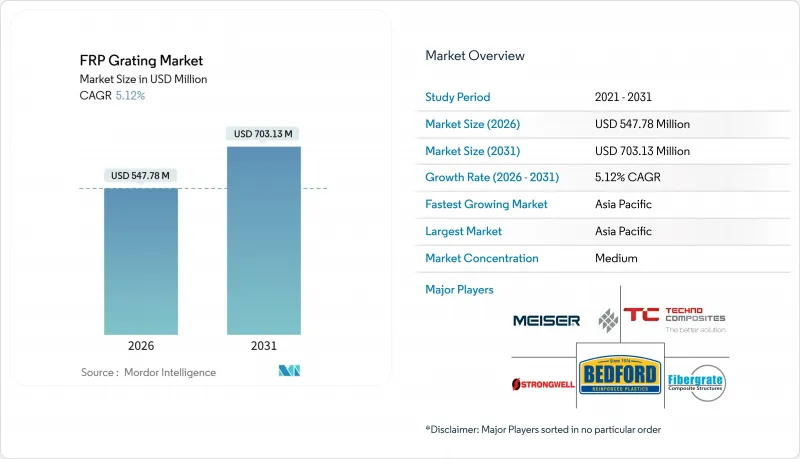
本報告按類型(聚酯、乙烯基酯等)、製造流程(拉擠成型和模壓成型)、應用(樓梯踏板、人行道等)、終端用戶行業(石油和天然氣、工廠和化學加工、廢棄物和水處理等)以及地區(亞太地區、北美、歐洲、南美、中東和非洲)進行細分。市場預測以美元計價。
全球FRP格柵市場趨勢與洞察
從鋼製格柵過渡到耐腐蝕FRP格柵
生命週期分析表明,儘管複合材料的初始成本比低碳鋼高出30%至50%,但在腐蝕性環境中,其性能更優。殼牌公司火星平台於2024年完成的維修,使維修停機時間減少了60%,並在15年內節省了120萬美元的噴漆人事費用。 ISO 24681:2023《船舶用統一設計標準》的發布,使得離岸風力發電開發商能夠提供一致的荷載、耐火性和抗紫外線(UV)性能標準。中國的《2024年產業結構調整目錄》進一步鼓勵大規模生產無鹼玻璃纖維,以確保纖維品質的穩定性。
污水處理設施資本支出(CAPEX)增加
在硫化氫環境中,鍍鋅鋼板會在5到7年內劣化,但模壓FRP板材具有更優異的耐腐蝕性,即使不塗漆也能滿足OSHA 1910.22防滑標準。印度耗資120億美元的「飲用水生命線計畫」(Jal Jeevan Mission)指定在沉澱池周圍的走道上使用模壓格柵,以滿足緊迫的工期要求。
與普通鋼格柵相比,初始成本較高
儘管FRP格柵的全生命週期成本效益更優,但其價格比同類鍍鋅鋼產品高出30-50%,這在預算緊張的專案中構成了採購障礙。在巴西和阿根廷,由於初期成本限制,預算有限的都市污水處理項目中通常使用鋼格柵。然而,FRP的使用壽命長達25-30年,而鋼格柵每10-15年就需要重新噴漆或更換,因此FRP的整體擁有成本更低。 KPS Capital Partners計劃在2024-2025年收購INEOS和Crane Composites,旨在擴大樹脂採購規模,並力爭2028年將製造商成本降低至多12%。
細分市場分析
預計到2025年,聚酯纖維仍將佔據FRP格柵市場42.36%的佔有率,反映了其在公共人行道領域長期穩定的應用。乙烯基酯的複合年成長率(CAGR)為6.24%,顯示其在大量使用酸和溶劑的領域發展勢頭強勁。酚醛樹脂板符合IMO SOLAS和ASTM E84 A級要求,但價格高出50%至70%。環氧樹脂目前仍僅限於需要靜電放電(ESD)性能的無塵室應用。樹脂供應商正在引入生物基乙烯基酯複合材料以降低碳強度,這表明隨著企業永續發展目標的日益嚴格,該材料將被廣泛採用。
由於海上和化學工業的買家已經為優質材料預留了預算,乙烯基酯的應用將會加速。聚酯樹脂將繼續用於成本是主要決策因素的領域,而酚醛樹脂將在防火性能至關重要的細分市場中佔有一席之地。環氧樹脂因承載能力有限而成長受限,但將導電添加劑摻入乙烯基酯中,並有望在電子地板材料市場從環氧樹脂手中奪取市場佔有率。
到2025年,成型板材將佔出貨量的58.47%,其採用拉擠成型工藝,具有雙向負載分佈特性,適用於承受多軸應力的平台和溝槽蓋板。拉擠成型板材是一項重要的資本投資,由於其高抗張強度,可應用於卡車裝卸平台和重型海上走道等場合,預計其複合年成長率將達到6.18%。
模塑產品提供雙向載重路徑,可防止裂紋擴展;而噴塑產品則可實現高精度,非常適合模組化維修。北美和歐洲的製造商正致力於透過自動化噴塑生產來降低人事費用,而亞洲製造商則利用手工積層模塑生產的人事費用優勢。
區域分析
預計到2025年,亞太地區將佔全球銷售額的47.38%,並將以5.94%的複合年成長率持續成長至2031年。中國的政策鼓勵生產高品質的玻璃纖維,從而保障了原料的品質。印度的「飲用水生命線計畫」(Jal Jeevan Mission)已投資120億美元用於污水處理項目,為模壓格柵創造了穩定的需求。馬來西亞和印尼等東協化工中心正在採用乙烯基酯板進行防腐蝕處理。在日本,沿海土木工程結構對抗震和防腐蝕性能的需求持續穩定成長。
在北美,美國環保署(EPA)耗資5,154億美元的水資源項目是區域支出中佔比最大的部分,東海岸離岸風力發電的建設也為此提供了有力支撐。在加拿大,拉擠成型板材被指定用於油砂項目,以應對極端溫度波動;而在墨西哥,近岸外包生產模式正在刺激新汽車工業園區對拉擠成型板材的需求。
在歐洲,多格班克離岸風電場正在展示FRP(纖維增強塑膠)在海上變電站的實際優勢。在德國萊茵-魯爾區,為了滿足ISO 14122標準的要求,鋼製走道正被乙烯基酯樹脂所取代。西班牙和希臘已投資興建紫外線穩定聚酯的海水淡化廠,並根據現場回饋改進樹脂。
在南美洲、中東和非洲,價格敏感性限制了其應用,但由於其耐腐蝕性和防火性,高等級乙烯基酯和酚醛樹脂板已被用於巴西的鹽層下下層平台和沙烏地阿拉伯的石化聯合體。
其他好處:
- Excel格式的市場預測(ME)表
- 3個月的分析師支持
目錄
第1章:引言
- 研究的先決條件
- 調查範圍
第2章:調查方法
第3章執行摘要
第4章 市場動態
- 促進因素
- 從鋼格柵過渡到耐腐蝕FRP格柵
- 污水處理廠資本支出(CAPEX)增加
- 離岸風電和浮體式太陽能發電平台的擴張
- 加強有關工人安全和防滑措施的法規。
- 引入整合智慧感測器的FRP人行道
- 抑制因子
- 初始成本高(與普通鋼格柵相比)
- 在陽光照射強烈的地區,樹脂會因紫外線照射劣化。
- 苯乙烯和玻璃纖維的價格波動
- 產業價值鏈分析
- 波特五力分析
第5章 市場規模與成長預測
- 按類型
- 聚酯纖維
- 乙烯基酯
- 酚類
- 環氧樹脂
- 透過製造程序
- 拉擠成型
- 模具
- 透過使用
- 樓梯踏板
- 人行道
- 平台
- 地板材料系統
- 按最終用戶行業分類
- 石油和天然氣
- 植物和化學加工
- 廢棄物和水處理
- 紙漿和造紙
- 建造
- 其他
- 按地區
- 亞太地區
- 中國
- 印度
- 日本
- 韓國
- 東南亞國協
- 其他亞太國家
- 北美洲
- 美國
- 加拿大
- 墨西哥
- 歐洲
- 德國
- 英國
- 法國
- 義大利
- 西班牙
- 俄羅斯
- 其他歐洲國家
- 南美洲
- 巴西
- 阿根廷
- 其他南美國家
- 中東和非洲
- 沙烏地阿拉伯
- 南非
- 其他中東和非洲國家
- 亞太地區
第6章 競爭情勢
- 市場集中度
- 策略趨勢
- 市佔率(%)** / 排名分析
- 公司簡介
- AGC MATEX CO., Ltd.
- AIMS COMPOSITES
- American Grating
- SEASAFE, INC.
- Bedford Reinforced Plastics
- Daikure Co., Ltd.
- Exel Composites
- FASTEC International
- FERROTECH INTERNATIONAL FZE
- Fibergrate Composite Structures, Inc.
- Gebruder MEISER GmbH
- SEASAFE, INC.
- STRONGWELL CORPORATION
- Techno-Composites Domine GmbH
- Valmont Industries, Inc.
第7章 市場機會與未來展望
According to Mordor Intelligence, the FRP grating market size is estimated at USD 547.78 million in 2026, and is expected to reach USD 703.13 million by 2031, at a CAGR of 5.12% during the forecast period (2026-2031).
This report is Segmented by Type (Polyester, Vinyl Ester, and More), Manufacturing Process (Pultruded and Molded), Application (Stair Treads, Walkways, and More), End-User Industry (Oil and Gas, Plant and Chemical Processing, Waste and Water Treatment, and More), and Geography (Asia-Pacific, North America, Europe, South America, and Middle-East and Africa). Market Forecasts are Provided in Terms of Value (USD).
Global FRP Grating Market Trends and Insights
Shift from Steel to Corrosion-Resistant FRP Gratings
Lifecycle studies demonstrate that composites outperform mild steel in corrosive environments, despite a 30-50% upfront premium. Shell's Mars Platform retrofit in 2024 recorded a 60% fall in maintenance downtime and saved USD 1.2 million in coating labor across fifteen years. Publication of ISO 24681:2023 unified marine-grade design criteria, allowing offshore wind developers to quote identical load, fire, and UV benchmarks. China's 2024 Industrial Structure Adjustment Catalogue further incentivizes large-scale alkali-free glass-fiber production, ensuring consistent fiber quality.
Rising CAPEX in Wastewater Treatment Facilities
Hydrogen sulfide environments degrade galvanized steel within five to seven years, whereas molded FRP panels resist corrosion and satisfy OSHA 1910.22 slip rules without coatings. India's USD 12 billion Jal Jeevan Mission program specifies molded gratings for clarifier walkways to meet tight construction windows.
High Upfront Cost Versus Mild-Steel Grating
FRP gratings command a 30-50% price premium over galvanized steel equivalents, creating a procurement barrier in capital-constrained projects despite superior lifecycle economics. Budget-driven municipal wastewater projects in Brazil and Argentina often default to steel due to upfront cost constraints, even though FRP's 25-30 year service life versus steel's 10-15 year repaint-and-replace cycle would yield lower total cost of ownership. KPS Capital Partners' 2024-25 acquisitions of INEOS and Crane Composites aim to scale resin volumes that could trim fabricator costs by up to 12% by 2028.
Other drivers and restraints analyzed in the detailed report include:
- Expansion of Offshore Wind and Floating Solar Platforms
- Stricter Worker-Safety and Anti-Slip Regulations
- UV-Induced Resin Degradation
For complete list of drivers and restraints, kindly check the Table Of Contents.
Segment Analysis
Polyester retained a 42.36% 2025 FRP grating market share, reflecting a vast legacy in municipal walkways. Vinyl ester's 6.24% CAGR signals momentum in acid and solvent rich zones. Phenolic panels satisfy IMO SOLAS and ASTM E84 Class A requirements but command 50-70% higher prices. Epoxy remains confined to cleanrooms needing electrostatic discharge performance. Resin suppliers are introducing bio-attributed vinyl ester formulations to cut carbon intensity, pointing to wider acceptance as corporate sustainability targets tighten.
Vinyl ester uptake will accelerate because offshore and chemical buyers already budget for premium materials. Polyester will persist where cost drives decisions, while phenolic will capture fire-critical niches. Epoxy's limited load capacity restricts growth, though conductive additives inside vinyl ester threaten to cannibalize epoxy in electronics flooring.
Molded panels commanded 58.47% of 2025 volume, pultrusion dies, and bi-directional load distribution that suits platforms and trench covers subjected to multi-axis stresses. Pultruded panels, although capital intensive, are registering 6.18% CAGR by delivering higher tensile strength for truck loading bays and heavy-duty offshore walkways.
Molded products give bi-directional load paths that resist crack propagation, while pultruded variants yield tight tolerances ideal for modular retrofits. North American and European producers emphasize pultrusion to offset labor costs via automation, whereas Asian manufacturers exploit labor advantages in hand-layup molded production.
Complete Report Scope:
- By Type
- Polyester
- Vinyl Ester
- Phenolic
- Epoxy
- By Manufacturing Process
- Pultruded
- Molded
- By Application
- Stair Treads
- Walkways
- Platforms
- Floor Systems
- By End-User Industry
- Oil and Gas
- Plant and Chemical Processing
- Waste and Water Treatment
- Pulp and Paper
- Construction
- Others
- By Geography
- Asia-Pacific
- China
- India
- Japan
- South Korea
- ASEAN Countries
- Rest of Asia-Pacific
- North America
- United States
- Canada
- Mexico
- Europe
- Germany
- United Kingdom
- France
- Italy
- Spain
- Russia
- Rest of Europe
- South America
- Brazil
- Argentina
- Rest of South America
- Middle-East and Africa
- Saudi Arabia
- South Africa
- Rest of Middle-East and Africa
- Asia-Pacific
Geography Analysis
Asia-Pacific held 47.38% of 2025 revenue and is set for 5.94% CAGR through 2031. Chinese policy encourages premium glass-fiber output, ensuring feedstock quality. India's Jal Jeevan Mission injects USD 12 billion into sewage projects, establishing steady molded grating demand. ASEAN chemical hubs in Malaysia and Indonesia turn to vinyl ester panels for corrosion control. Japan sustains stable purchases for coastal civil structures that require seismic and corrosion resilience.
In North America, the US EPA's USD 515.4 billion water program will drive the largest slice of regional spending, complemented by East Coast offshore wind farm construction. Canada's oil sands operations specify pultruded panels for extreme temperature swings, and Mexican near-shoring is spurring molded panel demand in new automotive parks.
In Europe, Dogger Bank Wind Farm demonstrates FRP advantages in offshore substations. Germany's Rhine-Ruhr legislative environment is replacing steel walkways with vinyl ester to meet ISO 14122 mandates. Spain and Greece invest in desalination plants that adopt UV-stabilized polyester, though field feedback has already prompted resin reformulations.
In South America and the Middle East-Africa price sensitivity limits penetration, yet Brazil's pre-salt platforms and Saudi petrochemical complexes buy higher-grade vinyl ester and phenolic panels for corrosion and fire safety.
- AGC MATEX CO., Ltd.
- AIMS COMPOSITES
- American Grating
- SEASAFE, INC.
- Bedford Reinforced Plastics
- Daikure Co., Ltd.
- Exel Composites
- FASTEC International
- FERROTECH INTERNATIONAL FZE
- Fibergrate Composite Structures, Inc.
- Gebruder MEISER GmbH
- SEASAFE, INC.
- STRONGWELL CORPORATION
- Techno-Composites Domine GmbH
- Valmont Industries, Inc.
Additional Benefits:
- The market estimate (ME) sheet in Excel format
- 3 months of analyst support
TABLE OF CONTENTS
1 Introduction
- 1.1 Study Assumptions
- 1.2 Scope of the Study
2 Research Methodology
3 Executive Summary
4 Market Dynamics
- 4.1 Drivers
- 4.1.1 Shift from steel to corrosion-resistant FRP gratings
- 4.1.2 Rising CAPEX in wastewater treatment facilities
- 4.1.3 Expansion of offshore wind and floating solar platforms
- 4.1.4 Stricter worker-safety and anti-slip regulations
- 4.1.5 Adoption of smart-sensor embedded FRP walkways
- 4.2 Restraints
- 4.2.1 High upfront cost versus mild-steel grating
- 4.2.2 UV-induced resin degradation in high-insolation zones
- 4.2.3 Volatile styrene and glass-fiber prices
- 4.3 Industry Value Chain Analysis
- 4.4 Porter's Five Forces Analysis
- 4.4.1 Threat of New Entrants
- 4.4.2 Bargaining Power of Buyers
- 4.4.3 Bargaining Power of Suppliers
- 4.4.4 Threat of Substitute Products
- 4.4.5 Degree of Competition
5 Market Size & Growth Forecasts (Value)
- 5.1 By Type
- 5.1.1 Polyester
- 5.1.2 Vinyl Ester
- 5.1.3 Phenolic
- 5.1.4 Epoxy
- 5.2 By Manufacturing Process
- 5.2.1 Pultruded
- 5.2.2 Molded
- 5.3 By Application
- 5.3.1 Stair Treads
- 5.3.2 Walkways
- 5.3.3 Platforms
- 5.3.4 Floor Systems
- 5.4 By End-User Industry
- 5.4.1 Oil and Gas
- 5.4.2 Plant and Chemical Processing
- 5.4.3 Waste and Water Treatment
- 5.4.4 Pulp and Paper
- 5.4.5 Construction
- 5.4.6 Others
- 5.5 By Geography
- 5.5.1 Asia-Pacific
- 5.5.1.1 China
- 5.5.1.2 India
- 5.5.1.3 Japan
- 5.5.1.4 South Korea
- 5.5.1.5 ASEAN Countries
- 5.5.1.6 Rest of Asia-Pacific
- 5.5.2 North America
- 5.5.2.1 United States
- 5.5.2.2 Canada
- 5.5.2.3 Mexico
- 5.5.3 Europe
- 5.5.3.1 Germany
- 5.5.3.2 United Kingdom
- 5.5.3.3 France
- 5.5.3.4 Italy
- 5.5.3.5 Spain
- 5.5.3.6 Russia
- 5.5.3.7 Rest of Europe
- 5.5.4 South America
- 5.5.4.1 Brazil
- 5.5.4.2 Argentina
- 5.5.4.3 Rest of South America
- 5.5.5 Middle-East and Africa
- 5.5.5.1 Saudi Arabia
- 5.5.5.2 South Africa
- 5.5.5.3 Rest of Middle-East and Africa
- 5.5.1 Asia-Pacific
6 Competitive Landscape
- 6.1 Market Concentration
- 6.2 Strategic Moves
- 6.3 Market Share (%)**/Ranking Analysis
- 6.4 Company Profiles (includes Global level Overview, Market level overview, Core Segments, Financials as available, Production Capacity, Strategic Information, Market Rank/Share for key companies, Products and Services, and Recent Developments)
- 6.4.1 AGC MATEX CO., Ltd.
- 6.4.2 AIMS COMPOSITES
- 6.4.3 American Grating
- 6.4.4 SEASAFE, INC.
- 6.4.5 Bedford Reinforced Plastics
- 6.4.6 Daikure Co., Ltd.
- 6.4.7 Exel Composites
- 6.4.8 FASTEC International
- 6.4.9 FERROTECH INTERNATIONAL FZE
- 6.4.10 Fibergrate Composite Structures, Inc.
- 6.4.11 Gebruder MEISER GmbH
- 6.4.12 SEASAFE, INC.
- 6.4.13 STRONGWELL CORPORATION
- 6.4.14 Techno-Composites Domine GmbH
- 6.4.15 Valmont Industries, Inc.
7 Market Opportunities and Future Outlook
- 7.1 White-space and Unmet-Need Assessment

 格柵緊固件市場:全球市場預測,2026-2032年
 FRP橋樑全球市場FRP容器市場 - 全球市場預測(2026-2032年)纖維增強塑膠市場:依纖維類型、樹脂類型、終端用戶產業和銷售管道分類-2026-2032年全球市場預測
 全球纖維增強塑膠市場規模、佔有率、趨勢和成長分析報告(2026-2034)
 2026年全球纖維增強聚合物(FRP)和複合材料市場報告
 纖維增強塑膠市場規模、佔有率和趨勢分析報告:按產品、應用、地區和細分市場預測(2026-2033 年)
 FRP容器:市場佔有率分析、產業趨勢與統計、成長預測(2026-2031年)
 2026 年至 2035 年模壓 FRP 格柵的市場機會、成長要素、產業趨勢和預測。
 FRP管材市場報告:按類型、製造流程、應用和地區分類(2026-2034年)