


 |
市場調查報告書
商品編碼
2115199
丁基三苯基磷酸酯:市場佔有率分析、行業趨勢和統計數據、成長預測(2026-2031)Butylated Triphenyl Phosphate - Market Share Analysis, Industry Trends & Statistics, Growth Forecasts (2026 - 2031) |
||||||

※ 本網頁內容可能與最新版本有所差異。詳細情況請與我們聯繫。
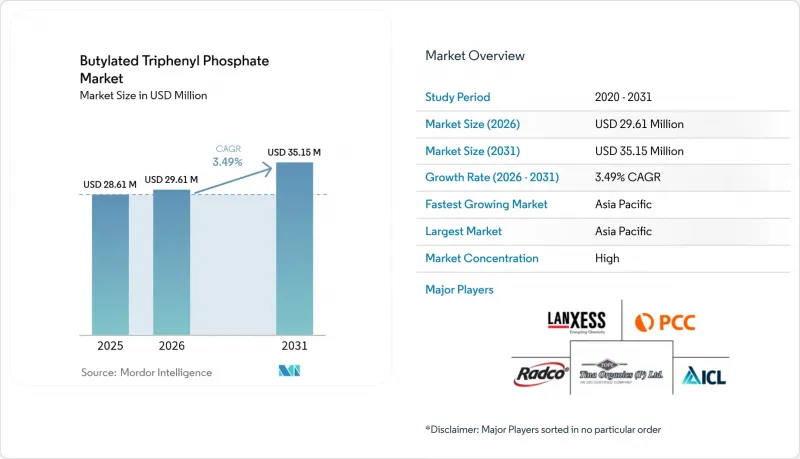
根據 Mordor Intelligence 預測,丁基三苯基磷酸酯的市場規模預計將從 2025 年的 2861 萬美元成長到 2026 年的 2961 萬美元,並將從 2026 年到 2031 年以 3.49% 的複合年成長率成長,到 2031 年達到 3515 萬美元。
本報告按功能(阻燃劑和塑化劑)、應用(潤滑劑、PVC化合物和樹脂及其他應用)、終端用戶行業(汽車和交通運輸、航太和國防及其他)以及地區(亞太地區、北美地區、歐洲地區、南美地區以及中東和非洲地區)進行細分。市場預測以美元計價。
全球丁基三苯基磷酸酯市場趨勢與洞察
由於對鹵素阻燃劑的法規限制,逐步淘汰
目前,多個司法管轄區已實施全面禁令,並設定了嚴格的合規期限。紐約州於2024年12月開始限制在家具和電子顯示器中使用阻燃劑,而美國環保署(EPA)則於2024年11月修訂了其持久性、生物累積性和有毒化學品(PBT)法規,以限制十溴二苯基醚及其相關化合物的使用。加拿大於2025年2月將更多物質列入其一級危險物質清單,從而加強了產品改革的力度。隨著製造商在各地同步重新設計產品線,受監管的有機磷替代品的需求短期內激增。電子產品和家具供應商面臨著最緊迫的期限,而工業用戶仍享有較長的過渡期,這允許他們在幾年內實現採購多元化。能夠確保產品品質穩定並提供完整文件的公司正逐漸成為優先供應商。
對阻燃潤滑劑和液壓油的需求正在激增。
在金屬加工、採礦和海上平台等領域,高溫機械對阻燃潤滑劑的需求日益成長,以降低保險成本並滿足更嚴格的安全審核要求。 Perimeter Solutions公司2024年提交給美國證券交易委員會(SEC)的文件重點介紹了五硫化二磷在耐磨添加劑中的作用,該添加劑能夠提高潤滑劑的閃點。由於密閉空間火災風險增加,亞洲的鋼鐵廠和造船廠正積極採用這些產品。雖然高昂的價格在對成本敏感的領域減緩了其應用,但買家認為減少停機時間和符合監管要求是主要優勢。能夠提供自身測試數據和快速技術支援的供應商可以縮短客戶的認證週期。預計長期成長將與動作溫度運作的可再生能源發電發電廠建設的擴張密切相關。
人們對毒性和生態毒性的擔憂正在推動更嚴格的監管。
2025年的一項同行評審研究證實,有機磷阻燃劑可能損害內分泌、肝臟和神經功能。同年,華盛頓州頒布了一項規定,如果檢測到的有機磷阻燃劑含量超過一定閾值,則推定為故意添加。監管機構表示,有機磷阻燃劑(如鹵代產品)可能面臨更嚴格的監管,這給長期規劃帶來了不確定性。因此,品牌商正在資助對生物基或聚合物基替代品的評估,這些替代品不會從最終產品中遷移出來。這一趨勢為能夠證明其產品毒性降低且不影響性能的供應商創造了創新空間,同時也抑制了傳統化學品的成長。
細分市場分析
2025年,丁基三苯基磷酸酯作為阻燃劑的應用佔市佔率的51.78%。家具、電子和建築業強制性防火安全標準的實施鞏固了這一市場地位。然而,成長中心正在轉向潤滑油和液壓添加劑的應用,預計到2031年,這些應用將以每年4.84%的速度成長,這主要得益於工廠現代化改造和安全審核力度的加大。由於高溫設備和海上平台對快速自熄性液體的需求日益成長,與潤滑油應用相關的丁基三苯基磷酸酯市場規模預計將進一步擴大。主要供應商正在調整磷含量和黏度調節劑,以滿足原始設備製造商(OEM)的設備標準,並提供技術指導,將工廠評估週期從數月縮短至數週。
區域分析
到2025年,亞太地區將佔全球丁基三苯基磷酸酯市場佔有率的38.10%,預計到2031年將以4.10%的複合年成長率成長。中國憑藉其電子製造地和持續的城市建設(這些建設消耗大量阻燃PVC),正在推動該地區的需求成長。日本和韓國則優先考慮航太級材料,並依靠其成熟的化學工業叢集來供應酚類和磷基中間體。
北美地區得益於早期監管措施的推動,這些措施正在加速向替代能源的轉型。紐約州於2024年12月開始實施的產品禁令設定了高標準,而加拿大於2025年2月將某些物質列為有害物質,進一步加速了向有機磷酸酯類的轉變。在歐洲,由於其已擁有世界上最嚴格的化學品監管法規,成長速度相對較慢。生產商正轉向生物基和聚合物基替代品,例如ALTANA AG對芬蘭創新公司NORDTREAT的投資。
南美洲、中東和非洲仍是新興市場,基礎建設正在創造新的需求,而相關法規才剛開始生效。跨國公司通常依賴進口來供應這些地區,以避免在政策更加明朗之前過度投資。
其他福利
- Excel格式的市場預測(ME)表
- 3個月的分析師支持
目錄
第1章:引言
- 研究假設和市場定義
- 調查範圍
第2章:調查方法
第3章執行摘要
第4章 市場狀況
- 市場概覽
- 市場促進因素
- 由於對鹵素阻燃劑的法規限制,逐步淘汰
- 阻燃潤滑油和液壓油需求激增
- 軟性聚氯乙烯在建築和電線電纜領域的快速成長
- 由於對汽車和航太航太設備內飾安全性的重視而普及
- 高壓鋰離子電池電解的應用
- 市場限制因素
- 人們對毒性的擔憂促使人們需要更嚴格的監管。
- 苯酚和三氯氧磷原料價格波動
- 潤滑迴路中設備腐蝕和水解相關的維護成本
- 價值鏈分析
- 波特五力模型
第5章 市場規模與成長預測
- 按功能
- 阻燃劑
- 塑化劑
- 透過使用
- 潤滑劑
- 聚氯乙烯化合物/樹脂
- 其他應用(工程塑膠、塗料和黏合劑等)
- 按最終用戶行業分類
- 汽車和運輸業
- 航太/國防
- 電氣和電子設備
- 建築/施工
- 工業機械和金屬加工
- 海洋/近海
- 消費品
- 按地區
- 亞太地區
- 中國
- 印度
- 日本
- 韓國
- 其他亞太國家
- 北美洲
- 美國
- 加拿大
- 墨西哥
- 歐洲
- 德國
- 英國
- 法國
- 義大利
- 其他歐洲國家
- 南美洲
- 巴西
- 阿根廷
- 其他南美國家
- 中東和非洲
- 沙烏地阿拉伯
- 南非
- 其他中東和非洲國家
- 亞太地區
第6章 競爭情勢
- 市場集中度
- 策略趨勢
- 市佔率和排名分析
- 公司簡介
- ADEKA Corporation
- China Zhang Jia Gang YaRui Chemical Co., Ltd
- ICL
- LANXESS
- PCC Group
- Radco Industries, Inc.
- Shandong Ruixing Flame Retardant Technology Co. LTD.
- Tina Organics(P)Ltd.
- Zhangjiagang Fortune Chemical Co., Ltd.
- ZhangJiaGang YaRui Chemical Co. Ltd.
- Zhejiang Wansheng Co., Ltd.
第7章 市場機會與未來展望
According to Mordor Intelligence, the butylated triphenyl phosphate market size is expected to grow from USD 28.61 million in 2025 to USD 29.61 million in 2026 and is forecast to reach USD 35.15 million by 2031 at 3.49% CAGR over 2026-2031.
This report is Segmented by Function (Fire Retardant and Plasticizer), Application (Lubricants, PVC Compounds and Resins, and Other Applications), End-User Industry (Automotive and Transportation, Aerospace and Defense, and More), and Geography (Asia-Pacific, North America, Europe, South America, and Middle-East and Africa). The Market Forecasts are Provided in Terms of Value (USD).
Global Butylated Triphenyl Phosphate Market Trends and Insights
Regulatory Phase-Out of Halogenated Flame Retardants
Comprehensive bans now enforce tight compliance deadlines in several jurisdictions. New York's restriction on flame retardants in furniture and electronic displays took effect in December 2024, while the United States EPA updated its Persistent, Bioaccumulative and Toxic Chemicals rule in November 2024 to curb decabromodiphenyl ether and allied compounds. Canada added further substances to its Schedule 1 toxic list in February 2025, intensifying reformulation pressure. As manufacturers re-engineer product lines simultaneously across regions, short-term demand spikes emerge for compliant organophosphorus alternatives. Electronics and furniture suppliers face the most urgent deadlines, whereas industrial users still enjoy longer transition windows that spread procurement over several years. Companies able to guarantee consistent quality and documentation earn preferred-supplier status.
Surging Demand for Fire-Resistant Lubricants and Hydraulic Fluids
High-temperature machinery in metalworking, mining, and offshore platforms increasingly specifies flame-retardant lubricants to lower insurance costs and meet stricter safety audits. Perimeter Solutions' 2024 SEC filing underscored the role of phosphorus pentasulfide in anti-wear additives that raise lubricant flash points. Asian steel mills and shipyards are major adopters because confined spaces magnify fire risk. Although premium prices slow uptake in cost-sensitive segments, buyers cite lower downtime and regulatory compliance as compelling benefits. Suppliers who provide in-house testing data and rapid technical support shorten customer qualification cycles. Long-term growth is expected to align with the build-out of renewable power plants, which run at elevated operating temperatures.
Toxicological and Eco-Tox Concerns Driving Stricter Regulations
Peer-reviewed work in 2025 confirmed that organophosphate flame retardants can disrupt endocrine, hepatic, and neurological functions. Washington State enacted rules in 2025 that presume intentional addition if organophosphate flame retardants appear above specific thresholds. Regulators indicate that organophosphates could follow the same tightening path as halogenated products, injecting uncertainty into long-term planning. Brands are therefore funding trials of bio-based or polymeric substitutes that cannot migrate out of end products. While this trend caps growth for legacy chemistries, it creates headroom for innovation among suppliers that can demonstrate reduced toxicity without compromising performance.
Other drivers and restraints analyzed in the detailed report include:
- Rapid Growth of Flexible PVC in Construction and Wire-Cable
- Safety-Driven Uptake in Automotive and Aerospace Interiors
- Volatile Prices of Phenol and Phosphorus Oxychloride Feedstocks
For complete list of drivers and restraints, kindly check the Table Of Contents.
Segment Analysis
The flame-retardant function captured 51.78% of the Butylated Triphenyl Phosphate market share in 2025, a position cemented by mandatory fire-safety codes in furniture, electronics, and construction. Growth, however, shifts toward lubricant and hydraulic additive roles, which are forecast to expand at 4.84% through 2031 as factories modernize and safety audits intensify. The Butylated Triphenyl Phosphate market size tied to lubricant uses is poised to widen because high-temperature equipment and offshore platforms insist on fluid that self-extinguishes quickly. Leading suppliers tailor phosphorus content and viscosity modifiers to meet OEM equipment standards, and they bundle technical guidance that shortens plant trials from months to weeks.
Complete Report Scope:
- By Function
- Fire Retardant
- Plasticizer
- By Application
- Lubricants
- Polyvinyl Compounds and Resins
- Other Applications (Engineering Plastics, Coatings and Adhesives, etc.)
- By End-user Industry
- Automotive and Transportation
- Aerospace and Defense
- Electrical and Electronics
- Building and Construction
- Industrial Machinery and Metalworking
- Marine and Offshore
- Consumer Goods
- By Geography
- Asia-Pacific
- China
- India
- Japan
- South Korea
- Rest of Asia-Pacific
- North America
- United States
- Canada
- Mexico
- Europe
- Germany
- United Kingdom
- France
- Italy
- Rest of Europe
- South America
- Brazil
- Argentina
- Rest of South America
- Middle-East and Africa
- Saudi Arabia
- South Africa
- Rest of Middle-East and Africa
- Asia-Pacific
Geography Analysis
Asia-Pacific controlled 38.10% of the Butylated Triphenyl Phosphate market in 2025 and is projected to grow at a 4.10% CAGR through 2031. China anchors regional demand with its electronics manufacturing base and ongoing urban construction that absorbs flame-retarded PVC. Japan and South Korea prioritize aerospace-grade materials, relying on established chemical clusters for phenol and phosphorus intermediates.
North America is buoyed by early regulatory moves that accelerate substitution. New York's product ban that began in December 2024 set a high bar, while Canada's February 2025 toxic-substances listing reinforced momentum toward organophosphates. Europe traces a flatter trajectory because the region already enforces the world's strictest chemical rules. Producers pivot to bio-based and polymeric options, illustrated by ALTANA AG's equity stake in Finnish innovator NORDTREAT.
South America and the Middle-East, and Africa remain emerging pockets, where infrastructure build-outs create fresh demand, yet regulatory enforcement remains nascent. Multinationals usually serve these territories via imports to avoid over-investment until policy clarity improves.
- ADEKA Corporation
- China Zhang Jia Gang YaRui Chemical Co., Ltd
- ICL
- LANXESS
- PCC Group
- Radco Industries, Inc.
- Shandong Ruixing Flame Retardant Technology Co. LTD.
- Tina Organics ( P ) Ltd.
- Zhangjiagang Fortune Chemical Co., Ltd.
- ZhangJiaGang YaRui Chemical Co. Ltd.
- Zhejiang Wansheng Co., Ltd.
Additional Benefits:
- The market estimate (ME) sheet in Excel format
- 3 months of analyst support
TABLE OF CONTENTS
1 Introduction
- 1.1 Study Assumptions and Market Definition
- 1.2 Scope of the Study
2 Research Methodology
3 Executive Summary
4 Market Landscape
- 4.1 Market Overview
- 4.2 Market Drivers
- 4.2.1 Regulatory Phase-Out of Halogenated Flame Retardants
- 4.2.2 Surging Demand for Fire-Resistant Lubricants and Hydraulic Fluids
- 4.2.3 Rapid Growth of Flexible Polyvinyl Chloride in Construction and Wire-Cable
- 4.2.4 Safety-Driven Uptake in Automotive and Aerospace Interiors
- 4.2.5 Adoption in High-Voltage Lithium-Ion Battery Electrolytes
- 4.3 Market Restraints
- 4.3.1 Toxicological Concerns Driving Stricter Regulations
- 4.3.2 Volatile Prices of Phenol and Phosphorus Oxychloride Feedstocks
- 4.3.3 Equipment Corrosion and Hydrolysis Maintenance Costs in Lubricant Circuits
- 4.4 Value Chain Analysis
- 4.5 Porter's Five Forces
- 4.5.1 Threat of New Entrants
- 4.5.2 Bargaining Power of Suppliers
- 4.5.3 Bargaining Power of Buyers
- 4.5.4 Threat of Substitutes
- 4.5.5 Competitive Rivalry
5 Market Size and Growth Forecasts (Value)
- 5.1 By Function
- 5.1.1 Fire Retardant
- 5.1.2 Plasticizer
- 5.2 By Application
- 5.2.1 Lubricants
- 5.2.2 Polyvinyl Compounds and Resins
- 5.2.3 Other Applications (Engineering Plastics, Coatings and Adhesives, etc.)
- 5.3 By End-user Industry
- 5.3.1 Automotive and Transportation
- 5.3.2 Aerospace and Defense
- 5.3.3 Electrical and Electronics
- 5.3.4 Building and Construction
- 5.3.5 Industrial Machinery and Metalworking
- 5.3.6 Marine and Offshore
- 5.3.7 Consumer Goods
- 5.4 By Geography
- 5.4.1 Asia-Pacific
- 5.4.1.1 China
- 5.4.1.2 India
- 5.4.1.3 Japan
- 5.4.1.4 South Korea
- 5.4.1.5 Rest of Asia-Pacific
- 5.4.2 North America
- 5.4.2.1 United States
- 5.4.2.2 Canada
- 5.4.2.3 Mexico
- 5.4.3 Europe
- 5.4.3.1 Germany
- 5.4.3.2 United Kingdom
- 5.4.3.3 France
- 5.4.3.4 Italy
- 5.4.3.5 Rest of Europe
- 5.4.4 South America
- 5.4.4.1 Brazil
- 5.4.4.2 Argentina
- 5.4.4.3 Rest of South America
- 5.4.5 Middle-East and Africa
- 5.4.5.1 Saudi Arabia
- 5.4.5.2 South Africa
- 5.4.5.3 Rest of Middle-East and Africa
- 5.4.1 Asia-Pacific
6 Competitive Landscape
- 6.1 Market Concentration
- 6.2 Strategic Moves
- 6.3 Market Share(%)/Ranking Analysis
- 6.4 Company Profiles (includes Global level Overview, Market level overview, Core Segments, Financials as available, Strategic Information, Market Rank/Share for key companies, Products and Services, and Recent Developments)
- 6.4.1 ADEKA Corporation
- 6.4.2 China Zhang Jia Gang YaRui Chemical Co., Ltd
- 6.4.3 ICL
- 6.4.4 LANXESS
- 6.4.5 PCC Group
- 6.4.6 Radco Industries, Inc.
- 6.4.7 Shandong Ruixing Flame Retardant Technology Co. LTD.
- 6.4.8 Tina Organics ( P ) Ltd.
- 6.4.9 Zhangjiagang Fortune Chemical Co., Ltd.
- 6.4.10 ZhangJiaGang YaRui Chemical Co. Ltd.
- 6.4.11 Zhejiang Wansheng Co., Ltd.
7 Market Opportunities and Future Outlook
- 7.1 White-space and Unmet-Need Assessment

 磷酸鹽:市場佔有率分析、行業趨勢和統計數據、成長預測(2026-2031 年)
 磷酸鹽市場規模、佔有率和成長分析:按產品類型、最終用途產業、應用、銷售管道和地區分類-2026-2033年產業預測
 二辛基苯基磷酸酯塑化劑市場-全球產業規模、佔有率、趨勢、機會、預測:按等級、應用、地區和競爭格局分類,2021-2031年
 磷酸鹽市場:按類型、生產流程、等級、應用和最終用戶產業分類-2026-2032年全球市場預測丁基三苯基磷酸酯市場:依形態、等級、應用、終端用戶產業及通路分類-2026-2032年全球預測
 磷酸鹽市場分析及預測(至2035年):類型、產品類型、應用、形態、材料類型、最終用戶、製程、技術、功能、設備
 全球磷酸鹽轉化膜市場規模、佔有率、趨勢及成長分析報告(2026-2034)
 磷酸鋅市場規模、佔有率及成長分析(按應用、形態、等級、粒度、產業細分及地區分類)-2026-2033年產業預測
 2026-2030年全球磷酸鹽市場全球鋅磷酸鹽電鍍服務市場(依服務模式、製程類型、基材、鍍層厚度及應用分類)預測(2026-2032年)