


 |
市場調查報告書
商品編碼
2115140
工業離心分離機:市佔率分析、產業趨勢與統計、成長預測(2026-2031)Industrial Centrifuges - Market Share Analysis, Industry Trends & Statistics, Growth Forecasts (2026 - 2031) |
||||||

※ 本網頁內容可能與最新版本有所差異。詳細情況請與我們聯繫。
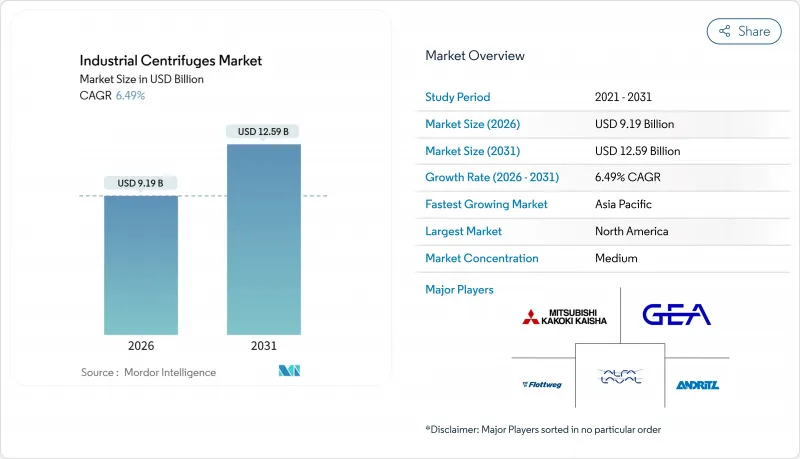
據 Mordor Intelligence 稱,工業離心機市場預計在 2026 年達到 91.9 億美元,預計在預測期(2026-2031 年)內將以 6.49% 的複合年成長率成長,到 2031 年達到 125.9 億美元。
本報告按類型(沉澱/過濾)、設計(水平/垂直)、操作模式(間歇/連續)、行業(食品和飲料、製藥/生物技術、水和廢水處理、化學品、金屬和採礦、發電、紙漿和造紙以及其他行業)和地區(北美、歐洲、亞太地區、南美以及中東和非洲)進行分類。
全球工業離心分離器市場趨勢及洞察
嚴格的污水法規
美國環保署 (EPA) 在《聯邦法規》第 40 篇第 437 部分中製定的標準迫使集中式污水處理廠採用臥螺離心機,這種離心機能夠產生更乾燥的濾餅並減少廢物量。在中國,修訂後的《水污染防治法》正在推動化學園區採用「零排放 (ZLD)」設備,尤其青睞能夠處理鹽水的緊湊型立式離心機。在歐盟,《工業排放指令》的修訂要求紙漿和造紙廠減少懸浮固體,從而促進了向能夠將濁度控制在 10 NTU 以下的盤式分離器的維修。雖然棕地空間的限制使立式離心機具有優勢,但監管合規期限延長至 2028 年,也支撐了多年的售後市場需求。
擴大製藥和生物技術領域的生產能力
2025年,AGC Biologics在哥本哈根的產能加倍,並引進了自動化碟片分離器,將收穫週期縮短了40%。 Griffols位於北卡羅來納州的FDA核准的血漿生產線採用管式離心機,可達到98%的免疫球蛋白純度。模組化潔淨室和一次性生物反應器的普及推動了對撬裝式立式離心機的需求,使契約製造生產商能夠在72小時內切換生產宣傳活動。印度和韓國生物類似藥生產的擴張正在促進成長,過濾離心機能夠提供更精確的粒徑控制,這對生物利用度至關重要。
高額資本投資
礦山尾礦離心機造價可能超過200萬美元,安裝成本還要額外增加40%,迫使南美洲和東南亞的業者延後採購。歐洲供應商現在提供「按噸收費」的契約,將資本支出轉移到原始設備製造商(OEM),但製藥業以外的採用率仍然很低。客製化料斗材料的前置作業時間超過12個月,給企劃案融資時間表帶來了壓力。
細分市場分析
到2025年,沉澱裝置將佔據工業離心機市場佔有率的56.6%,這主要得益於其在採礦、都市污水污泥處理和食用油精煉等領域的成熟應用。用於銅尾礦池的連續式臥螺離心機每小時可處理100立方米物料,並產生固態為22%的濾餅;而乳製品行業的澄清器則可將濁度降低至1 NTU以下。預計過濾裝置的年成長率將達到7.2%,其應用領域包括原料藥結晶、碳酸鋰精煉和特殊化學品精煉。籃式裝置適用於小批量醫藥中間體的生產,而推桿式裝置則用於己二酸晶體的連續加工。鋰電池製造廠使用的剝離式離心機可自動排出濾餅,並保護操作人員免受腐蝕性鹼液飛濺的傷害。隨著 ISO 14644 無塵室標準越來越嚴格,具有整合 CIP(就地清洗)功能的垂直過濾機型正在成為 C 級和 D 級無塵室的標準配備。
這兩種工藝將並存。在加工能力、穩定性和低營運成本至關重要的領域,沉澱法將佔據主導地位;而在純度、洗滌效率和濾餅過濾直接影響產品價值的領域,過濾法將佔據主導地位。這些相互衝突的需求促成了市場需求的平衡,在預測期內,兩種技術都不會完全取代另一種。
到2025年,臥式離心機將佔工業離心機市場的60.1%。這主要得益於採礦、污水處理和船舶應用領域的廣泛應用,這些占地面積更為充足,且低重心設計能夠有效抑制振動。臥式離心機可全天候運作,且只需極少的監控;在船舶燃油淨化領域,臥式碟片組離心機可防止污泥積聚。同時,受潔淨室空間成本高達每平方公尺5000至10,000美元的驅動,立式離心機預計將以7.6%的複合年成長率成長。在AGC Biologics位於哥本哈根的工廠,採用垂直碟片組離心機減少了40%的安裝面積,因此可以在相同的空間內安裝兩條額外的生物反應器生產線。立式剝離離心機能夠更好地控制溶劑,並降低使用易燃溶劑的原料藥生產廠爆炸的風險。在電池回收生產線中,立式臥式離心機更受歡迎,因為架空輸送機可以直接將漿料送入頂部的進料口。
在工業離心機市場,隨著供應商不斷改進混合形狀、傾斜碗或模組化框架,將兩種形式的空間和維護優勢結合起來,預計每個最終用途領域的准入門檻將會降低,從而導致市場融合。
區域分析
在聯邦基礎設施建設資金、電池超級工廠建設以及關鍵藥物活性成分近岸外包的支持下,北美預計到2025年將佔全球銷售額的36.7%。僅Li-Cycle位於羅徹斯特的工廠和BASF計劃在南卡羅來納州建設的工廠就需要大約20台工業離心機來處理黑塊和前體物質。亞伯達省的油砂生產商每年投資5億美元用於尾礦離心機,以滿足土地修復法規的要求;而位於墨西哥的API中心正在部署密封盤式離心機,以符合FDA和EMA的標準。
亞太地區預計將以7.5%的複合年成長率成長,成為全球成長最快的地區。在中國,2024年至2025年間,化學園區新增了300多台臥螺離心機,以滿足零液體排放(ZLD)的要求。在印度海得拉巴-艾哈默德巴德醫藥走廊,面向歐洲和美洲出口市場的生物相似藥生產線正在採用立式盤式分離器。在日本和韓國,市政和工業廢水處理廠正在安裝和維修節能型垂直分離器。東南亞國協在永續性的獎勵下,正在擴大棕櫚油和橡膠的離心分離能力。
在歐洲,工業排放指令的更嚴格規定以及透過修訂都市污水處理指令設定的營養物限值,迫使市政設施升級其沉澱池,而這些系統仍然佔據著較大的市場佔有率。在德國等能源密集地區,採用再生煞車的碗式設計更受青睞,以抵銷高昂的電費。在南美洲,智利銅礦和巴西鋰礦零星地訂購了高價值的訂單。同時,在中東和非洲地區(MEA),阿拉伯聯合大公國和沙烏地阿拉伯正在使用碟式分離器處理海水淡化濃縮液,用於水資源再利用專案。在非洲礦區,由於外匯壁壘,再生產品較受歡迎,銷售量仍較低,但售後服務活躍。
其他好處:
- Excel格式的市場預測(ME)表
- 3個月的分析師支持
目錄
第1章:引言
- 研究假設和市場定義
- 調查範圍
第2章:調查方法
第3章執行摘要
第4章 市場狀況
- 市場概覽
- 市場促進因素
- 嚴格的廢水排放法規
- 擴大製藥和生物技術領域的生產能力
- 食品飲料業的需求;澄清。
- 工業污水強制再利用
- 鋰離子電池回收生產線數量迅速增加
- 擴大藻類生質燃料工廠的規模
- 市場限制因素
- 巨額資本投資
- 營運成本和能源成本不斷上漲
- 透過膜技術展開競爭
- 熟練離心機操作人員短缺
- 供應鏈分析
- 監理情勢
- 技術展望
- 波特五力模型
第5章 市場規模與成長預測
- 按類型
- 沉澱法
- 沉澱池/濃縮池
- 醒酒器
- 盤片堆疊類型
- 水力旋流器
- 其他沉降方法
- 濾
- 籃子
- 滾動螢幕
- 削皮器
- 推手
- 其他篩選
- 沉澱法
- 有意為之
- 水平的
- 垂直的
- 按操作模式
- 批次
- 連續的
- 按行業
- 食品/飲料
- 製藥和生物技術
- 供水和廢水處理
- 化學品
- 金屬和採礦
- 發電
- 紙漿和造紙
- 其他行業
- 按地區
- 北美洲
- 美國
- 加拿大
- 墨西哥
- 歐洲
- 德國
- 英國
- 法國
- 義大利
- 西班牙
- 北歐國家
- 俄羅斯
- 其他歐洲國家
- 亞太地區
- 中國
- 印度
- 日本
- 韓國
- 東南亞國協
- 澳洲和紐西蘭
- 其他亞太國家
- 南美洲
- 巴西
- 阿根廷
- 智利
- 哥倫比亞
- 其他南美國家
- 中東和非洲
- 阿拉伯聯合大公國
- 沙烏地阿拉伯
- 埃及
- 南非
- 奈及利亞
- 其他中東和非洲國家
- 北美洲
第6章 競爭情勢
- 市場集中度
- 策略趨勢(併購、聯盟、購電協議)
- 市場佔有率分析(主要公司的市場排名和佔有率)
- 公司簡介
- Alfa Laval AB
- Flottweg SE
- Multotec(Pty)Ltd
- Mitsubishi Kakoki Kaisha Ltd
- Pieralisi MAIP SpA
- IHI Rotating Machinery
- Hiller Separation & Process
- Flsmidth(Escher Wyss)
- Andritz AG
- Ferrum Ltd
- Thomas Broadbent & Sons Ltd
- Centrisys Corp.
- G-Tech Separation
- FLSmidth & Co. A/S
- Hutchison-Hayes Separation
- GEA Group AG
- MSE Hiller
- HAUS Centrifuge Technologies
- Siebtechnik Tema
- SPX FLOW(Seital)
- Suez Water Technologies
- Andritz-Frautech
第7章 市場機會與未來展望
According to Mordor Intelligence, the industrial centrifuges market size is estimated at USD 9.19 billion in 2026, and is expected to reach USD 12.59 billion by 2031, at a CAGR of 6.49% during the forecast period (2026-2031).
This report is Segmented by Type (Sedimentation and Filtering), Design (Horizontal and Vertical), Operation Mode (Batch and Continuous), Industry (Food and Beverages, Pharmaceutical and Biotech, Water and Wastewater Treatment, Chemical, Metals and Mining, Power Generation, Pulp and Paper, and Other Industries), and Geography (North America, Europe, Asia-Pacific, South America, and Middle East and Africa)
Global Industrial Centrifuges Market Trends and Insights
Stringent Wastewater Regulations
EPA's 40 CFR Part 437 limits are forcing centralized waste-treatment operators to adopt decanter centrifuges that yield drier cake and lower disposal volumes. China's updated Water Pollution Prevention and Control Law drives Zero Liquid Discharge installations in chemical parks, favoring compact vertical designs able to handle saline brines. In the EU, Industrial Emissions Directive updates require pulp-and-paper mills to cut suspended solids, spurring retrofits with disc-stack separators that achieve turbidity below 10 NTU. Brownfield space constraints give vertical machines an edge, while compliance deadlines stretching to 2028 anchor multi-year aftermarket demand.
Capacity Expansion in Pharma & Biotech
AGC Biologics doubled its Copenhagen capacity in 2025 and installed automated disc-stack separators that trim harvest cycle time by 40%. Grifols' FDA-approved plasma line in North Carolina employs tubular-bowl centrifuges to reach 98% immunoglobulin purity. Modular cleanrooms and single-use bioreactors fuel demand for skid-mounted vertical centrifuges, allowing contract manufacturers to switch campaigns within 72 hours. Biosimilar ramp-ups in India and South Korea extend growth, as filtering centrifuges deliver tighter particle-size control critical for bioavailability.
High Capital Expenditure
A mining-tailings decanter can cost more than USD 2 million, and installation adds up to 40% on top, pressuring operators in South America and Southeast Asia to delay purchases. European suppliers now offer pay-per-tonne contracts that shift capex onto the OEM, but uptake remains low outside pharma. Custom bowl materials push lead times past 12 months, stretching project-finance windows.
Other drivers and restraints analyzed in the detailed report include:
- Demand from F&B Clarification
- Industrial Wastewater-Reuse Mandates
- Elevated Operating & Energy Cost
For complete list of drivers and restraints, kindly check the Table Of Contents.
Segment Analysis
Sedimentation equipment retained 56.6% of the industrial centrifuge market share in 2025, thanks to entrenched use in mining, municipal sludge, and edible oil refining. Continuous decanters in copper-tailings ponds treat 100 m3/h and yield cake at 22% solids, while clarifiers in dairy achieve turbidity under 1 NTU. Filtering machines are forecast to grow 7.2% annually, capturing API crystallization, lithium-carbonate refining, and specialty-chemical purification. Basket units suit small-batch drug intermediates, whereas pusher designs run continuous adipic-acid crystals. Peeler centrifuges in battery-grade lithium facilities automate cake discharge and shield operators from caustic spray. As ISO 14644 cleanroom rules tighten, vertical filtering models that integrate clean-in-place features are becoming the standard in Grade C and D suites.
Both categories will coexist: sedimentation variants dominate where throughput, robustness, and low opex rule; filtering types win where purity, wash efficiency, and cake dryness directly influence product value. These divergent requirements underpin a balanced demand outlook and ensure no single technology displaces the other over the forecast window.
Horizontal layouts held 60.1% of the industrial centrifuge market in 2025, driven by mining, wastewater, and shipboard installations where floor space is abundant and low center-of-gravity designs curb vibration. Decanters process 24/7 with minimal oversight, and horizontal disc-stack models in marine fuel-oil purification prevent sludge accumulation. Vertical machines, however, are set to compound 7.6% a year, propelled by cleanroom economics that price space at USD 5,000-10,000 per square meter. AGC Biologics' Copenhagen site realized a 40% footprint saving by selecting vertical disc stacks, enabling two extra bioreactor trains within the same envelope. Vertical peeler centrifuges boost solvent containment, mitigating explosion hazards in flammable-solvent API plants. Battery-recycling lines favor vertical decanters because overhead conveyors feed slurry directly into top-mounted inlets.
The industrial centrifuge market will likely see convergence as suppliers refine hybrid geometries, tilted bowls, or modular frames that blend the space and maintenance advantages of both forms, smoothing adoption barriers across end-use sectors.
Complete Report Scope:
- By Type
- Sedimentation
- Clarifier/Thickener
- Decanter
- Disc-stack
- Hydrocyclone
- Other Sedimentation
- Filtering
- Basket
- Scroll-screen
- Peeler
- Pusher
- Other Filtering
- Sedimentation
- By Design
- Horizontal
- Vertical
- By Operation Mode
- Batch
- Continuous
- By Industry
- Food and Beverages
- Pharmaceutical and Biotech
- Water and Wastewater Treatment
- Chemical
- Metals and Mining
- Power Generation
- Pulp and Paper
- Other Industries
- By Geography
- North America
- United States
- Canada
- Mexico
- Europe
- Germany
- United Kingdom
- France
- Italy
- Spain
- NORDIC Countries
- Russia
- Rest of Europe
- Asia-Pacific
- China
- India
- Japan
- South Korea
- ASEAN Countries
- Australia and New Zealand
- Rest of Asia-Pacific
- South America
- Brazil
- Argentina
- Chile
- Colombia
- Rest of South America
- Middle East and Africa
- United Arab Emirates
- Saudi Arabia
- Egypt
- South Africa
- Nigeria
- Rest of Middle East and Africa
- North America
Geography Analysis
North America secured 36.7% of 2025 revenue, buoyed by federal infrastructure funds, battery gigafactory buildouts, and near-shoring of critical pharma actives. Li-Cycle's Rochester and BASF's planned South Carolina sites alone will need roughly 20 industrial centrifuges for black-mass and precursor processing. Alberta's oil-sands producers invest USD 500 million annually in tailings decanters to satisfy reclamation rules, while Mexico's API hubs add hermetic disc stacks to comply with FDA and EMA standards.
Asia-Pacific is projected to log a 7.5% CAGR, the fastest global clip. China's chemical parks deployed more than 300 new decanters across 2024-2025 to meet Zero Liquid Discharge obligations. India's Hyderabad-Ahmedabad pharma corridor adopts vertical disc stacks for biosimilar lines targeting Western export markets. Japan and South Korea retrofit municipal and industrial wastewater plants with energy-saving vertical separators, and ASEAN nations scale palm-oil and rubber centrifuge capacity amid sustainability incentives.
Europe retains a sizeable share as the Industrial Emissions Directive tightens limits and the revised Urban Wastewater Treatment Directive imposes nutrient caps, compelling clarifier upgrades in municipal facilities. Energy-intensive regions like Germany favor bowl designs with regenerative braking to offset high electricity tariffs. South America sees sporadic yet high-value orders in Chilean copper and Brazilian lithium mines, while MEA water-reuse projects in the UAE and Saudi Arabia rely on disc-stack separators for desalination brine. Africa's mining belts prefer refurbished units due to foreign-exchange hurdles, keeping sales volumes low but aftermarket services active.
- Alfa Laval AB
- Flottweg SE
- Multotec (Pty) Ltd
- Mitsubishi Kakoki Kaisha Ltd
- Pieralisi MAIP S.p.A
- IHI Rotating Machinery
- Hiller Separation & Process
- Flsmidth (Escher Wyss)
- Andritz AG
- Ferrum Ltd
- Thomas Broadbent & Sons Ltd
- Centrisys Corp.
- G-Tech Separation
- FLSmidth & Co. A/S
- Hutchison-Hayes Separation
- GEA Group AG
- MSE Hiller
- HAUS Centrifuge Technologies
- Siebtechnik Tema
- SPX FLOW (Seital)
- Suez Water Technologies
- Andritz-Frautech
Additional Benefits:
- The market estimate (ME) sheet in Excel format
- 3 months of analyst support
TABLE OF CONTENTS
1 Introduction
- 1.1 Study Assumptions & Market Definition
- 1.2 Scope of the Study
2 Research Methodology
3 Executive Summary
4 Market Landscape
- 4.1 Market Overview
- 4.2 Market Drivers
- 4.2.1 Stringent wastewater regulations
- 4.2.2 Capacity expansion in pharma & biotech
- 4.2.3 Demand from F&B clarification
- 4.2.4 Industrial wastewater reuse mandates
- 4.2.5 Surge in Li-ion battery recycling lines
- 4.2.6 Scale-up of algae-based biofuel plants
- 4.3 Market Restraints
- 4.3.1 High capital expenditure
- 4.3.2 Elevated operating & energy cost
- 4.3.3 Competition from membrane tech
- 4.3.4 Shortage of skilled centrifuge operators
- 4.4 Supply-Chain Analysis
- 4.5 Regulatory Landscape
- 4.6 Technological Outlook
- 4.7 Porter's Five Forces
- 4.7.1 Bargaining Power of Suppliers
- 4.7.2 Bargaining Power of Buyers
- 4.7.3 Threat of New Entrants
- 4.7.4 Threat of Substitutes
- 4.7.5 Intensity of Rivalry
5 Market Size & Growth Forecasts
- 5.1 By Type
- 5.1.1 Sedimentation
- 5.1.1.1 Clarifier/Thickener
- 5.1.1.2 Decanter
- 5.1.1.3 Disc-stack
- 5.1.1.4 Hydrocyclone
- 5.1.1.5 Other Sedimentation
- 5.1.2 Filtering
- 5.1.2.1 Basket
- 5.1.2.2 Scroll-screen
- 5.1.2.3 Peeler
- 5.1.2.4 Pusher
- 5.1.2.5 Other Filtering
- 5.1.1 Sedimentation
- 5.2 By Design
- 5.2.1 Horizontal
- 5.2.2 Vertical
- 5.3 By Operation Mode
- 5.3.1 Batch
- 5.3.2 Continuous
- 5.4 By Industry
- 5.4.1 Food and Beverages
- 5.4.2 Pharmaceutical and Biotech
- 5.4.3 Water and Wastewater Treatment
- 5.4.4 Chemical
- 5.4.5 Metals and Mining
- 5.4.6 Power Generation
- 5.4.7 Pulp and Paper
- 5.4.8 Other Industries
- 5.5 By Geography
- 5.5.1 North America
- 5.5.1.1 United States
- 5.5.1.2 Canada
- 5.5.1.3 Mexico
- 5.5.2 Europe
- 5.5.2.1 Germany
- 5.5.2.2 United Kingdom
- 5.5.2.3 France
- 5.5.2.4 Italy
- 5.5.2.5 Spain
- 5.5.2.6 NORDIC Countries
- 5.5.2.7 Russia
- 5.5.2.8 Rest of Europe
- 5.5.3 Asia-Pacific
- 5.5.3.1 China
- 5.5.3.2 India
- 5.5.3.3 Japan
- 5.5.3.4 South Korea
- 5.5.3.5 ASEAN Countries
- 5.5.3.6 Australia and New Zealand
- 5.5.3.7 Rest of Asia-Pacific
- 5.5.4 South America
- 5.5.4.1 Brazil
- 5.5.4.2 Argentina
- 5.5.4.3 Chile
- 5.5.4.4 Colombia
- 5.5.4.5 Rest of South America
- 5.5.5 Middle East and Africa
- 5.5.5.1 United Arab Emirates
- 5.5.5.2 Saudi Arabia
- 5.5.5.3 Egypt
- 5.5.5.4 South Africa
- 5.5.5.5 Nigeria
- 5.5.5.6 Rest of Middle East and Africa
- 5.5.1 North America
6 Competitive Landscape
- 6.1 Market Concentration
- 6.2 Strategic Moves (M&A, Partnerships, PPAs)
- 6.3 Market Share Analysis (Market Rank/Share for key companies)
- 6.4 Company Profiles (includes Global level Overview, Market level overview, Core Segments, Financials as available, Strategic Information, Products & Services, and Recent Developments)
- 6.4.1 Alfa Laval AB
- 6.4.2 Flottweg SE
- 6.4.3 Multotec (Pty) Ltd
- 6.4.4 Mitsubishi Kakoki Kaisha Ltd
- 6.4.5 Pieralisi MAIP S.p.A
- 6.4.6 IHI Rotating Machinery
- 6.4.7 Hiller Separation & Process
- 6.4.8 Flsmidth (Escher Wyss)
- 6.4.9 Andritz AG
- 6.4.10 Ferrum Ltd
- 6.4.11 Thomas Broadbent & Sons Ltd
- 6.4.12 Centrisys Corp.
- 6.4.13 G-Tech Separation
- 6.4.14 FLSmidth & Co. A/S
- 6.4.15 Hutchison-Hayes Separation
- 6.4.16 GEA Group AG
- 6.4.17 MSE Hiller
- 6.4.18 HAUS Centrifuge Technologies
- 6.4.19 Siebtechnik Tema
- 6.4.20 SPX FLOW (Seital)
- 6.4.21 Suez Water Technologies
- 6.4.22 Andritz-Frautech
7 Market Opportunities & Future Outlook
- 7.1 White-space & Unmet-need Assessment

 水力旋流器市場:全球市場預測,2026-2032年工業離心分離器市場-2026-2032年全球市場預測
 北美工業離心機:市佔率分析、產業趨勢與統計及成長預測(2026-2031 年)
 工業離心機市場:規模、佔有率、成長、全球產業分析、區域趨勢及2026-2034年預測
 沉澱和離心分離市場報告:按產品和地區分類 2026-2034 年離心分離器市場:按類型、容量、材質、設計、最終用戶和銷售管道分類-2026-2032年全球市場預測澱粉回收系統市場:按設備類型、終端用戶產業、分銷管道和應用分類的全球預測,2026-2032年濕式離心離合器市場:依產品類型、摩擦材料、額定功率、銷售管道、應用、最終用戶分類,全球預測(2026-2032年)鑽井液減速器市場:按類型、設備配置、技術、鑽井應用、最終用戶分類,全球預測(2026-2032年)旋風乾燥機市場:依技術、運作模式、產能、終端用戶產業及通路分類,全球預測,2026-2032年