


 |
市場調查報告書
商品編碼
2115139
土壤改良劑:市場佔有率分析、行業趨勢和統計數據、成長預測(2026-2031 年)Soil Conditioners - Market Share Analysis, Industry Trends & Statistics, Growth Forecasts (2026 - 2031) |
||||||

※ 本網頁內容可能與最新版本有所差異。詳細情況請與我們聯繫。
根據 Mordor Intelligence 預測,土壤改良劑市場規模將從 2025 年的 44.5 億美元成長到 2026 年的 48.1 億美元,到 2031 年將達到 70.6 億美元,2026 年至 2031 年的複合年成長率為 7.99%。
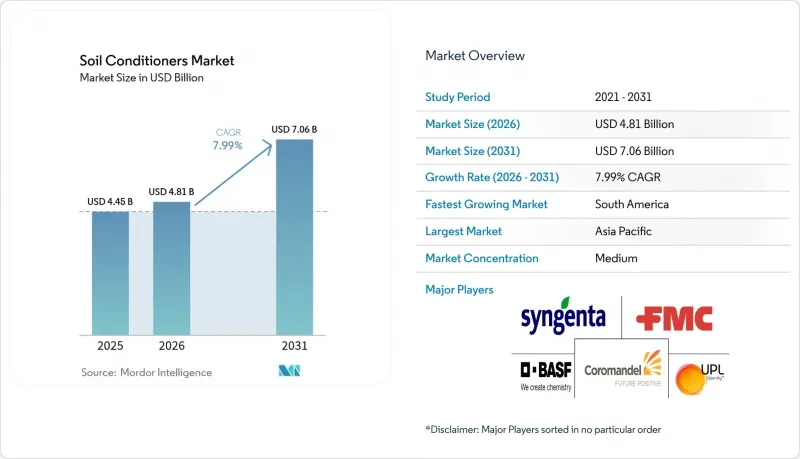
本報告按產品類型(有機和無機)、作物類型(穀物、水果和蔬菜等)、製劑形式(乾粉、液體、顆粒等)和地區(北美、歐洲、南美、亞太等)進行細分。市場預測以美元計價。
全球土壤改良劑市場趨勢及洞察
擴大有機和再生農業的影響範圍
全球向再生農業的轉型正在推動土壤改良劑市場的擴張。 2022年,有機蔬果零售額達600億美元,凸顯了消費者為永續種植的農產品支付更高價格的意願。 Agrology公司2024年的一項研究表明,在易旱果園中,用作覆蓋作物的默塞德干大麥能夠增強土壤微生物活性和保水能力。隨著農民尋求既符合土壤健康標準又符合認證標準的材料,有機土壤改良劑的需求正在加速成長。
土壤劣化和侵蝕問題日益嚴重。
目前,約40%的農業用地被列為土壤劣化地區,威脅糧食安全。亞太地區和非洲受到的影響尤其嚴重。在土壤修復試驗中,生物炭的應用已證實可使土壤保水能力提高高達154%,植物生長量提高約70%。因此,土壤改良劑市場被視為恢復農業生產力、減輕土地劣化所帶來的經濟損失的重要戰略手段。
高級土壤改良劑價格高昂
酵素活性和微生物土壤改良劑價格較高,反映了其研發投入巨大。早期採用者可以透過提高產量和排碳權來證明其成本合理,但發展中市場的小規模農戶仍然對價格敏感。製造商也努力透過開發分階段的產品線來緩解土壤改良劑市場受到的負面影響,以滿足不同消費者的購買力。
細分市場分析
到2025年,有機材料將佔土壤改良劑市場55.60%的佔有率,但酶強化產品預計到2031年將以8.54%的複合年成長率成長,這主要得益於市場對無殘留農產品需求的成長以及對生物來源材料的監管支持。有機材料也符合碳權框架,進一步促進了其應用。在該領域,酵素強化有機材料正在興起,它們能夠加快養分循環並促進微團聚體的形成。
儘管無機改良劑市場規模較小,但它持續致力於解決重粘土土壤的酸鹼失衡和結構問題,液態石膏也在英國新的農業法案合規計劃中獲得了認可。在土壤改良劑市場,以聚合物為基體的顆粒劑正被積極研發,這類產品兼具改善土壤結構和增強保水性的雙重功效。
區域分析
2025年,亞太地區將佔據土壤改良劑市場37.90%的佔有率,其中南美洲是成長最快的地區,複合年成長率達8.15%。廣大的農業基礎和嚴峻的土壤侵蝕挑戰是推動土壤改良劑市場成長的主要動力。中國和印度政府對有機材料提供補貼,日本和澳洲也積極推廣保護性耕作。貴州省的田間試驗表明,生質能灰基土壤改良劑可顯著改善土壤性能,包括土壤pH值提高13.6%,作物產量提高25.3%。
在歐洲、中東和非洲,隨著政策轉變將土壤健康納入農業立法,市場成長最為迅速。歐盟的有機農業目標要求採用基於生物學方法的土壤肥力管理。雖然生物炭在德國和北歐國家的使用量激增,但非洲的回收舉措表明,有機和生物肥料可以滿足作物20%至40%的營養需求。
北美在土壤改良劑市場中保持著技術領先地位。目前,排碳權帶來的收入正在抵消保護性農業初期帶來的產量損失,從而支持對土壤改良劑的投資。精密農業平台透過將建議的土壤改良劑用量與儀器安裝的可變施用裝置相結合,進一步鞏固了主導地位。
其他好處:
- Excel格式的市場預測(ME)表
- 3個月的分析師支持
目錄
第1章:引言
- 研究假設和市場定義
- 調查範圍
第2章:調查方法
第3章執行摘要
第4章 市場狀況
- 市場概覽
- 市場促進因素
- 有機農業和再生農業正在逐步推廣。
- 土壤劣化和侵蝕進程
- 保護性耕作和垂直農業的耕地面積迅速擴大。
- 將排碳權貨幣化,用於改善土壤健康的舉措
- 酵素活化生物調節劑可提高營養物質的利用效率。
- 政府的「每千人 4 人」等土壤碳排放計劃以及類似的土壤碳舉措,將補貼與土壤改良劑的引入掛鉤。
- 市場限制因素
- 高級土壤改良劑價格較高
- 諮商體系碎片化與農場意識不足
- 關於新興生物促效劑分類的監管不確定性
- 特種原料供應鏈風險
- 波特五力模型
第5章 市場規模與成長預測
- 依產品類型
- 有機的
- 堆肥
- 綠肥和牲畜糞便
- 皮特
- 其他有機產品
- 無機物
- 聚合物
- 石膏
- 有機的
- 按作物類型
- 穀類和穀類食品
- 水果和蔬菜
- 油籽/豆類
- 其他作物
- 配方
- 乾燥
- 液體
- 顆粒狀
- 顆粒和其他
- 按地區
- 北美洲
- 美國
- 加拿大
- 墨西哥
- 其他北美國家
- 南美洲
- 巴西
- 阿根廷
- 其他南美國家
- 歐洲
- 德國
- 法國
- 英國
- 西班牙
- 義大利
- 俄羅斯
- 其他歐洲國家
- 亞太地區
- 中國
- 印度
- 日本
- 澳洲
- 其他亞太國家
- 中東
- 沙烏地阿拉伯
- 其他中東國家
- 非洲
- 南非
- 其他非洲國家
- 北美洲
第6章 競爭情勢
- 市場集中度
- 策略趨勢
- 市佔率分析
- 公司簡介
- BASF SE
- UPL Limited
- Syngenta Group
- Croda International Plc
- Solvay SA
- Evonik Industries AG
- Coromandel International Ltd.
- Novonesis Group
- Humintech GmbH
- FMC Corporation
- Yara International ASA
- Haifa Group
第7章 市場機會與未來展望
According to Mordor Intelligence, the soil conditioners market size is expected to grow from USD 4.45 billion in 2025 to USD 4.81 billion in 2026 and is forecast to reach USD 7.06 billion by 2031 at 7.99% CAGR over 2026-2031.
This report is Segmented by Product Type (Organic and Inorganic), by Crop Type (Cereals and Grains, Fruits and Vegetables, and More), by Formulation (Dry, Liquid, Granular, and More), and by Geography (North America, Europe, South America, Asia-Pacific, and More). The Market Forecasts are Provided in Terms of Value (USD).
Global Soil Conditioners Market Trends and Insights
Rising Adoption of Organic and Regenerative Farming
A global pivot toward regenerative practices is elevating the soil conditioners market. Retail sales of organic fruits and vegetables reached USD 60 billion in 2022, underscoring consumer willingness to pay for sustainably grown produce. Agrology's 2024 trials revealed that Merced rye cover crops boosted microbial activity and soil water retention in drought-prone orchards. As farmers seek inputs compatible with both soil health and certification standards, demand for organic conditioners accelerates.
Increasing Soil Health Degradation and Erosion
Roughly 40% of farmland is now classified as degraded, placing food security at risk, with the most severe effects in Asia-Pacific and Africa. Biochar applications have demonstrated water-retention gains of up to 154% and plant-growth increases of nearly 70% in rehabilitation trials. The soil conditioners market is therefore viewed as a strategic lever to restore productivity and mitigate the economic drag linked to land degradation.
Premium Pricing of Advanced Soil Conditioners
Enzyme-activated and microbial conditioners can command higher prices, reflecting their high R&D intensity. While early adopters justify the cost through higher yields and carbon credits, smallholders in developing markets remain price-sensitive. Producers are also experimenting with tiered product lines to accommodate diverse purchasing power, tempering the negative impact on the soil conditioners market.
Other drivers and restraints analyzed in the detailed report include:
- Rapid Growth in Protected and Vertical Farming Acreage
- Carbon-Credit Monetization for Soil-Health Inputs
- Fragmented On-Farm Advisory and Awareness Gaps
For complete list of drivers and restraints, kindly check the Table Of Contents.
Segment Analysis
Organic inputs held 55.60% of the soil conditioners market share in 2025, while enzyme-enhanced variants are predicted to grow at an 8.54% CAGR through 2031, aided by burgeoning demand for residue-free produce and regulatory support for biological inputs. Organic amendments also align with carbon credit frameworks, reinforcing their uptake. Enzyme-enhanced organic variants are emerging within this space, offering faster nutrient cycling and micro-aggregate formation.
The inorganic segment, although smaller, continues to address pH imbalances and structural issues in heavy soils, with liquid gypsum gaining favour in the United Kingdom's new Agriculture Bill compliance programs. The soil conditioners market is witnessing increased R&D in polymer-based micro-granules that combine soil structural benefits with enhanced moisture retention.
Complete Report Scope:
- By Product Type
- Organic
- Compost
- Green and Farmyard Manure
- Peat
- Other Organic Types
- Inorganic
- Polymers
- Gypsum
- Organic
- By Crop Type
- Cereals and Grains
- Fruits and Vegetables
- Oilseeds and Pulses
- Other Crops
- By Formulation
- Dry
- Liquid
- Granular
- Pellets and Others
- By Geography
- North America
- United States
- Canada
- Mexico
- Rest of North America
- South America
- Brazil
- Argentina
- Rest of South America
- Europe
- Germany
- France
- United Kingdom
- Spain
- Italy
- Russia
- Rest of Europe
- Asia-Pacific
- China
- India
- Japan
- Australia
- Rest of Asia-Pacific
- Middle East
- Saudi Arabia
- Rest of Middle East
- Africa
- South Africa
- Rest of Africa
- North America
Geography Analysis
Asia-Pacific accounted for 37.90% of the market share of the soil conditioners market in 2025, and South America is the fastest-growing region at 8.15% CAGR. An extensive agricultural base and acute challenges related to soil erosion drive the soil conditioners market. Government programs in China and India subsidise organic inputs, and protected cultivation is expanding in Japan and Australia. Biomass-ash conditioners increased soil pH by up to 13.6% and crop yield by 25.3% in Guizhou field tests, demonstrating notable performance gains.
Europe, the Middle East, and Africa record the fastest market growth as policy shifts embed soil health into agricultural legislation. The European Union's organic-farming targets mandate biologically driven fertility management. Biochar adoption is surging in Germany and the Nordics, while African recycling initiatives propose that organic and bio-fertiliser streams could supply 20-40% of crop nutrient demand.
North America maintains a technologically advanced position within the soil conditioners market. Carbon-credit revenues now offset early yield dips associated with conservation agriculture, underpinning investments in soil amendments. Precision-ag platforms integrate soil-conditioner recommendations with equipment-mounted variable-rate applicators, reinforcing regional leadership.
- BASF SE
- UPL Limited
- Syngenta Group
- Croda International Plc
- Solvay S.A.
- Evonik Industries AG
- Coromandel International Ltd.
- Novonesis Group
- Humintech GmbH
- FMC Corporation
- Yara International ASA
- Haifa Group
Additional Benefits:
- The market estimate (ME) sheet in Excel format
- 3 months of analyst support
TABLE OF CONTENTS
1 Introduction
- 1.1 Study Assumptions and Market Definition
- 1.2 Scope of the Study
2 Research Methodology
3 Executive Summary
4 Market Landscape
- 4.1 Market Overview
- 4.2 Market Drivers
- 4.2.1 Rising adoption of organic and regenerative farming
- 4.2.2 Increasing soil-health degradation and erosion
- 4.2.3 Rapid growth in protected and vertical farming acreage
- 4.2.4 Carbon-credit monetization for soil-health inputs
- 4.2.5 Enzyme-activated bio-conditioners boosting nutrient-use efficiency
- 4.2.6 Government "4 per 1000" and similar soil-carbon initiatives are linking subsidies to conditioner adoption
- 4.3 Market Restraints
- 4.3.1 Premium pricing of advanced soil conditioners
- 4.3.2 Fragmented on-farm advisory and awareness gaps
- 4.3.3 Regulatory uncertainty on emerging bio-stimulant classifications
- 4.3.4 Supply-chain risk for speciality raw materials
- 4.4 Porter's Five Forces
- 4.4.1 Bargaining Power of Buyers
- 4.4.2 Bargaining Power of Suppliers
- 4.4.3 Threat of New Entrants
- 4.4.4 Threat of Substitute Products
- 4.4.5 Intensity of Competitive Rivalry
5 Market Size and Growth Forecasts (Value)
- 5.1 By Product Type
- 5.1.1 Organic
- 5.1.1.1 Compost
- 5.1.1.2 Green and Farmyard Manure
- 5.1.1.3 Peat
- 5.1.1.4 Other Organic Types
- 5.1.2 Inorganic
- 5.1.2.1 Polymers
- 5.1.2.2 Gypsum
- 5.1.1 Organic
- 5.2 By Crop Type
- 5.2.1 Cereals and Grains
- 5.2.2 Fruits and Vegetables
- 5.2.3 Oilseeds and Pulses
- 5.2.4 Other Crops
- 5.3 By Formulation
- 5.3.1 Dry
- 5.3.2 Liquid
- 5.3.3 Granular
- 5.3.4 Pellets and Others
- 5.4 By Geography
- 5.4.1 North America
- 5.4.1.1 United States
- 5.4.1.2 Canada
- 5.4.1.3 Mexico
- 5.4.1.4 Rest of North America
- 5.4.2 South America
- 5.4.2.1 Brazil
- 5.4.2.2 Argentina
- 5.4.2.3 Rest of South America
- 5.4.3 Europe
- 5.4.3.1 Germany
- 5.4.3.2 France
- 5.4.3.3 United Kingdom
- 5.4.3.4 Spain
- 5.4.3.5 Italy
- 5.4.3.6 Russia
- 5.4.3.7 Rest of Europe
- 5.4.4 Asia-Pacific
- 5.4.4.1 China
- 5.4.4.2 India
- 5.4.4.3 Japan
- 5.4.4.4 Australia
- 5.4.4.5 Rest of Asia-Pacific
- 5.4.5 Middle East
- 5.4.5.1 Saudi Arabia
- 5.4.5.2 Rest of Middle East
- 5.4.6 Africa
- 5.4.6.1 South Africa
- 5.4.6.2 Rest of Africa
- 5.4.1 North America
6 Competitive Landscape
- 6.1 Market Concentration
- 6.2 Strategic Moves
- 6.3 Market Share Analysis
- 6.4 Company Profiles (Includes Global level Overview, Market level overview, Core Segments, Financials as available, Strategic Information, Market Rank/Share, Products and Services, Recent Developments)
- 6.4.1 BASF SE
- 6.4.2 UPL Limited
- 6.4.3 Syngenta Group
- 6.4.4 Croda International Plc
- 6.4.5 Solvay S.A.
- 6.4.6 Evonik Industries AG
- 6.4.7 Coromandel International Ltd.
- 6.4.8 Novonesis Group
- 6.4.9 Humintech GmbH
- 6.4.10 FMC Corporation
- 6.4.11 Yara International ASA
- 6.4.12 Haifa Group
7 Market Opportunities and Future Outlook

 土壤改良劑市場:全球市場預測,2026-2032年
 全球土壤改良劑市場規模、佔有率、趨勢和成長分析報告(2026-2034年)土壤改良劑市場-2026-2032年全球市場預測
 土壤改良劑市場預測至2034年-按產品類型、形態、功能、通路、應用、最終用戶和地區分類的全球分析
 土壤改良劑市場規模、佔有率和成長分析:按產品類型、作物類型、應用方法和地區分類-2026-2033年產業預測
 土壤肥力檢測市場規模、佔有率和成長分析:按檢測類型、方法、應用、最終用戶和地區分類-2026-2033年產業預測
 土壤改良劑:市場佔有率分析、行業趨勢和統計數據、成長預測(2025-2030 年)
 土壤改良劑市場:依產品類型、土壤類型、作物類型、應用和地區分類。全球土壤燻蒸劑市場規模、佔有率、趨勢和成長分析報告(2026-2034年)
 2026年全球土壤肥力檢測市場報告