


 |
市場調查報告書
商品編碼
2115070
歐洲汽車座椅:市佔率分析、產業趨勢與統計及成長預測(2026-2031)Europe Automotive Seat - Market Share Analysis, Industry Trends & Statistics, Growth Forecasts (2026 - 2031) |
||||||

※ 本網頁內容可能與最新版本有所差異。詳細情況請與我們聯繫。
據 Mordor Intelligence 稱,2025 年歐洲汽車座椅市值為 158.1 億美元,預計到 2031 年將達到 200.7 億美元,而 2026 年為 164.5 億美元,預測期(2026-2031 年)的複合年成長率為 4.06%。
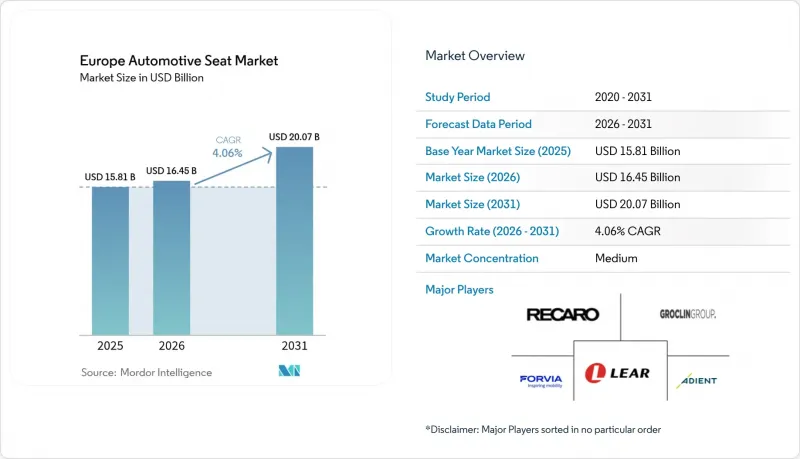
本報告按材質(真皮、合成皮革(PU)等)、技術(標準/手動、電動/可調節等)、車輛類型(乘用車、商用車)、座椅組件(框架/結構、泡棉/襯墊等)、銷售管道(OEM、售後市場)和地區進行細分。市場預測以美元計價。
歐洲汽車座椅市場的趨勢與洞察
快速的電氣化正在為座椅帶來新的溫度控管功能。
隨著電池式電動車(BEV)佔有率的增加,車內供暖不再依賴引擎廢熱。根據Vitesco的數據顯示,48V座椅加熱器可將整體HVAC負載降低三分之一,從而提高冬季續航里程的可靠性,這在北歐的嚴寒氣候下至關重要。電動汽車座椅整合了具有主動通風、區域微氣候控制和自我診斷功能的電力電子元件。設計團隊正在測試新型材料層壓板和導電泡沫,以解決電池線束附近的電磁相容性(EMC)限制。溫度控管專家可以檢驗長期振動和溫度波動,隨著需求的激增,歐洲汽車座椅市場正朝著每輛車配備更高搭載率電子元件的方向發展。
歐盟通用安全法規 2019/2144 強制要求使用先進的座椅感測器。
自2024年7月起,所有在歐洲銷售的新車都必須配備基於創新座椅電子技術的乘員狀態偵測和安全帶未繫提醒系統。壓力感測器墊、體重分類裝置和基於攝影機的姿態追蹤系統現已成為消費級車型的標準配備。 FORVIA和Lear公司在ADAS系統中整合了冗餘CAN節點,以確保資料完整性,從而將座椅轉變為即時乘員資訊中心。據認證機構稱,與座椅相關的EMC測試增加了五分之二,雖然工程進度有所延長,但合規性得到了保障。這項法規刺激了車隊車輛的售後改裝,並進一步擴大了歐洲汽車座椅市場對感測器套件的需求。
座椅所用電子元件晶片短缺,價格上漲。
智慧座椅最多可容納 15 個微控制器和電源驅動器,但車規級微控制器的前置作業時間從 2024 年的 14 週激增至 38 週。在斯洛伐克,乘員感測器專用積體電路 (ASIC) 的供應中斷導致一條高階 SUV 生產線停產九個班次。一些供應商正在重新設計基板,將功能整合到現有的處理器中,晶片數量減少了八倍,但研發成本卻不斷增加。在台灣和歐洲擁有雙重採購安排的公司正在成功應對這些波動,並從歐洲汽車座椅市場的原始設備製造商 (OEM) 獲得了緊急轉移的訂單。從長遠來看,建造本地半導體製造工廠或許可以緩解這些限制,但預計產能的提高要到 2027 年或更晚才能解決短缺問題。
細分市場分析
由於合成PU皮革具有表面品質均勻、設計靈活以及缺陷率低於真皮等優點,預計到2025年,合成PU皮革將佔據歐洲汽車座椅市場43.02%的佔有率。生物基PU皮革雖然仍屬於小眾市場,但隨著汽車製造商發布生命週期報告,量化證明其碳排放量減少了25%,其複合年成長率正以4.12%的速度成長。再生PET布料的技術創新使製造商能夠在不影響耐磨性的前提下,滿足歐盟關於廢棄產品處置的指令,而耐磨性是共享汽車內裝的關鍵指標。真皮仍然用於旗艦車型的內飾,但由於六價鉻法規導致後處理成本上升,大眾品牌正在轉向使用純素材料。複合材料和3D針織座椅套透過提供更輕的重量和更好的透氣性,幫助電動車滿足嚴格的續航里程目標。
歐洲汽車座椅市場的參與企業正透過將水性聚氨酯塗料與低揮發性黏合劑(VOC)背膠相結合,大幅減少製程用水量和固化所需的能源。供應鏈正在多元化發展,東歐的紡紗廠生產再生紗線,以抵消西歐的人事費用。儘管原料價格仍然波動,但生物基材料的長期合約正在穩定投入成本。永續紡織品標籤透過提升展示室吸引力和提高消費者接受度,正在加速歐洲汽車座椅市場材料結構的轉型。
歐盟指令GSR 2019/2144強制要求所有新車配備乘員監測功能,預計到2031年,整合ADAS(高級駕駛輔助系統)的智慧座椅將達到4.15%的複合年成長率。電動調整座椅目前仍佔據歐洲汽車座椅市場36.20%的佔有率,這主要得益於消費者對多向舒適性的既定期望。北歐的冬季氣候使得加熱坐墊的需求量居高不下,而地中海氣候則促使透氣孔設計的應用。高階汽車製造商正在將按摩功能和姿勢矯正演算法融入座椅,以記錄駕駛員疲勞情況,並將這些數據與雲端分析平台共用,從而提供預測性醫療保健服務。
歐洲汽車座椅產業的先驅者們正在將座椅ECU和區域控制器整合在一起,每套座椅的線束重量可減輕800克。無線韌體更新支援遠端編輯舒適曲線,使座椅成為軟體定義功能。模組化電子元件便於根據安全法規的變化進行合規性更新,並透過基於訂閱的按摩程序提供持續的收入模式,從而帶來競爭優勢。隨著半導體供應的正常化,配備ADAS功能的座椅將擴展到C級跨界車型,進一步提升電子元件在歐洲汽車座椅市場的附加價值。
其他好處:
- Excel格式的市場預測(ME)表
- 3個月的分析師支持
目錄
第1章:引言
- 研究假設和市場定義
- 調查範圍
第2章:調查方法
第3章執行摘要
第4章 市場狀況
- 市場概覽
- 市場促進因素
- 快速的電氣化過程催生了具有溫度控管功能的新型座椅特性。
- 歐盟通用安全法規 2019/2144 強制安裝先進的座椅感知器。
- OEM廠商對輕量化複合材料座椅框架的需求不斷成長。
- 推廣循環室內裝飾材料(再生PET和生物基PU)的永續性
- 電子商務平台推動了售後客製化市場的蓬勃發展
- 車輛數量增加/共享出行服務中耐用且易於維護的座椅維修週期
- 市場限制因素
- 電子元件短缺和價格飆升
- 聚氨酯和皮革的原料成本波動很大。
- 由於電動車產量波動,歐洲的組裝產能未能充分利用。
- 歐盟加強對皮革加工廢水中六價鉻的化學品監管。
- 價值供應鏈分析
- 監理情勢
- 技術展望
- 波特五力模型
第5章 市場規模與成長預測
- 材料
- 真皮
- 合成皮革-PU
- 合成革-PVC
- 織物
- 複合材料/3D針織
- 其他
- 透過技術
- 標準/手動
- 電動/可調節
- 加熱類型
- 通風類型
- 按摩
- 智慧ADAS整合
- 兒童安全座椅
- 車輛類型
- 搭乘用車
- 掀背車
- 轎車
- SUV/跨界車
- MPV
- 商用車輛
- 輕型商用車
- 大型卡車
- 巴士/長途巴士
- 搭乘用車
- 座椅部件
- 框架和結構部件
- 泡棉墊
- 內部裝潢建材和裝飾
- 馬達和執行器
- 感知器和ECU
- 安全氣囊及約束裝置
- 按銷售管道
- 目的地設備製造商 (OEM)
- 售後市場
- 國家
- 德國
- 英國
- 法國
- 義大利
- 西班牙
- 荷蘭
- 波蘭
- 瑞典
- 俄羅斯
- 其他歐洲國家
第6章 競爭情勢
- 市場集中度
- 策略趨勢
- 市佔率分析
- 公司簡介
- Adient plc
- Lear Corporation
- Forvia SE(Faurecia SE)
- Magna International Inc.
- Brose Fahrzeugteile SE & Co. KG
- Toyota Boshoku Corporation
- TACHI-S CO., LTD.
- TS Tech Co. Ltd.
- Gentherm Inc.
- RECARO Automotive Italy Srl
- Sparco SpA
- Britax Romer
- Maxi-Cosi(Dorel)
- RENNTech Seats
- Grammer AG
- Groclin SA
- Kongsberg Automotive
- Hyundai Transys
- Johnson Controls(Trimlines)
第7章 市場機會與未來展望
According to Mordor Intelligence, the Europe automotive seat market size was valued at USD 15.81 billion in 2025 and estimated to grow from USD 16.45 billion in 2026 to reach USD 20.07 billion by 2031, at a CAGR of 4.06% during the forecast period (2026-2031).
This report is Segmented by Material (Genuine Leather, Synthetic Leather PU, and More), Technology (Standard/Manual, Powered/Adjustable, and More), Vehicle Type (Passenger Car and Commercial Vehicle), Seat Component (Frame & Structures, Foam & Padding, and More), Sales Channel (OEM and Aftermarket), and Geography. The Market Forecasts are Provided in Terms of Value (USD).
Europe Automotive Seat Market Trends and Insights
Rapid Electrification Creating New Thermal-Management Seat Features
A high BEV share means cabin heating no longer taps engine waste heat. Vitesco data show 48 V seat heaters slash whole-vehicle HVAC load by one-third, raising winter-range credibility-vital in Nordic sub-zero climates EV-centric seats gain active ventilation, zonal micro-climate control, and self-diagnosing power electronics. Design teams juggle electromagnetic-compatibility constraints next to battery cabling, triggering fresh material stack-ups and conductive-foam trials. Thermal specialists can validate long-cycle vibration and temperature swings and see demand surge, propelling the European automotive seat market toward higher electronic content per unit.
EU General Safety Regulation 2019/2144 Mandating Advanced Seat Sensors
Since July 2024, every new European vehicle must host occupant-status detection and belt reminders rooted in innovative seat electronics. Pressure mats, weight classifiers, and camera-assisted posture tracking now ship standard on mass-market trims. FORVIA and Lear embed redundant CAN nodes to guarantee data integrity for ADAS stacks, turning the seat into a real-time occupant-intelligence hub. Certification labs note a two-fifths increase in seat-related EMC tests, extending program timelines yet assuring compliance. The regulation sparks aftermarket retrofits for fleet vehicles, further stretching the supply of sensor kits across the European automotive seat market.
Seat-Electronics Chip Shortages and Price Spikes
Smart seats may host up to 15 microcontrollers and power drivers; however, automotive-grade MCU lead times ballooned from 14 to 38 weeks in 2024. Premium SUV lines in Slovakia idled for nine shifts when occupancy-sensor ASICs ran dry. Some suppliers redesign boards to consolidate functions onto readily available processors, cutting chip count by one-eight but raising R&D spend. Firms with dual-sourcing in Taiwan and Europe ride out volatility better, capturing urgently rerouted OEM volumes in the European automotive seat market. Long-term, localized semiconductor fabs could dilute this restraint, yet capacity additions will not ease shortages before 2027.
Other drivers and restraints analyzed in the detailed report include:
- Rise in OEM Demand for Lightweight, Mixed-Material Seat Frames
- Sustainability Push for Circular Upholstery (Recycled PET & Bio-PU)
- Volatile Polyurethane & Leather Input Costs
For complete list of drivers and restraints, kindly check the Table Of Contents.
Segment Analysis
Synthetic PU leather controlled 43.02% of the European automotive seat market size in 2025, thanks to its uniform surface quality, design latitude, and lower scrap rates than genuine hides. Bio-based PU, although niche, is climbing at a 4.12% CAGR as OEMs publish life-cycle reports quantifying 25% carbon savings. Recycled PET fabric innovations allow manufacturers to meet European end-of-life directives without sacrificing abrasion resistance, a key metric for ride-hailing interiors. Genuine leather persists in flagship trims, but hexavalent-chrome restrictions elevate finishing costs, nudging volume brands toward vegan alternatives. Composite and 3D-knit seat skins shrink mass and uplift breathability, supporting stringent EV range targets.
Europe automotive seat market participants now pair water-borne PU coatings with low-VOC backing adhesives, eliminating most of the process water and cutting curing energy. Supply chains diversify, with Eastern European mills spinning recycled yarns to offset Western labor costs. While raw-material volatility remains, long-term contracts for bio-based feedstocks stabilize input pricing. Sustainable textile labels bolster showroom messaging, reinforcing consumer acceptance and thus accelerating material-mix transition across the European automotive seat market.
Smart ADAS-integrated seats will clock a 4.15% CAGR to 2031 as EU GSR 2019/2144 forces occupant-monitoring deployment on every new model. Powered and adjustable mechanisms still own 36.20% of the European automotive seat market share, owing to entrenched consumer expectations for multi-way comfort. Nordic winters sustain elevated demand for heated cushions, whereas Mediterranean climates steer ventilated-perforation take-rates. Premium OEMs bundle massage and posture-correction algorithms that log driver fatigue and then share data with cloud analytics for predictive health services.
Europe's automotive seat industry pioneers now co-package seat ECUs with zonal controllers, trimming wiring weight by 800 g per vehicle. Over-the-air firmware updates allow remote comfort-curve edits, positioning seats as software-defined features. Modular electronics ease compliance updates when safety rules evolve, a competitive lever that underpins recurring revenue models through subscription-based massage sequences. As semiconductor availability normalizes, ADAS seat content will spread into C-segment crossovers, deepening electronic value capture inside the European automotive seat market.
Complete Report Scope:
- By Material
- Genuine Leather
- Synthetic Leather - PU
- Synthetic Leather - PVC
- Fabric
- Composite/3D-knit
- Others
- By Technology
- Standard/Manual
- Powered/Adjustable
- Heated
- Ventilated
- Massage
- Smart ADAS-integrated
- Child Safety Seats
- By Vehicle Type
- Passenger Car
- Hatchback
- Sedan
- SUV/Crossover
- MPV
- Commercial Vehicle
- Light Commercial Vehicle
- Heavy Truck
- Bus/Coach
- Passenger Car
- By Seat Component
- Frame & Structures
- Foam & Padding
- Upholstery & Trim
- Motors & Actuators
- Sensors & ECUs
- Airbags & Restraints
- By Sales Channel
- Original Equipment Manufacturer (OEM)
- Aftermarket
- By Country
- Germany
- United Kingdom
- France
- Italy
- Spain
- Netherlands
- Poland
- Sweden
- Russia
- Rest of Europe
List of Companies Covered in this Report:
- Adient plc
- Lear Corporation
- Forvia SE (Faurecia SE)
- Magna International Inc.
- Brose Fahrzeugteile SE & Co. KG
- Toyota Boshoku Corporation
- TACHI-S CO., LTD.
- TS Tech Co. Ltd.
- Gentherm Inc.
- RECARO Automotive Italy S.r.l.
- Sparco SpA
- Britax Romer
- Maxi-Cosi (Dorel)
- RENNTech Seats
- Grammer AG
- Groclin SA
- Kongsberg Automotive
- Hyundai Transys
- Johnson Controls (Trimlines)
Additional Benefits:
- The market estimate (ME) sheet in Excel format
- 3 months of analyst support
TABLE OF CONTENTS
1 Introduction
- 1.1 Study Assumptions & Market Definition
- 1.2 Scope of the Study
2 Research Methodology
3 Executive Summary
4 Market Landscape
- 4.1 Market Overview
- 4.2 Market Drivers
- 4.2.1 Rapid Electrification Creating New Thermal-Management Seat Features
- 4.2.2 EU General Safety Regulation 2019/2144 Mandating Advanced Seat Sensors
- 4.2.3 Rise In OEM Demand For Lightweight, Mixed-Material Seat Frames
- 4.2.4 Sustainability Push For Circular Upholstery (Recycled PET & Bio-PU)
- 4.2.5 Aftermarket Customization Boom Via E-Commerce Platforms
- 4.2.6 Growing Fleet/Ride-Hailing Refurb Cycles For Durable, Easy-Clean Seats
- 4.3 Market Restraints
- 4.3.1 Seat-Electronics Chip Shortages And Price Spikes
- 4.3.2 Volatile Polyurethane & Leather Input Costs
- 4.3.3 Under-Utilised European Assembly Capacity Amid EV-Production Swings
- 4.3.4 Stricter EU Chemical Rules On Hexavalent-Chrome Tannery Effluents
- 4.4 Value / Supply-Chain Analysis
- 4.5 Regulatory Landscape
- 4.6 Technological Outlook
- 4.7 Porter's Five Forces
- 4.7.1 Threat of New Entrants
- 4.7.2 Bargaining Power of Buyers
- 4.7.3 Bargaining Power of Suppliers
- 4.7.4 Threat of Substitutes
- 4.7.5 Intensity of Rivalry
5 Market Size & Growth Forecasts (Value (USD))
- 5.1 By Material
- 5.1.1 Genuine Leather
- 5.1.2 Synthetic Leather - PU
- 5.1.3 Synthetic Leather - PVC
- 5.1.4 Fabric
- 5.1.5 Composite/3D-knit
- 5.1.6 Others
- 5.2 By Technology
- 5.2.1 Standard/Manual
- 5.2.2 Powered/Adjustable
- 5.2.3 Heated
- 5.2.4 Ventilated
- 5.2.5 Massage
- 5.2.6 Smart ADAS-integrated
- 5.2.7 Child Safety Seats
- 5.3 By Vehicle Type
- 5.3.1 Passenger Car
- 5.3.1.1 Hatchback
- 5.3.1.2 Sedan
- 5.3.1.3 SUV/Crossover
- 5.3.1.4 MPV
- 5.3.2 Commercial Vehicle
- 5.3.2.1 Light Commercial Vehicle
- 5.3.2.2 Heavy Truck
- 5.3.2.3 Bus/Coach
- 5.3.1 Passenger Car
- 5.4 By Seat Component
- 5.4.1 Frame & Structures
- 5.4.2 Foam & Padding
- 5.4.3 Upholstery & Trim
- 5.4.4 Motors & Actuators
- 5.4.5 Sensors & ECUs
- 5.4.6 Airbags & Restraints
- 5.5 By Sales Channel
- 5.5.1 Original Equipment Manufacturer (OEM)
- 5.5.2 Aftermarket
- 5.6 By Country
- 5.6.1 Germany
- 5.6.2 United Kingdom
- 5.6.3 France
- 5.6.4 Italy
- 5.6.5 Spain
- 5.6.6 Netherlands
- 5.6.7 Poland
- 5.6.8 Sweden
- 5.6.9 Russia
- 5.6.10 Rest of Europe
6 Competitive Landscape
- 6.1 Market Concentration
- 6.2 Strategic Moves
- 6.3 Market Share Analysis
- 6.4 Company Profiles (Includes Global Level Overview, Market Level Overview, Core Segments, Financials as Available, Strategic Information, Market Rank/Share for Key Companies, Products and Services, SWOT Analysis, and Recent Developments)
- 6.4.1 Adient plc
- 6.4.2 Lear Corporation
- 6.4.3 Forvia SE (Faurecia SE)
- 6.4.4 Magna International Inc.
- 6.4.5 Brose Fahrzeugteile SE & Co. KG
- 6.4.6 Toyota Boshoku Corporation
- 6.4.7 TACHI-S CO., LTD.
- 6.4.8 TS Tech Co. Ltd.
- 6.4.9 Gentherm Inc.
- 6.4.10 RECARO Automotive Italy S.r.l.
- 6.4.11 Sparco SpA
- 6.4.12 Britax Romer
- 6.4.13 Maxi-Cosi (Dorel)
- 6.4.14 RENNTech Seats
- 6.4.15 Grammer AG
- 6.4.16 Groclin SA
- 6.4.17 Kongsberg Automotive
- 6.4.18 Hyundai Transys
- 6.4.19 Johnson Controls (Trimlines)
7 Market Opportunities & Future Outlook
- 7.1 White-space & Unmet-Need Assessment

 2026年全球保暖舒適服飾市場報告2026年全球先進汽車座椅系統市場報告2026年全球汽車座椅馬達市場報告2026年全球汽車賽車座椅市場報告
 全球汽車座椅市場:依技術、內部裝潢建材、零件、車輛類型、座椅類型、動力系統、材質、座椅數量、銷售管道和地區分類-預測至2033年
 汽車座椅市場規模、佔有率和趨勢分析報告:按座椅類型、材料、技術、車輛類型、銷售管道、地區和細分市場預測(2026-2033 年)
 北美汽車座椅:市佔率分析、產業趨勢與統計及成長預測(2026-2031 年)
 汽車座椅市場報告:趨勢、預測和競爭分析(至2035年)
 多功能兒童兒童安全座椅市場規模、佔有率和成長分析:按安裝類型、方向、承重能力、銷售管道、最終用戶和地區分類-2026-2033年產業預測
 汽車座椅市場規模、佔有率、成長、全球產業分析、區域趨勢及2026年至2034年預測。