


 |
市場調查報告書
商品編碼
2114969
北美汽車座椅:市佔率分析、產業趨勢與統計及成長預測(2026-2031 年)North America Automotive Seat - Market Share Analysis, Industry Trends & Statistics, Growth Forecasts (2026 - 2031) |
||||||

※ 本網頁內容可能與最新版本有所差異。詳細情況請與我們聯繫。
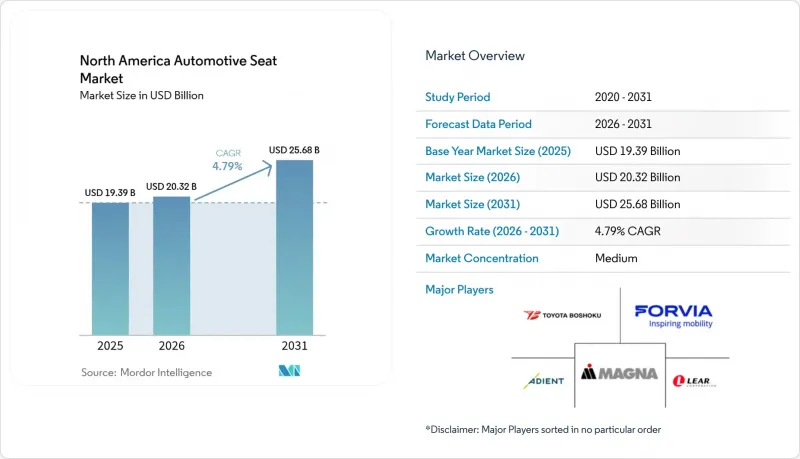
根據 Mordor Intelligence 預測,北美汽車座椅市場規模將從 2025 年的 193.9 億美元成長到 2026 年的 203.2 億美元,然後在 2031 年達到 256.8 億美元,2026 年至 2031 年的複合年成長率為 4.79%。
本報告材料類型(皮革、織物、其他)、技術類型(標準座椅、電動座椅、其他)、車輛類型(乘用車、其他)、分銷管道(OEM 和售後市場)、動力傳動系統(內燃機、其他)、價格範圍(低價、中價、高價)和地區(美國、其他)進行細分。市場預測以美元計價。
北美汽車座椅市場趨勢與洞察
高階SUV和皮卡車的普及推動了對電動通風座椅的需求。
目前,高階皮卡車型普遍配備30向電動調整座椅、主動按摩功能和自動空調,這些配置也推高了車輛價格。林肯領航員的「完美位置」座椅和福特的「主動按摩」功能便是舒適性創新如何有效緩解駕駛疲勞的典範。隨著北美地區全尺寸皮卡註冊量的持續成長,能夠以主流價格提供高階配置的廠商,其座椅相關功能的發展機會也隨之進一步擴大。
將先進的舒適功能(溫度控制、按摩)整合到中型車中。
李爾公司與通用汽車合作開發的「ComfortMax」系統將於2025年第一季首次亮相,該系統在減少50%零件數量的同時,將加熱和冷卻速度提升了40%,充分展現了模組化設計降低零件成本的優勢。麥格納公司的「FreeForm」座椅裝飾已被四款2025款新車型選中,其特點是高度凹陷的造型,並且後部面板使用了50%的回收材料。 Vitesco公司指出,其48V架構和乙太網路供電(PoE)線束是實現高耗能座椅功能而無需笨重佈線的關鍵。隨著消費者越來越重視健康和出行便利性,按摩和溫度控制功能即使在中階車型中也變得至關重要。
皮革和石化產品的價格波動推高了物料清單(BOM)成本。
合成皮革採用聚氨酯,而聚氨酯是由石油衍生原料製成,因此座椅成本會受到原油價格波動的影響。真皮則受畜牧業生產週期和環境限制的影響。與原始設備製造商 (OEM) 簽訂的價格協議迫使供應商要么對沖價格波動風險,要么自行承擔其影響,從而壓縮了利潤空間。像 Rheom 這樣的新創公司提供生物基皮革以穩定投入成本,但檢驗其有效性和實現大規模生產仍然是挑戰。
細分市場分析
到2025年,合成皮革將以41.83%的市佔率繼續領先北美汽車座椅市場,這主要得益於其成本優勢和非動物來源的吸引力。然而,真皮是成長最快的材料,預計到2031年將以7.38%的複合年成長率成長,因為豪華SUV和皮卡的買家將「真皮」視為身份的象徵。供應商正透過試點使用無需添加PFAS即可達到耐久性標準的生物基聚合物來規避價格波動風險。 Rheom的植物來源表面材料展示瞭如何將永續性和奢華感完美結合。
在北美汽車座椅市場,真皮座椅的市場規模預計將以最快的速度成長,這促使皮革加工商根據美墨加協定(USMCA)實現其後加工流程的在地化。雖然織物座椅在入門級車型和商用卡車中仍然佔據主導地位,但聚氨酯泡棉正在向低揮發性有機化合物(VOC)混合物發展,以滿足加州的相關法規。麥格納的「FreeForm」座椅靠背板採用了高達50%的再生塑膠,凸顯了材料創新如何支持設計自由和法規遵循。
到2025年,標準手動座椅將佔北美汽車座椅市場61.85%的佔有率。車隊採購者優先考慮的是座椅的簡易性和運作。預計到2031年,具備按摩和健康功能的座椅將以6.21%的複合年成長率成長,這反映了人口結構變化趨勢和日益增強的健康意識。李爾公司的「ComfortMax」模組整合了響應式微氣候控制和按摩節點,其緊湊的尺寸使其能夠安裝在中型跨界車中。
隨著48V網路的普及,北美電動、加熱和通風汽車座椅市場正在不斷擴大,這使得汽車製造商(OEM)能夠避免使用粗線徑的電線。 Vitesco的乙太網路供電(PoE)方案減輕了線束重量,有助於實現減重目標。隨著健康功能日益普及,一級供應商正轉向軟體定義座椅控制器,支援空中下載(OTA)功能升級,從而拓展售後市場收入來源。
其他福利
- Excel格式的市場預測(ME)表
- 3個月的分析師支持
目錄
第1章:引言
- 研究假設和市場定義
- 調查範圍
第2章:調查方法
第3章執行摘要
第4章 市場狀況
- 市場概覽
- 市場促進因素
- 高階SUV和皮卡車的普及推動了對電動通風座椅的需求。
- OEM廠商的減重目標正在加速合成材料和生物基片材的採用。
- 將先進的舒適功能(溫度控制、按摩)整合到中型車中。
- 美墨加協定(USMCA)的規定正在促進座椅子組件的近岸外包。
- 人工智慧驅動的即時(JIT)大規模客製化座椅生產線
- 地方政府強制推行電動車隊,推動了對超輕量商用車座椅的需求。
- 市場限制因素
- 皮革和石化產品的價格波動推高了物料清單(BOM)成本。
- 供不應求限制了電動座椅的生產。
- 關於 PFAS/發泡的 VOC 法規正在增加合規相關的成本。
- 北美準時制(Just-In-Time,簡稱JIT)工廠面臨技術純熟勞工短缺和薪資上漲的問題
- 價值供應鏈分析
- 監理情勢
- 技術展望
- 波特五力分析
第5章 市場規模與成長預測
- 依材料類型
- 皮革
- 織物
- 合成皮革
- 聚氨酯泡棉及其他
- 依技術類型
- 標準(手動調整)座椅
- 電動座椅
- 座椅加熱
- 通風/冷卻片
- 按摩養生椅
- 按車輛類型
- 搭乘用車
- 輕型商用車
- 大型商用車輛和巴士
- 透過分銷管道
- 原始設備製造商 (OEM)
- 售後市場(替換/改裝/客製化)
- 按動力傳動系統
- 內燃機(ICE)
- 混合動力電動車(HEV)
- 插電式混合動力車(PHEV)
- 電池式電動車(BEV)
- 燃料電池汽車(FCEV)
- 價格範圍(相容原廠配置)
- 低價
- 中價位
- 高價
- 國家
- 美國
- 加拿大
- 墨西哥
- 其他北美
第6章 競爭情勢
- 市場集中度
- 策略趨勢
- 市佔率分析
- 公司簡介
- Adient PLC
- Lear Corporation
- Faurecia SE(FORVIA)
- Magna International Inc.
- Toyota Boshoku Corporation
- TS TECH Co., Ltd.
- Aisin Corporation
- Grupo Antolin
- RECARO Automotive Italy Srl
- HO Bostrom Company, Inc.
- Gentherm Inc.
- Brose Fahrzeugteile SE and Co.
- Kongsberg Automotive ASA
- Hyundai Transys Inc.
- Futuris Group
- Freedman Seating Company
- Katzkin Leather Interiors Inc.
- NHK Spring Co., Ltd.
- Toyo Seat Co., Ltd.
- Yanfeng International Automotive Technology Co. Ltd.
第7章 市場機會與未來展望
According to Mordor Intelligence, the north american automotive seat market size is expected to grow from USD 19.39 billion in 2025 to USD 20.32 billion in 2026 and is forecast to reach USD 25.68 billion by 2031 at 4.79% CAGR over 2026-2031.
This report is Segmented by Material Type (Leather, Fabric, and More), Technology Type (Standard Seats, Powered Seats, and More), Vehicle Type (Passenger Cars, and More), Sales Channel (OEM and Aftermarket), Powertrain (ICE, and More), Price Band (Economy, Mid-Range, and Luxury), and Geography (United States, and More). The Market Forecasts are Provided in Terms of Value (USD).
North America Automotive Seat Market Trends and Insights
Shift Toward Premium SUVs and Pickups Boosting Demand for Powered, Ventilated Seating
Premium truck-based nameplates now integrate 30-way adjustment, active massage, and climate-control features that command higher transaction values. Lincoln's Navigator Perfect Position seats and Ford's Active Motion massage illustrate how comfort innovation reduces driver fatigue. Full-size pickup registrations keep rising across North America, magnifying seat-content growth opportunities for vendors able to deliver premium functions at mainstream price points.
Integration of Advanced Comfort Functions in Mid-Segment Vehicles
Lear's ComfortMax, debuting with GM in Q1 2025, heats or cools 40% faster with 50% fewer parts, proving that modular design shrinks bill-of-material cost . Magna's FreeForm trim, already specified for four new 2025 models, delivers high concavity and 50% recycled back-panel content. Vitesco pinpoints 48V architectures and power-over-Ethernet harnesses as enablers for energy-intensive seat features without bulky wiring. As consumers equate wellness with mobility, massage and thermal functions become necessary in mid-price vehicles.
Leather and Petrochemical Price Volatility Inflating BOM Costs
Synthetic leather uses polyurethane derived from oil-based feedstocks, tying seat economics to crude swings. Genuine hides track livestock cycles and environmental constraints. OEM price-freeze contracts force suppliers to hedge or absorb volatility, tightening margins. Start-ups like Rheom offer bio-based leather to stabilize input costs, but validation and scale remain hurdles.
Other drivers and restraints analyzed in the detailed report include:
- OEM Lightweighting Targets Accelerating Adoption of Synthetic and Bio-Based Seat Materials
- Municipal EV Fleet Mandates Driving Demand for Ultralight Commercial-Vehicle Seats
- Semiconductor Shortages Limiting Powered-Seat Output
For complete list of drivers and restraints, kindly check the Table Of Contents.
Segment Analysis
Synthetic leather retained the largest 41.83% slice of the North America automotive seat market in 2025, underscoring its cost benefit and animal-free appeal. Nevertheless, genuine leather is the fastest-rising material, charting a 7.38% CAGR through 2031 as luxury SUV and pickup buyers equate authenticity with status. Suppliers hedge volatility by trialing bio-based polymers that meet durability metrics without PFAS additives. Rheom's plant-based surfaces illustrate how sustainability and premium cues can converge.
The North American automotive seat market size tied to genuine leather is projected to expand at the segment-leading pace, encouraging tanners to localize finishing operations under USMCA. Fabric remains prevalent in entry cars and vocational trucks, while polyurethane foams evolve toward low-VOC blends to satisfy California regulations. Magna's FreeForm back panels, embedding up to 50% recycled plastic, highlight how material innovation underpins design freedom and regulatory compliance.
Standard manual units hold 61.85% share of the North America automotive seat market in 2025; fleet buyers prize simplicity and uptime. Massage and wellness seats will clock a 6.21% CAGR to 2031, reflecting demographic trends and heightened health awareness. Lear's ComfortMax module fuses rapid-response micro-climate control with massage nodes, shrinking packaging to fit mid-size crossovers.
The North American automotive seat market share for powered, heated, and cooled configurations widens as 48V networks proliferate, letting OEMs avoid heavy-gauge wiring. Vitesco's power-over-Ethernet approach reduces harness mass, aiding lightweighting goals. As wellness features normalize, tier-one suppliers pivot toward software-defined seat controllers capable of over-the-air function upgrades, opening aftermarket revenue streams.
Complete Report Scope:
- By Material Type
- Leather
- Fabric
- Synthetic Leather
- Polyurethane Foam and Others
- By Technology Type
- Standard (Manual-Adjust) Seats
- Powered Seats
- Heated Seats
- Ventilated / Cooled Seats
- Massage and Wellness Seats
- By Vehicle Type
- Passenger Cars
- Light Commercial Vehicles
- Heavy Commercial Vehicles and Buses
- By Sales Channel
- Original Equipment Manufacturer (OEM)
- Aftermarket (Replacement / Retrofit / Customization)
- By Propulsion
- Internal-Combustion Engine (ICE)
- Hybrid Electric Vehicle (HEV)
- Plug-in Hybrid (PHEV)
- Battery Electric Vehicle (BEV)
- Fuel-Cell Electric Vehicle (FCEV)
- By Price Band (OEM Trim Alignment)
- Economy
- Mid-range
- Luxury
- By Country
- United States
- Canada
- Mexico
- Rest of North America
List of Companies Covered in this Report:
- Adient PLC
- Lear Corporation
- Faurecia SE (FORVIA)
- Magna International Inc.
- Toyota Boshoku Corporation
- TS TECH Co., Ltd.
- Aisin Corporation
- Grupo Antolin
- RECARO Automotive Italy S.r.l.
- H.O. Bostrom Company, Inc.
- Gentherm Inc.
- Brose Fahrzeugteile SE and Co.
- Kongsberg Automotive ASA
- Hyundai Transys Inc.
- Futuris Group
- Freedman Seating Company
- Katzkin Leather Interiors Inc.
- NHK Spring Co., Ltd.
- Toyo Seat Co., Ltd.
- Yanfeng International Automotive Technology Co. Ltd.
Additional Benefits:
- The market estimate (ME) sheet in Excel format
- 3 months of analyst support
TABLE OF CONTENTS
1 Introduction
- 1.1 Study Assumptions and Market Definition
- 1.2 Scope of the Study
2 Research Methodology
3 Executive Summary
4 Market Landscape
- 4.1 Market Overview
- 4.2 Market Drivers
- 4.2.1 Shift Toward Premium SUVs and Pickups Boosting Demand for Powered, Ventilated Seating
- 4.2.2 OEM Lightweighting Targets Accelerating Adoption of Synthetic and Bio-Based Seat Materials
- 4.2.3 Integration Of Advanced Comfort Functions (Thermal, Massage) In Mid-Segment Vehicles
- 4.2.4 USMCA Rules Spurring Near-Shoring of Seat Sub-Assemblies
- 4.2.5 AI-Enabled JIT Mass-Customized Seat Production Lines
- 4.2.6 Municipal EV Fleet Mandates Driving Demand for Ultralight Commercial?Vehicle Seats
- 4.3 Market Restraints
- 4.3.1 Leather and Petrochemical Price Volatility Inflating BOM Costs
- 4.3.2 Semiconductor/Actuator Shortages Limiting Powered-Seat Output
- 4.3.3 PFAS / VOC Regulations on Foams Raising Compliance Spend
- 4.3.4 Skilled-Labor Shortages and Wage Hikes at NA JIT Seat Plants
- 4.4 Value / Supply-Chain Analysis
- 4.5 Regulatory Landscape
- 4.6 Technological Outlook
- 4.7 Porter's Five Forces Analysis
- 4.7.1 Threat of New Entrants
- 4.7.2 Bargaining Power of Buyers / Consumers
- 4.7.3 Bargaining Power of Suppliers
- 4.7.4 Threat of Substitute Products
- 4.7.5 Intensity of Competitive Rivalry
5 Market Size and Growth Forecasts (Value (USD))
- 5.1 By Material Type
- 5.1.1 Leather
- 5.1.2 Fabric
- 5.1.3 Synthetic Leather
- 5.1.4 Polyurethane Foam and Others
- 5.2 By Technology Type
- 5.2.1 Standard (Manual-Adjust) Seats
- 5.2.2 Powered Seats
- 5.2.3 Heated Seats
- 5.2.4 Ventilated / Cooled Seats
- 5.2.5 Massage and Wellness Seats
- 5.3 By Vehicle Type
- 5.3.1 Passenger Cars
- 5.3.2 Light Commercial Vehicles
- 5.3.3 Heavy Commercial Vehicles and Buses
- 5.4 By Sales Channel
- 5.4.1 Original Equipment Manufacturer (OEM)
- 5.4.2 Aftermarket (Replacement / Retrofit / Customization)
- 5.5 By Propulsion
- 5.5.1 Internal-Combustion Engine (ICE)
- 5.5.2 Hybrid Electric Vehicle (HEV)
- 5.5.3 Plug-in Hybrid (PHEV)
- 5.5.4 Battery Electric Vehicle (BEV)
- 5.5.5 Fuel-Cell Electric Vehicle (FCEV)
- 5.6 By Price Band (OEM Trim Alignment)
- 5.6.1 Economy
- 5.6.2 Mid-range
- 5.6.3 Luxury
- 5.7 By Country
- 5.7.1 United States
- 5.7.2 Canada
- 5.7.3 Mexico
- 5.7.4 Rest of North America
6 Competitive Landscape
- 6.1 Market Concentration
- 6.2 Strategic Moves
- 6.3 Market Share Analysis
- 6.4 Company Profiles (Includes Global level Overview, Market level overview, Core Segments, Financials as available, Strategic Information, Market Rank/Share for key companies, Products and Services, and Recent Developments)
- 6.4.1 Adient PLC
- 6.4.2 Lear Corporation
- 6.4.3 Faurecia SE (FORVIA)
- 6.4.4 Magna International Inc.
- 6.4.5 Toyota Boshoku Corporation
- 6.4.6 TS TECH Co., Ltd.
- 6.4.7 Aisin Corporation
- 6.4.8 Grupo Antolin
- 6.4.9 RECARO Automotive Italy S.r.l.
- 6.4.10 H.O. Bostrom Company, Inc.
- 6.4.11 Gentherm Inc.
- 6.4.12 Brose Fahrzeugteile SE and Co.
- 6.4.13 Kongsberg Automotive ASA
- 6.4.14 Hyundai Transys Inc.
- 6.4.15 Futuris Group
- 6.4.16 Freedman Seating Company
- 6.4.17 Katzkin Leather Interiors Inc.
- 6.4.18 NHK Spring Co., Ltd.
- 6.4.19 Toyo Seat Co., Ltd.
- 6.4.20 Yanfeng International Automotive Technology Co. Ltd.
7 Market Opportunities and Future Outlook

 2026年全球保暖舒適服飾市場報告2026年全球先進汽車座椅系統市場報告2026年全球汽車座椅馬達市場報告2026年全球汽車賽車座椅市場報告
 全球汽車座椅市場:依技術、內部裝潢建材、零件、車輛類型、座椅類型、動力系統、材質、座椅數量、銷售管道和地區分類-預測至2033年
 汽車座椅市場規模、佔有率和趨勢分析報告:按座椅類型、材料、技術、車輛類型、銷售管道、地區和細分市場預測(2026-2033 年)
 歐洲汽車座椅:市佔率分析、產業趨勢與統計及成長預測(2026-2031)
 汽車座椅市場報告:趨勢、預測和競爭分析(至2035年)
 多功能兒童兒童安全座椅市場規模、佔有率和成長分析:按安裝類型、方向、承重能力、銷售管道、最終用戶和地區分類-2026-2033年產業預測
 汽車座椅市場規模、佔有率、成長、全球產業分析、區域趨勢及2026年至2034年預測。