


 |
市場調查報告書
商品編碼
2115061
智慧互聯摩托車:市場佔有率分析、產業趨勢與統計、成長預測(2026-2031)Connected Motorcycle - Market Share Analysis, Industry Trends & Statistics, Growth Forecasts (2026 - 2031) |
||||||

※ 本網頁內容可能與最新版本有所差異。詳細情況請與我們聯繫。
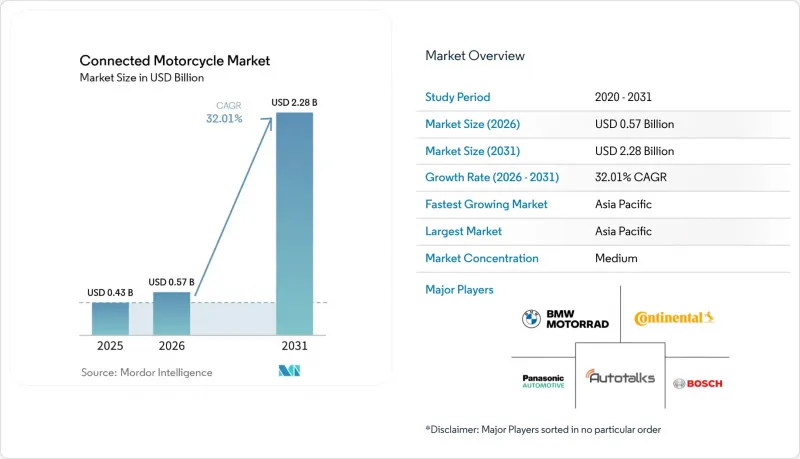
根據 Mordor Intelligence 預測,連網摩托車市場規模將從 2025 年的 4.3 億美元成長到 2026 年的 5.7 億美元,然後在 2031 年達到 22.8 億美元,2026 年至 2031 年的複合年成長率為 32.01%。
本報告按服務(駕駛輔助、資訊娛樂、安全和緊急呼叫等)、硬體類型(嵌入式ECU、支援網路共享的智慧型手機、整合式駕駛座)、最終用戶(個人和商業)、網路類型(蜂窩網路、DSRC、衛星物聯網)和地區(北美、南美等)進行細分。市場預測以價值(美元)和數量(台)兩種形式呈現。
全球互聯摩托車市場趨勢與洞察
5G 的部署將實現超低延遲的 V2X。
隨著獨立組網的5G網路實現毫秒無線延遲,碰撞預警和協同自適應主動式車距維持定速系統等功能正逐漸成為騎乘者的現實。 Autotalks和Rolling Wireless宣布推出一系列即將量產的5G-V2X晶片組,支援蜂巢V2X和傳統的DSRC模式。在日本,已分配了V2X專用頻段,為全國範圍內的V2X示範路段奠定了基礎。同時,美國也在努力擴大高速公路的V2X覆蓋範圍。這些舉措鞏固了5G作為互聯摩托車市場基石的地位,將在未來十年為騎乘者提供先進的安全功能和無縫通訊體驗。
政府網路安全法規(UNECE R155/156)
聯合國歐洲經濟委員會第155號法規強制要求自2029年7月起,所有新摩托車型式認證車輛必須安裝完整的網路安全管理系統。同時,第156號法規要求記錄並檢驗軟體更新。這些法規適用於L類車輛,這意味著即使是入門車型也需要承擔安全硬體的成本。一級供應商正在積極回應,提供捆綁式遠端資訊處理系統和ABS單元,以分攤認證成本。中小製造商需要考慮採用白牌平台還是開發自己的解決方案。這是一個可能影響品牌差異化的策略性十字路口。隨著截止日期的臨近,儘早採用這些法規將有助於避免未來的生產瓶頸。
大眾市場摩托車的物料清單成本大幅增加。
入門級摩托車製造商正面臨利潤率壓力,因為隨著車載資訊系統、顯示器和安全閘道器的加入,零件成本顯著增加。瑞薩電子正透過一款單晶片車載資訊系統控制器來應對這項挑戰,該控制器可減少PCB面積和韌體開銷。然而,符合UNECE R155標準(該標準要求進行全面的網路安全審計)進一步推高了成本。為了保持競爭力,像Hero MotoCorp這樣的製造商正在轉向基於智慧型手機的儀表板。這些儀錶板將大部分處理負載轉移到了騎手的設備上。然而,這種整合的複雜性可能會影響整體用戶體驗。這些挑戰正在阻礙連網摩托車的快速普及,尤其是在價格敏感型細分市場。
細分市場分析
預計到2025年,資訊娛樂系統將佔總收入的34.31%,這表明其目前是互聯摩托車市場的重心所在。駕駛輔助服務預計將在2026年至2031年間成長44.21%,是所有服務類別中成長最快的。隨著歐盟委員會強制要求使用eCall功能,安全服務正成為不可或缺的附加功能。同時,遠距離診斷和韌體更新符合聯合國歐洲經濟委員會(UNECE)的安全法規,而基於里程的保險(UBI)在交通繁忙地區也獲得了風險規避型保險公司的支持。監管機構和保險公司的獎勵相結合,有望使駕駛輔助系統在整個預測期內成為主要的成長引擎。
法規正在影響部署優先級,促使原始設備製造商 (OEM) 投資於空中下載 (OTA) 功能,而資訊娛樂功能仍然依賴可選的額外支出。駕駛輔助功能介於熱門功能和必備功能之間,在監管和市場力量的共同支持下,處於相對平衡的位置。商用車隊往往優先考慮車輛管理以控制成本,而個人騎士則更傾向於娛樂性和安全性之間的平衡。因此,不同客戶群的服務組合各不相同,供應商正在建立分級交付系統,以滿足各個細分市場的支付意願。這一趨勢將繼續推動互聯摩托車市場收入來源的多元化。
嵌入式控制單元在2025年部署的單元總數中佔比54.82%,這體現了它們能夠提供始終線上連接和無縫的空中升級功能。高階品牌正在將這些單元整合在座椅下方或整流罩內,提供整合的導航、診斷功能和騎乘輔助警報。雖然隨著產量的增加,零件成本正在逐步下降,但注重成本的原始設備製造商(OEM)仍在尋求價格更低的替代方案,以滿足價格敏感型買家的需求。基於手機互聯的解決方案預計到2031年將以37.51%的複合年成長率成長,它利用騎手的行動電話進行數據處理和網路存取,從而滿足了這一需求。雖然當行動電話互聯無法提供自動事故通知功能,但對於初次接觸連網摩托車的客戶來說,它仍然是一個極具吸引力的入門選擇。
這種混合架構介於這兩種極端之間,它將用於基本安全功能的小型嵌入式模組與用於資訊娛樂和騎乘分析的智慧型手機應用程式相結合。這種硬體分離模式使原始設備製造商 (OEM) 能夠避免高規格 ECU 的全部成本,同時又能符合法規要求。整合式駕駛座叢集(將彩色顯示器和遠端資訊處理調變解調器整合到儀表板中)深受長途騎乘者的青睞,他們期望獲得全面、按需的地圖功能。供應商不斷透過進一步縮小顯示器邊框來提升產品價值,從而改善陽光直射下的可視性。隨著這些技術進步擴展到中階車型,硬體多樣化正在擴大互聯摩托車市場,加劇各個價格區間的競爭。
區域分析
預計到2025年,亞太地區將佔全球銷售額的41.73%,並在2031年之前以35.81%的年均成長率成長,成為互聯摩托車市場成長最快的地區。中國強制部署V2X智慧道路正加速各大城市的普及。在日本和韓國,由於智慧型手機普及率高,有線架構的額外硬體成本較低,因此更受青睞。同時,在東南亞,用於外帶和叫車服務的摩托車正在應用遠端資訊處理技術,以降低營運成本並提高安全性。這些需求因素共同作用,增強了供應鏈的韌性,並隨著零件供應商在地化生產線的建設,縮短了前置作業時間。政府將智慧基礎設施建設資金與稅收優惠結合的舉措,進一步推動了這一發展勢頭。
北美緊隨其後,預計複合年成長率將達到 24.92%,這主要得益於各州提供的保險折扣鼓勵騎士採用遠端資訊處理技術以換取更低的保費。雖然聯邦機構尚未強制要求使用 eCall 系統,但提案的安全法規持續向汽車製造商施壓,要求他們在法規最終確定前整合碰撞通知功能。歐洲市場預計將以 23.99% 的速度成長,儘管由於 GDPR(一般資料保護規則)的嚴格合規要求導致開發成本增加。德國、法國和英國憑藉其高人均收入和成熟的旅遊文化,正在推動區域消費成長。另一方面,東歐的成長速度較為緩慢,因為行動電話網路覆蓋不均限制了遠端資訊處理技術在都市區的效用。
南美洲、中東和非洲的摩托車連網技術正在迅速普及,儘管用戶基數較小。居住在擁擠都市區的巴西騎士將車輛防盜找回服務放在首位,但外匯波動限制了他們的升級換代週期。海灣國家正在投資建造智慧城市走廊,強制所有新車配備V2X車聯網系統,從而推動了對高階互聯車型的需求。在非洲廣大的農村地區,結合行動電話和衛星連接的混合模組更受歡迎,以確保即使在行動電話基地台覆蓋範圍有限的地區也能進行緊急通訊。隨著地面網路的日益普及,供應商正在推出低成本的改裝套件,以開拓龐大的非連網摩托車市場。
其他好處:
- Excel格式的市場預測(ME)表
- 3個月的分析師支持
目錄
第1章:引言
- 研究假設和市場定義
- 調查範圍
第2章:調查方法
第3章執行摘要
第4章 市場狀況
- 市場概覽
- 市場促進因素
- 5G部署可實現超低延遲V2X。
- 政府網路安全法規(UNECE R155/156)
- 基於eSIM的車載資訊系統的整合正在迅速成長。
- OEM公司為研發相容ADAS系統的摩托車所做的努力
- 亞太地區新興國家的豪華自行車銷售正在激增。
- 邊緣AI晶片顯著降低了板載功耗
- 市場限制因素
- 大眾市場自行車物料清單成本增量高
- 鋰離子電池熱失控導致的召回事件正在打擊原始設備製造商的熱情。
- 持續數據上傳引發了對騎士隱私的擔憂
- 歐盟27國對DSRC/5.9 GHz頻段的限制
- 價值供應鏈分析
- 監理情勢
- 技術展望
- 波特五力模型
第5章 市場規模與成長預測
- 按服務
- 駕駛輔助
- 資訊娛樂
- 安全/緊急呼叫
- 車輛管理/OTA更新
- 保險和全民基本收入
- 依硬體類型
- 嵌入式控制單元
- 有線智慧型手機底座
- 整合式駕駛座叢集
- 最終用戶
- 一般消費者
- 商業/車隊
- 依網路類型
- 蜂窩網路(4G/5G)
- 專用短程通訊(C-V2X/802.11p)
- 衛星物聯網和低功耗廣域網
- 地區
- 北美洲
- 美國
- 加拿大
- 其他北美國家
- 南美洲
- 巴西
- 阿根廷
- 其他南美國家
- 歐洲
- 德國
- 英國
- 法國
- 俄羅斯
- 其他歐洲國家
- 亞太地區
- 中國
- 印度
- 日本
- 韓國
- 其他亞太國家
- 中東和非洲
- 埃及
- 土耳其
- 南非
- 沙烏地阿拉伯
- 阿拉伯聯合大公國
- 其他中東和非洲國家
- 北美洲
第6章 競爭情勢
- 市場集中度
- 策略趨勢
- 市佔率分析
- 公司簡介
- BMW Motorrad
- Continental AG
- Robert Bosch GmbH
- Panasonic Corporation
- TE Connectivity
- Autotalks
- Aeris Communications
- Vodafone Group PLC
- Starcom Systems
- KPIT Technologies
- Honda Motor Co.
- Yamaha Motor Co.
- Hero MotoCorp
- NXP Semiconductors
- Qualcomm Technologies
- Harman International
- Telit Cinterion
- Alpinestars
- Dainese SpA
- Sena Technologies
第7章 市場機會與未來展望
According to Mordor Intelligence, the connected motorcycle market size is expected to grow from USD 0.43 billion in 2025 to USD 0.57 billion in 2026 and is forecasted to reach USD 2.28 billion by 2031 at a 32.01% CAGR over 2026-2031.
This report is Segmented by Service (Driver Assistance, Infotainment, Safety and Emergency Call, and More), Hardware Type (Embedded ECU, Tethered Smartphone, and Integrated Cockpit), End User (Private and Commercial), Network Type (Cellular, DSRC, and Satellite-IoT), and Geography (North America, South America, and More). Market Forecasts are Provided in Terms of Value (USD) and Volume (Units).
Global Connected Motorcycle Market Trends and Insights
5G Roll-Outs Enabling Ultra-Low-Latency V2X
With stand-alone 5G networks achieving radio latency in the millisecond range, features like collision warnings and cooperative adaptive cruise control are becoming a reality for riders. Autotalks and Rolling Wireless have unveiled a 5G-V2X chipset family set for series production, compatible with both cellular V2X and older DSRC modes. Japan has allocated a dedicated frequency band for V2X, laying the groundwork for nationwide V2X pilot corridors. Meanwhile, in the United States, efforts are underway to expand V2X coverage on highways. Such initiatives firmly establish 5G as the cornerstone of the connected motorcycle market, enabling advanced safety features and seamless communication for riders over the coming decade.
Government Cyber-Security Mandates (UNECE R155/156)
UNECE Regulation 155 obliges every new motorcycle type-approval from July 2029 to include a full Cyber Security Management System, while Regulation 156 codifies software-update logging and validation. These rules apply to category L vehicles and push security hardware costs into even entry-level models. Tier-one suppliers respond with bundled telematics and ABS units that amortize certification expense. Smaller manufacturers must weigh white-label platforms against in-house solutions, a strategic fork that can alter brand differentiation. Early adoption helps firms avoid future production bottlenecks as the deadline approaches.
High Incremental BOM Cost for Mass-Market Bikes
Entry-level motorcycle manufacturers are experiencing a squeeze on margins as the addition of telematics, displays, and secure gateways significantly increases component costs. Renesas is addressing this challenge with its single-chip telematics controllers, which reduce both PCB area and firmware overhead. However, costs are further increased by UNECE R155 compliance, which requires comprehensive cybersecurity audits. To maintain their edge, manufacturers such as Hero MotoCorp are turning to smartphone-based dashboards. These dashboards shift much of the processing burden to the rider's device. Yet, this integration complexity can detract from the overall user experience. Such challenges are curbing the rapid adoption of connected motorcycles, especially in price-sensitive segments.
Other drivers and restraints analyzed in the detailed report include:
- Surging Integration of eSIM-Based Telematics
- OEM Push Toward ADAS-Ready Two-Wheelers
- Li-Ion Thermal-Runaway Recalls Dampen OEM Appetite
For complete list of drivers and restraints, kindly check the Table Of Contents.
Segment Analysis
Infotainment accounted for 34.31% of 2025 revenue, indicating the current center of gravity in the connected motorcycle market. Driver assistance services are projected to grow at 44.21% between 2026 and 2031, the fastest among all service categories. Mandatory eCall functions, as outlined by the European Commission, transform safety services into non-optional add-ons. Meanwhile, remote diagnostics and firmware updates satisfy UNECE security rules, and usage-based insurance gains favor with risk-averse insurers in high-traffic regions. The combined pull of regulation and insurer incentives positions driver assistance as the lead growth engine over the forecast horizon.
Regulation influences adoption priorities, encouraging OEMs to invest in over-the-air capabilities while leaving infotainment dependent on discretionary spending. Driver assistance sits between crowd-pleasing features and mandatory functions, giving it a balanced mix of regulatory and market support. Commercial fleets tend to prioritize vehicle management for cost control, whereas private riders prefer a balance of entertainment and safety. As a result, service portfolios diverge by customer group, and suppliers craft tiered offerings that align with each segment's willingness to pay. This dynamic ensures the connected motorcycle market continues to diversify its revenue streams.
Embedded control units commanded 54.82% of 2025 deployments, reflecting their ability to provide always-on connectivity and seamless over-the-air updates. Premium brands embed these units under the seat or fairing to deliver integrated navigation, diagnostics, and rider-assistance alerts. Rising production volumes gradually trim bill-of-materials costs, but budget-conscious OEMs still seek lower-priced alternatives to address price-sensitive buyers. Tethered smartphone solutions, forecast to grow at a 37.51% CAGR through 2031, answer that need by using the rider's handset for data processing and network access. Although tethering lacks automatic crash notification if the phone is absent, it offers a compelling entry point for first-time connected motorcycle customers.
Hybrid architectures sit between both extremes, combining a small embedded module for mandatory safety functions with a phone-based app for infotainment and ride analytics. This split hardware model helps OEMs comply with regulations while avoiding the full cost of a high-spec ECU. Integrated cockpit clusters, which incorporate a color display and telematics modem into the instrument panel, appeal to touring riders who spend long hours on the road and expect rich mapping capabilities on demand. Suppliers continue to shrink display bezels and improve sunlight readability, enhancing perceived value. As these advances roll into mid-range models, hardware diversity broadens the connected motorcycle market size and keeps competition active across price tiers.
Complete Report Scope:
- By Service
- Driver Assistance
- Infotainment
- Safety and Emergency Call
- Vehicle Management / OTA Updates
- Insurance and UBI
- By Hardware Type
- Embedded Control Unit
- Tethered Smartphone-based
- Integrated Cockpit Cluster
- By End User
- Private Consumers
- Commercial / Fleet
- By Network Type
- Cellular (4G/5G)
- Dedicated Short-Range Comms (C-V2X/802.11p)
- Satellite-IoT and LPWAN
- Geography
- North America
- United States
- Canada
- Rest of North America
- South America
- Brazil
- Argentina
- Rest of South America
- Europe
- Germany
- United Kingdom
- France
- Russia
- Rest of Europe
- Asia-Pacific
- China
- India
- Japan
- South Korea
- Rest of Asia-Pacific
- Middle East and Africa
- Egypt
- Turkey
- South Africa
- Saudi Arabia
- United Arab Emirates
- Rest of Middle East and Africa
- North America
Geography Analysis
The Asia-Pacific region accounted for 41.73% of 2025 revenue and is projected to grow at 35.81% through 2031, giving the region the steepest slope on the connected motorcycle market growth curve. China's mandate for V2X-ready smart roads accelerates adoption in every major city. Japan and South Korea favor tethered architectures because high smartphone penetration lowers incremental hardware cost. At the same time, Southeast Asian fleets deploy telematics across food-delivery and ride-hailing bikes to control operating expenses and raise safety. Together, these demand vectors strengthen supply-chain resilience and encourage component vendors to localize production lines, shortening lead times. Government initiatives that pair smart infrastructure funding with tax incentives further boost momentum.
North America follows with a forecasted CAGR of 24.92%, as state-level insurance discounts prompt riders to accept telemetry in exchange for lower premiums. Federal agencies have not yet mandated eCall; however, proposed safety rules continue to pressure OEMs to embed crash notification capability before regulations are finalized. Europe advances at 23.99% despite strict GDPR compliance burdens that elevate development costs. Germany, France, and the United Kingdom dominate regional spending due to their high per-capita incomes and established touring cultures. Eastern Europe lags as patchy cellular coverage limits the utility of telematics beyond urban zones.
South America, the Middle East and Africa grow from smaller bases yet show pockets of rapid uptake. Brazilian riders in congested cities value theft-recovery services, but exchange-rate fluctuations constrain upgrade cycles. Gulf states are investing in smart-city corridors that require V2X compliance for all new vehicles, thereby driving demand for premium connected models. Africa's vast rural expanses favor hybrid cellular-satellite modules that ensure emergency connectivity where cellular towers are scarce. As terrestrial networks spread, suppliers position low-cost retrofit kits to tap the vast installed base of unconnected motorcycles.
- BMW Motorrad
- Continental AG
- Robert Bosch GmbH
- Panasonic Corporation
- TE Connectivity
- Autotalks
- Aeris Communications
- Vodafone Group PLC
- Starcom Systems
- KPIT Technologies
- Honda Motor Co.
- Yamaha Motor Co.
- Hero MotoCorp
- NXP Semiconductors
- Qualcomm Technologies
- Harman International
- Telit Cinterion
- Alpinestars
- Dainese SpA
- Sena Technologies
Additional Benefits:
- The market estimate (ME) sheet in Excel format
- 3 months of analyst support
TABLE OF CONTENTS
1 Introduction
- 1.1 Study Assumptions & Market Definition
- 1.2 Scope of the Study
2 Research Methodology
3 Executive Summary
4 Market Landscape
- 4.1 Market Overview
- 4.2 Market Drivers
- 4.2.1 5G Roll-Outs Enabling Ultra-Low-Latency V2X
- 4.2.2 Government Cyber-Security Mandates (UNECE R155/156)
- 4.2.3 Surging Integration of eSIM-Based Telematics
- 4.2.4 OEM Push Toward ADAS-Ready Two-Wheelers
- 4.2.5 Premium Bike Sales Boom in Emerging Asia-Pacific
- 4.2.6 Edge-AI Chips Slashing On-Board Power Draw
- 4.3 Market Restraints
- 4.3.1 High Incremental BOM Cost for Mass-Market Bikes
- 4.3.2 Li-Ion Thermal-Runaway Recalls Dampen OEM Appetite
- 4.3.3 Rider Privacy Concerns Over Continuous Data Upload
- 4.3.4 Limited DSRC/5.9 GHz Spectrum in EU-27
- 4.4 Value / Supply-Chain Analysis
- 4.5 Regulatory Landscape
- 4.6 Technological Outlook
- 4.7 Porter's Five Forces
- 4.7.1 Bargaining Power of Buyers
- 4.7.2 Bargaining Power of Suppliers
- 4.7.3 Threat of New Entrants
- 4.7.4 Threat of Substitute Products
- 4.7.5 Intensity of Competitive Rivalry
5 Market Size & Growth Forecasts (Value (USD) and Volume (Units))
- 5.1 By Service
- 5.1.1 Driver Assistance
- 5.1.2 Infotainment
- 5.1.3 Safety and Emergency Call
- 5.1.4 Vehicle Management / OTA Updates
- 5.1.5 Insurance and UBI
- 5.2 By Hardware Type
- 5.2.1 Embedded Control Unit
- 5.2.2 Tethered Smartphone-based
- 5.2.3 Integrated Cockpit Cluster
- 5.3 By End User
- 5.3.1 Private Consumers
- 5.3.2 Commercial / Fleet
- 5.4 By Network Type
- 5.4.1 Cellular (4G/5G)
- 5.4.2 Dedicated Short-Range Comms (C-V2X/802.11p)
- 5.4.3 Satellite-IoT and LPWAN
- 5.5 Geography
- 5.5.1 North America
- 5.5.1.1 United States
- 5.5.1.2 Canada
- 5.5.1.3 Rest of North America
- 5.5.2 South America
- 5.5.2.1 Brazil
- 5.5.2.2 Argentina
- 5.5.2.3 Rest of South America
- 5.5.3 Europe
- 5.5.3.1 Germany
- 5.5.3.2 United Kingdom
- 5.5.3.3 France
- 5.5.3.4 Russia
- 5.5.3.5 Rest of Europe
- 5.5.4 Asia-Pacific
- 5.5.4.1 China
- 5.5.4.2 India
- 5.5.4.3 Japan
- 5.5.4.4 South Korea
- 5.5.4.5 Rest of Asia-Pacific
- 5.5.5 Middle East and Africa
- 5.5.5.1 Egypt
- 5.5.5.2 Turkey
- 5.5.5.3 South Africa
- 5.5.5.4 Saudi Arabia
- 5.5.5.5 United Arab Emirates
- 5.5.5.6 Rest of Middle East and Africa
- 5.5.1 North America
6 Competitive Landscape
- 6.1 Market Concentration
- 6.2 Strategic Moves
- 6.3 Market Share Analysis
- 6.4 Company Profiles (includes Global Level Overview, Market Level Overview, Core Segments, Financials as Available, Strategic Information, Market Rank/Share for Key Companies, Products and Services, SWOT Analysis, and Recent Developments)
- 6.4.1 BMW Motorrad
- 6.4.2 Continental AG
- 6.4.3 Robert Bosch GmbH
- 6.4.4 Panasonic Corporation
- 6.4.5 TE Connectivity
- 6.4.6 Autotalks
- 6.4.7 Aeris Communications
- 6.4.8 Vodafone Group PLC
- 6.4.9 Starcom Systems
- 6.4.10 KPIT Technologies
- 6.4.11 Honda Motor Co.
- 6.4.12 Yamaha Motor Co.
- 6.4.13 Hero MotoCorp
- 6.4.14 NXP Semiconductors
- 6.4.15 Qualcomm Technologies
- 6.4.16 Harman International
- 6.4.17 Telit Cinterion
- 6.4.18 Alpinestars
- 6.4.19 Dainese SpA
- 6.4.20 Sena Technologies
7 Market Opportunities & Future Outlook
- 7.1 White-space & Unmet-Need Assessment

 互聯摩托車市場:全球預測,2026-2032年
 互聯機車市場分析及預測(至2035年):按類型、產品、服務、技術、組件、應用、設備、最終用戶、功能及安裝類型分類
 互聯摩托車市場-全球產業規模、佔有率、趨勢、機會和預測:按車輛類型、動力類型、服務類型、互聯類型、最終用戶、地區和競爭對手分類,2021-2031年
 摩托車市場報告:按服務、硬體、網路類型、最終用戶和地區分類(2026-2034 年)
 智慧互聯自行車市場機會、成長要素、產業趨勢分析及2026-2035年預測
 互聯摩托車市場:按服務類型、硬體類型、網路類型、通訊類型、最終用戶和地區分類
 全球連網自行車市場(按車輛類型、硬體類型、推進類型、網路類型、最終用戶、應用和地區分類)- 預測至 2032 年
 聯網摩托車市場規模、佔有率和成長分析(按類型、連接解決方案、服務、推進、通訊類型、網路類型、最終用戶和地區)- 產業預測 2025-2032