


 |
市場調查報告書
商品編碼
2115060
汽車數位駕駛座:市場佔有率分析、產業趨勢與統計及成長預測(2026-2031)Automotive Digital Cockpit - Market Share Analysis, Industry Trends & Statistics, Growth Forecasts (2026 - 2031) |
||||||

※ 本網頁內容可能與最新版本有所差異。詳細情況請與我們聯繫。
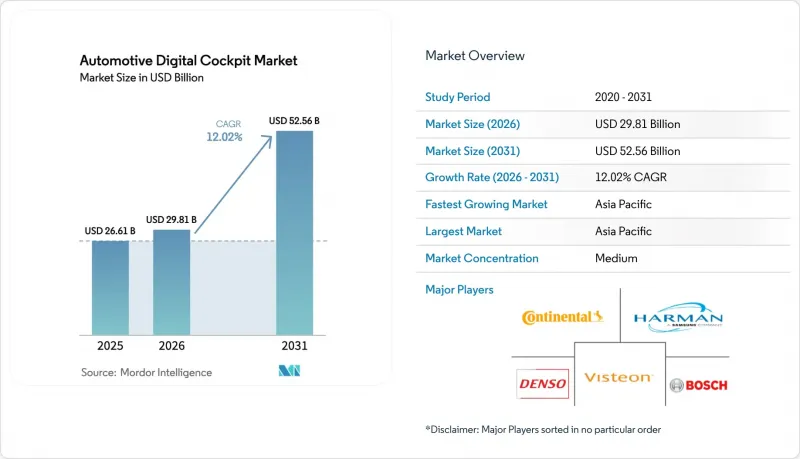
根據 Mordor Intelligence 估計,到 2026 年,汽車數位駕駛座市值將達到 298.1 億美元,高於 2025 年的 266.1 億美元,預計到 2031 年將達到 525.6 億美元。
預計從 2026 年到 2031 年,其複合年成長率將達到 12.02%。
本報告按類型(抬頭顯示器(HUD)、數位儀錶群、中控台顯示器等)、車輛類型(乘用車、輕型商用車等)、動力系統(內燃機 (ICE) 等)、銷售管道(原廠配套和售後改裝)以及地區進行細分。市場預測以價值(美元)表示。
全球汽車數位駕駛座市場趨勢及洞察
消費者對身臨其境型資訊娛樂的需求日益成長
汽車製造商正在圍繞多螢幕佈局設計車內空間,以模仿智慧型手機和人工智慧語音助理的使用者體驗。 TCL華星光電的全景抬頭顯示器和32:9中央顯示器在下一代設計語言方面處於領先地位,而本田即將推出的「ASIMO OS」則融合了基於機器學習的個人化功能。偉世通和TuneIn等內容合作夥伴正在將串流媒體功能引入儀錶板。高階品牌正在進一步推動這一趨勢。例如,A6 Sportback e-tron將11.9吋虛擬叢集與14.5吋OLED觸控螢幕結合,呈現出鮮豔的畫面。
強制性ADAS和安全法規
監管要求正在推動高級駕駛輔助系統 (ADAS) 與數位駕駛座平台的整合,從而產生協同效應,在提升安全性和使用者體驗的同時,降低系統複雜性。歐盟《通用安全法規 II》的修訂強制要求所有乘用車配備 ADAS 功能,並要求車輛顯示直覺的即時警告。高通和博世為此開發了一種混合優先級電腦,可在單一 SoC 上處理資訊娛樂和 ADAS 工作負載,從而降低延遲並減少佈線。 ISO 26262 ASIL-B 合規性要求等功能安全標準進一步加速了這項融合進程,推動了顯示技術和 LED 驅動架構的創新。
較高的初始系統和檢驗成本
要使駕駛座顯示器達到 ISO 26262 ASIL-B 標準,需要冗餘電源軌、故障注入測試和全面的軟體審核,所有這些都會導致高昂且不重複的工程成本。光是哈曼一家公司就在其駕駛座專案中僱用了 500 多名工程師,凸顯了該專案的勞動密集程度。規模較小的原始設備製造商 (OEM) 採用這項技術的速度較慢,一些舊款機型在 2024 年新的網路安全法規生效後已退出歐洲市場。
細分市場分析
到2025年,數位儀錶群將佔據汽車數位駕駛座市場37.45%的佔有率,作為速度、續航里程和ADAS警報的主要介面發揮關鍵作用。同時,抬頭顯示器)正以18.05%的複合年成長率推動市場成長,這主要得益於OEM廠商對擴增實境(AR)疊加功能的需求,該功能能夠幫助駕駛員將視線集中在前方。數位駕駛座市場也在向全景式CID、面向乘客的PID以及基於攝影機的駕駛員監控模組發展,這些技術有助於滿足歐洲新車安全評估協會(Euro NCAP)的駕駛注意力評估標準。
由於高像素密度和低功耗LTPO背板(可有效抑制發熱),中控台螢幕尺寸正擴展到15吋以上。 Envisics的第二代全像顯示器(HUD)在通用汽車2024年凱迪拉克Lyriq上首次亮相,顯示曾經被視為高階技術的HUD正在各個細分市場普及。 TCL華星光電的32:9組合顯示器將儀錶板和資訊娛樂系統整合到單一螢幕上,預示著未來組件整合度的進一步提升。隨著人們對身臨其境型體驗的需求日益成長,多螢幕顯示方案必將繼續成為推動數位駕駛座市場成長的重要動力。
到2025年,乘用車將引領汽車數位駕駛座市場,佔68.89%的市場佔有率,並達到13.92%的年成長率。消費者現在期望曾經僅在豪華轎車上才能享受到的雲端連接服務也能出現在緊湊型掀背車,這迫使大眾汽車品牌擴展駕駛座功能清單。隨著車隊對結合路線規劃和駕駛員狀態監控的遠端資訊處理整合的需求不斷成長,輕型商用車採用數位駕駛座的趨勢也在加速發展。
在中型和重型卡車領域,電子數據記錄器(ELD)的整合變得日益重要,而配備網域控制器的駕駛座不僅滿足了這一需求,還支援預測性維護分析。比亞迪推出的21款搭載其自主研發駕駛座晶片的車型表明,成本最佳化設計正擴展到旗艦級廂型車和皮卡。這一趨勢預示著,儘管乘用車在數位駕駛座市場規模上仍佔據主導地位,但輕型商用車在銷售成長方面可能超越乘用車。
區域分析
2025年,亞太地區引領數位駕駛座市場,佔全球銷售量的39.42%。預計到2031年,該地區將維持14.44%的強勁複合年成長率。在強力的補貼和強大的本土零件生態系統的推動下,中國電動車的蓬勃發展已使國內品牌轉型為駕駛座技術出口商。大眾、通用和日產已獲得中國的人機互動(HMI)系統授權,用於其本土市場車型。日本也在推動該地區的軟體發展。電裝計畫在2035年將軟體銷售額翻兩番,達到8,000億日圓,而豐田的「Arene OS」旨在提供跨車型的車載體驗。
在歐洲,預計駕駛座儀錶板的普及速度將較為溫和,這主要得益於歐洲大陸在高階品牌領域的領先地位,這些品牌擁有充足的研發預算。歐盟的《通用安全法規II》強制要求採用能夠顯示強制性警告訊息的智慧型叢集。然而,合規成本仍然很高,而且隨著網路安全法規的實施,一些銷售量較低的車型將於2024年停產。為了應對這項挑戰,德國汽車製造商正將資源集中投入到以數位化為先的平台,例如BMW的「NEUE KLASSE」平台,該平台優先考慮以使用者為中心的抬頭顯示器(HUD),而非傳統的類比儀表。
北美市場預計將以8.94%的複合年成長率穩定成長。該地區的大型SUV和皮卡市場對高亮度顯示器的需求日益成長,即使在陽光直射下也需要清晰可見,這推動了光學貼合和抗反射膜技術的創新。美國國家公路交通安全管理局(NHTSA)擴展了國家碰撞測試(NCAP)標準,新增了盲點偵測、車道維持和行人用煞車等要求,實際上強制要求採用先進的人機互動系統(HMI)。同時,Stellantis以美元計價的軟體銷售目標表明,整合於駕駛座的數位服務可以成為獲利能力的重要促進因素。
其他好處:
- Excel格式的市場預測(ME)表
- 3個月的分析師支持
目錄
第1章:引言
- 研究假設和市場定義
- 調查範圍
第2章:調查方法
第3章執行摘要
第4章 市場狀況
- 市場概覽
- 市場促進因素
- 消費者對身臨其境型資訊娛樂和始終在線連接的需求正在激增。
- 強制性ADAS和安全法規正在加速多顯示叢集的整合。
- 採用軟體定義駕駛座和基於區域的架構的電動車平台
- 透過集中式網域控制站顯著降低物料清單成本
- 訂閱收入(車載資訊娛樂系統、遊戲、影片)正在推動汽車製造商對駕駛座進行升級。
- Android Automotive 及其開放原始碼堆疊正在降低二級 OEM 廠商的進入門檻。
- 市場限制因素
- 系統實施和檢驗的初始成本較高。
- 汽車網路安全和資料隱私方面的法律責任日益增加。
- 用於汽車應用的先進工藝SoC供應緊張。
- 對駕駛分心行為的監控力道加大,促使人們需要製定顯示器尺寸法規。
- 價值供應鏈分析
- 監理情勢
- 技術展望
- 波特五力分析
第5章 市場區隔
- 按類型
- 抬頭顯示器(HUD)
- 數位儀表叢集
- 中控台顯示螢幕
- 高級駕駛員監視錄影機
- 遠端資訊處理/連接控制單元
- 車輛類型
- 搭乘用車
- 輕型商用車
- 中型和重型商用車輛
- 透過推廣
- 內燃機(ICE)
- 電池式電動車(BEV)
- 混合動力和插電式混合動力(HEV/PHEV)
- 按銷售管道
- OEM 原廠設備
- 售後改裝
- 按地區
- 北美洲
- 美國
- 加拿大
- 其他北美國家
- 南美洲
- 巴西
- 阿根廷
- 其他南美國家
- 歐洲
- 德國
- 英國
- 法國
- 義大利
- 西班牙
- 其他歐洲國家
- 亞太地區
- 中國
- 日本
- 韓國
- 印度
- 其他亞太國家
- 中東和非洲
- 阿拉伯聯合大公國
- 沙烏地阿拉伯
- 摩洛哥
- 南非
- 其他中東和非洲國家
- 北美洲
第6章 競爭情勢
- 市場集中度
- 策略趨勢
- 市佔率分析
- 公司簡介
- Continental AG
- Robert Bosch GmbH
- DENSO Corporation
- Visteon Corporation
- Harman International(Samsung)
- Panasonic Holdings Corp.
- Aptiv PLC
- Hyundai Mobis
- Nippon Seiki Co., Ltd.
- Faurecia SE
- LG Electronics Inc.
- Qualcomm Technologies Inc.
- NVIDIA Corp.
- Magna International Inc.
- Marelli Holdings
- Pioneer Corp.
- Alps Alpine Co., Ltd.
- Valeo SA
- Yazaki Corp.
- Panasonic Automotive Systems
第7章 市場機會與未來展望
According to Mordor Intelligence, automotive digital cockpit market size in 2026 is estimated at USD 29.81 billion, growing from 2025 value of USD 26.61 billion with 2031 projections showing USD 52.56 billion, growing at 12.02% CAGR over 2026-2031.
This report is Segmented by Type (Heads-Up Display (HUD), Digital Instrument Cluster, Center Stack Display, and More), Vehicle Type (Passenger Cars, Light Commercial Vehicles, and More), Propulsion (Internal Combustion Engine (ICE) and More), Sales Channel (OEM-Fitted and Aftermarket Retro-Fit), and Geography. The Market Forecasts are Provided in Terms of Value (USD).
Global Automotive Digital Cockpit Market Trends and Insights
Surging Consumer Appetite for Immersive Infotainment
Carmakers are designing cabins around multi-screen layouts and AI voice assistants that mimic smartphone experiences. TCL CSOT's panoramic HUD and 32:9 center displays preview the next design language, while Honda's forthcoming ASIMO OS embeds machine-learning personalization. Content partnerships, such as Visteon-TuneIn, add streaming media to the dashboard. Premium brands further reinforce the trend. For instance, Audi's A6 Sportback e-tron combines an 11.9-inch virtual cluster with a 14.5-inch OLED touch screen for vivid graphics.
Mandatory ADAS and Safety Regulations
Regulatory mandates are catalyzing the integration of advanced driver assistance systems with digital cockpit platforms, creating synergies that enhance both safety and user experience while reducing system complexity. EU General Safety Regulation II updates require mandatory advanced driver-assistance features in all passenger vehicles, all of which must present intuitive, real-time alerts. Qualcomm and Bosch responded with a mixed-criticality computer that hosts infotainment and ADAS workloads on one SoC, reducing latency and wiring. This convergence is further accelerated by functional safety standards like ISO 26262 ASIL-B compliance requirements, which are driving innovation in display technologies and LED driver architectures.
High Upfront System and Validation Cost
Achieving ISO 26262 ASIL-B for cockpit displays demands redundant power rails, fault-injection testing, and exhaustive software audits, all of which inflate non-recurring engineering spend. HARMAN alone employs more than 500 engineers on cockpit programs, underscoring the labor intensity. Smaller OEMs delay rollouts, and some legacy models were withdrawn in Europe when new cybersecurity rules took effect in 2024.
Other drivers and restraints analyzed in the detailed report include:
- EV Platforms Favoring Software-Defined Cockpits
- Centralized Domain Controllers Slashing BOM Cost
- Escalating Vehicle-Cybersecurity and Data-Privacy Liabilities
For complete list of drivers and restraints, kindly check the Table Of Contents.
Segment Analysis
In 2025, digital instrument clusters commanded a 37.45% of the automotive digital cockpit market share, serving as the primary interface for speed, range, and ADAS alerts. Heads-up displays, however, are setting the pace with an 18.05% CAGR, pushed by OEM demand for augmented-reality overlays that keep drivers' eyes forward. The digital cockpit market is also shifting toward panoramic CIDs, passenger-indulgent PIDs, and camera-based driver-monitoring modules that help satisfy Euro NCAP driver-attention ratings.
Center stack screens now stretch beyond 15 inches, enabled by higher pixel densities and low-power LTPO backplanes that limit heat. Envisics' second-generation holographic HUD debuted in GM's 2024 Cadillac Lyriq, highlighting cross-segment trickle-down of once-premium tech. TCL CSOT's 32:9 combo display merges cluster and infotainment on a single surface, heralding further component consolidation. Growing demand for immersive experiences guarantees that multi-display packages remain a growth lever for the digital cockpit market.
In 2025, passenger cars led the automotive digital cockpit market, securing a 68.89% share and witnessing a 13.92% annual growth. Consumers now expect the same cloud-linked services in a compact hatchback that they once saw only in luxury sedans, forcing volume brands to stretch cockpit feature lists. Digital cockpit market adoption in light commercial vehicles is quickening as fleets seek telematics integration that pairs route planning with driver-condition monitoring.
Medium and heavy trucks increasingly require electronic logging devices, and domain-controller cockpits satisfy this mandate while supporting predictive maintenance analytics. BYD's roll-out of 21 models with self-developed cockpit chips demonstrates how cost-optimized designs are scaling into workhorse vans and pickups. This divergence means light commercial vehicles may outpace passenger cars in incremental unit growth, even though the latter still dominate the digital cockpit market size.
Complete Report Scope:
- By Type
- Heads-up Display (HUD)
- Digital Instrument Cluster
- Center Stack Display
- Advanced Driver-Monitoring Camera
- Telematics/Connectivity Control Unit
- By Vehicle Type
- Passenger Cars
- Light Commercial Vehicles
- Medium and Heavy Commercial Vehicles
- By Propulsion
- Internal Combustion Engine (ICE)
- Battery Electric Vehicle (BEV)
- Hybrid and Plug-in Hybrid (HEV/PHEV)
- By Sales Channel
- OEM-fitted
- Aftermarket Retro-fit
- By Geography
- North America
- United States
- Canada
- Rest of North America
- South America
- Brazil
- Argentina
- Rest of South America
- Europe
- Germany
- United Kingdom
- France
- Italy
- Spain
- Rest of Europe
- Asia-Pacific
- China
- Japan
- South Korea
- India
- Rest of Asia-Pacific
- Middle East and Africa
- United Arab Emirates
- Saudi Arabia
- Morocco
- South Africa
- Rest of the Middle East and Africa
- North America
Geography Analysis
In 2025, the Asia-Pacific region dominated the digital cockpit market, accounting for 39.42% of global revenues. Projections indicate a robust growth rate of 14.44% CAGR for the region, extending through 2031. China's EV boom, propelled by aggressive subsidies and local component ecosystems, has turned domestic brands into cockpit technology exporters; Volkswagen, GM, and Nissan have licensed Chinese HMI stacks for local-market variants. Japan reinforces the region's software push: DENSO plans to quadruple software revenue to JPY 800 billion by 2035, and Toyota's Arene OS aims to deliver cross-model cabin experiences.
Europe is projected to maintain a medium pace, driven by the continent's leadership in premium marques that anchor cockpit R&D budgets. EU General Safety Regulation II forces the adoption of smart clusters capable of presenting mandatory warnings. Yet compliance costs remain high; several low-volume models exited production in 2024 after cybersecurity rules took effect. German OEMs counter by concentrating resources on digital-first platforms such as BMW's NEUE KLASSE, which prioritizes user-centric HUDs over analog gauges.
North America is expected to deliver a steady 8.94% CAGR. The region's large SUV and pickup segments demand high-brightness displays visible under direct sunlight, spurring innovation in optical bonding and anti-reflective coatings. NHTSA's broadened NCAP adds blind-spot, lane-keep, and pedestrian braking criteria, effectively mandating advanced HMIs. Meanwhile, Stellantis' USD-denominated software revenue goals illustrate how cockpit-tied digital services can become a core margin contributor.
- Continental AG
- Robert Bosch GmbH
- DENSO Corporation
- Visteon Corporation
- Harman International (Samsung)
- Panasonic Holdings Corp.
- Aptiv PLC
- Hyundai Mobis
- Nippon Seiki Co., Ltd.
- Faurecia SE
- LG Electronics Inc.
- Qualcomm Technologies Inc.
- NVIDIA Corp.
- Magna International Inc.
- Marelli Holdings
- Pioneer Corp.
- Alps Alpine Co., Ltd.
- Valeo SA
- Yazaki Corp.
- Panasonic Automotive Systems
Additional Benefits:
- The market estimate (ME) sheet in Excel format
- 3 months of analyst support
TABLE OF CONTENTS
1 Introduction
- 1.1 Study Assumptions and Market Definition
- 1.2 Scope of the Study
2 Research Methodology
3 Executive Summary
4 Market Landscape
- 4.1 Market Overview
- 4.2 Market Drivers
- 4.2.1 Surging consumer appetite for immersive infotainment and always-on connectivity
- 4.2.2 Mandatory ADAS and safety regulations accelerating integration of multi-display clusters
- 4.2.3 EV platforms favouring software-defined cockpits and zonal architectures
- 4.2.4 Centralized domain controllers slashing BOM cost
- 4.2.5 Subscription revenue (IVI, games, video) incentivizing OEM cockpit upgrades
- 4.2.6 Android Automotive and open-source stacks lowering entry barriers for Tier-2 OEMs
- 4.3 Market Restraints
- 4.3.1 High upfront system and validation cost
- 4.3.2 Escalating vehicle-cybersecurity and data-privacy liabilities
- 4.3.3 Automotive-grade advanced-node SoC supply tightness
- 4.3.4 Driver-distraction scrutiny spurring display size restrictions
- 4.4 Value / Supply-Chain Analysis
- 4.5 Regulatory Landscape
- 4.6 Technological Outlook
- 4.7 Porter's Five Forces Analysis
- 4.7.1 Threat of New Entrants
- 4.7.2 Bargaining Power of Buyers/Consumers
- 4.7.3 Bargaining Power of Suppliers
- 4.7.4 Threat of Substitute Products
- 4.7.5 Intensity of Competitive Rivalry
5 Market Segmentation
- 5.1 By Type
- 5.1.1 Heads-up Display (HUD)
- 5.1.2 Digital Instrument Cluster
- 5.1.3 Center Stack Display
- 5.1.4 Advanced Driver-Monitoring Camera
- 5.1.5 Telematics/Connectivity Control Unit
- 5.2 By Vehicle Type
- 5.2.1 Passenger Cars
- 5.2.2 Light Commercial Vehicles
- 5.2.3 Medium and Heavy Commercial Vehicles
- 5.3 By Propulsion
- 5.3.1 Internal Combustion Engine (ICE)
- 5.3.2 Battery Electric Vehicle (BEV)
- 5.3.3 Hybrid and Plug-in Hybrid (HEV/PHEV)
- 5.4 By Sales Channel
- 5.4.1 OEM-fitted
- 5.4.2 Aftermarket Retro-fit
- 5.5 By Geography
- 5.5.1 North America
- 5.5.1.1 United States
- 5.5.1.2 Canada
- 5.5.1.3 Rest of North America
- 5.5.2 South America
- 5.5.2.1 Brazil
- 5.5.2.2 Argentina
- 5.5.2.3 Rest of South America
- 5.5.3 Europe
- 5.5.3.1 Germany
- 5.5.3.2 United Kingdom
- 5.5.3.3 France
- 5.5.3.4 Italy
- 5.5.3.5 Spain
- 5.5.3.6 Rest of Europe
- 5.5.4 Asia-Pacific
- 5.5.4.1 China
- 5.5.4.2 Japan
- 5.5.4.3 South Korea
- 5.5.4.4 India
- 5.5.4.5 Rest of Asia-Pacific
- 5.5.5 Middle East and Africa
- 5.5.5.1 United Arab Emirates
- 5.5.5.2 Saudi Arabia
- 5.5.5.3 Morocco
- 5.5.5.4 South Africa
- 5.5.5.5 Rest of the Middle East and Africa
- 5.5.1 North America
6 Competitive Landscape
- 6.1 Market Concentration
- 6.2 Strategic Moves
- 6.3 Market Share Analysis
- 6.4 Company Profiles (includes Global Level Overview, Market Level Overview, Core Segments, Financials as Available, Strategic Information, Market Rank/Share for Key Companies, Products and Services, SWOT Analysis, and Recent Developments)
- 6.4.1 Continental AG
- 6.4.2 Robert Bosch GmbH
- 6.4.3 DENSO Corporation
- 6.4.4 Visteon Corporation
- 6.4.5 Harman International (Samsung)
- 6.4.6 Panasonic Holdings Corp.
- 6.4.7 Aptiv PLC
- 6.4.8 Hyundai Mobis
- 6.4.9 Nippon Seiki Co., Ltd.
- 6.4.10 Faurecia SE
- 6.4.11 LG Electronics Inc.
- 6.4.12 Qualcomm Technologies Inc.
- 6.4.13 NVIDIA Corp.
- 6.4.14 Magna International Inc.
- 6.4.15 Marelli Holdings
- 6.4.16 Pioneer Corp.
- 6.4.17 Alps Alpine Co., Ltd.
- 6.4.18 Valeo SA
- 6.4.19 Yazaki Corp.
- 6.4.20 Panasonic Automotive Systems
7 Market Opportunities and Future Outlook

 全球汽車數位駕駛座市場規模、佔有率、趨勢和成長分析報告(2026-2034)
 汽車數位駕駛座市場預測至2034年-全球駕駛座組件、顯示技術、車輛類型、整合度、最終用戶和區域分析
 汽車數位駕駛座市場:2026-2032年全球市場預測(依產品類型、技術、使用者互動、連結性、顯示類型、顯示尺寸、車輛類型、應用程式和最終用戶分類)汽車數位駕駛座市場預測至2034年:全球組件、顯示技術、駕駛座類型、連接性、自動化程度、應用和區域分析
 汽車數位駕駛座市場(第一版)2034年車載數位駕駛座系統市場預測-全球設備、車輛類型、顯示技術、顯示尺寸、通路與區域分析
 2026年全球汽車數位駕駛座市場報告
 汽車數位駕駛座市場-全球產業規模、佔有率、趨勢、機會及預測(依車輛類型、設備、動力系統、地區及競爭格局分類,2021-2031年)
 全球汽車數位駕駛座市場(至2032年):按設備、應用、車輛類型、電動車類型、顯示器類型和顯示器尺寸分類
 汽車數位駕駛座市場規模、佔有率和成長分析(按車輛類型、電動車類型、設備、顯示技術和地區分類)-2026-2033年產業預測