


 |
市場調查報告書
商品編碼
2115031
導電黏合劑:市場佔有率分析、產業趨勢與統計、成長預測(2026-2031)Electrically Conductive Adhesives - Market Share Analysis, Industry Trends & Statistics, Growth Forecasts (2026 - 2031) |
||||||

※ 本網頁內容可能與最新版本有所差異。詳細情況請與我們聯繫。
據 Mordor Intelligence 稱,2025 年導電黏合劑市值為 27.8 億美元,預計到 2031 年將達到 38.8 億美元,而 2026 年為 29.4 億美元,預測期(2026-2031 年)的複合年成長率為 5.72%。
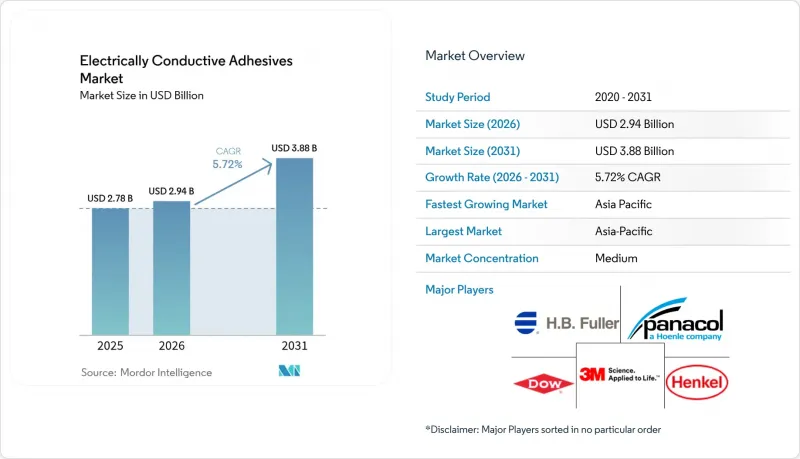
本報告按化學類型(環氧樹脂、矽酮、聚氨酯、丙烯酸酯及其他)、類型(等向性、異向性)、應用領域(太陽能電池、汽車、LED照明、印刷基板等)和地區(亞太地區、北美、歐洲、南美以及中東和非洲)進行細分。市場預測以美元計價。
全球導電黏合劑市場趨勢及洞察
電力電子領域的應用不斷擴展
採用碳化矽 (SiC) 和氮化鎵 (GaN) 裝置的新一代功率轉換器,其結溫超過 200 度C,而錫鉛焊料和低銀焊料無法在此溫度範圍內使用。填充高純度銀、鍍銀銅或混合石墨烯網路的環氧樹脂和矽酮黏合劑,可在保持高電流密度下導電的同時,有效緩解熱衝擊,從而實現更小的功率模組,並提高開關頻率,同時減少寄生元件。這些配方也可用作導熱界面材料,降低牽引逆變器中結到機殼的熱阻。材料科學家透過在3D結構中分散奈米碳管纖維,確保平行的電熱通路,從而推動導電黏合劑市場在寬能隙功率元件設計領域中佔據領先地位。
電動車使用範圍的擴大
在單體電池到電池組的一體化電池策略中,模組外殼被取消,負載支撐和溫度控管的功能轉移到了黏合劑層。剪切強度超過20 MPa的導電環氧樹脂能夠承受振動和衝擊,同時將電流均勻地分配到每個電池組超過3000個圓柱形或棱柱形單體電池上。結合金屬填料和陶瓷球的混合系統形成了一種軟性晶格結構,可以吸收鋁匯流排和銅極片之間的熱膨脹差異,從而延長電池組的使用壽命,使其能夠承受數千次高倍率充放電循環。輕型車輛輔助電氣化採用的48V架構引入了高密度配電基板,其中細間距異向性黏合可以防止短路,這為導電黏合劑市場創造了新的需求。
銀色填充材料價格波動
銀粉佔典型等向性黏合劑重量的60%至80%,而裸金屬價波動劇烈,季度內漲幅可能超過25%。銅、鎳和奈米碳管有望降低成本,但由於氧化、擴散和滲流等限制,它們完全取代銀的能力有限。以銅為芯,外覆300奈米銀殼的混合顆粒結構,可在不影響整體導電性的前提下,將貴金屬含量降低30%至40%,但其供應鏈仍易受地緣政治因素導致的採礦中斷的影響。儘管價格轉嫁機制在航太和醫療合約中很常見,但家用電子電器的原始設備製造商(OEM)卻不願支付額外費用,這阻礙了導電黏合劑市場的短期擴張。
細分市場分析
到2025年,環氧樹脂導電膠將佔導電黏合劑市場佔有率的44.62%,在那些對搭接剪切強度和柔軟性的領域,環氧樹脂仍將保持領先地位。配方師採用雙酚A、雙酚F和酚醛清漆作為骨架,透過調節黏度、玻璃化轉變溫度和模量,以滿足從剛性基板黏接到功率模組晶片黏接等各種應用需求。儘管競爭日益激烈,環氧樹脂黏合劑市場預計仍將穩定成長。使用潛伏型咪唑催化劑可以加速固化並縮短烘箱處理時間,且不會影響產品的保存期限。對於高溫碳化矽元件,醯亞胺改質環氧樹脂可承受200 度C的黏接環境,並維持熱循環穩定性,在2000次循環後電阻漂移在5%以內。在環保方面,無鹵配方符合RoHS指令及廢舊產品回收要求。
預計到2031年,矽基體系的複合年成長率將達到6.42%,其市場佔有率正迅速縮小,這得益於其超過70%的延伸率以及即使經過1000小時鹽霧試驗後仍能保持的導電性。這些特性在汽車引擎室控制設備和離岸風力發電轉換器中具有極高的價值。聚二甲基矽氧烷網路能夠吸收衝擊負荷並防止水分滲入,從而解決環氧樹脂無法應對的失效模式。採用鉑催化劑的室溫硫化矽酮可降低LED照明中精密透鏡組件的熱應力。環氧樹脂和矽酮的混合化學結構提供了剛性內層以確保黏合表面的完整性,以及軟性外層以緩解熱膨脹係數(CTE)的差異。這些協同效應表明,導電黏合劑市場的發展方向是透過成分創新,而不是趨向於單一的化學結構。
區域分析
預計到2025年,亞太地區將佔全球銷售額的54.83%,憑藉中國、韓國和台灣強大的半導體產業生態系統,繼續保持其在銷售和銷售額方面的領先地位。地方政府推行的新能源汽車和太陽能發電政策持續推動市場需求,使全部區域導電黏合劑市場實現了6.31%的複合年成長率。中國對電動乘用車的補貼政策促成了與主要黏合劑供應商簽訂長期採購協議,有效降低了外匯風險,並確保了工廠運轉率的穩定性。深圳、蘇州和班加羅爾等地的創業中心正在與成熟的跨國公司形成互補,並透過推出軟性電子產品、穿戴式裝置和印刷電子產品,拓展利基配方產品的基本客群。
在北美,國防航空電子設備、太空探勘項目以及功率半導體晶圓廠的回歸是推動導電膠消費成長的主要動力。該地區的認證標準(例如NASA的脫氣測試、IPC-CC-830C和UL-94V0)提高了准入門檻,使高品質環氧樹脂、銀膠和導熱膜的供應商能夠獲得可觀的毛利率。德樂(DELO)和漢高(Henkel)近期在德克薩斯州和俄亥俄州的投資進一步增強了市場對長期需求的信心。 《晶片與科學法案》(CHIPS and Science Act)下的政府獎勵正在吸引先進封裝項目,從而進一步擴大導電黏合劑市場。
歐洲在汽車、醫療和可再生能源領域保持著強勁的地位。德國在電動車電池組的整合方面處於主導,法國和北歐國家正在擴大離岸風力發電的建設,而荷蘭則在軟性OLED的研發方面處於領先地位。儘管面臨宏觀經濟逆風,但這些趨勢共同維持了穩定的採購量。嚴格的REACH和RoHS法規促使複合材料生產商轉向無鹵、無鉛和低溶劑體系,這為能夠平衡性能和永續性的創新公司帶來了先發優勢。隨著企業平均二氧化碳排放目標的日益嚴格,原始設備製造商(OEM)將導電黏合劑視為實現更輕線束和更高效率模組的有效途徑,這進一步鞏固了導電膠在導電黏合劑市場的長期重要性。
其他好處:
- Excel格式的市場預測(ME)表
- 3個月的分析師支持
目錄
第1章:引言
- 研究假設和市場定義
- 調查範圍
第2章:調查方法
第3章執行摘要
第4章 市場狀況
- 市場概覽
- 市場促進因素
- 電力電子領域的應用不斷擴展
- 電動車使用範圍的擴大
- 在航太和國防領域的應用日益廣泛
- 可再生能源系統需求不斷成長
- 用於植入的生物相容性導電黏合劑
- 市場限制因素
- 銀色填充料價格波動
- 在高電流和熱循環條件下的可靠性極限。
- 更長的固化時間和更高的製程複雜性
- 價值鏈分析
- 波特五力模型
第5章 市場規模與成長預測
- 依化學類型
- 環氧樹脂
- 矽酮
- 聚氨酯
- 丙烯酸纖維
- 其他化學類型
- 按類型
- 等向性
- 異向性
- 透過使用
- 太陽能電池
- 車
- LED照明
- 印刷基板
- 液晶顯示器
- 其他用途
- 按地區
- 亞太地區
- 中國
- 印度
- 日本
- 韓國
- 其他亞太國家
- 北美洲
- 美國
- 加拿大
- 墨西哥
- 歐洲
- 德國
- 英國
- 法國
- 義大利
- 其他歐洲國家
- 南美洲
- 巴西
- 阿根廷
- 其他南美國家
- 中東和非洲
- 沙烏地阿拉伯
- 南非
- 其他中東和非洲國家
- 亞太地區
第6章 競爭情勢
- 市場集中度
- 策略趨勢
- 市佔率和排名分析
- 公司簡介
- 3M
- Aremco
- Arkema
- Creative Materials
- DELO Industrie Klebstoffe GmbH & Co. KGaA
- Dow
- Dymax
- HB Fuller Company
- Henkel AG & Co. KGaA
- Heraeus Electronics
- HITEK Electronic Materials Ltd
- Master Bond Inc.
- MG Chemicals
- Nagase ChemteX America LLC
- Panacol-Elosol GmbH
- Parker Hannifin Corp.
- Permabond
- Protavic International
第7章 市場機會與未來展望
According to Mordor Intelligence, the electrically conductive adhesives market size was valued at USD 2.78 billion in 2025 and estimated to grow from USD 2.94 billion in 2026 to reach USD 3.88 billion by 2031, at a CAGR of 5.72% during the forecast period (2026-2031).
This report is Segmented by Chemistry Type (Epoxy, Silicone, Polyurethane, Acrylic, Other Chemistries), Type (Isotropic, Anisotropic), Application (Solar Cells, Automotive, LED Lighting, Printed Circuit Boards, and More), and Geography (Asia-Pacific, North America, Europe, South America, Middle East and Africa). The Market Forecasts are Provided in Terms of Value (USD).
Global Electrically Conductive Adhesives Market Trends and Insights
Increasing Application in Power Electronics
Next-generation power converters incorporating silicon-carbide and gallium-nitride devices run at junction temperatures above 200 °C, a regime that invalidates tin-lead and low-silver solders. Epoxy and silicone adhesives filled with high-purity silver, silver-coated copper, or hybrid graphene networks maintain conductivity under high current densities while buffering thermal shock, enabling miniaturized power modules that deliver higher switching frequencies with lower parasitics. The formulations also double as thermal interface materials, reducing junction-to-case resistance in traction inverters. Material scientists are dispersing carbon-nanotube strands in three-dimensional architectures to unlock parallel electrical and thermal pathways, pushing the electrically conductive adhesives market to the forefront of wide-bandgap power design.
Increasing Utilization in Electric Vehicles
Cell-to-pack battery strategies eliminate module housings, transferring load-bearing and thermal duties to the adhesive layer. Conductive epoxies with shear strengths above 20 MPa withstand vibration and crash pulses while equalizing current across 3,000-plus cylindrical or prismatic cells per pack. Hybrid systems that marry metallic fillers with ceramic spheres form a compliant lattice that absorbs differential expansion between aluminum busbars and copper tabs, extending service life over thousands of high-rate charge-discharge cycles. The 48-V architecture adopted for auxiliary electrification in light vehicles introduces dense power distribution boards where fine-pitch anisotropic joints prevent short circuits, adding fresh volume to the electrically conductive adhesives market.
Silver-Filler Price Volatility
Silver powders account for 60-80 wt% of typical isotropic adhesives, exposing formulators to bullion swings that can exceed 25% within a quarter. While copper, nickel, and carbon nanotubes promise cost relief, oxidation, diffusion, and percolation thresholds curb their ability to fully replace silver. Hybrid particle architectures that coat copper cores with 300-nm silver shells cut precious-metal content by 30-40% without compromising bulk conductivity, yet the supply chain remains vulnerable to geopolitical mining disruptions. Price pass-through mechanisms are standard in aerospace and medical contracts, but consumer electronics OEMs resist surcharges, trimming near-term expansion of the electrically conductive adhesives market.
Other drivers and restraints analyzed in the detailed report include:
- Growing Demand from Renewable Energy Systems
- Bio-Compatible Conductive Bio-Adhesives for Implants
- Reliability Limits Under High Current & Thermal Cycling
For complete list of drivers and restraints, kindly check the Table Of Contents.
Segment Analysis
Epoxy-based grades comprised 44.62% of the electrically conductive adhesives market in 2025 and remain a mainstay where high lap-shear strength and easy dispensing outweigh flexibility concerns. Formulators exploit bisphenol-A, bisphenol-F and novolac backbones to tailor viscosity, glass-transition temperature and modulus, covering everything from rigid board attach to die-attach in power modules. The electrically conductive adhesives market size for epoxy chemistries is projected to grow steadily even as competition intensifies. Their state-of-cure can be accelerated with latent imidazole catalysts, trimming oven time without compromising shelf life. For high-temperature silicon-carbide devices, imide-modified epoxies withstand 200 °C junction environments while keeping thermal cycling stability within 5% resistance drift over 2,000 cycles. On the environmental front, halogen-free formulations satisfy RoHS directives and end-of-life recycling mandates.
Silicone-based systems, recording a 6.42% CAGR to 2031, are closing the market-share gap by delivering elongation over 70% and sustained conductivity after 1,000 salt-spray hours-attributes prized in under-hood automotive controls and offshore wind converters. Polydimethylsiloxane networks absorb shock loads and seal against moisture ingress, addressing failure modes that epoxy cannot. Room-temperature-vulcanizing silicones with platinum catalysts reduce thermal stress on sensitive lens assemblies in LED lighting. Hybrid epoxy-silicone chemistries combine a rigid inner phase for bondline integrity with a compliant outer domain that relieves CTE mismatch. Such synergies reveal how the electrically conductive adhesives market evolves through compositional innovation rather than one-chemistry-wins-all convergence.
Complete Report Scope:
- By Chemistry Type
- Epoxy
- Silicone
- Polyurethane
- Acrylic
- Other Chemistries
- By Type
- Isotropic
- Anisotropic
- By Application
- Solar Cells
- Automotive
- LED Lighting
- Printed Circuit Boards
- LCD Displays
- Other Applications
- By Geography
- Asia-Pacific
- China
- India
- Japan
- South Korea
- Rest of Asia-Pacific
- North America
- United States
- Canada
- Mexico
- Europe
- Germany
- United Kingdom
- France
- Italy
- Rest of Europe
- South America
- Brazil
- Argentina
- Rest of South America
- Middle East and Africa
- Saudi Arabia
- South Africa
- Rest of Middle East and Africa
- Asia-Pacific
Geography Analysis
Asia-Pacific retained 54.83% of 2025 revenue and continues as both volume and value leader due to semiconductor powerhouse ecosystems in China, South Korea and Taiwan. Local policy mandates for new-energy vehicles and photovoltaic rollouts funnel sustained demand, translating to a 6.31% CAGR for the electrically conductive adhesives market across the region. National subsidy programs for domestic electric passenger cars anchor long-term offtake contracts with major adhesive suppliers, reducing currency-exchange risk and ensuring steady plant utilization. Start-up clusters in Shenzhen, Suzhou, and Bangalore complement entrenched multinationals by launching flexible, wearable, and printed-electronics products, widening the customer base for niche formulations.
North America demonstrates significant consumption, driven by defense avionics, space exploration initiatives, and the reshoring of power-semiconductor fabs. The region's qualification standards-NASA outgassing, IPC-CC-830C, UL-94V0-elevate entry barriers, allowing suppliers of premium epoxy-silver pastes and thermally conductive films to command healthy gross margins. Recent capital expansions by DELO and Henkel in Texas and Ohio underscore confidence in long-term demand. Government incentives under the CHIPS and Science Act draw advanced-packaging projects that further enlarge the electrically conductive adhesives market footprint.
Europe maintains a stronghold in automotive, medical and renewable segments. Germany spearheads EV battery pack integration, France and the Nordic nations ramp offshore wind farms, and the Netherlands leads in flexible OLED R&D. These trends converge to sustain steady purchasing volumes despite macroeconomic headwinds. Stringent REACH and RoHS compliance pushes formulators toward halogen-free, lead-free, and solvent-reduced systems, awarding first-mover advantage to innovators capable of aligning performance with sustainability. With corporate average CO2 targets tightening, OEMs view conductive adhesives as enablers for lighter wiring harnesses and higher-efficiency modules, reinforcing their long-run importance within the electrically conductive adhesives market.
- 3M
- Aremco
- Arkema
- Creative Materials
- DELO Industrie Klebstoffe GmbH & Co. KGaA
- Dow
- Dymax
- H.B. Fuller Company
- Henkel AG & Co. KGaA
- Heraeus Electronics
- HITEK Electronic Materials Ltd
- Master Bond Inc.
- MG Chemicals
- Nagase ChemteX America LLC
- Panacol-Elosol GmbH
- Parker Hannifin Corp.
- Permabond
- Protavic International
Additional Benefits:
- The market estimate (ME) sheet in Excel format
- 3 months of analyst support
TABLE OF CONTENTS
1 Introduction
- 1.1 Study Assumptions and Market Definition
- 1.2 Scope of the Study
2 Research Methodology
3 Executive Summary
4 Market Landscape
- 4.1 Market Overview
- 4.2 Market Drivers
- 4.2.1 Increasing application in power electronics
- 4.2.2 Increasing utilization in electric vehicles
- 4.2.3 Increasing usage in aerospace and defense applications
- 4.2.4 Growing demand from renewable energy systems
- 4.2.5 Bio-compatible conductive bio-adhesives for implants
- 4.3 Market Restraints
- 4.3.1 Silver-filler price volatility
- 4.3.2 Reliability limits under high current and thermal cycling
- 4.3.3 Longer curing times and process complexity
- 4.4 Value Chain Analysis
- 4.5 Porter's Five Forces
- 4.5.1 Threat of New Entrants
- 4.5.2 Bargaining Power of Buyers
- 4.5.3 Bargaining Power of Suppliers
- 4.5.4 Threat of Substitute Products
- 4.5.5 Degree of Competition
5 Market Size and Growth Forecasts (Value)
- 5.1 By Chemistry Type
- 5.1.1 Epoxy
- 5.1.2 Silicone
- 5.1.3 Polyurethane
- 5.1.4 Acrylic
- 5.1.5 Other Chemistries
- 5.2 By Type
- 5.2.1 Isotropic
- 5.2.2 Anisotropic
- 5.3 By Application
- 5.3.1 Solar Cells
- 5.3.2 Automotive
- 5.3.3 LED Lighting
- 5.3.4 Printed Circuit Boards
- 5.3.5 LCD Displays
- 5.3.6 Other Applications
- 5.4 By Geography
- 5.4.1 Asia-Pacific
- 5.4.1.1 China
- 5.4.1.2 India
- 5.4.1.3 Japan
- 5.4.1.4 South Korea
- 5.4.1.5 Rest of Asia-Pacific
- 5.4.2 North America
- 5.4.2.1 United States
- 5.4.2.2 Canada
- 5.4.2.3 Mexico
- 5.4.3 Europe
- 5.4.3.1 Germany
- 5.4.3.2 United Kingdom
- 5.4.3.3 France
- 5.4.3.4 Italy
- 5.4.3.5 Rest of Europe
- 5.4.4 South America
- 5.4.4.1 Brazil
- 5.4.4.2 Argentina
- 5.4.4.3 Rest of South America
- 5.4.5 Middle East and Africa
- 5.4.5.1 Saudi Arabia
- 5.4.5.2 South Africa
- 5.4.5.3 Rest of Middle East and Africa
- 5.4.1 Asia-Pacific
6 Competitive Landscape
- 6.1 Market Concentration
- 6.2 Strategic Moves
- 6.3 Market Share(%)/Ranking Analysis
- 6.4 Company Profiles (includes Global level Overview, Market level overview, Core Segments, Financials as available, Strategic Information, Market Rank/Share for key companies, Products and Services, and Recent Developments)
- 6.4.1 3M
- 6.4.2 Aremco
- 6.4.3 Arkema
- 6.4.4 Creative Materials
- 6.4.5 DELO Industrie Klebstoffe GmbH & Co. KGaA
- 6.4.6 Dow
- 6.4.7 Dymax
- 6.4.8 H.B. Fuller Company
- 6.4.9 Henkel AG & Co. KGaA
- 6.4.10 Heraeus Electronics
- 6.4.11 HITEK Electronic Materials Ltd
- 6.4.12 Master Bond Inc.
- 6.4.13 MG Chemicals
- 6.4.14 Nagase ChemteX America LLC
- 6.4.15 Panacol-Elosol GmbH
- 6.4.16 Parker Hannifin Corp.
- 6.4.17 Permabond
- 6.4.18 Protavic International
7 Market Opportunities and Future Outlook

 導電黏合劑市場報告:趨勢、預測及競爭分析(至2035年)
 導電黏合劑市場:按類型、材料、填料、配方、固化方法、銷售管道、應用和最終用戶分類-2026-2032年全球市場預測
 2026年全球鎳填充導電黏合劑市場報告
 黏合劑市場:按化學成分、類型、應用和地區分類 -
 黏合劑市場報告:按類型、化學成分、填充材、應用和地區分類(2026-2034 年)
 航太導電密封劑市場規模、佔有率和成長分析:按產品類型、應用、用戶類型、最終用途行業、配方技術和地區分類 - 行業預測,2026-2033年
 電動車導電黏合劑市場預測至2034年—按黏合劑類型、導電填充材、電動車類型、應用和地區分類的全球分析新能源汽車導熱黏合劑市場:依產品類型、車輛類型、導熱係數、形狀、最終用途分類,全球預測(2026-2032年)導電碳黏合劑膏市場:依最終用途產業、黏合劑化學成分、應用、形態、導電等級、固化溫度及銷售管道,全球預測,2026-2032年
 導電黏合劑市場規模、佔有率及成長分析(按類型、化學成分、應用和地區分類)-2026-2033年產業預測