


 |
市場調查報告書
商品編碼
2115015
玻璃黏合劑:市場佔有率分析、產業趨勢和統計數據、成長預測(2026-2031)Glass Bonding Adhesives - Market Share Analysis, Industry Trends & Statistics, Growth Forecasts (2026 - 2031) |
||||||

※ 本網頁內容可能與最新版本有所差異。詳細情況請與我們聯繫。
據 Mordor Intelligence 稱,玻璃黏合劑市場預計到 2026 年價值 44.5 億美元,高於 2025 年的 42.1 億美元,預計到 2031 年將達到 58.6 億美元。
預計 2026 年至 2031 年的複合年成長率為 5.68%。
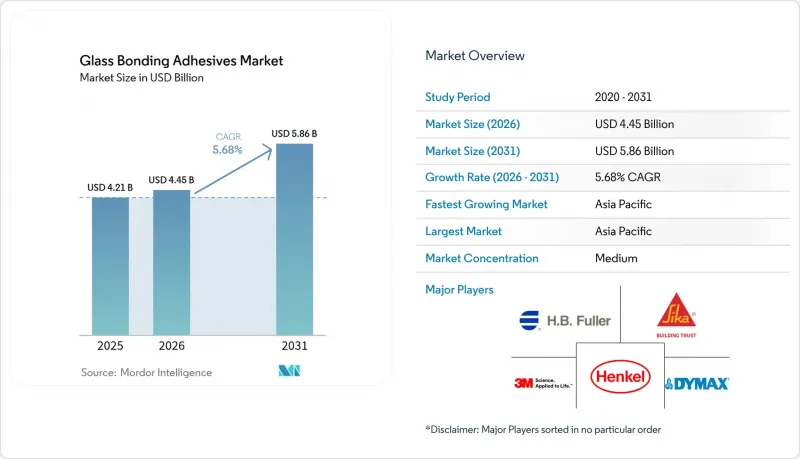
本報告按類型(環氧樹脂、矽酮、聚氨酯、UV固化樹脂等)、終端用戶產業(家具、醫療、電氣電子、汽車及運輸、建築施工及其他終端用戶產業)和地區(亞太地區、北美、歐洲、南美以及中東和非洲)進行細分。市場預測以美元計價。
全球玻璃黏合劑市場趨勢及洞察
汽車玻璃領域對夾層玻璃和智慧玻璃的應用正在迅速增加。
汽車製造商正將抬頭顯示器、電致變色層和感測器陣列直接整合到擋風玻璃中,無需支架和夾具,並採用透明結構黏合劑。西卡(Sika)的「PowerCure」技術與傳統胺甲酸乙酯黏合劑相比,固化時間縮短了50%,維持了高級駕駛輔助系統(ADAS)雷達的電磁滲透性,並能承受-40 度C至+120 度C範圍內的週期性熱負荷。黏合劑必須吸收玻璃和金屬框架之間的熱膨脹差異,即使在持續的紫外線照射下也能保持透明度。智慧玻璃在豪華車專案中的應用早於量產車型,隨著一級玻璃供應商將紫外線穩定矽酮標準化,下游市場的應用也正在加速。由於每塊夾層玻璃都包含更多需要單獨密封的功能層,這種轉變正在增加單車耗材量。這些因素綜合起來將使玻璃黏合劑市場的預期複合年成長率(CAGR)增加1.2個百分點。
擴大Mini-LED和Micro-LED顯示器組裝線
智慧型手機、筆記型電腦和車載資訊娛樂系統製造商正在運作高產能的Mini-LED背板生產線,這些生產線需要亞毫米級的轉印專利,當黏合劑圓角高度小於2μm時,良率可達99.99%。此技術的應用範圍擴展到工業人機介面(HMI)和航空電子設備,這些應用需要彈性模量在0.5至1.2MPa範圍內的材料,以承受振動和-55 度C至+85 度C的熱循環。紫外線曝光時間通常不到2秒,快速的組裝週期可提高面板製造商的整體設備效率(OEE),進一步推動市場複合年成長率(CAGR)提高0.8個百分點。
能源價格波動推高了環氧樹脂和矽膠的原料成本。
地緣政治緊張局勢和煉油廠停產預計將在2024年下半年推高布蘭特原油價格至每桶97美元,進而推高苯和金屬矽基中間體的價格。複合樹脂供應商AOC已在歐洲將價格上調150-200歐元/噸,這將對下游黏合劑產品線的利潤率造成壓力。中小規模的複合材料生產商往往缺乏長期契約,迫使他們維持更大的庫存緩衝,導致營運資金增加和創新項目延期。由此產生的成本上漲正在威脅對價格敏感的玻璃和顯示器應用領域,預計將使複合年成長率下降0.7個百分點。
細分市場分析
預計到2025年,紫外光固化系統將佔銷售額的29.78%,發揮核心作用。這主要得益於其一秒閃固化技術,顯著縮短了汽車擋風玻璃和電視背光條的生產週期。隨著原始設備製造商(OEM)轉向無汞LED燈和線上偵測感測器,與紫外光產品相關的玻璃黏合劑市場預計將以每年5.72%的速度成長。環氧樹脂在鐵路車輛車窗的結構連接中仍然佔據主導地位,因為這些連接要求剝離強度達到12 N/mm或更高。但由於歐洲對二異氰酸酯的監管規定,聚氨酯的使用量正在下降。受無框牆面工程對極高熱柔軟性的需求推動,矽基產品預計將以6.86%的複合年成長率成長。熱熔膠和厭氧樹脂仍然是小眾市場,但它們在消費性電子產品的玻璃面板和壓縮機視鏡中至關重要,因為在這些應用中,工藝簡便性比光學完美性更為重要。
原始設備製造商 (OEM) 正專注於總體擁有成本 (TCO)。與對流烘箱相比,紫外光固化設備可降低 95% 的能耗,從而釋放出先前已被對流烘箱佔用的寶貴占地面積。信越化學的紫外光固化液態矽橡膠 (LSR) 的固化收縮率低於 0.1%,可實現超薄相機蓋玻片的黏合,且不會產生光學畸變。將黏合劑和可程式設計應用/點膠機器人成套銷售的供應商,雖然提高了客戶的轉換成本,但同時也確保了產品生命週期內的業務收益來源。
區域分析
預計到2025年,亞太地區將佔總銷售額的41.02%,並在2031年之前維持6.54%的複合年成長率。這主要得益於中國兆美元的基礎建設項目以及印度汽車產量兩位數的成長。政府法規強制要求電動車玻璃必須本地採購,這推動了需求的成長,並促進了密封劑進口產品的替代。西卡運作縮短了前置作業時間,並研發出適用於炎熱潮濕的熱帶建築環境的配方。在日本和韓國,微型LED和半導體晶圓的鍵結製程創造了高附加價值銷售額,其缺陷接受度以十億分之一(ppb)為單位進行衡量。
在北美,輕型卡車的強勁需求,加上航太領域大量訂單積壓(這些訂單涉及需要低模量矽酮封裝的玻璃駕駛座顯示器),共同推動了市場發展。加州的揮發性有機化合物(VOC)法規正在加速紫外線固化產品的普及,中西部地區的擋風玻璃工廠也正在進行維修。美國在醫療設備消費領域佔據主導地位,這反映了美國食品藥物管理局(FDA)的嚴格監管和健全的契約製造體系。
在歐洲,德國豪華車產業和英國先進的帷幕牆設計技術依然擁有強大的創新基礎,但天然氣價格飆升持續擠壓著利潤空間。該地區對二異氰酸酯的監管迫使原始設備製造商(OEM)轉向使用矽酮和紫外線改質聚丙烯酸酯配方。在南美洲,巴西乘用車市場的復甦和哥倫比亞城市軌道交通項目的推進正逐步擴大玻璃黏合劑的市場需求,並呈現出新的成長跡象。中東和非洲地區的成長依賴於杜拜、杜哈和利雅德等海灣國家的高層建築建設計畫,在這些地區,高品質的矽酮密封膠對於抵禦沙漠地區強烈的紫外線輻射和溫度波動至關重要。蓋勒斯海默公司2025年上半年玻璃包裝業務的銷售額預計達到11.207億歐元,這也凸顯了該地區醫療耗材產業的垂直協同效應。
其他好處:
- Excel格式的市場預測(ME)表
- 3個月的分析師支持
目錄
第1章:引言
- 研究假設和市場定義
- 調查範圍
第2章:調查方法
第3章執行摘要
第4章 市場狀況
- 市場概覽
- 市場促進因素
- 汽車玻璃領域對夾層玻璃和智慧玻璃的應用正在迅速增加。
- 擴大Mini-LED和Micro-LED顯示器的組裝
- 無框建築立面在亞太地區的快速發展。
- 嚴格的VOC減量法規正在推動UV固化化學品的廣泛應用。
- 對即時醫療診斷設備的需求日益成長
- 市場限制因素
- 能源價格波動推高了環氧樹脂和矽膠的原料成本。
- 某些氰基丙烯酸酯在醫療應用上存在細胞毒性問題。
- 大型玻璃面板高精度點膠技術存在技能缺口
- 價值鏈分析
- 波特五力模型
第5章 市場規模與成長預測
- 按類型
- 環氧樹脂
- 矽酮
- 聚氨酯
- 紫外線固化型
- 其他類型
- 按最終用戶行業分類
- 家具
- 衛生保健
- 電氣和電子設備
- 汽車和運輸業
- 建築/施工
- 其他終端用戶產業
- 按地區
- 亞太地區
- 中國
- 印度
- 日本
- 韓國
- ASEAN
- 其他亞太國家
- 北美洲
- 美國
- 加拿大
- 墨西哥
- 歐洲
- 德國
- 英國
- 法國
- 義大利
- 其他歐洲國家
- 南美洲
- 巴西
- 阿根廷
- 其他南美國家
- 中東和非洲
- 沙烏地阿拉伯
- 阿拉伯聯合大公國
- 南非
- 其他中東和非洲國家
- 亞太地區
第6章 競爭情勢
- 市場集中度
- 策略趨勢
- 市佔率(%)/排名分析
- 公司簡介
- 3M
- Arkema(Bostik)
- Ashland
- Dow
- DuPont
- Dymax Corporation
- HB Fuller Company
- Henkel AG & Co. KGaA
- Huntsman International LLC
- Momentive
- Panacol-Elosol GmbH
- Parker Hannifin Corp
- Permabond LLC
- Saint-Gobain
- Sika AG
- ThreeBond Holdings Co., Ltd.
第7章 市場機會與未來展望
According to Mordor Intelligence, glass bonding adhesives market size in 2026 is estimated at USD 4.45 billion, growing from 2025 value of USD 4.21 billion with 2031 projections showing USD 5.86 billion, growing at 5.68% CAGR over 2026-2031.
This report is Segmented by Type (Epoxy, Silicone, Polyurethane, UV Cured, and More), End-User Industry (Furniture, Healthcare, Electrical and Electronics, Automotive and Transportation, Building and Construction, and Other End-User Industries), and Geography (Asia-Pacific, North America, Europe, South America, and Middle East and Africa). The Market Forecasts are Provided in Terms of Value (USD).
Global Glass Bonding Adhesives Market Trends and Insights
Surge in Laminated and Smart-glass Adoption in Automotive Glazing
Automakers are embedding heads-up displays, electrochromic layers, and sensor arrays directly into windshields, eliminating brackets and clamps in favor of transparent structural joints. PowerCure technology from Sika trims curing time by 50% relative to legacy urethanes, maintains electromagnetic transparency for Advanced Driver Assistance System (ADAS) radar, and withstands cyclic heat loads between -40°C and +120°C. Adhesives must absorb differential thermal expansion between glass and metal frames while retaining clarity under continuous UV bombardment. Premium vehicle programs deploy smart glass faster than mass-market models, yet downstream adoption is accelerating as tier-one glazing suppliers standardize on UV-stable silicones. The transition lifts unit consumption per vehicle because each laminated lite now carries more functional layers that must be sealed independently. Combined, these factors add 1.2 percentage points to the projected CAGR in the glass bonding adhesives market.
Growing Mini-LED and Micro-LED Display Assembly Lines
Smartphone, notebook, and in-car infotainment makers are commissioning high-throughput Mini-LED backplane lines that demand sub-millimeter die placement accuracy. UV-curable acrylates with outgassing below 5 ppm protect sensitive junctions, while low-shrink silicone hybrids prevent warpage of ultrathin cover glass during post-cure. X Display Company's micro-transfer printing patents report 99.99% yield when adhesive fillets remain under 2 μm in height. Integration also extends to industrial Human-Machine Interfaces (HMIs) and avionics, where vibration tolerance and thermal cycling from -55°C to +85°C require elastic moduli in the 0.5-1.2 MPa window. Rapid assembly cycles, often under two seconds of UV exposure, translate into measurable Overall Equipment Effectiveness (OEE) gains for panel makers, supporting an additional 0.8 percentage-point lift in market CAGR.
Energy-Price Volatility Inflating Epoxy and Silicone Feedstock Costs
Geopolitical tension and refinery downtimes pushed Brent crude toward USD 97 per barrel in late 2024, inflating benzene- and silicon-metal-derived intermediates. Composite resin supplier AOC raised prices by EUR 150-200 per ton in Europe, eroding margins in downstream adhesive lines. Smaller formulators often lack long-term contracts and must hold higher inventory buffers, boosting working capital and delaying innovation projects. The resulting cost pass-through threatens price-sensitive glazing or display applications, paring an estimated 0.7 percentage point from projected CAGR.
Other drivers and restraints analyzed in the detailed report include:
- Rapid Expansion of Frameless Architectural Facades in Asia-Pacific
- Stringent VOC-reduction Mandates Driving UV-curable Chemistries
- Cytotoxicity Concerns Around Certain Cyanoacrylates in Medical Use
For complete list of drivers and restraints, kindly check the Table Of Contents.
Segment Analysis
UV-cured systems accounted for 29.78% revenue in 2025 and hold center stage because one-second flash curing compresses takt times for automotive windshields and television backlight bars. The glass bonding adhesives market size tied to UV products is set to expand at 5.72% annually as OEMs retrofit mercury-free LED lamps and inline inspection sensors. Epoxies still dominate structural joints in rail windows where peel strength above 12 N/mm is mandated, but polyurethane usage is tapering under Europe's diisocyanate restrictions. Silicone grades are expected to capture 6.86% CAGR on the back of frameless facade projects demanding extreme thermal flexibility. Hot-melt and anaerobic chemistries remain niche yet indispensable in appliance glass panels and compressor sight glasses, where process simplicity trumps optical perfection.
OEMs weigh total cost of ownership: UV rigs use 95% less energy and free valuable floor space once occupied by convection ovens. Shin-Etsu's UV-cure Liquid Silicone Rubbers (LSRs) show cure shrinkage under 0.1%, enabling ultra-thin camera cover-glass bonding without optical distortion. Suppliers that bundle adhesives with programmable dose-/-dispense robots enlarge switching costs for customers and capture lifecycle service revenue streams.
Complete Report Scope:
- By Type
- Epoxy
- Silicone
- Polyurethane
- UV Cured
- Other Types
- By End-User Industry
- Furniture
- Healthcare
- Electrical and Electronics
- Automotive and Transportation
- Building and Construction
- Other End-User Industries
- By Geography
- Asia-Pacific
- China
- India
- Japan
- South Korea
- ASEAN
- Rest of Asia-Pacific
- North America
- United States
- Canada
- Mexico
- Europe
- Germany
- United Kingdom
- France
- Italy
- Rest of Europe
- South America
- Brazil
- Argentina
- Rest of South America
- Middle East and Africa
- Saudi Arabia
- United Arab Emirates
- South Africa
- Rest of Middle East and Africa
- Asia-Pacific
Geography Analysis
Asia-Pacific controlled 41.02% of 2025 revenue and is tracking a 6.54% CAGR through 2031, underpinned by China's USD 1 Trillion infrastructure program and India's double-digit automotive output gains. Government mandates for locally sourced electric vehicle (EV) glazing add volume while incentivizing import substitution for sealants. Singapore and Xi'an plants commissioned by Sika shorten lead times and tailor formulations to humid tropical builds. Japan and South Korea provide high-value sales in Micro-LED and semiconductor wafer bonding where defect tolerances are measured in parts per billion.
North America benefits from resilient light-truck demand and a robust aerospace backlog that leverages glass cockpit displays requiring low-modulus silicone encapsulants. California's VOC limits accelerate UV-curable uptake, prompting retrofits in Midwestern windshield plants. The United States dominates medical device consumption, reflecting stringent FDA oversight and a deep contract-manufacturing ecosystem.
Europe maintains a strong innovation base in Germany's premium car sector and the UK's advanced facade design practices, yet profit margins remain compressed by elevated natural-gas costs. The region's diisocyanate restriction is nudging OEMs toward silicone or UV-modified polyacrylate formulations. South America presents emerging upside, with Brazil's passenger-car recovery and Colombia's urban rail projects adding incremental glass bonding adhesives market demand. Middle East & Africa growth hinges on Gulf skyscraper pipelines in Dubai, Doha, and Riyadh, where desert UV load and temperature cycling mandate premium silicone sealants. Gerresheimer's EUR 1,120.7 million glass packaging revenue in H1 2025 also illustrates vertical synergies for regional medical consumables.
- 3M
- Arkema (Bostik)
- Ashland
- Dow
- DuPont
- Dymax Corporation
- H.B. Fuller Company
- Henkel AG & Co. KGaA
- Huntsman International LLC
- Momentive
- Panacol-Elosol GmbH
- Parker Hannifin Corp
- Permabond LLC
- Saint-Gobain
- Sika AG
- ThreeBond Holdings Co., Ltd.
Additional Benefits:
- The market estimate (ME) sheet in Excel format
- 3 months of analyst support
TABLE OF CONTENTS
1 Introduction
- 1.1 Study Assumptions & Market Definition
- 1.2 Scope of the Study
2 Research Methodology
3 Executive Summary
4 Market Landscape
- 4.1 Market Overview
- 4.2 Market Drivers
- 4.2.1 Surge in Laminated and Smart-glass Adoption in Automotive Glazing
- 4.2.2 Growing Mini-LED and Micro-LED Display Assembly Lines
- 4.2.3 Rapid Expansion of Frameless Architectural Facades in Asia-Pacific
- 4.2.4 Stringent VOC-reduction Mandates Driving UV-curable Chemistries
- 4.2.5 Rising Demand for Point-of-care Medical Diagnostics Devices
- 4.3 Market Restraints
- 4.3.1 Energy-Price Volatility Inflating Epoxy and Silicone Feedstock Costs
- 4.3.2 Cytotoxicity Concerns Around Certain Cyanoacrylates in Medical Use
- 4.3.3 Skill Gap in Precision Dispensing for Large-format Glass Panels
- 4.4 Value Chain Analysis
- 4.5 Porter's Five Forces
- 4.5.1 Threat of New Entrants
- 4.5.2 Bargaining Power of Buyers
- 4.5.3 Bargaining Power of Suppliers
- 4.5.4 Threat of Substitutes
- 4.5.5 Degree of Competition
5 Market Size & Growth Forecasts (Value)
- 5.1 By Type
- 5.1.1 Epoxy
- 5.1.2 Silicone
- 5.1.3 Polyurethane
- 5.1.4 UV Cured
- 5.1.5 Other Types
- 5.2 By End-User Industry
- 5.2.1 Furniture
- 5.2.2 Healthcare
- 5.2.3 Electrical and Electronics
- 5.2.4 Automotive and Transportation
- 5.2.5 Building and Construction
- 5.2.6 Other End-User Industries
- 5.3 By Geography
- 5.3.1 Asia-Pacific
- 5.3.1.1 China
- 5.3.1.2 India
- 5.3.1.3 Japan
- 5.3.1.4 South Korea
- 5.3.1.5 ASEAN
- 5.3.1.6 Rest of Asia-Pacific
- 5.3.2 North America
- 5.3.2.1 United States
- 5.3.2.2 Canada
- 5.3.2.3 Mexico
- 5.3.3 Europe
- 5.3.3.1 Germany
- 5.3.3.2 United Kingdom
- 5.3.3.3 France
- 5.3.3.4 Italy
- 5.3.3.5 Rest of Europe
- 5.3.4 South America
- 5.3.4.1 Brazil
- 5.3.4.2 Argentina
- 5.3.4.3 Rest of South America
- 5.3.5 Middle East and Africa
- 5.3.5.1 Saudi Arabia
- 5.3.5.2 United Arab Emirates
- 5.3.5.3 South Africa
- 5.3.5.4 Rest of Middle East and Africa
- 5.3.1 Asia-Pacific
6 Competitive Landscape
- 6.1 Market Concentration
- 6.2 Strategic Moves
- 6.3 Market Share (%)/ Ranking Analysis
- 6.4 Company Profiles (includes Global level Overview, Market level overview, Core Segments, Financials as available, Strategic Information, Market Rank/Share for key companies, Products & Services, and Recent Developments)
- 6.4.1 3M
- 6.4.2 Arkema (Bostik)
- 6.4.3 Ashland
- 6.4.4 Dow
- 6.4.5 DuPont
- 6.4.6 Dymax Corporation
- 6.4.7 H.B. Fuller Company
- 6.4.8 Henkel AG & Co. KGaA
- 6.4.9 Huntsman International LLC
- 6.4.10 Momentive
- 6.4.11 Panacol-Elosol GmbH
- 6.4.12 Parker Hannifin Corp
- 6.4.13 Permabond LLC
- 6.4.14 Saint-Gobain
- 6.4.15 Sika AG
- 6.4.16 ThreeBond Holdings Co., Ltd.
7 Market Opportunities & Future Outlook
- 7.1 White-space & Unmet-need Assessment
- 7.2 Nanotechnology-Enhanced Adhesives


