


 |
市場調查報告書
商品編碼
2114995
乳化劑:市場佔有率分析、產業趨勢與統計、成長預測(2026-2031)Demulsifier - Market Share Analysis, Industry Trends & Statistics, Growth Forecasts (2026 - 2031) |
||||||

※ 本網頁內容可能與最新版本有所差異。詳細情況請與我們聯繫。
根據 Mordor Intelligence 估計,到 2026 年,抗乳化劑的市場規模將達到 29.3 億美元,從 2025 年的 28.2 億美元成長到 2031 年的 35.7 億美元。
預計從 2026 年到 2031 年,其複合年成長率將達到 4.01%。
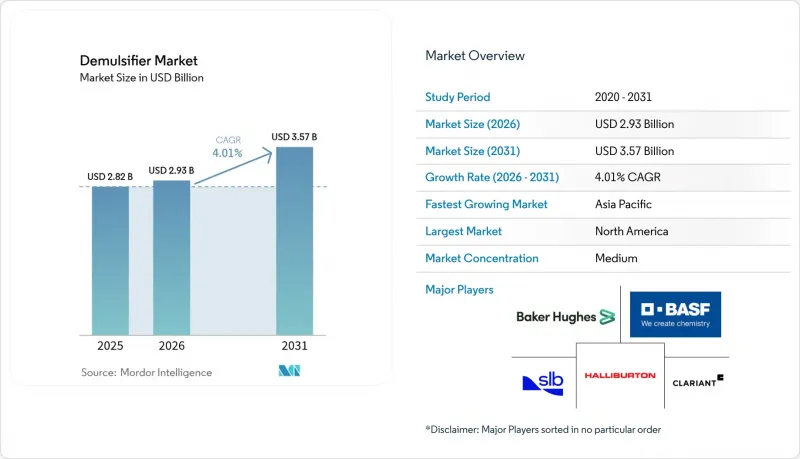
本報告按溶解度(水溶性和油溶性)、化學性質(陰離子、陽離子等)、油田位置(陸上和海上)、應用(原油加工、煉油廠等)以及地區(亞太地區、北美地區、歐洲地區、南美地區、中東和非洲)進行細分。市場預測以美元計價。
全球乳化劑市場趨勢與洞察
成熟油田供應鏈的安全需求
減産傾向にある儲存層における水分の割合の上昇により、生産者は既存の資産を維持するための、個別に調整された分離プログラムの導入を余儀なくされています。ベイカー,ヒューズ社の報告によると、現在、世界の原油生産量の70%は成熟油田に由来しており、この割合の高まりが、高効率の乳化防止剤への依存度を高めています。実地試験によると、スクイーズ処理パッケージにより生産量を50%から200%向上させつつ、1坑井あたりの薬品コストを2,500米ドルに抑えることが可能であり、化学的介入の費用対効果の高さが裏付けられています。オペレーター各社は、これらのメリットを、儲存層圧力の低下や利益率の縮小を相殺するために不可欠なものだと捉えています。その結果、乳化防止剤市場の需要は、既存資産の寿命延長プログラムと密接に結びついています。世界の生産者が原油価格の変動リスクをヘッジするために棕地のポートフォリオを最適化していく中、この傾向は中期的な成長の柱であり続けると予想されます。
轉向在更深水域和高濕度油井進行生產
メキシコ湾、北海、およびブラジルの鹽層下層における深海投資は、乳化防止剤技術に対して極めて厳しい性能要件を課しています。浮體式生產系統の分離装置は、水分含有率が80%を超える可能性のある乳化液を処理しつつ、1リットルあたり40 mg未満の油分排出制限を満たさなければなりません。そのため、乳化防止剤市場では、脱水効率を損なうことなく高圧,高温に耐えることができる配合の革新が進められています。オペレーター各社が、トップサイドの重量を削減するために化学薬品をコンパクトなコアレッサーや膜スキッドと組み合わせていることから、オフショア用途はCAGR5.08%を記録しています。これらのプロジェクトは本質的に長期にわたるものであり、油田のライフサイクル全体を通じて持続的な化学薬品の需要が確保されています。過酷な海底環境下で実証済みの性能を提供するサプライヤーは、複数年にわたる契約を獲得し、収益の見通しを確固たるものにしています。
原油價格波動抑制了對化學生產領域的資本投資。
國際能源論壇 (IEF) 預測,到 2025 年,原油供應將出現每日 140 萬桶的過剩,這項預測迫使營運商推遲對化學品的非必要支出。隨著現貨價格跌破盈虧平衡點,採購團隊將優先考慮基本負載採購量,並重新談判與價格指數掛鉤的契約,這將對供應商的利潤率造成壓力。單位成本較高的特殊混合物,例如離子液體,是短期減產的主要目標。這種週期性挫折是短期內最大的不利因素,將預期複合年成長率 (CAGR) 拉低 1.1 個百分點。雖然隨著價格回升,化學品需求也會恢復,但這種抑制趨勢凸顯了抗乳化劑市場對石油宏觀週期的敏感度。
細分市場分析
2025年の売上高のうち、油溶性製品が63.62%を占めており、一次脱水ユニットや分離装置への注入において、その確固たる役割が浮き彫りになっています。その優位性は、坑口での遊離水の分離を促進する迅速な界面作用に根ざしており、これは腐食や海水淡化装置のトラブルを最小限に抑えるための重要なステップです。水溶性製品は、現時点ではシェアが小さいもの、より厳しい廃棄制限に対応するため、事業者が生産水処理インフラを拡充していることから、CAGR5.78%で急速に拡大しています。この急増は、原油の品質のみに焦点を当てるのではなく、包括的な水資源管理へと移行しつつある乳化防止剤市場の動向と一致しています。
第2世代の膜生物反応器(MBR)システムでは、供給流を前処理するために水溶性乳化防止剤の使用がますます指定されており、水中油の精製段階の効率が向上しています。凝集媒体や高分子吸着剤を採用したハイブリッド処理ラインは、上游工程で水溶性化学物質が乳化の不安定化を促進することで、効率が向上します。その結果、サプライヤー各社は、従来の樹脂系製品にとどまらず、幅広いpH範囲で性能を発揮するポリエチレングリコール、ポリエーテルアミン、生分解性エステルを主成分とする製品へとポートフォリオを拡大しています。この動向は、仕様パターンの緩やかではあるが紛れもない変化を示しており、将来の乳化防止剤市場の需要構造を再構築することになるでしょう。
2025年には、非イオン性ブレンドが売上高の34.74%を占め、ライト,タイトオイルから超重質原油に至るまで、あらゆる原油グレードに対応できる汎用性が高く評価されています。これらは、腐蝕抑制劑、スケール抑制剤、パラフィン溶剤とシームレスに統合され、複数井戸のパッドにおける化学薬品管理を簡素化します。対照的に、イオン液体はCAGR 6.47%という目覚ましい成長を見せており、200 度Cまでの儲存層条件や200,000 ppmを超える塩分濃度下でも優れた安定性を示す実験室データに支えられています。
コスト面の障壁やサプライチェーンの未成熟さにより、商業化の勢いはやや鈍化していますが、南シナ海やメキシコ湾での初步試驗の成功は、その潜在力を裏付けています。両性およびカチオン性製品は、電荷に基づく分離メカニズムが酸性原油においてより高い効率をもたらすため、ニッチな分野での需要を維持しています。一方、陰離子性界面活性剤は、製油所の海水淡化回路において安定した需要が見込まれており、海水淡化との相性が良く、塩化物の除去に寄与しています。今後10年間、競合上の優位性は、イオン液体の機能性と非イオン性界面活性剤のコスト効率を融合させるサプライヤーの能力にかかっており、この展望は乳化防止剤市場にさらなる変革をもたらす可能性があります。
區域分析
北米は、豊富なシェール液体の生産量と、メキシコ湾の複雑な深海資産に支えられ、2025年には売上高の30.24%を占め、世界の乳化防止剤市場を牽引しました。米国のオペレーターは2025年の生産量を増やす見込みであり、ESG規制により排出許可の要件が厳格化される中でも、分離用化学薬品への安定した需要が維持されるでしょう。カナダにおけるPAH(多環芳香族炭化水素)に対する規制の強化は、フェノール系前駆体を回避する環境に優しい化学物質への移行をサプライヤーにさらに促しています。地域サービス企業は大手化学メーカーと提携し、統合的な最適化ソリューションを提供しており、パーミアンおよびMontney層全域で掘削パッド数が増加する中、乳化防止剤の選定を包括的な水資源管理戦略に組み込んでいます。
アジア太平洋地域は、中国の精製処理量が過去最高の1,480万バレル/日(bpd)に達し、浙江省や広東省の叢集で石油化学への投資が持続していることを背景に、CAGR 6.52%という顕著な伸びを見せています。統合型複合施設では、安定した乳化液を生成する重質原油や残渣系原料を処理することで、乳化防止剤の使用量が増加しています。東南アジアの化学市場は、2030年までに4,480億米ドルへとほぼ倍増する見込みであり、これにより特殊化学品メーカーがベトナム、インドネシア、マレーシアに進出しています。インドでは、製油所の生産ライン拡大や石炭層メタン(CBM)開発が進んでおり、現地の事業者が「バーラト,ステージVI」燃料基準を満たすために先進パッケージングを導入するにつれ、需要量のさらなる増加が見込まれます。
在歐洲、中東和非洲,受嚴格的REACH法規以及北海和阿拉伯半島現有設施的大規模維修的推動,市場需求成熟且強勁。歐洲營運商優先採用可生物分解的抗乳化劑以滿足歐盟水框架指令的標準,而中東生產商則專注於降低高鹽度儲存的水處理成本。在南美洲,市場預計將保持溫和成長,這主要得益於巴西鹽層下油藏儲量的擴張以及阿根廷非傳統資源的發展。這些區域差異清晰地表明,當地的生產條件、管理體制和投資週期正在塑造抗乳化劑市場的趨勢。
其他好處:
- Excel格式的市場預測(ME)表
- 3個月的分析師支持
目錄
第1章:引言
- 研究假設和市場定義
- 調查範圍
第2章:調查方法
第3章執行摘要
第4章 市場狀況
- 市場概覽
- 市場促進因素
- 成熟油田供應鏈的安全要求
- 向深水區和高濕度油井的生產過渡
- 更嚴格的廢水排放標準對分離性能提出了更高的要求。
- 原油產量增加導致需求增加
- 生物可分解聚酯基抗乳化劑的商業化
- 市場限制因素
- 原油價格波動抑制了對化學生產領域的資本投資。
- 加大對烷基酚聚氧乙烯醚的使用禁令
- 離子液體配方規模化生產的挑戰
- 價值鏈分析
- 波特五力模型
第5章 市場規模與成長預測
- 透過溶解度
- 水溶性
- 油溶性
- 解體性
- 陰離子類型
- 陽離子
- 非離子型
- 雌雄同體
- 離子液體
- 油田位置
- 陸上
- 離岸
- 透過使用
- 原油加工
- 煉油廠
- 油泥處理
- 燃油發電廠
- 潤滑油製造
- 其他用途(例如,提高採收率)
- 按地區
- 亞太地區
- 中國
- 日本
- 印度
- 韓國
- 東南亞國協
- 其他亞太國家
- 北美洲
- 美國
- 加拿大
- 墨西哥
- 歐洲
- 德國
- 英國
- 法國
- 義大利
- 西班牙
- 俄羅斯
- 北歐國家
- 其他歐洲國家
- 南美洲
- 巴西
- 阿根廷
- 其他南美國家
- 中東和非洲
- 沙烏地阿拉伯
- 南非
- 亞太地區
第6章 競爭情勢
- 市場集中度
- 策略趨勢
- 市佔率分析
- 公司簡介
- Baker Hughes Company
- BASF
- Clariant
- Croda International Plc
- Dorf Ketal
- Dow
- Ecolab
- Halliburton Company
- Innospec
- NCPIQ8(National Chemical & Petroleum Industries Co.)
- PT Eonchemicals Putra
- Sasol
- SLB
- Solvay
- Stepan Company
第7章 市場機會與未來展望
According to Mordor Intelligence, demulsifier market size in 2026 is estimated at USD 2.93 billion, growing from 2025 value of USD 2.82 billion with 2031 projections showing USD 3.57 billion, growing at 4.01% CAGR over 2026-2031.
This report is Segmented by Solubility (Water Soluble and Oil Soluble), Chemistry (Anionic, Cationic, and More), Oilfield Location (Onshore and Offshore), Application (Crude Oil Processing, Petro Refineries, and More), and Geography (Asia-Pacific, North America, Europe, South America, Middle East and Africa). The Market Forecasts are Provided in Terms of Value (USD).
Global Demulsifier Market Trends and Insights
Supply-chain Security Needs in Mature Oilfields
Rising water-cut levels in declining reservoirs are forcing producers to adopt tailored separation programs that keep established assets viable. Baker Hughes reports that 70% of global crude flows now originate from mature fields, a share that heightens dependence on high-efficiency demulsifiers. Field trials demonstrate that squeeze-treatment packages can lift production between 50% and 200% while bringing per-well chemical costs down to USD 2,500, reinforcing the cost-effectiveness of chemical intervention. Operators view these gains as vital for offsetting lower reservoir pressures and shrinking margins. As a result, demulsifier market demand is tightly linked to life-extension programs for legacy assets. The trend is expected to remain a medium-term growth pillar as global producers optimize brownfield portfolios to hedge against crude-price volatility.
Shift Toward Deeper Offshore Production & Higher Water-Cut Wells
Deepwater investments in the Gulf of Mexico, the North Sea, and pre-salt Brazil place exacting performance requirements on demulsifier technology. Separators on floating production systems must process emulsions that may exceed 80% water content while meeting discharge limits below 40 mg oil per liter. The demulsifier market is therefore innovating around formulations that tolerate high pressure and temperature without sacrificing dehydration efficiency. Offshore applications are delivering a 5.08% CAGR as operators pair chemicals with compact coalescers and membrane skids to save topside weight. These projects are inherently long-cycle, locking in durable chemical demand across the life of field. Suppliers that provide proven performance under extreme subsea conditions secure multi-year contracts, anchoring revenue visibility.
Volatile Crude-Oil Prices Curbing CapEx on Production Chemicals
The International Energy Forum predicts a 1.4 million bpd surplus in 2025, a scenario that pressures operators to defer discretionary chemical spend. When spot prices slide below breakeven thresholds, procurement teams prioritize base-load volumes and renegotiate price-indexed contracts that compress supplier margins. Specialty blends carrying higher unit costs, including ionic liquids, become prime targets for short-term cutbacks. This cyclical pullback is the strongest near-term headwind and subtracts 1.1 percentage points from the projected CAGR. Although chemical adoption rebounds with pricing recovery, the restraint underscores the demulsifier market's sensitivity to macro-oil cycles.
Other drivers and restraints analyzed in the detailed report include:
- Stringent Water-Discharge Norms Raising Separation Performance Specs
- Growing Demand from Increasing Production of Crude Oil
- Increasing Bans on Alkyl-Phenol Ethoxylates
For complete list of drivers and restraints, kindly check the Table Of Contents.
Segment Analysis
Oil-soluble products controlled 63.62% of 2025 revenues, underscoring their entrenched role in primary dehydration units and separator train injections. Their dominance is rooted in quick interfacial action that expedites free-water drop-out at the wellhead, a critical step in minimizing corrosion and desalter upsets. Water-soluble alternatives, though smaller today, are scaling quickly at a 5.78% CAGR as operators expand produced-water treatment infrastructure to meet stricter disposal limits. This surge aligns with the demulsifier market's pivot toward holistic water management rather than singular focus on crude quality.
Second-generation membrane-bioreactor systems increasingly specify soluble demulsifiers to pre-condition feed streams, boosting oil-in-water polishing stages. Hybrid treatment trains employing coalescing media and polymeric adsorbents gain efficiency when soluble chemistries improve emulsion destabilization upstream. Consequently, suppliers broaden portfolios beyond conventional resin bases to polyethylene glycol, polyetheramine, and biodegradable ester backbones that perform across varying pH windows. The trend signals a gradual but unmistakable shift in specification patterns that will reshape future demulsifier market demand profiles.
Non-ionic blends held 34.74% revenue in 2025, prized for versatility across crude grades from light tight oil to extra-heavy. They integrate seamlessly with corrosion inhibitors, scale squeezes, and paraffin solvents, simplifying chemical management for multi-well pads. Ionic liquids, in contrast, are the breakout story with a 6.47% CAGR, buoyed by laboratory data showing superior stability under reservoir conditions up to 200 °C and salinities above 200,000 ppm.
Commercial momentum is tempered by cost barriers and supply-chain immaturity, yet pilot successes in the South China Sea and Gulf of Mexico underscore their potential. Amphoteric and cationic products retain niche appeal where charge-based separation mechanisms yield higher efficiency in acidic crudes. Meanwhile, anionic surfactants see steady demand in refinery desalter circuits, where their compatibility with brine desalting aids in chloride removal. Over the coming decade, competitive edge will hinge on suppliers' ability to hybridize ionic-liquid functionalities with non-ionic cost profiles, a prospect that could further disrupt the demulsifier market.
Complete Report Scope:
- By Solubility
- Water Soluble
- Oil Soluble
- By Chemistry
- Anionic
- Cationic
- Non-ionic
- Amphoteric
- Ionic Liquids
- By Oilfield Location
- Onshore
- Offshore
- By Application
- Crude Oil Processing
- Petro Refineries
- Sludge Oil Treatment
- Oil-based Power Plants
- Lubricant Manufacturing
- Other Applications (Enhanced Oil Recovery, etc.)
- By Geography
- Asia-Pacific
- China
- Japan
- India
- South Korea
- ASEAN Countries
- Rest of Asia-Pacific
- North America
- United States
- Canada
- Mexico
- Europe
- Germany
- United Kingdom
- France
- Italy
- Spain
- Russia
- NORDIC Countries
- Rest of Europe
- South America
- Brazil
- Argentina
- Rest of South America
- Middle East and Africa
- Saudi Arabia
- South Africa
- Asia-Pacific
Geography Analysis
North America led the global demulsifier market with 30.24% revenue in 2025, anchored by prolific shale liquids output and complex Gulf of Mexico deepwater assets. Operators in the United States are set to boost 2025 production, reinforcing a steady draw on separation chemicals even as ESG mandates tighten discharge permits. Canada's heightened scrutiny of PAHs further nudges suppliers toward eco-friendly chemistries that avoid phenolic precursors. Regional service companies partner with chemical majors to deliver bundled optimization offerings, embedding demulsifier selection into holistic water-management strategies as pad counts rise across the Permian and Montney formations.
Asia-Pacific stands out with a 6.52% CAGR, underpinned by China's record 14.8 million bpd refining throughput and sustained petrochemical investment across Zhejiang and Guangdong clusters. Integrated complexes amplify demulsifier usage by processing heavier crudes and resid-based feeds that generate stable emulsions. Southeast Asia's chemical market is poised to nearly double to USD 448 billion by 2030, drawing specialty-chemical players into Vietnam, Indonesia, and Malaysia. India's expanded refinery slate and coal-bed methane developments present additional volume upside as local operators adopt advanced separation packages to meet Bharat Stage-VI fuel standards.
Europe and the Middle East & Africa display mature yet resilient demand, guided by stringent REACH compliance and large-scale brownfield upgrades in the North Sea and Arabian Peninsula. European operators prioritize biodegradable demulsifiers to satisfy Water Framework Directive thresholds, whereas Middle Eastern producers focus on reducing water-handling costs in high-salinity reservoirs. South America offers moderate growth led by Brazil's expanding pre-salt portfolio and Argentina's unconventional drives. Collectively, geographic variations reveal how local production profiles, regulatory regimes, and investment cycles shape the trajectory of the demulsifier market.
- Baker Hughes Company
- BASF
- Clariant
- Croda International Plc
- Dorf Ketal
- Dow
- Ecolab
- Halliburton Company
- Innospec
- NCPIQ8 (National Chemical & Petroleum Industries Co.)
- PT Eonchemicals Putra
- Sasol
- SLB
- Solvay
- Stepan Company
Additional Benefits:
- The market estimate (ME) sheet in Excel format
- 3 months of analyst support
TABLE OF CONTENTS
1 Introduction
- 1.1 Study Assumptions & Market Definition
- 1.2 Scope of the Study
2 Research Methodology
3 Executive Summary
4 Market Landscape
- 4.1 Market Overview
- 4.2 Market Drivers
- 4.2.1 Supply-chain security needs in mature oilfields
- 4.2.2 Shift toward deeper offshore production & higher water-cut wells
- 4.2.3 Stringent water-discharge norms raising separation performance specs
- 4.2.4 Growing Demand from Increasing Production of Crude Oil
- 4.2.5 Commercialisation of biodegradable polyester-based demulsifiers
- 4.3 Market Restraints
- 4.3.1 Volatile crude-oil prices curbing CapEx on production chemicals
- 4.3.2 Increasing bans on alkyl-phenol ethoxylates
- 4.3.3 Scale-up challenges for ionic-liquid formulations
- 4.4 Value Chain Analysis
- 4.5 Porter's Five Forces
- 4.5.1 Threat of New Entrants
- 4.5.2 Bargaining Power of Buyers
- 4.5.3 Bargaining Power of Suppliers
- 4.5.4 Threat of Substitutes
- 4.5.5 Intensity of Competitive Rivalry
5 Market Size & Growth Forecasts (Value)
- 5.1 By Solubility
- 5.1.1 Water Soluble
- 5.1.2 Oil Soluble
- 5.2 By Chemistry
- 5.2.1 Anionic
- 5.2.2 Cationic
- 5.2.3 Non-ionic
- 5.2.4 Amphoteric
- 5.2.5 Ionic Liquids
- 5.3 By Oilfield Location
- 5.3.1 Onshore
- 5.3.2 Offshore
- 5.4 By Application
- 5.4.1 Crude Oil Processing
- 5.4.2 Petro Refineries
- 5.4.3 Sludge Oil Treatment
- 5.4.4 Oil-based Power Plants
- 5.4.5 Lubricant Manufacturing
- 5.4.6 Other Applications (Enhanced Oil Recovery, etc.)
- 5.5 By Geography
- 5.5.1 Asia-Pacific
- 5.5.1.1 China
- 5.5.1.2 Japan
- 5.5.1.3 India
- 5.5.1.4 South Korea
- 5.5.1.5 ASEAN Countries
- 5.5.1.6 Rest of Asia-Pacific
- 5.5.2 North America
- 5.5.2.1 United States
- 5.5.2.2 Canada
- 5.5.2.3 Mexico
- 5.5.3 Europe
- 5.5.3.1 Germany
- 5.5.3.2 United Kingdom
- 5.5.3.3 France
- 5.5.3.4 Italy
- 5.5.3.5 Spain
- 5.5.3.6 Russia
- 5.5.3.7 NORDIC Countries
- 5.5.3.8 Rest of Europe
- 5.5.4 South America
- 5.5.4.1 Brazil
- 5.5.4.2 Argentina
- 5.5.4.3 Rest of South America
- 5.5.5 Middle East and Africa
- 5.5.5.1 Saudi Arabia
- 5.5.5.2 South Africa
- 5.5.1 Asia-Pacific
6 Competitive Landscape
- 6.1 Market Concentration
- 6.2 Strategic Moves
- 6.3 Market Share Analysis
- 6.4 Company Profiles (includes Global level Overview, Market level overview, Core Segments, Financials as available, Strategic Information, Market Rank/Share for key companies, Products & Services, and Recent Developments)
- 6.4.1 Baker Hughes Company
- 6.4.2 BASF
- 6.4.3 Clariant
- 6.4.4 Croda International Plc
- 6.4.5 Dorf Ketal
- 6.4.6 Dow
- 6.4.7 Ecolab
- 6.4.8 Halliburton Company
- 6.4.9 Innospec
- 6.4.10 NCPIQ8 (National Chemical & Petroleum Industries Co.)
- 6.4.11 PT Eonchemicals Putra
- 6.4.12 Sasol
- 6.4.13 SLB
- 6.4.14 Solvay
- 6.4.15 Stepan Company
7 Market Opportunities & Future Outlook
- 7.1 White-space & Unmet-need Assessment


